Braintrust query: I'm interested in getting an adjustable height desk. I'd like to start with an inexpensive one, and if I like it, I'll get a real one. If I can get it via Amazon that would be best. #
I won't believe the NYT has any integrity until they let people criticize them on their op-ed page. #
 I don't think conversation on the web has been the big benefit some people think. Do you remember when you first realized that people weren't talking to you in a response to your post, they were talking over your shoulder to the people who read your post. I guess it depends on who you are, but I don't see any value in providing a surface for spam. These days I block people without much thought if I think that's what they're doing. So, why should you design a protocol, and pay the cost of supporting, something that is a vector for spam and abuse? That's the argument in favor of using RSS to glue things together. You can comment on my post, in your space, but my followers don't have to see it. That's up to me. I think it would change the nature of discourse, for the better. #
A backgrounder on how the web is used for conversation, the pros and cons of each variant, and what role RSS can play in it, thanks to ChatGPT.#
When you really have federation no one needs to hype it, people don't even realize it because things just work the way you expect them to. Every time I hear "Where ever you get your podcasts," I'm reminded of how well that worked. 😄#
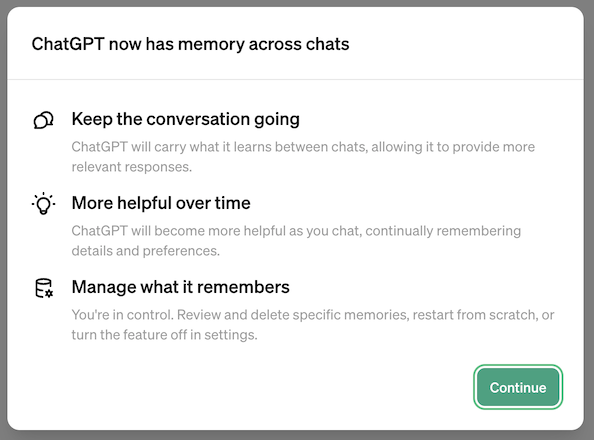
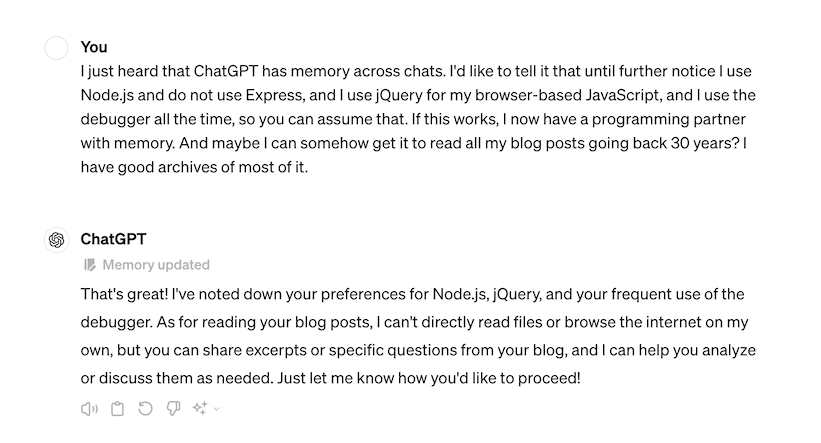
ChatGPT has memory across chats. This just popped up on the screen. I'd like to tell it that until further notice I use Node.js and do not use Express, and do use jQuery for my browser-based JavaScript, and I use the debugger all the time, so you can assume that. If this works, I now have a programming partner with memory. And maybe I can somehow get it to read all my blog posts going back 30 years? I have good archives of most of it. Also, of course I fed this post to ChatGPT of course. So ChatGPT is not resting on its laurels. That's good. I'd really like a Personal ChatGPT, and this is on the way to that goal. #
When I started working with Automattic last year, one of the big milestones we were aiming for was getting FeedLand and WordPress working together. Now we have the first step. I hope you take a moment to give it a try and let us know how it works. Scripting News readers have helped bootstrap all kinds of cool stuff, we can do it again. #
Jay Gilmore: "ActivityPub breaks my brain. It doesn’t need to be that hard given the payloads we are talking about." True.#
- There's a new plugin that adds a blogroll to a WordPress site. #
- It would be helpful if people who are regular readers of Scripting News who use WordPress, set up a test site, give it a try and let us know how it goes. You can help us get to the next level with this stuff. #
- So there are two sides, the FeedLand side and the WordPress side.#
- The FeedLand side. Sign on to FeedLand, create an account if you don't have one, and subscribe to a bunch of feeds. These will be the feeds in your blogroll. There are some tips on how to find feeds, in the next section.#
- The WordPress side. There's a new plugin, developed by the people at the Team51 group at Automattic. They have a checklist for how to install the plugin in a WordPress site. #
- You can get ideas for feeds for your blogroll from reading other people's feed lists. When you see a checkbox that isn't checked, you can subscribe to the feed simply by checking the box. #
- Have a look at my feed list for ideas. Here's a list of recent users, click on their names to see their feed lists. You don't have to finish this now, you can come back and tune this up anytime.#
- Developers: Use feedlandBlogrollToolkit to add blogrolls to other platforms. #
- If you have questions or comments, or need help getting it working, post a note in the discussion group here. #
 A big idea for the blogging world. I'd like to combine AI and search to make a really great search engine for bloggers. We would contribute what we know (we already do) and in return, along with everyone else, get to benefit from the collection. And when we browse, it knows which blog we write. So it has a very good idea of what we mean when we ask a question and what we already know. This is totally missing in ChatGPT and is something Google and other search engines have never been willing to do (or even understood, I guess). But this is a huge idea. I'd like to give it my blogroll too, so it knows which sources I consider credible. I love that it creates an incentive to post to your blog, and it makes working together automatic. #
John Palfrey as the mover behind Press Forward will bring the gospel of EZ Pass for News on his "ongoing whistle-stop tour" of local news orgs. JP was my boss/rabbi when I was at Berkman, and is why we got so much done there. He ran air cover for what we did, the BloggerCons, giving RSS a home, podcasting, blogs for everyone, the people and democracy. Now he's doing it for the local news business. #
EZ Pass for News is formula for functional relationships between local news pubs and people in far away places (ie not their locality) who may from time to time want to read an article or a series of articles on their site, and pay per-issue instead of buying a subscription.#
I was chatting with a friend who went to Bronx Science, as I did, and we were talking about Isaac Asimov, and I said I thought he went to Science too. So I fired up ChatGPT and asked if Asimov went to Science, and it said yes. Then I asked where he went to high school and it said Bronx Science. But by then I was pretty sure he didn't, so I went to Google and meta.ai, and neither knew where he went to high school. So I asked on Twitter, Mastodon, Blue Sky and Threads. Not sure why I even care! Oh well. 😄#
I don't have time to write about it now but the end of last night's Knicks game was one of the most dramatic bits of NY sports ever. I would like to thank Kevin Durant for saying the Knicks weren't cool. It's somewhat like the Streisand Effect where the thing KD was trying to hide was that he was no longer cool. Classic projection. Obviously he was not the hot shit he thought he was in 2019. 😄#
 The idea of us all working together to federate is the right idea, but making ActivityPub the hurdle everyone has to jump over is imho the wrong idea. I'm building on feeds -- RSS, Atom, RDF. A lot of good stuff works on that basis. And it's a much shorter path to interop than ActivityPub.#
I hate paywalls tied to subscription. I’m never going to subscribe to a Philadelphia news org, but based on Jay’s recommendation I might pay $1 on my EZ Pass for News to read this story, esp since I saw the Civil War movie. I just had a thought, I might subscribe to a Philadelphia news org for a week or two, given that the Knicks are playing their NBA team right now in the first round of the playoffs. I really want to know everything there is to know about this faceoff. See, I want to pay for journalism here, but journalism hasn't been willing to sell it to me, at any price. They've never gotten the basic truth of: "The customer is always right." Really important point and true in every way.#
Over the weekend I tested the blogroll plugin for WordPress. It worked. After a little more testing and docs-writing we'll be ready for other people to test it, an important step before wider use. So if you're a regular Scripting News reader, and are curious what this blogroll stuff is about, you'll be able to try it out pretty soon. #
Jeff Jarvis writes that a German man who died with 70K books in his house was obsessed with the work of writer Arno Schmidt, who was my great-uncle, my grandmother's brother. #
Good morning sports fans!#
I asked meta.ai to draw a pastoral scene with sheep and dogs, birds, fish, airplanes, clams and seagoing ships in ancient England.#
 Back in the old days, during a great sport event, we'd post our feelings, pro or con, to Twitter. I observed as follows: "Let's do something great with our lives! In the meantime I miss the role that twitter used to play and never will play again. It was the place to go to say 'How about those Knicks!' when they win a game like the one they won last night. Not no mo." Betsy Devine was the first to like this. I felt heard. #
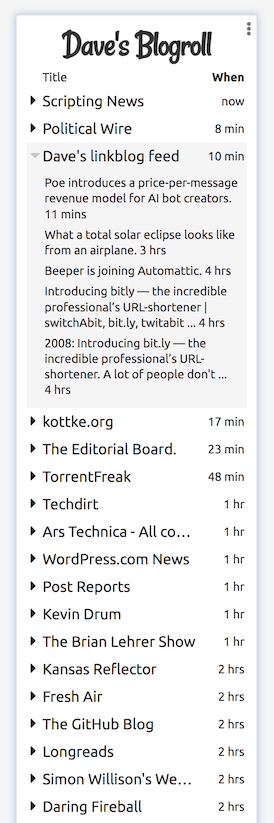
- After living with the blogroll on the home page of Scripting News for about a month, and having heard from early testers, I felt that it was demanding too much attention when I was reading stuff on the blog. So I made some time last week to experiment with a subtler sidebar.#
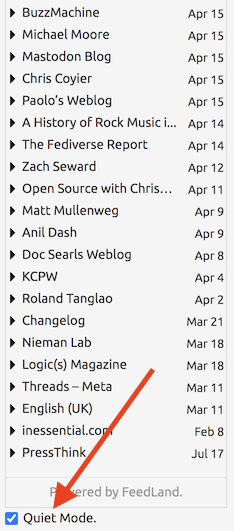
- In Quiet Mode, the blogroll doesn't call attention to itself until you click on it. Then its background changes from neutral to white. That's the equivalent of shining a spotlight on it. Also the borders become blue to indicate that the browser's focus is on the blogroll.#
- I wanted to do more to tone it down. So, in Quiet Mode the title moves up and to the left, and is in a much smaller font, boldface, nicely visible and stands off from the list, but doesn't call your attention to it. It's there when you want to know more. #
- You may want to call it something other than a blogroll, btw. If you're using blogs to coordinate projects with others, something I think a lot more people would do if it worked better, instead of "blogroll" you'd might call it your "workgroup."#
- Anyway, I have switched Scripting News over to the new quiet mode, it's already the default, but I put a checkbox just below the blogroll that lets you toggle between the two modes to see the difference and possibly spot problems. The checkbox will go away before long. I just want it there to quickly do an A-B comparison. #
- Here's a quick video demo of Quiet Mode. #
- And a place to comment or ask questions.#
 It's totally ridiculous to equate protest with antisemitism, esp with Israel led by a MAGA ally. The two concepts are orthogonal. I do not support the Israeli government any more than I supported the government of my country, the United States, when the MAGAs were in charge. We lost over 1 million Americans who did not have to die imho, because our government was not only immoral and hugely corrupt, but also made no attempt to govern. I am a child of Holocaust survivors and an American born in the USA, and am proud of and grateful to my country. Any American is free to protest the actions of our government or any other government, or really anything. If you don't believe in that then you aren't actually trying to make America great, you're saying something altogether different and incompatible. I am American. I am also deeply offended at other Americans who propose to speak for me. That actually is antisemitic, btw.#
Quick video demo of meta.ai. This is a demo of just one feature, its ability to recalc drawings as you edit the prompt that defines the picture. As you can tell from the demo I love it because it's new, creative, super fun to use and to watch the result. And lovely to see this much progress so quickly. You really should watch it on YouTube so you can see how what I type relates to the image in real-time. It's like subtitles inverted, with a very knowledgeable, creative and high bandwidth computer network behind it. Living in the future. #
 More and more I'm getting used to WordPress as the platform I develop for. #
- Imagine if you, as a developer, could add your own data to a WordPress post. Then you could build editors that work at a higher level. For example, you'd keep the Markdown source for the page. When it was saved the system would re-render the Markdown, turning it into HTML, but you'd still have the Markdown around for editing. And of course there are other kinds of editors that make sense, knowing that the output is going to the web, but you don't have to write in the technical language of the web. You might want something more suited to wordsmiths -- ie writers, if you are a writer. I have that working here, and have been building on it.#
- I've gone back to Radio UserLand and tried to extrapolate, where would we have gone with that product, 22 years later. And now I'm beginning to see in the pieces that are forming the new product I've been working on, something whole, something that works. #
- I think of it as "WordPress For One" -- you might be writing as part of a larger site, but this is your writing space, a place you can mold to fit your style, where it gets more comfortable over the years, more you. That's what I've felt has been wrong with the direction the web has been going in, we're getting boxed into smaller and smaller spaces, but for some of my writing I want a nice stage with good lighting and full freedom to tell a story that I have to tell, not necessarily all at once, but possibly in a series, over time. #
- I also want to be influenced by your story. I want Working Together. #
- Of course I still very much develop for FeedLand, and in the back of my mind I want to loop back around to Drummer (it's my main writing environment), and then I have another product I call Belter I want to finish. And I wouldn't mind trying to make a CSS thing that makes more sense than the tragedy CSS is, and also would love to see a port of Frontier to Linux, though I don't see doing that myself, but I would like to guide it (so it runs all the old stuff first). #

I did the blogroll stuff because I needed a minimal feed reader that could run from the right sidebar of any app. #
I just spent a few minutes with meta.ai, Facebook's answer to ChatGPT, and it's really good. The drawing functionality recalcs while you're entering the prompt, so if you type, "vary gender, age and race," and as you type each word, the image changes. #
 Suppose you're working deep inside a complex project and have an unrelated idea. How long does it take to switch to writing mode, get the idea down, and return to what you were doing. The less time it takes the more fluidity. Twitter totally won there. And we, the bloggers, made a tradeoff. We accepted fewer features and writing in a silo because it was practical. It worked, where less fluid software didn't. So they got all the casual writing, and over time sucked the life out of blogging. I think it's time to put the fluidity back, without compromising on features and lock-in. #
I just tripped across this post from 2009 where Matt had sent me an email saying they were supporting the Twitter API in WordPress. I had forgotten this. That's how long it's been that he's wanted to hook WP up to the social web. It doesn't look like I posted that to Scripting News. I wonder what other nuggets of forgotten history I'll find there. #
If Tesla went out of business, would my Model Y stop working??#
I've never been to TED or SXSW.#
Good morning NBA fans. Today is the official beginning of the post-season, and this Knicks fan is one freaking happy camper. Just thought I'd get that outta the way before getting down to business. #
- Each form of online discussion has a grain to it. Doc and I used to talk about how something "follows the grain of the web." Twitter has its own grain, formed by its character limit, what information is shared (ie number of followers in both directions). #
- I made a list of some of the social networks I've been on starting in the mid-70s. The list is very long. And each of them had their own limits, rules and features, and each led to a certain kinds of relationships between the participants. Mail lists that gain traction always flame out. It's hard to get people to read your blog. If you make it easier it changes into something else. Instagram, Youtube, TikTok form hierarchies of influencers. I think of those as the networks Taylor Lorenz covers. #
- But there isn't a structure that I'm aware of that leads to people working together. It's a puzzle I keep trying to figure out. #
- We need working together to survive climate change and fascism. It would be good to crack this nut. #
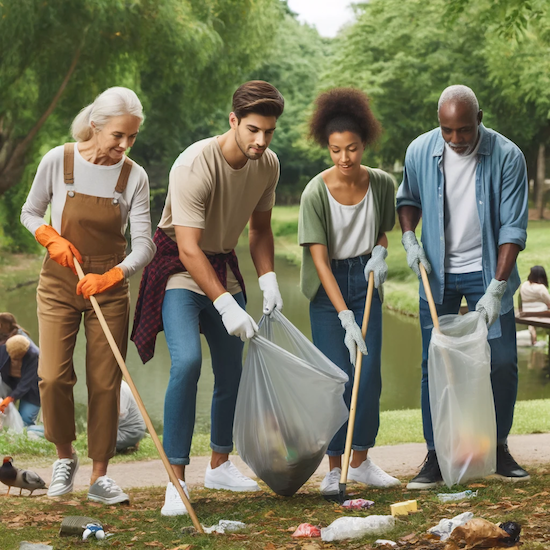
- One of the nicest things about ChatGPT is that it's always up for working with you. The critics of AI don't begin to understand this. As an example, I'm going to ask ChatGPT to draw a picture of people working together. Here it is. I didn't have to wait. It didn't look at my follower count, or my bank statement to decide if it was willing to work with me. I pay the $20 a month, and I've got a persistent always-on collaborator. #
- What got me thinking this way this morning is a bit of collaboration I did with palafo (a human) on Threads. It's remarkable. We actually did some work together. No sarcasm. It may be hard to read the thread but if you're curious about collaborative systems, here's a real example. Serendipitous, unplanned, but we figured something out by combining our experiences. Fantastic.#
- Later, Ben Werdmuller, a person who I've gotten to know recently, is intelligent and asks good questions. He asked one today, how do they get the live audience on SNL to laugh when they want them to laugh. I had an idea and shared it. (This was discussed on Reddit. I also checked with ChatGPT.) #
- If you take away one thing from this post it's that we can collaborate with the machines, and maybe that will unlock collaboration between humans. In fact, in a way they are facilitating the collaboration. If you want to be part of the collective human intelligence, you may be thinking about the machines the wrong way. Maybe they're the most human thing we have, because AI is made up of humans, somewhat like Soylent Green. 😄#
- PS: I asked ChatGPT to draw a picture of humans working together to clean up a mess. #
- PPS: Yesterday I gave John O'Nolan what I think is a good idea for getting his Ghost blogs federating with Threads, Mastodon et al. I didn't expect thanks or even a response, but I wonder if he even heard it. Most of the time, trying to help other people results in not even an acknowledgment that they saw it. If I were him I'd look for a painless, quick way to get maximum interop. Something like ghost.social. I'd give the same advice to Matt at Automattic (in fact I think I did). #
- PPPS: I think acknowledgment is a key part of working together on the web. Nothing more than "I wanted you to know I saw it" is often all that's needed to grease the skids of discourse. I've had a friendly disagreement with Manton at micro.blog about this. #
- How to add a FeedLand blogroll to a Drummer blog. #
- You must have a Drummer blog and a FeedLand account.#
- You can specify that all the feeds you're subscribed to are in your blogroll or use a category and only feeds in that category will be in the blogroll. #
- The blogroll updates automatically, when one of the feeds has a new post, it goes to the top of the list.#
- You can expand a feed to see the five most recent items. Click on the pubdate to go to the full item on the web. #
- It supports keyboard navigation. Up and down arrows move through the list, Return to expand/collapse. #
- We're working on WordPress plugin. #
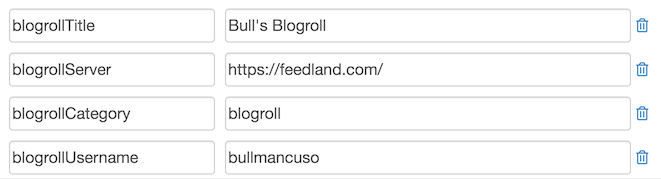
- Four head-level attributes in your blog.opml file. Only one required. #
- blogrollUsername -- required#
- blogrollServer -- optional, if not specified it's feedland.com#
- blogrollCategory -- optional#
- blogrollTitle -- optional, but you really should provide a title, otherwise we invent a silly one for you. 😄#
- Screen shot of how the head-level attributes are set on Bull Mancuso's blog. #
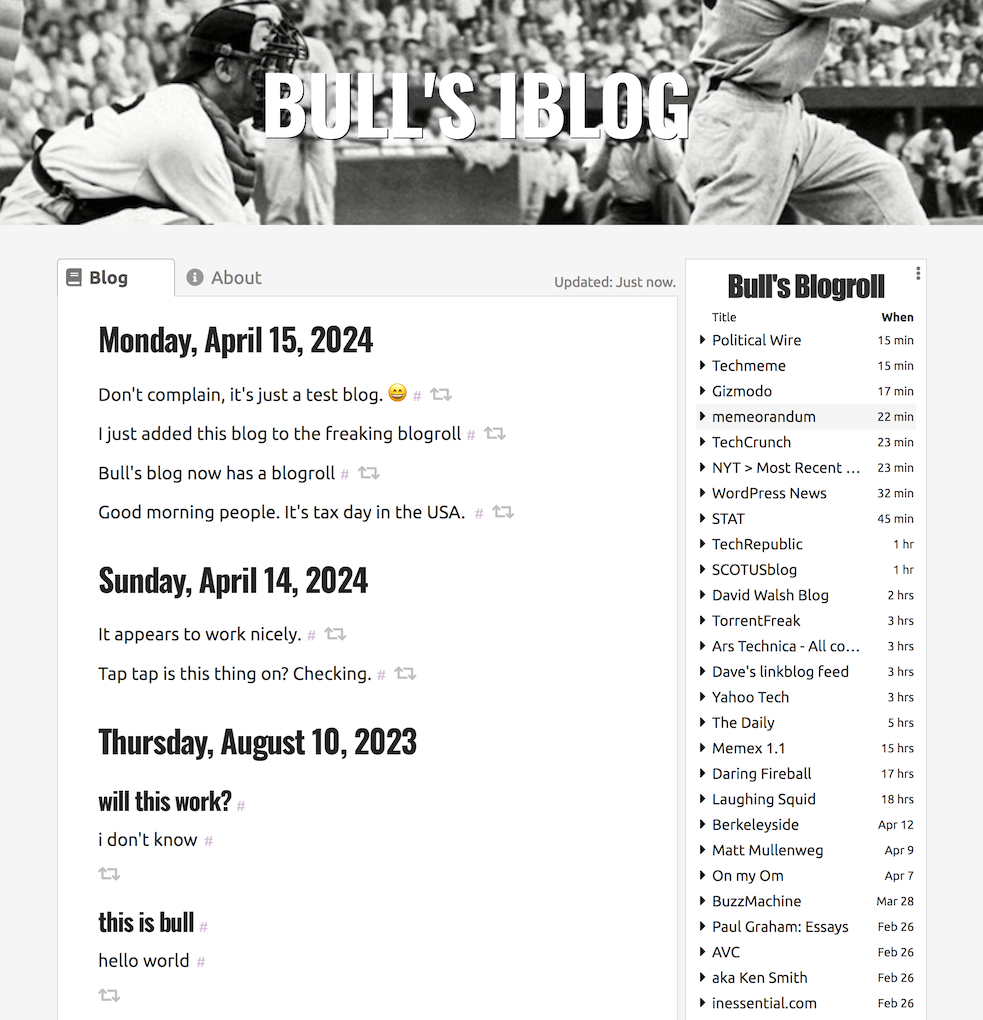
- Screen shot of the blog itself with the blogroll.#
- A link to Bull's blogroll category on feedland.com.#
- A place to ask questions offer kudos, etc. 😄#
- PS: I'm not trying to sell you on using Drummer to run a blog. Rather I needed a place to figure out how this works, so we know how to set up and document the WordPress plugin. #
 I want to work with the best developers, I don't care where they work. It occurred to me watching a Martin Scorcese documentary about the life of George Harrison, how much people in music seek out opportunities to create with other musicians. In technology, it doesn't happen, we don't even look at each others software. After waiting a whole lifetime for a culture of collaboration, we have had it for short periods, but it's most of the time it's been people trying to deconstruct and reinvent other people's work, not build on it. I'm still open to this changing. I hope to be a catalyst for it, one more time. #
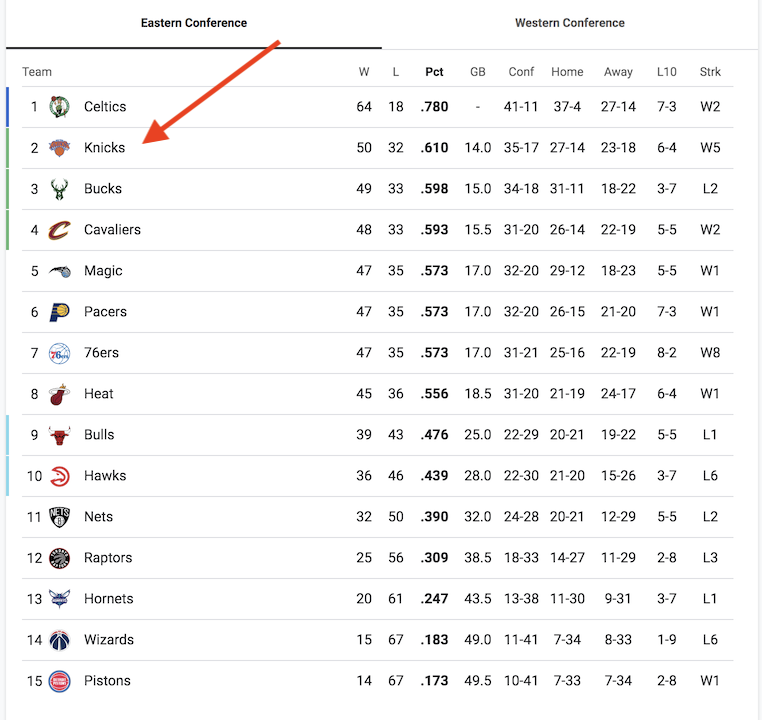
Final Eastern Division standings. Knicks finish second. Best Knicks team in a long time. Ended the season with a five-game winning streak.#
 I don’t like how betting has invaded sports broadcasting. I don't like that it breaks the bond among people who root for one team their whole lives, as I have with the Knicks and the Mets. I think of people who love the same teams as I do as family. I like that there are Knicks fans who also like the Yankees even though I totally despise the Yankees and everything they (don't) stand for, but we all love the freaking Knicks (and ignore the Nets, btw). Before long there won't be any of us left, everyone will see sports as a business, an obsession, or their downfall, because you can't win at gambling, we all know that. The whole tribal thing about sports is broken by integrated gambling, it suggests many of us, maybe eventually most of us, are here not for love of team, rather they're feeding an addiction.#
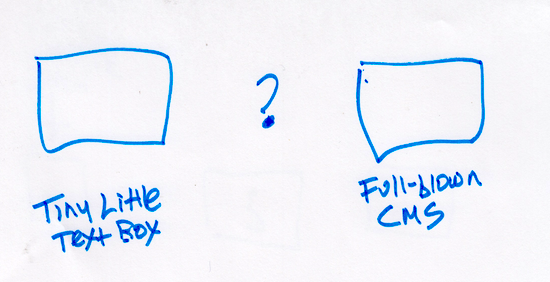
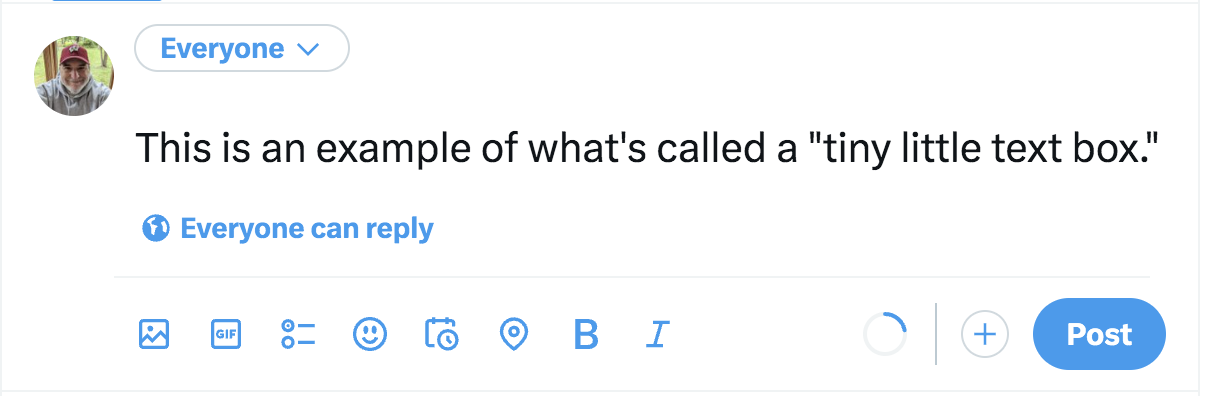
- Question: What's between a tiny little text box and a full-blown content management system?#
- Answer: A full-featured text editor with a social media feel to it without the limits of twitter-like systems. #
- That's what textcasting is for, to identity the essential features. This editor supports them. #
- 100% built on WordPress. Why reinvent all the good stuff that's been debugged and scaled and has all that support in the world. As I like to say, one way of doing something is better than two, no matter how much better the second way is. #
- PS: A seven-minute podcast that explains. 😄 #
- PPS: And don't forget about the blogroll. It's part of the puzzle too.#
- PPPS: The house was really cold when I did this recording so I walked around to try to stay warm. By the end I was pretty close to shivering out loud. I turned the heat up after I finished. #
 I just finished Ripley on Netflix, an 8-part miniseries remake of The Talented Mr. Ripley, which I remember, probably incorrectly, as a light-hearted story. There was very little to laugh about in this new version, but omg it is such a beautifully presented story. Even if you hated the plot you'd have to watch it just to see the art. And if you're Italian or love Italy, you have to watch it. Anyway now that I know all the twists and how it ends, I'm going to have to watch it again, but I might wait to recover from the experience. It is, at times, hard to watch. But oh so goooood. #
In some ways the look of Ripley resembles Poor Things, another eclectic and lovely to look at presentation. #
 In an email to Doc this morning: "The web is such a huge total mess. CSS is a junk pile of reinventing that learned nothing from the ideas it was reinventing. The only reason we put up with this is the freedom we got from it. But that’s been gone for a long time. I have a feeling we’re wasting our golden years overlooking that we’re trying to get creative work done in a corporate crime scene. We won, only to have our victory enshrined by a bunch of corpy wiseasses and nazis." Doc is a very literate and quote-worthy writer, and we bring out the best from each other. So next time you see Doc thank him for me, for the creativity. We're making the best of a bad situation. It's even worse than it appears and I'm old enough to know better. #
So this ticking time bomb was sitting there all the time the journalists were talking about how Biden is too old to win the election with Trump. Biden was never the issue, the issue was the freaking Supreme freaking Court.#
The Arizona court decision won’t just have an effect on the politics of Arizona. It will have effect on the politics of the entire freaking United freaking states of freaking America.#
I was closing tabs this morning and came across this sweet little test app I did when I was working on tabs. I wish there were a practical use for something like this. #
- I have a suggestion for an internet holiday.#
- Call it Freakout Day.#
- Works like this.#
- When you think of a pronouncement you'd like to make, write it in your favorite tiny little text box, but before you send it, add the word "freaking" between every word in the punchline.#
- Like so --#
- The Arizona court decision won’t just have an effect on the politics of Arizona. It will have effect on the politics of the entire freaking United freaking States of freaking America.#
- Really impresses people. 😀#
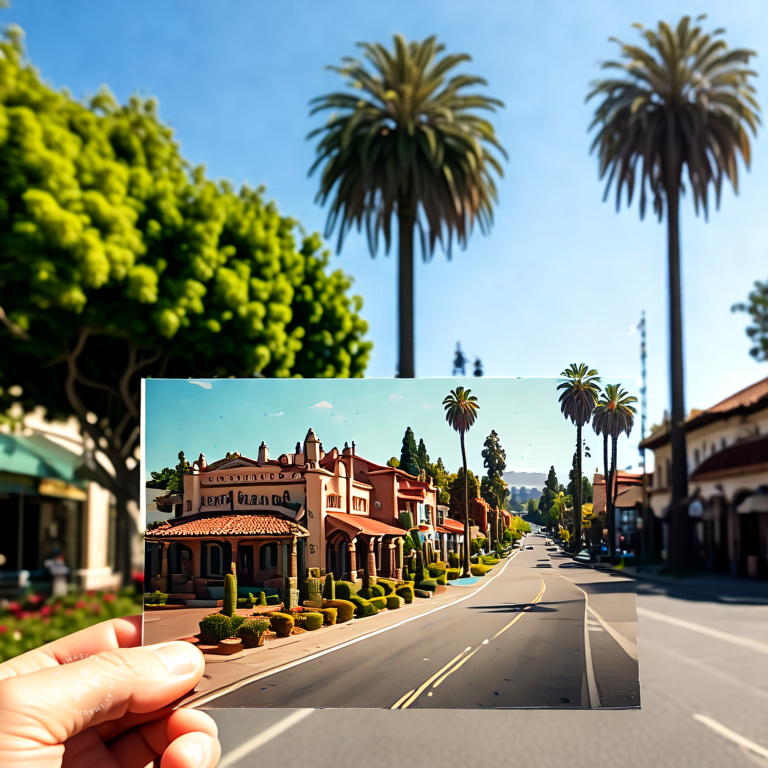
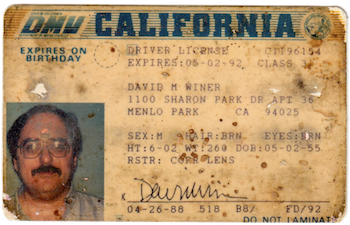
- Found this in my desk drawer today. Amazing the things you carry with you over the ages. I lived in an apartment building on top of a hill in the middle of a golf course, smack in the heart of Silicon Valley, if it actually had a heart, and that's debatable. All the Sand Hill Road VCs were on the other side of the hill. And one exit south on 280 was Xerox PARC, and where NeXT had its startup offices. #
- This was the place where I started development of what became Frontier. I always wanted to do a great system level scripting thing, based on what I learned from Unix and what I loved about the graphic user interface. #
- It became a lot bigger than I anticipated. In the beginning it was meant to be a replacement for the Macintosh Finder, with an outliner for a file system browser, and of course a fantastic scripting ability, of the OS and of scriptable apps. I wish Apple had supported this effort but I didn't understand at the time that they couldn't. They weren't set up to let anyone but Bill and Andy make great products, even if their products weren't all that great, imho of course. You have to live with the mythology you create. #
- A lot of people got their first programming experience with Hypercard. I would have loved if more of them get their first experience with Frontier. Even better would have been if our products worked together, but that wasn't in the cards either. #
 I've been trying to pay my NY State income tax and estimated tax for hours. I finally managed to log in, but that doesn't help. They have all kinds of links that say click here to pay the thing you want to pay, and that just takes me to a login page where it says someone with that email address already has an account, which I knew because I'm already logged in using that account. The IRS site was a comparative breeze, even though it had its own mysteries to solve and a certain amount of luck was required to be allowed to pay my freaking taxes. I think when Reagan said the government was the problem this is one of the times he was right about that. #
- Check out my political preamble on Tesla, X and Musk. #
- One more disclaimer: I love my Tesla Model Y. Best car ever. I've been driving a Tesla since late 2021, and I still feel privileged to drive the car every time I do. It's the Macintosh of cars.#
- I don't generally use FSD, even though I paid for it and have had it available all the time I've driven a Tesla.#
- They say you should always be fully attentive when using FSD. I am always soooo ready to take over for it. I don't trust it. And I also don't feel that when I'm in white-knuckle mode when it's driving, that my reflexes are anywhere near as good as the reflexes I have when I'm driving, with fifty years of experience, and maybe a few hours of experience supervising a FSD car. I don't have a sense of how to work with it. So I err on the side of turning it off whenever I feel like even slightly scared. #
 I also don't like roller coasters, but if I did, I'd recognize that this is different. A roller coaster is designed to give the exact same experience to every user every time. It's designed to give the impression that your life is about to end, using gravity and eyesight and all that evolution trained you to be scared of. It fools you into being scared, when you're actually safe. Every so often you read about someone dying on a rollercoaster. That probably improves the fun for thrill-seekers, and gives people like me justification for staying away. People also bungee jump knowing there's a chance the chord could break, but they know it's not going to. #
- None of that is true for the Tesla. It's making it up as it goes along. And it definitely encounters situations it can't handle, or it misinterprets a set of obvious facts, or even worse it hallucinates just like ChatGPT.#
- Yesterday, I was driving from Lake Katrine to Woodstock with FSD, and it was doing really well, up to a point. First I was on Route 28, a four-lane road, for about five miles, it turned onto 375 which is a curvy two-lane road. I was starting to feel slightly comfortable. Then we come up to 212, where 375 ends. A busy intersection. Traffic coming from the left and right, and many are turning onto the road I'm on. I watched in awe as FSD tried to find a way to make a left turn in this complicated situation, starting, stopping, it tried, found itself out in traffic, and got stuck there. I had enough and took over. Luckily the car waiting behind us had left a little room. I've dealt with this intersection probably a few hundred times in the last few years. I know the crazy things the other drivers do here, and I know to watch out for them. The Tesla didn't know. #
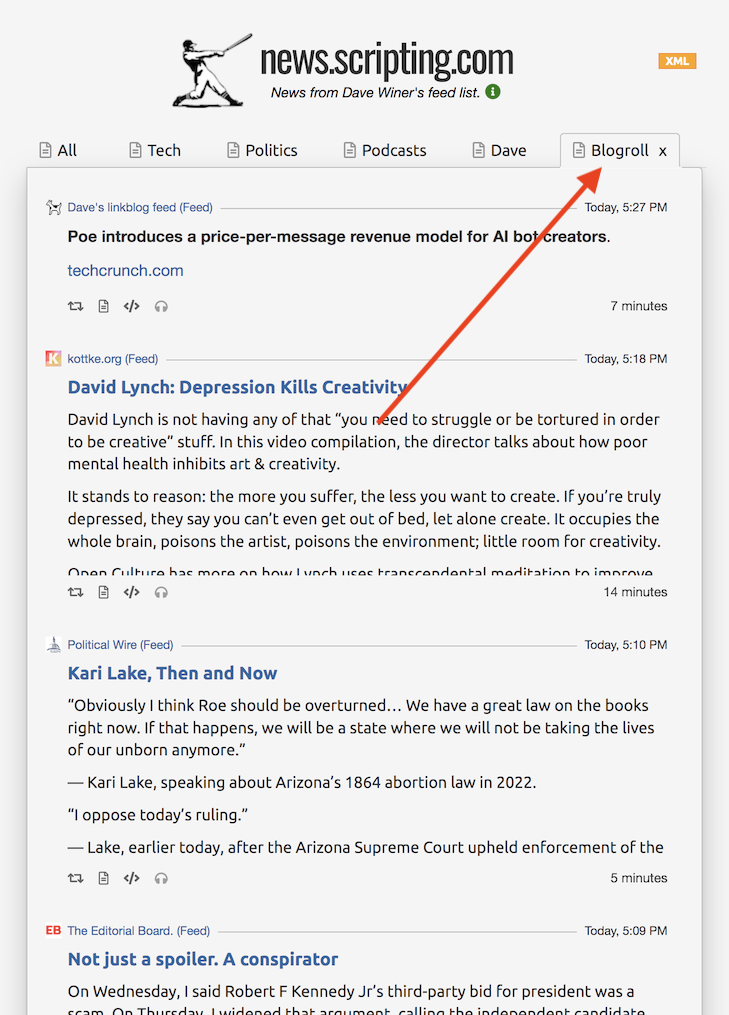
The last tab on news.scripting.com now contains news from the blogroll on scripting.com. Same feeds, different view. #
Far more important than machine consciousness is: 1. Human consciousness. 2. Species-level consciousness.#
BTW, straight -- everything Kara Swisher claims to be, the insider with the best view of the industry, they got that wrong. The things that matter happen far away from her conferences and dinners. It's as if Silicon Valley were Hollywood. To some people it is. But the big changes are never recognized by those people until they're juggernauts. They don't make the changes. They soak them up and devour them. They best of the people she writes about are not creators, they're pirates.#
- I'm not sure I'd buy a Tesla today because of Musk's politics which he puts in our face, thus influencing other people to inflict their nightmares on us. I bet in the end Musk will be responsible for a lot of people dying. #
- On the other hand, I love the car, and thus love the people who developed it, who I don't know. I hope they're not Nazis. I don't see how someone who could design such a thing as a Tesla Model Y, in 2021, the year I bought mine, could be anything like that. #
- This car is going to be copied. There will be a generation of cars that comes along, some that have not arrived yet, that will have to stand up to a comparison to a Tesla. This is the original. #
- To be alive when such a product comes out and not own one, that would be hard for me to do. I don't think my "support" of Tesla could mean that much. The money is already spent. It costs nothing to maintain the car (one of its innovations). #
 It's like the Macintosh of cars. I would have owned a Macintosh in 1984 even if I wasn't one of Apple's top developers. I also know that Steve Jobs didn't design the machine, he stole it from people at Xerox who did. Apple refined the idea, made it practical, like a Tesla, commercial. That's a huge accomplishment, commercializing and humanizing a concept like the Mac was harder than inventing, imho. I have a feeling that Tesla must stand on the shoulders of giants in a similar way. #
- Tesla is always sending me emails, which I usually read, but last week I got one urging me to join X. I thought what bullshit. I don't want these products connected. There was a time, not that long ago, that I would have thought a car hooked up to Twitter as a fantastic and futuristic idea, but now, I think it means no one of principle, certainly no one who is a target of Nazis could work at Tesla in the future. And those are some of the brightest people out there. #
- Meanwhile I'm looking at other company's EVs with lust. I might like a Kia or a BMW. If you're making a consumer product, Nazi branding is not a good look. And X is becoming a stinker too. #
- PS: I was inspired to write this piece by one written by Ben Wurdmuller posted yesterday. I've had much the same feeling about FSD. This piece started out to be about FSD, but the preamble, like the one in his piece, got so long I decided to post it first as its own piece. #

I don't think eclipsy is a word. #
Something disturbing about America in 2024. Over a million Americans died of Covid, but they aren’t on our minds. A million more have long Covid, perhaps. This suggests a million Americans could be killed by our government in the name of a conspiracy, and we’d shrug it off like good Germans. “We didn’t know,” a likely defense.#
Back in the day, many of the early writing tools were called Word-something. WordStar, Microsoft Word, WordPerfect. #
I wrote four posts on micro.blog just before midnight. Probably some of the ideas will appare on Scripting News before too long. #
 On Bluesky, Andrew Hickey explains how hard it is for him to focus while construction is going on at his house. I recognize the problem. I had major work done on the roof of my house last summer, and lost focus for a good two months, even though I had rented office space and at times an AirBnb to get away from the chaos. It wasn't until the work was over that I was able to start to get back into my flow. #
- In my work, I start pretty much at the same time every day, and I get a good five or six hours before it's time to do the next thing. The first hour is warming up. Then I go to the notes I left the night before about where I'm going next. By hour two, I'm not quite at my highest rate but getting there, by hours 3-5 I get monster stuff done, if I'm in a good groove. Hour six is iffy. All the while I'm taking short breaks to check email, tweets, whatever. All of it asynchronous. Waiting for my attention to be available, for a short period.#
- After 5-6 hours of this, I'm wiped out.#
- I can handle small interruptions, like a package delivery.#
- But if it involves the front of my brain for any real amount of time, if I have to shift my attention elsewhere, boom, it all drops out of my head. It doesn't take much of a shift in attention to lose the whole thing, and basically have to start over the next day.#
- Try to imagine a professional tennis player. Do they talk about anything other than tennis during the game. Not with any focus. I'm sure of it. Their attention is fully on the sport. Same deal with intellectual achievement. If you're doing something that few other people do well, you're not only doing the complex things, and require multiple steps and a lot of detail, and memory, but you're sometimes inventing things that no one has done before. All the levels interact and affect each other. And you're doing a shitload of learning the whole time. Until you're burned out for the day that is. Or your deck gets shuffled. ;-)#
- PS: People sending you emails saying how great your last thing was, they don't interfere at all. ;-)#
- PPS: I wrote this post during one of my breaks. I won't edit it until the evening, when I do lite work that doesn't require much focus for any duration.#
- Somewhat-related notes about different kinds of networks, ActivityPub and RSS, various twitter-like systems, as the social web spreads out and tries out new ideas.#
- With ActivityPub you know who's following you and in RSS you don't. This may sound like a negative until you think about it from the user's standpoint: no spam, spyware, etc. Which is probably why Google didn't like RSS btw. #
- It has been pointed out that some level of spying happens based on IP address, and I can testify to that, I get podcasts with ads for a local supermarket, kind of spooky but I guess ok. I can't recall ever receiving spam as a result of subscribing to a feed, and I never get messages from them when I unsub begging me to come back. So it isn't a huge problem in a real way at least for me, yet.#
- I block spammers. In twitter-like systems, like Mastodon, spam means you attached a post to my post that is in no way responsive to it. You're just trying to coast on the flow generated by other posts. I don't abide that. Have a nice day.#
 Facebook, 3 years ago: "I want to use my own editor and have my writing emanate from there, without me having to copy and paste into various forms on different sites. I’m not a copypaste machine. Technically, it’s an easy problem to solve, and I don’t see how it hurts various tech companies to let users write in their favorite editor. This is severely limiting what we can do with networks, and there seems to be no reason for it. APIs let us build networks out of software. Devs, take a chance on other developers. Let the web expand. Let the web breathe."#
- I think you can save time by starting over sometimes, and rebuild the complexity, carefully testing at every step. #
- Going back and fixing a poorly tested corner-turn, esp one you did a while ago, is a time-consuming and frustrating process. You need to have a fully consistent model to evolve. When you try to reorganize a complicated bit of code, and you find yourself scratching your head about how this or that works, that's a sign that it doesn't work. #
- But it's much more fun to add new features to a broken foundation than it is to either fix the foundation or rip it out and put in a new one. #
No no we are not supposed to have earthquakes in NY. #
Yes we're having an eclipse next week. Earthquakes often find other kinds of energy to feed on, like the one during Game 2 of the Bay Bridge series between the As and Giants in 1989. The Bay Area doesn't really get baseball. You have to pick sides. You can't root for both teams. So an earthquake knocked out the Bay Bridge and screwed up the Bay Area for quite some time to come. #
I have lived on the San Andreas and Hayward faults, was in the Valley for the Loma Prieta quake -- and I have to say this was a real earthquake. It wasn't very long, but it had a real jolt. Scared the shit out of me. I'm still very sensitive to this kind of disaster.#
Perhaps Twitter will be like Algol, as in there are algol-like languages, of which one is Algol itself. There will be a mass of twitter-like systems, of which X is one. They really should have tried to keep ownership of the trademark, another one of Musk's mistakes he's about to realize he made. Twitter really is on its way to achieving its destiny as a coral reef. More of a concept than a product.#
When I can't quickly find a good definitive page on Google for a concept, I ask ChatGPT to explain it, and if they got it right, I spawn a new page with their explanation. Just doing my part to tend the commons garden. 😄#
 One thing Twitter is good for — getting support from your cable ISP. Spectrum’s other ways of providing support are designed to get you to give up without using too much of their employees' time. On Twitter, they pretty much always stay with it to resolution. And on Twitter, they have real people who have access to network tools, so they can see the problem from their end, and can give you a clue of what if anything you can do to fix it. #
- I'm pretty good at bug reports, and that appears to work with the online support people they have on Twitter. If you try to chat with them or call them on the phone they read from a script which has you completely tear down and rebuild your system before they'll consider thinking about the data you have. And all this after keeping you on hold listening to their insidious advertising for 15 or more minutes. #
- I don't think the other twitter-like systems have any critical mass with support people from ISPs. Not like Twitter.#
- BTW, support is one place ChatGPT would excel, btw. All kinds. And I don't think too many people will lose their jobs, because their support systems are so bad because they don't hire enough people, or give them enough time with customers, or training, to actually help them very much. I know how to completely tear down the network without them instructing me how to do it. #
Today we got Doc's blogroll working on his WordPress blog. This is the first of our blogrolls on WordPress anywhere. It's been tricky to get the CSS worked out, but we're getting there. It's worth the effort. #
Threads: Maybe The Atlantic or New Yorker could write a detailed article about what the great purges in China and Russia were like. How many millions died. Hitler isn’t the only recent model for an authoritarian government. We should be studying this, you can be sure Trump’s government has and is.#
- What does ActivityPub does that RSS doesn't?#
- Off the top of my head, it's not the ability to syndicate, RSS already does that. I can follow anyone on any server. #
- I think it's the timeline? And the ability to delete posts. Keeping all that in sync is a lot of work, and presumably a lot of traffic? #
- Also replies. If I reply to a post when viewing it on another server, the reply should show up under any other view of that post.#
- What else??#
- PS: Only thinking about features that are used by Mastodon to federate, not potential future features. If that were the rule, then RSS could do anything AP could do, right -- because you can always add the feature. So, just the features that are in use.#
- PPS: I posted this on Mastodon and may post it elsewhere, if I do I'll link them in here. #
- Back in the Valley some of my friends called me El Grandé.#
- Some still do.#
- Dave Jacobs has been playing with ChatGPT art, and sent me this one, and I thought it belonged here. #
- PS: You say the El part softly then pause on the G and add a slightly gutteral H before proceeding with rand and then stretch out the "ay" with a smile and you got it. #
- PPS: You could roll the R too, for fun, if you're into it.#
- PPPS: Guy Kawasaki calls me Beeeeeeg Stuffff. #

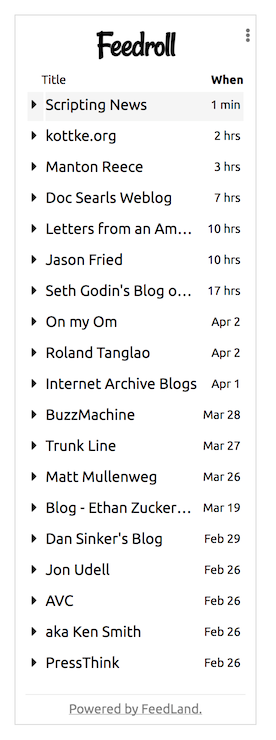
I wonder if people know that news.scripting.com is a simple UI on top of FeedLand. It's 98% FeedLand, 2% hiding the power so people will feel more comfortable. I'm thinking of pulling back the curtain. 😄#
Twitter is the place old friends who haven't heard they should find a new home are still posting. There are quite a few of them. Fact. It's kind of like what Facebook has become. There are a set of people I expect to see there regularly, and that's why I keep going back. Again, fact. #
 I want all the information about the products I make to be instantly available to anyone who wants to know, in exactly the form they want it. Until ChatGPT, that was a totally unattainable dream. But now, for many topics, it's reality. For example, if I have a question about CSS, and believe me, I do -- if I can ask the question clearly enough, I can get a clear and complete explanation of why the browser did the crazy thing with layout that it did. It means I could do something beautiful and refined like the blogroll I worked on in February and March, and the UI stuff I'm working on in March and April. #
- I can't wait until ChatGPT can answer all those questions about my stuff. But then people who make music don't want their songs to be available the same way. As someone who wants to know as much as possible about songs I have always loved but had no idea how they were made, or what they meant to the writer, knowledge about the work is equally valuable as understanding technical topics. I think the big difference is knowing that life is short, and if we want to leave something behind of ourselves, having the information be available is a blessing, not something to fight against. I don't see why software designers in the future should have to reinvent what my generation has already figured out. I don't want them to have to. It keeps coming back to this one idea -- to solve the problems we have as a species we're going to have to work together, and part of that means not being so guarded and selfish about sharing what we've learned. #
- We had this problem with music before, with Napster. The users of music, such as myself, found that the ability to program our own music was so liberating. To listen to a song a few times before moving on made a huge difference, or to choose a song to hear because we just thought of it for the first time in 30 years. But we were literally mocked by music promoters and artists. But ultimately, like it or not, the users got the power they wanted. It's got to happen that way too for ChatGPT et al. I guess some people must've felt that search engines were going to rob creative people of control of their creations. I guess this is something we always have to go through. #
 We're starting to test the blogroll software with a few users, but we hit a problem before we began. The blogroll code includes the CSS for the Bootstrap Toolkit. I use it as if it were part of the OS, but not everyone does, and it changes the global values of things. So when you install it on a page that has its own ideas how things should work, you can get an unpleasant effect (to put it mildly). So I created a localized subset of Bootstrap's styles, to be a better guest in other people's pages. That is now done. I expect we'll see more of that kind of thing. Web plugins are a new area for me. I guess that's pretty obvious. #
- I can't stand to look at images of Trump or his followers. Fed up with it. I want our own heroes. #
- When I see a picture of Trump, and they are impossible to avoid, I will envision a washed out picture of a dead dictator on a screen and the runner slinging the hammer at the image and it crashing. #
- She represents life and strength. She is the America I love. #




 We need a resistance movement that reporters can report on. A new women’s march for reproductive health would be a great place to start. I'm not giving up on journalism yet, just knowing they need to see a resistance to report on it. That means big marches, streets filled with Americans, who will sound angry and determined when interviewed by reporters. And spokespersons who can be interviewed by Maddow and Blitzer. #
Ken Smith summarizes: "Figure out what kinds of events the press likes to cover, then create that kind of event." That's right. Let's not argue about what the press should cover. We can't change them. Just give them what they need to do the right thing. #
After a couple of tests, the fix below is implemented here. For some reason I wasn't subscribed to my own feed, which accounted for the fact that updates from this blog weren't getting into the blogroll. That troubles me, I have to try to piece together how that happened. In the meantime it's nice to have the instant updating working again. I didn't know that I had missed it, but I did.#
 I introduced a bug in the blogroll code where it was ignoring instant updates. Probably the sexiest feature in the whole thing. The bug was introduced on March 21, so it's been there a while. You have to hard-reload the page to get the new version. So, when I post this on Scripting News, it should move to the top of the list immediately. So a good use-case is to leave Scripting News open with the blogroll visible and every once in a while you may find something interesting to read. I like having it there, but of course, it's my baby, so that's understandable. :-)#
I tried listening to one of Kara Swisher's interviews for her new book. The interviewer was someone I respect, Brian Lehrer at WNYC. But he has an old and imho unfair view that CraigsList and Facebook are responsible for the demise of local news. I was surprised when he said as much near the start of the interview. Then Swisher went into an obviously very well rehearsed schpiel that confirmed that he was absolutely right and the tech gods weren't fooling anyone. OK that was my limit, I switched to another podcast. She's got a great business model. Tell the press what they want to hear and you will get good press, pretty much guaranteed.#
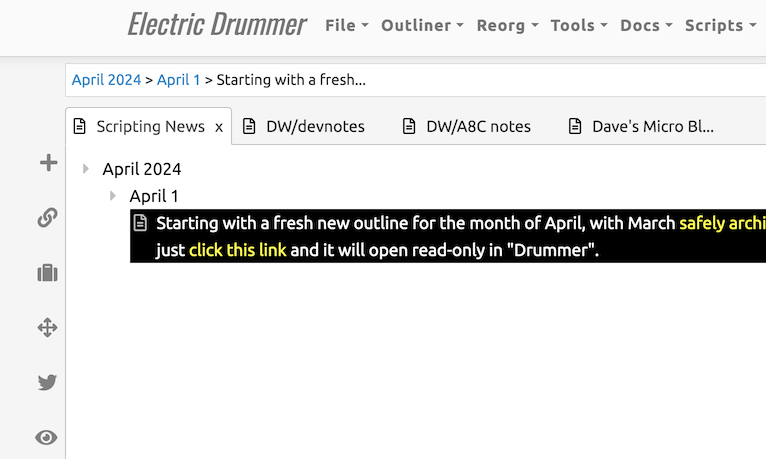
Started a new outline for the month of April, with March safely archived on GitHub. If you want to read the month in outline form, click this link and it will open read-only in Drummer. That's a pretty good approximation of how I edit it, except I use the desktop version of Drummer that writes files to the local Mac filesystem as well as to the cloud. #