|
|||||||||||||||||||||||||||||||||||||||||||||||||||||||||||||||||||||||||||||||||||||||||||||||||||||||||||||||||||||||||||
Monday, February 28, 2005
A short podcast, introduces the new Morning Coffee Notes feed. As a bonus there's a bit of new stuff about Google's toolbar, and, don't miss this -- I bark like a dog. We're moving in more ways than one! Yehi. I'm going to be on NHPR tomorrow at 9AM Eastern, on a call-in show about blogging. The other guest is Dan Gillmor. 2WW: "Cory Doctorow provides several examples of content modification that Google allows. However this isn't responsive to the question I raised on Scripting News yesterday." Rex Hammock: "I don't know which is more ironic. A Google employee using a Microsoft's employee's weblog to make the point about Autolink...or the Google employee's point." Plenty of Cowbell, a long-time Boing Boing reader, is "desperate to prove that this is a big deal and that bloggers such as Cory..." Zeldman: Protect your site from Google's new toolbar. Mitch Kapor: "I met Jef in 1980 while I was working at Personal Software. His girlfriend at the time was a coworker of mine." Time: "Mayer says Google is unlikely to remove AutoLink but the ultimate decision will be based on public feedback over the next few months." Steve Rubel: "This is a pivotal discussion that bloggers, journalists, PR professionals and marketers need to jump into. Do you really want Google, Microsoft, George W. Bush, God or anyone adding links to your content?" Good old USA. The cable guys came when they were scheduled to be here, delivered the modem, hooked it up, connected the laptop, and it worked.
Sunday, February 27, 2005
The ocean was angry today. Jef Raskin: "The popular media has a poor track record of presenting the recent history of technology." To me, Florida feels like Silicon Valley, with hotter weather, closer to the beach, and without the traffic. And real estate is more reasonable too. I often get confused, thinking I'm in Palo Alto. When I realize I'm not, it's a good feeling. Rebecca MacKinnon, a Gmail user, has the top hit for Gmail down. Apparently Gmail goes down from time to time, but Google doesn't communciate with users.
Scoble asks Cory Doctorow to take another look at AdLink. John Robb says give it up, but then demonstrates why we shouldn't. I hadn't thought of the connection between Scoble and John, it's true John put in the early work to flesh out the idea of business blogging, and Scoble gets the lucrative book deal. I never would have put that together had John not made the point. In our society it's considered rude, by some, to claim your achievements. Not here. Not with me. If you invented something that proved useful, I want to know. On the other hand, if you point this out to Scoble, I bet he'll do what he can to pass some of the juice to you. (And if it's any consolation, you have company. I'm net-negative on blogging, by several million dollars. I'll never recoup the financial investment.) A little story. I was at a meeting with potential investors when the Fortune article hit, with all the bloggers on the cover. We had just said I was one of the leaders of the blogging revolution, and one of the investors pulled out the magazine, as if to ask why my name and picture weren't in the piece. It does hurt when you don't get the credit. It limits how much you can do in the future. It determines who gets the money to pursue their ideas. It's not something to brush aside so easily. It matters. Steve Burgess said: "It doesn't matter who gets credit." I don't agree. "In academia, for example, trying to take credit for someone else's work is called plagiarism, and it's very serious. You can lose your job if you're caught doing it. The rules are different in the commercial world. If you have a patent and someone tries to use it without your permission, you have a good case for damages, and money may change hand." Today's moving day, out of a hotel and into a house, which won't have Internet access until tomorrow morning, knock wood, praise Murphy. Starbuck's is not too far away, so there may be a chance to get mail, check the aggregator, and, if the spirit cooperates, upload a podcast.
One of my first podcasts was a response to a shitstorm that Halley and a few others fed. It was an attempt to get my perspective into a jihad against me. It didn't work then. I have been very wary of having anything to do with the primary feeders of that storm, but enough time has passed. We won't be friends, but I can acknowledge kindness, and be appreciative of it. A lot of people use me as a foil to express their rage, but I'm actually just a person. It's not fair, and it hurts, but it comes with the turf. 7 years ago today: "It's RPC over HTTP via XML. I believe it's the next protocol for runtimes." That piece began the work with Microsoft that led to XML-RPC and then SOAP. It was the next protocol for runtimes. Who do I have to blow to get ads on audio.weblogs.com?
Saturday, February 26, 2005
SJ Merc: "The Sports Podcast Network is among the first of what will likely be a plethora of networks that sprout up as podcasting gains popularity and entrepreneurs seek out business opportunities." Michael Gorman: "The piece was intended to be satirical, though I am certainly no fan of 'blogs,' having an old fashioned belief that, if one wishes to air one's views and be taken seriously, one should go through the publishing/editing process." Via Ed Cone. Another announcement I missed, Scoble and Israel have their book deal. The Red Couch will be published by Wiley. Can't wait to read it.
Battelle also has a pointer to an interesting article about Google in GQ. I didn't know that Bill Campbell got involved in Google management. Jonas Maurus: "Imagine a gay-community page linked to Pat Robertson... and the author wouldn't even know that his users see this." Sean McGrath: "In an ideal world I would put the following people into a room full of white boards and feed them coffee. Their task -- sort out the terminology guys!" iPodderSP is "the podcasting client for SmartPhones." Dan Gillmor meets with Google Dan Gillmor: "I have trouble with Search Engine Watch's Danny Sullivan's view that publishers of Web sites should be able to opt out of the toolbar changes. In theory, once I have content on my desktop it should be my right to 'remix' it in the way I choose." I go a step further, authors and publishers should have to opt in, as we do for Google ads. I only put their ads on two of my pages, out of god knows how many. I'd be willing to try this feature out with my content, provided: 1. There was a financial incentive for me (this as advertising) and 2. I have control over which pages its on. A question for Dan, suppose Google had the power to put ads on every page of yours, but didn't offer to pay you for it, and further it was hard to tell what was advertising and what was editorial. What happened to your ability to communicate with people who read your site? Never mind right and wrong, for a minute, or whether Google is good or evil, how do you communicate with any kind of integrity in that environment? And as I asked in my essay, what happens when Google isn't satisfied to add links to our sites, suppose they were to change the actual words? I haven't heard Google say they would never do that, have you?
I thought Danny's hypothetical question was right on the money. What if a larger company, say Microsoft, without asking for permission, offered Google searches to its users without Google's ads, or even better, with more informative ads, chosen by Microsoft? I assume Google would think this is okay because hey, it's the user's content to remix as he or she wants to, right?
Friday, February 25, 2005Steve Gillmor is the guest on Chris Pirillo's podcast.
Rex Hammock: Podcasting needs no eBay.
Steven Cohen: Revenge of the Blog People? Danny Sullivan: "How would Google feel about programs that modified its search results?" Quick comment on Danny's article. No mention of integrity issues. The issue for authors and publishers is whether readers know they're reading text that's been modified. How far can Google go? Can they correct our spelling? If so, can they correct our thinking? And if it's okay for a toolbar, what if Google (as widely rumored) is building a browser? Mr Sun discovers Winer-rimmed glasses.
Don Park's story of two parrots. Sit down before reading it. Monkey Media Report: "Google-worship sucks." NY Times: "While still too much in its infancy to be considered an immediate threat to the radio industry, podcasting does present the prospect of a growing army of iPod-toting commuters who take programming decisions out of the hands of broadcasters and customize their own listening."
Read this if you need a kidney Boing Boing: "Alex Crionas needs a kidney, and his friend Patrick Garrity would like to give him one. But the transplant was recently blocked by a coordinating group because Crionas published an account of his need for the procedure on a personal website." Good thing Dave Jacobs already got his kidney. And if I ever need one, I can't imagine not writing about it on my website. What happened to the First Amendment? And can you believe the argument that some people don't have access to the Internet? I don't. If you need a kidney, you'll find your way there. This is how the public gets educated on this stuff, by reading first-hand pleas from people in need. A lot of people learned about that by reading Dave's plea here. And what if I wrote it, not him (which I did, btw). Could he be penalized for something a friend of his did? (And if you read that piece, Dave got his kidney. This week he took his first post-transplant vacation with his wife and four boys. He's healthy, happy, glad to be alive.)
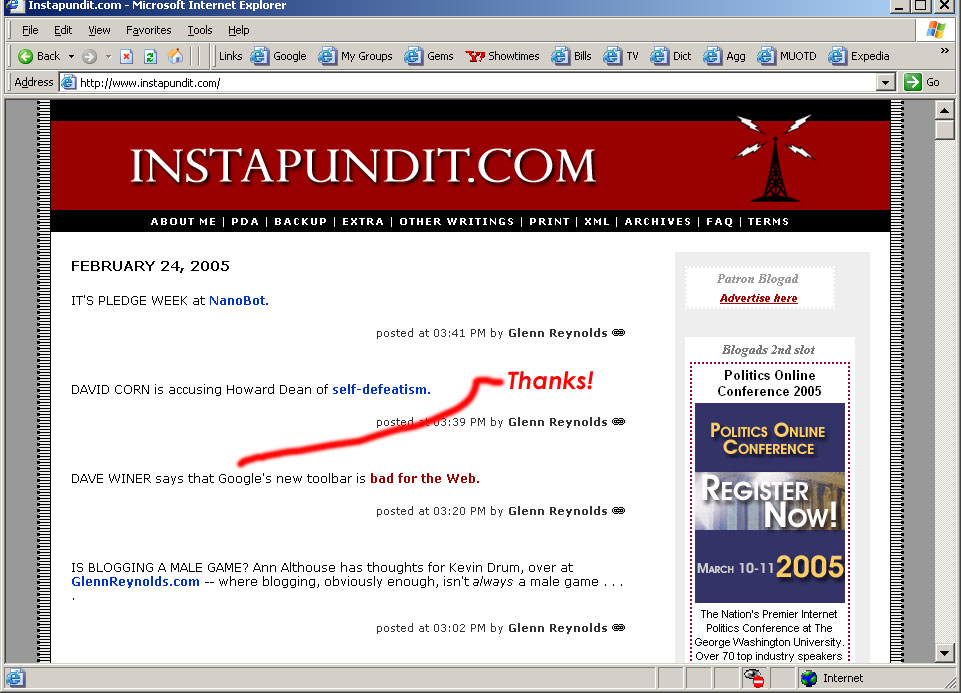
Thursday, February 24, 2005AP supports RSS. Welcome! It's great to get AP on board. Now the crucial question -- what's their archive policy? How long will the stories they point to from their feeds be on the Web? Thanks to Glenn Reynolds for the pointer. Instapundit is a flow machine! One of the cool things about being in Florida in March is spring training with the Mets and all the other major league baseball teams. New header graphic, the dreaded blue screen of death.
Somehow I missed the announcement last week that Microsoft is doing a version 7 of MSIE, proving once again that big technology companies don't really listen to their users (although they claim to), but they do listen to their competitors.
Zawodny: The world could really use Google Calendar.
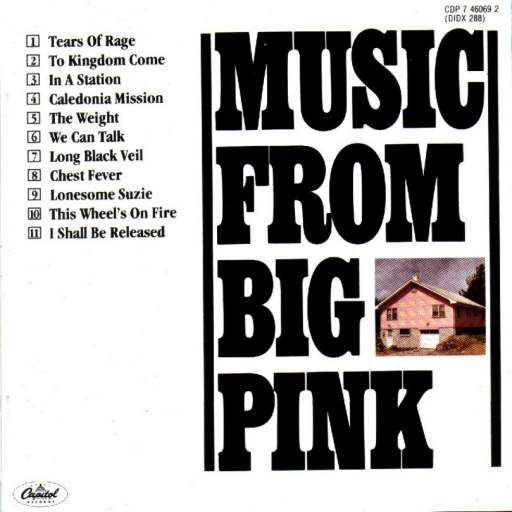
Hey it's been a long time since I've seen one of these. Knock wood. Today's song Good morning Campers! I'm your Uncle Ernie. And I welcome you to Tommy's Holiday Camp! The camp with the difference. Never mind the weather. When you come to Tommy's. The holiday's forever! Haha! PS: Put in your ear plugs, put on your eye shades, you know where to put the cork!
Wednesday, February 23, 2005A new slogan for RSS? A movie of tonight's thunderstorm. It's like summer here in Florida, high 70s, low 80s; and it's February. I rented a beach house today. For the first time since college I'm a southern boy, y'all. Dan Gillmor hasn't commented on the Eason Jordan affair because "I still don't know what the man actually said at the now-notorious World Economic Forum panel." KCRW: Podcasting is the Word. Last night's moon rise over the Atlantic. Sue Polinsky comments on my analysis of AutoLink. Gary Price: Google Goes to the Movies. Sylvia introduces the blog of Oakland mayor Jerry Brown. Dear Wired, please get a fact-checker. Don Park says AutoLink should be opt-in only. I agree. It's Wednesday so the Chapel Hill Bloggers Meetup is tonight, 6PM. Kottke: "I recently quit my web design gig and -- as of today -- will be working on kottke.org as my full-time job." Google Watch: "The toolbar updates automatically, without asking." Jessica Baumgart on car navigation systems. IE Blog: What have you guys been doing since IE6? Ben Edelman: "Google is far from blameless in the spyware battle." eWeek report on Edelman's research. WebReference reviews a program called FTPEditor, which is a text editor and an FTP client. It's a problem more nimbly solved by upstreaming, which allows you to use the editor you like best, and can upload any file type, text, graphics, etc.
Tuesday, February 22, 2005
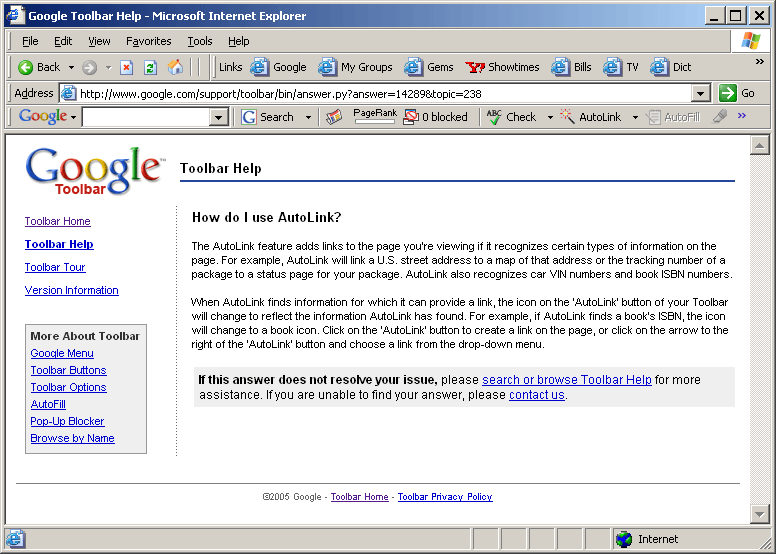
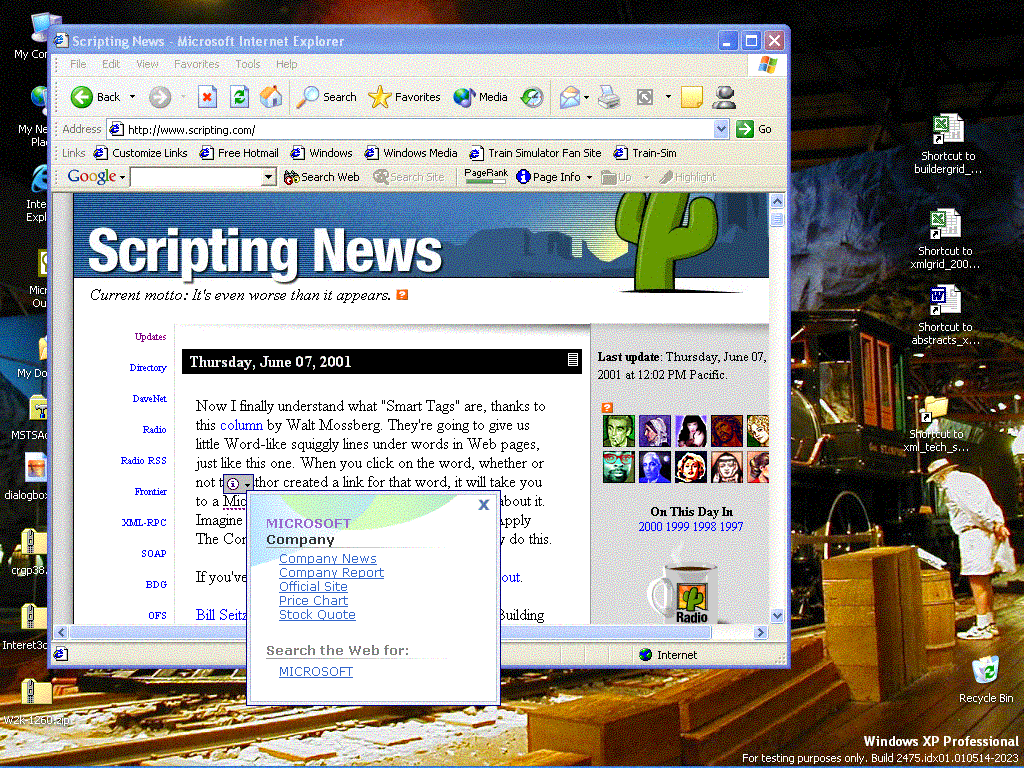
BBC: Google's toolbar sparks concern. Google: "The AutoLink feature adds links to the page you're viewing if it recognizes certain types of information on the page." So if there was any doubt that the purpose of AutoLink was to add links to pages created by others, it's right there in black and white on google.com. Len Bullard: "Some are glossing right past the ChoicePoint fiasco." NY Times: "Mr. Thompson's approach in many ways mirrors the style of modern-day bloggers." Scoble: "No RSS? No downloads? Fake content? You're fired!" Dear Googlebot: "This site points to lots of podcasts." Cyrus Farivar sent pictures of Winter 2005 in NYC. John Robb calls Google's move into content modification a strategic mistake, a bet-the-company mistake. In June 2001, Scoble sent me a screen shot that explained Smart Tags. Krugman: "National security policy should not be a refuge to which Mr Bush can flee when his domestic agenda falls apart. "
Monday, February 21, 2005Rogers Cadenhead: "Software that manipulates digital content in transit should not present it as if no changes were made." Howard Greenstein on the User's Guide to the Brain. Marc Canter on Hunter S Thompson and Julie Leung. Anton explains how the Chapel Hill blogger conference came together. Sylvia once took a tech support call from Hunter S Thompson. Dowbrigade: "Abandoning all pretense of objectivity, [Thompson] was overwhelmingly, enthusiastically, visciously.part of the story." John Robb: "Google is pushing its ads into content it does not own." Yesterday I discovered that the MailTheFuture app wasn't sending mail due to a configuration error. This morning it's working like a champ. There was a special on TV last night, commemorating the first five years of Saturday Night Live, which I remember very well, of course. Too bad they didn't have more of the skits, the ones they had were so funny they hurt. I especially liked the one about the douchebags. The tale of the iPod continues. Now, as if by magic, it's charging. As bummed out as I was before is how good this makes me feel now. News.Com: "Google's browser toolbar is raising eyebrows over a feature that inserts new hyperlinks in Web pages, giving the Internet search provider a powerful tool to funnel traffic to destinations of its choice." Rex Hammock: "Thank god podcasting was not a corporate idea." Fast Company has a next-gen radio article, I guess they heard about the Wired piece. No mention of podcasting. BBC: Hunter S Thompson commits suicide.
Sunday, February 20, 2005
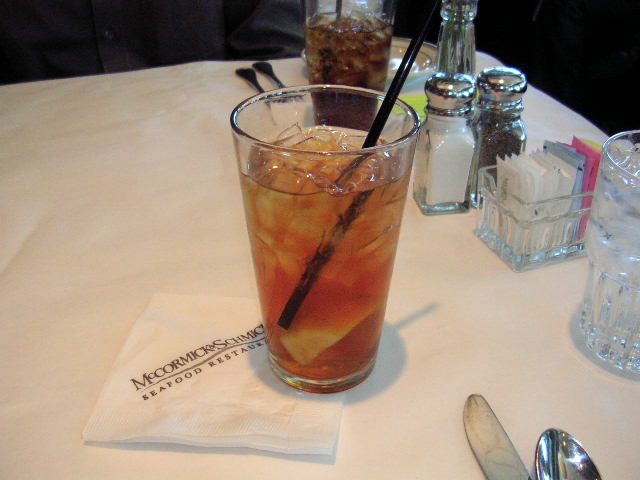
Ed Cone: Beginner's Guide to the Blogosphere. Doc Searls went shopping for a new car radio and found the sales guy knew all about podcasting. That's just amazing. Here's a quick snow-digger's guide to ordering ice tea in the south. Do you like it with sugar? Then simply order tea. They know it's not hot because you didn't say "hot tea." If you don't like it with sugar, then order "unsweet tea" not "unsweetened tea." Anyway, the ubiquity of ice tea is one of my favorite things about the south. That and there's no snow. Whew. Rogers Cadenhead on the new Google toolbar. Washington Post: Newspaper Industry Struggling. Jay Rosen isn't worried about search engine optimization. An update on the iPod that was lost and then found. It won't take a charge. Plug it in, no light. I've tried every socket in sight. No joy.
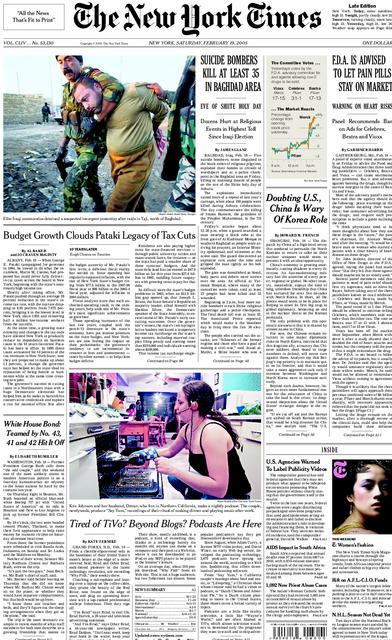
Saturday, February 19, 2005A scan of Saturday's NY Times page A1 with the podcasting piece. Daily Show segment on blogging. Hey they like us. Steve Rubel: "Robert Scoble left a comment on my last post that Jeff Reynar at Google is behind the Google Toolbar's controversial new Autolink feature. Ironically, he's the same person who was behind the similar SmartTag feature that Microsoft tried to build into IE. Reynar co-authored Microsoft's Smart Tag FAQ in 2001 and his home page identifies him as a current Google program manager." Blogging started in the tech community, and over the years, we've followed stories, sometimes they were picked up by mainstream media, often with little or no credit to the bloggers who did the discovery and research. Then the political bloggers did the same, and got the credit for putting the pressure on the MSM that's been going on in technology reporting for so long. Today we work with our colleagues at eWeek and News.Com, ZDNet, and even some of the reporters for business publications and local newspapers. I have a feeling the story we're working on, with Google pushing the envelope on the story of Smart Tags, is going that way. Let's hope the larger press community tunes in, and let's keep this a class act on both sides. There are some interesting issues, and few clear answers. Let's show everyone what the political blogosphere may look like in a few years.
NY Times article on podcasting. Ed Cone says it's on page A1. An instant review of the Times article from Paul Jones. "The Times knows podcasting is important, but they give it the pajama treatment." I was the guest on the WGBH Morning Stories podcast this week. I can't believe they played the Dean Scream. Twice. Arrrrgh! (But they did a great job, and in this one piece, the scream actually fit.) Scoble weighs in on browsers that modify content. Susan Crawford: "Can one industry force another to constrain new general purpose technologies in the name of copyright protection?" Question of the day: Should I take up golf? Or is golf evil? Bill Cheeseman says Croquet. "It's a good game to grow old with." John Robb suggests that Microsoft might offer a Windows patch that blocks toolbars from doing the kind of stuff Google is doing. Interesting possibility. This would be a good way for Microsoft to help ensure the integrity of our content. In case anyone from Microsoft reads this, it's something to think about, not to do (yet).
We all have a brain, but how well do we use it? Too bad we don't have an owner's manual for the human brain. What would such an owner's manual be called? The Human Brain for Dummies?
Friday, February 18, 2005Today's Morning Coffee Notes was recorded in the pre-dawn hours in Atlanta. Lots of stuff about Google and Smart Tags. Tod Maffin explains the first podcast network which launched on the 14th. I spoke with Marissa Mayer from Google today, briefly. We'll talk again next week, giving me a chance to become familiar with the toolbar, and they're going to study the issues raised by Microsoft's Smart Tags. My goal is to come up with the line discussed earlier, not sure if they agree. eWeek: Google's Tool Bar Links Stir Debate. 4:30PM: Arrived safely in Waycross, GA. The Media Drop reports that the Business Wire now supports RSS. Jeremy Bowers on Message Integrity. I stopped at a random truck stop on I-75 south of Atlanta and it has better wifi than the last few hotels I was at, and it's free, and I get free refills for my unsweet ice tea. Life is good!
Technorati is organizing a "Web Spam Squashing Summit" to, according to Jeremy Zawodny, "get the tool makers in a room together to talk about web spam, share info, and brainstorm." It's on February 24, in (I guess) Santa Clara, CA. I hope they invited someone from UserLand, because I use their tools. Also would be great to see Feedster and PubSub participating, so we know it's really open. What about Google? Don't they have something to contribute? The list of "key industry players" seems a bit short. Maybe this is something users could help with? Just an idea. Susan Mernit wonders about the NY Times acquisition of About.com.
Thursday, February 17, 2005How many blogs were there in 1997? Check this out. The NY Times bought About.com for $410 million. Bob Stepno amplifies Peggy Noonan's thoughts. Great stuff. Note: The Westin in downtown Atlanta has excellent free wifi and landed Ethernet on the second floor. It's supposed to cost something ridiculous like $10 per hour, but there's no meter, and no place to deposit the money. Enjoy it while you can.
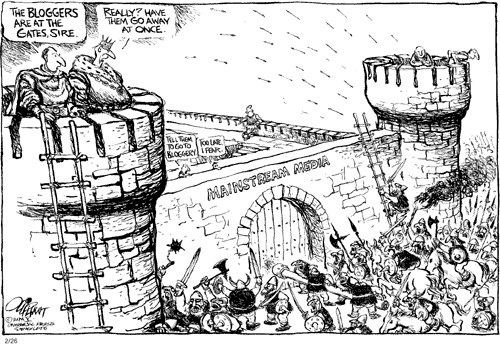
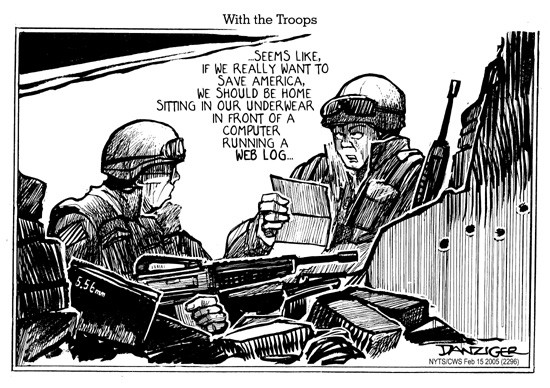
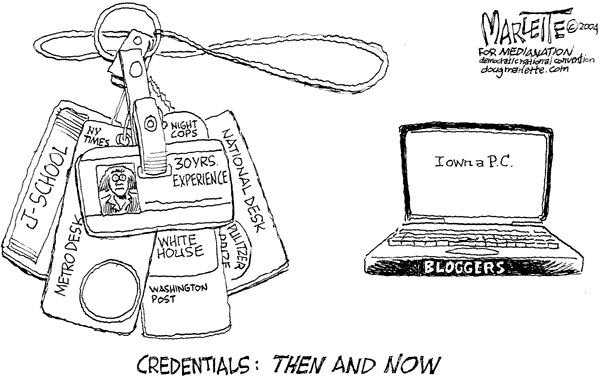
Excellent cartoon, a sign of the times. A pro takes a self-deprecating shot at the pros. Bravo! Along with Peggy Noonan's piece, cracks are growing in the walls of the palace. A little light is coming in. Hmmm. Sylvia: "Maybe Blogland is Davos, too, my own private Davos open to everyone."
Peggy Noonan, writing in the Wall Street Journal, explains blogging better than I've ever seen it done. Savor every word. It's a gem. BTW, my hotel is blocking outbound port 25, so I can receive but not send email. If you're waiting for a response, it's queued in my Outbox. Sorry. Also, sorry for the blackout on the purpose of my stay in Atlanta. The people I'm visiting don't want publicity for what they're doing, and I of course am respecting that.
Greg Linden: "The modifications are useful, sure, but what does it do to Mapquest to have all addresses everywhere pointing to Google Maps? What does it do to Barnes & Noble if all ISBNs point off to Amazon?"
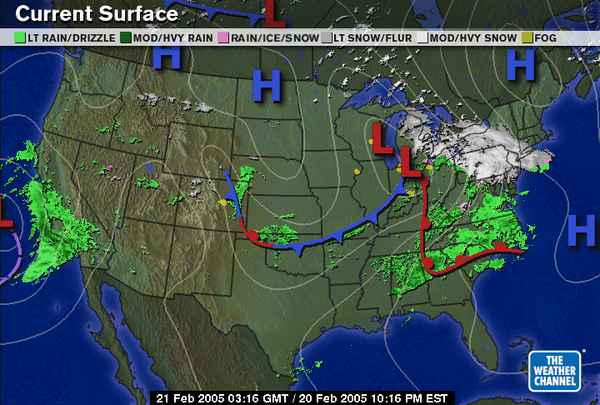
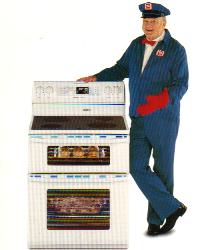
Wednesday, February 16, 2005Lance Knobel, former programme director for the World Economic Forum, and a blogger who covered the 2000 annual meeting, weighs in on the role of the weblog in the Eason Jordan affair. Lance has a very interesting perspective on the events of the last week. Ruby and Brian gave me a bunch of presents as I was leaving Chapel Hill on Sunday. One of them was a rocking Buddha designed for dashboard mounting. Today I installed the Buddha and he kept me company while I was driving. Of course I immortalized him with a movie. Four years ago today David Galbraith had a design for a neat user interface for The Semantic Web. Five years ago today I was working on a browser-based interface for editing Scripting News. David, it's a much faster ramp-up than the blogosphere. In the first year, 1997, there were maybe four or five blogs. 3:45PM: Arrived safely in Atlanta. The first Chapel Hill Blogger's Meetup is today, 6PM at Caffe Driade. Help bootstrap a vibrant blogging community and keep Anton company. The Guardian joins the NY Times as a lynch mob of salivating morons. And they're old, stupid, and fighting the wrong battle, and as useful as Control Data, Sperry-Univac, DEC, or the Maytag repair man. Scoble: "Don't forget the geeks!" Today's a lite travel day, from Spartanburg to Atlanta, where I'll spend two nights. Blogs have a job Greensboro, Chapel Hill, Spartanburg are very different places. I had never spent time in either of the Carolinas, I still haven't spent very much time here. I also had never spent time at small-city newspapers, or gotten to know small-city bloggers, in any part of the world. These were all firsts. Spartanburg is much smaller than either of the North Carolina cities, with a population of 40,000, in Spartanburg County, whose population is 253,000. The people are less literate, according to the newspaper only 12 percent of the people who read the paper have college degrees. South Carolina is commonly divided into three regions, the lowlands (Charleston), upstate, and the midlands. I was told the midlands are backward and dirt poor, like much of the rural south. Spartanburg is the city of the upstate region. The local paper, the Herald-Journal, is owned by The New York Times Company.
Yesterday's meeting began with a joke about bloggers working in their pajamas. I've come to hate that joke, and to see it as a yet another way for professionals to push bloggers to the side, to a place they (theoretically) don't have to look at us. At the same time, we're their most interested readers, and we can help them build credibility, and all this came out at the meeting, and these are intelligent and thoughtful people, and once they realized that I am not a joke, and have self-respect, we got along very well. In fact, they're going to start immediately with a first step toward blogging, by putting the Letters to the Editor on the Web in a format where readers can comment. This is one of the first things they did in Greensboro, and it's enormously popular there. It's a relatively easy first step for Spartanburg.
By the end of the meeting I had a feeling that there's a logic to blogging and local news, more than including the work of the community in the output of the newspaper. Clearly the weblog allows the people of the news organization to be more specific, more personal, and still be under the masthead. News of a staff assistant moving on to a new job in a new state wouldn't belong in the paper, but it does belong on the weblogs. Newspapers are not only journalism, they are also organizations, and like all organizations, they have stories to tell, and where there are stories, blogs have a job. What Horace really means A long time ago, in another lifetime, when I was a Mac software entrepreneur who had sold out, I was working in the company that had acquired ours to build a product line of Mac software tools, shipped in source code. I had approached developers of products that were past their prime, probably not selling much, if at all, and proposed we repackage the software as toolkits for programmers. I had put together a list, a graphics program, word processor, a small spreadsheet, a database, and had called each of the developers and set up meetings at MacWorld Expo, where I was joined by a corporate business development manager, who would negotiate the deals. His name wasn't really Horace, but let's call him that. The story isn't really about him, so his name doesn't matter. After we sat down with the first developer, after chitchat, and some enthusiasm for the idea on both sides, I started explaining the terms of the deal. Horace interrupted and took over. I couldn't believe what I was hearing. Technically, he was explaining the deal correctly, but you had to be very cynical to get how little he was actually offering. He was changing the terms so that the developer would stand very little chance of making any money at all. I was shocked. Then, at the second meeting he started doing the same thing, but I interrupted and said "What Horace really means is..." and then explained how the deal was horrible for the developer, and of course he walked out, thinking our company was pretty slimy. On the way out, Horace was furious. I told him that I'd have to deal with the developers who eventually would find out there was no money for them, and I'd never get a second version of their software, and my reputation in the business would be trashed, all for what? So we could shave a few more points from a product line that hadn't even been built yet? How could that possibly work? In the end, the product line never happened. It would have been a good complement for our language tools, might have generated some new products, would have been good for developers and good for the Mac, and would likely have enhanced our company's reputation and would have returned a 20 percent pretax profit, which is pretty respectable, imho. Didn't happen. The moral of the story is this -- if you're sitting opposite a guy like Horace, and there's a guy like me sitting at the table, you should ask him what Horace really means. And if you don't think you're getting a straight story, get a lawyer, and trust his or her paranoia. There are business guys who think a good deal is one where they make all the money and you make none. These are the ones you want to avoid doing business with.
Tuesday, February 15, 2005Draft: Blogging howto for small city newspapers. "Say goodbye to the notion that reporters are interchangeable parts, readers are right to trust sources that identify themselves, and that goes for reporters too." Sylvia Paull: "I hope Jordan gets online and explains his comments; otherwise, we'll be killing journalists by more than guns alone." Archive of today's KPBS segment on Podcasting, which begins about 35 minutes into the show. I've been hanging out with Dan Conover from The Charleston Post and Courier today. He has a blog, of course. He explains the Charleston point of view as "this car craze looks like it's here to stay" and "Charleston is where the Ashley and Cooper rivers meet to form the Atlantic Ocean." Andy Rhinehart has this incredible screen saver containing the latest AP photos coming into the newspaper. He just points Windws at a shared folder on the LAN and it picks the pictures at random. It's absolutely captivating. I think it would make a great product. Andy and Dan both started on the same day at The Mountaineer in Waynesville, NC. Today's movie is of the newsroom at the Herald-Journal. Press release: "Today the EFF asked a California Superior Court for a protective order that would prevent Apple Computer from forcing three online journalists to identify their confidential sources and hand over unpublished materials." I got an email from Dan Gillmor saying I didn't quote him correctly, and that's certainly possible, but I think I responded to the essence of what he said. There's nothing controversial about eBay or Craig's List, nor surprising, nor unethical. At some point there will be an MP3 of the session so we can check. Further he says that he didn't give a speech, and this is true. I wrote my comment in real time, as his session was starting up. After the fact, it was more of a Q&A with Dan and to a lesser extent, Paul Jones. This would have been uremarkable at a Silicon Valley tech conference, but was unusual for a blogging conference. I also would not have been at the SV tech conference, that model is over as far as I'm concerned. I don't believe in fountains of wisdom, I think there's more smarts in what we used to think of as an "audience" than there ever is at the front of the room. Funny thing is, I thought Dan believed that too.
The Herald-Journal has a howto for people with news. Good start! An angle the NY Times spotted but buried in the middle of the Eason Jordan piece, is the central role that Rebecca MacKinnon played. "On Feb 2, Rebecca MacKinnon, who worked under Mr. Jordan when she was a producer and bureau chief at CNN, and organized the blog from Davos, contacted him after seeing that conservative blogs had picked up on his remarks."
Monday, February 14, 2005TidBITS article on Podcasting. "The People's Radio." I'm going to be on KPBS-radio in San Diego, tomorrow 9AM Pacific. Scott Rosenberg: "The idea that angry bloggers alone laid Jordan low seems extraordinary unlikely to me." Kevin Reynen is compiling a list of US newspapers with RSS feeds. FCW supports RSS.
And here's a request for the cable news networks, who, now that Dean is back in the news, are running the scream again. The request: Stop, it's not news, if it ever was. 1:45PM Eastern: Arrived safely in Spartanburg.
NY Times piece on the Eason Jordan affair. Not very balanced, mostly apologizing for Jordan, and casting the bloggers in a very negative light. The problem for the pros, in the end, is that they've been very sheltered, above criticism, and that's over now. The sooner they adjust, the better for them. Name-calling may make them feel better, for a very short time, but it won't make the problem go away. Pew: "11% of all American adults own iPods or MP3 players -- that's more than 22 million people."
Sunday, February 13, 2005
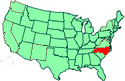
Terry Heaton: "Nashville area bloggers gathered Saturday to meet each other and swap yarns in the studios of WKRN-TV." At 11AM we're having the second-ever Scripting News brunch at Crook's Corner in lovely Chapel Hill, N. Cackalacky. I called the restaurant to tell them to expect ten geeks, based on the comments we've received. Mike Manuel: Oracle's Taste of Media Transparency. Advertising and the Internet At yesterday's conference Dan Gillmor talked about a looming crisis for print pubs, that most of their advertising is moving to the Internet, to services that don't care much about objectivity. This line must go over well when he's talking to editorial people at Knight-Ridder, for example, but to a blogger, well, I want to ask the (obvious) questions. Isn't it true that eBay and Craig's List (two leading examples) don't actually have editorial content that could be objective or not? Hasn't the Internet done what it always does, unbundle and disintermediate? Who says that local advertising has to be bundled with local editorial and opinion? Sure, it was that way in the past, but why should it continue? What advantage is there for the user? And by the way, can we once and for all get rid of the notion that professional journalists are objective? They may offer independence, but no human being can get away from their own experience, which colors everything they see.
Saturday, February 12, 2005
Rafe Colburn, one of the first bloggers, was at today's conference. It was great to meet him after all these years! Conference links. Today's word: Cackalacky. They are breaking some of the basic rules of BloggerCon-ness. They just plugged Dan Gillmor's book, and the sponsor Bob Young (founder of Red Hat) is giving a schpiel about his new company. Then Dan Gillmor is going to give a speech. I guess I won't say anything about this in the room, but I had to say something here. I won't be calling this a BloggerCon.
Dan Gillmor is in the room blogging the event. We the Bloggers of the Great Volunteer State of Tennessee... Ed Cone: "Poor Charlotte, trying to be cool but not knowing how." The conference has started, 9:15AM Eastern, after a little bit of confusion I have a network connection. If you're in the room and blogging it, send me a pointer and I'll link. It's on: Tomorrow at 11AM at Crook's Corner in Chapel Hill, the second-ever Scripting News brunch.
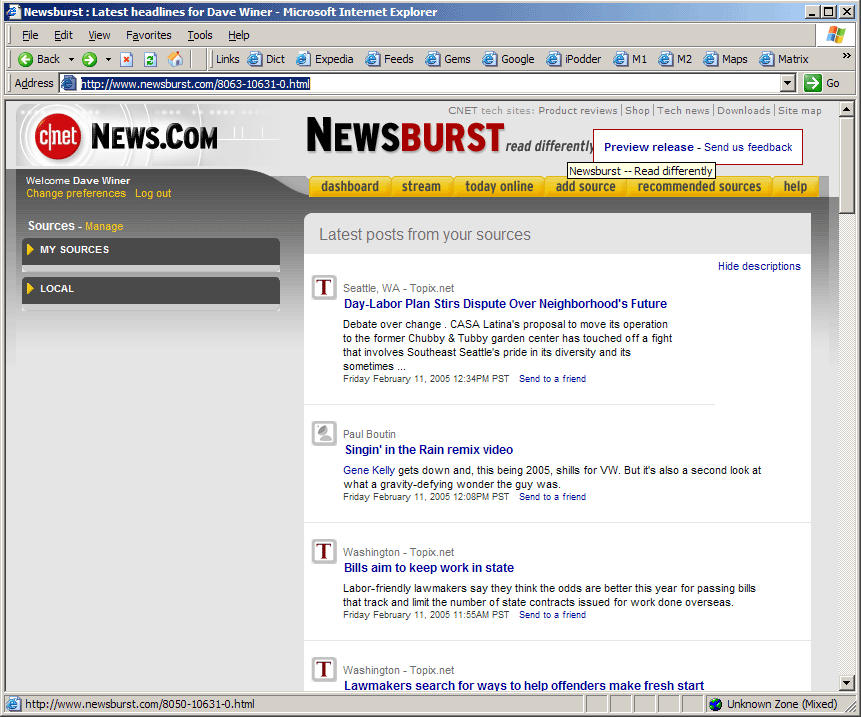
Friday, February 11, 2005NY Times: "Eason Jordan, a senior executive at CNN, resigned on Friday night, citing a tempest he touched off during a panel discussion at the World Economic Forum in Davos." 10 points for CNET: "Newsburst allows OPML import and export. If the service doesn't earn your time, your subscriptions go with you." People: If your aggregator doesn't make this offer, switch aggregators, immediately, unceremoniously and never look back. Update: Now that I've been able to log on to Newsburst, the "stream" tab seems to be a River of News aggregator. If so, they should just nuke everything else, and not require a log-in to see a nice river. Don't make me wait or hunt for the pleasure button. I might not find it. Interesting data in the logs. Over 14,000 hits came from one machine at Apple today, and the next two top clients were also from apple.com, leading me to wonder if they're working on some kind of search engine. This has been going on all week, so it's not just one day. The Economist has RSS. The Economist has Scoble. "...seems to be worth his salary." They say he started blogging when he was at NEC. They need better fact checkers. 12:30PM Eastern: Arrived safely in Chapel Hill. Greensboro is cool. The first time I was here, last summer, I missed that. I've got a smile on my face.
Political Wire surveys news about Dean as the DNC chair. Scoble's been pretty busy. Last night he had dinner with the blogger that Google fired (he's also an ex-Microsoft guy). Earlier in the day he spoke to San Jose State journalism students about weblogs. "I was struck by how many students thought they would be working at newspapers in the future. I think I got a few of them to think differently," said Scoble. I also used him as an example in the discussion in Greensboro on Tuesday night. Steve Gillmor wrote last night to ask why the Greensboro meetup podcast wasn't in my RSS feed yesterday. It's a long and not a very interesting story. As a make-up, it's in today's feed. Sorry for the omission, thanks for keeping me on my toes Steve!
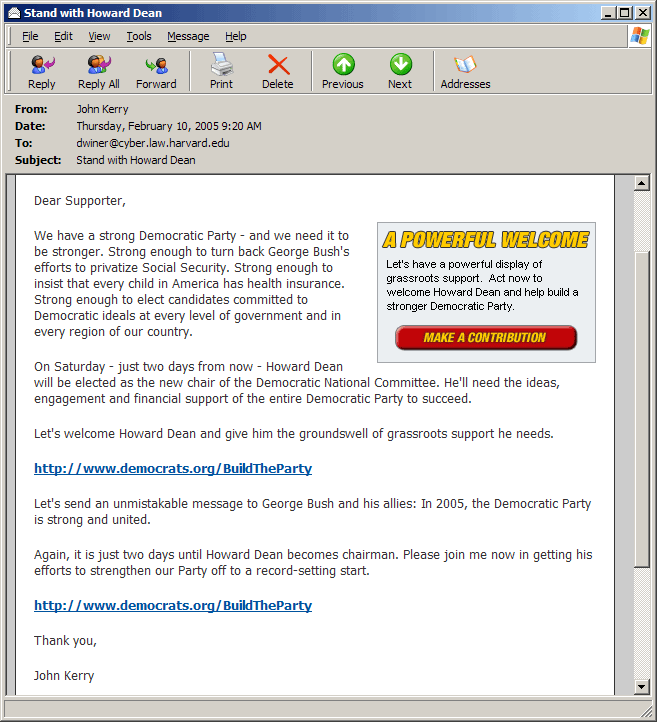
Thursday, February 10, 2005Quick review of CNET's Newsburst app, pointed to yesterday. There seems to be plenty of interest, so let's do a Scripting News brunch in Chapel Hill on Sunday, 11AM. Location TBD. Here is an example of the News-Record editorial staff asking for community input before finalizing its editorial. Okay this is when it officially got totally out of control. An executive at General Motors is podcasting. Great new Gene Kelly car ad mashup at Canter's. How do they do it? Steve Rubel: "The moves that CNET, the LA Times, the Guardian and the others that follow will have profound impact on PR." Another way of looking at the River of News approach is conveyor-belt sushi. Works the same way. Feeder is an "application for creating, editing and publishing RSS feeds." Matt Haughey has a clip from last night's West Wing where Christopher Lloyd played Larry Lessig. I didn't know that Lessig helped Belarus write its constitution. Is that true? Professor Lessig comments on his WW fame. One of his former Harvard Law students is a writer for the show. A weird email from John Kerry asking me to "stand by" Howard Dean. I had to think twice to realize that John Kerry is just a Senator now. NY Times: "There may be some truth to the old idea that people can be scared to death or die from sorrow like characters in a romantic novel or a country song." Newsburst CNET's new centralized RSS reader, Newsburst, is unremarkable except for the fact that it's a reader that's branded by a leading news organization that's also a leading supplier of news via RSS. As a piece of software, it's very unimpressive, and even as a power play, it's unimpressive. But the potential is there, and other news organizations should be thinking seriously about following suit, and upping the ante. Imagine putting your best news, with links to pages with your ads on it, in the right column of a River of News style aggregator with all your competitors' news on it (and weblogs of course, thank you). Now the readers no longer need to go to your competitors' home pages, you've just given them an incentive to come to you to get news from them. All of this is perfectly legal in the world of RSS, and it's likely to cause some serious rock and roll in the news business when one of these guys steps out and gets gutsy, and offers the users something really tasty and useful. If you want to do this, let me know. (Hint: I'll be pretty close to Atlanta on Monday. Bottom-line: Aggregator software and the news business, looking forward, are very tightly bound. Every major media company is going to want to have an advantage in this area. Greensboro in a podcast Last night I led a discussion, BloggerCon style, with about 30 people at the News-Record offices in Greensboro, NC. It was a broad group, an open meeting, including members of the community, many bloggers, staff and management of the News-Record, the editor in chief and the managing editor of the paper. Greensboro is a small city in north-central North Carolina. The News-Record serves Guilford County, where Greensboro is located, and the adjacent counties. It's the third largest paper in North Carolina, owned by Landmark Communications, based in Norfolk, Virginia, which owns a string of newspapers, and The Weather Channel. It's a privately held company, thought to be very profitable. The News-Record itself is generally thought to be very profitable as well.
Hearing them talk about adoption of technology isn't much different from what you'd hear in a conference room in Silicon Valley or Redmond. "If we don't move, someone else will get there first," says Lex Alexander, the editorial director of the News-Record's online efforts. Last night's meeting was open, there were two reporters from the Winston-Salem paper, down the road, a smaller affair than the News-Record. Another observation: I never once felt the urge to explain how the mainframe guys failed to heed the call to personal computers. Greensboro decided to embrace citizen journalism by becoming citizen journalists. I'll have more comments in the next few days and weeks, for sure. My meetup yesterday is being followed by a meetup on Sunday with Dan Gillmor, and Jay Rosen of NYU is making the trek down to Greensboro soon, so there will be lots of triangulation. Today's podcast was recorded by Brian Russell of audioactivism.org. Many thanks! Recall this cartoon from last summer's DNC. It seems so long ago. Toward the end I was asked of the origins of podcasting, so I rambled for a good 15 minutes. Give the boy a bit of rope...
Wednesday, February 09, 2005Great meeting tonight at the Greensboro News-Record, talking about blogging at the community, the newspaper. We'll have an MP3 of it in the morning. Everyone who's interested in blogging on a local level should catch the discussion. Steve Rubel: CNET to Launch Web-based RSS Reader. Here's what Scripting News looks like in their reader. Press release: WNYC Radio Launches Second Podcast. Podcasting News has a story about a new ASCAP license for podcasts. I don't understand what the deal is. $288 buys you what? If you have an idea, please post a note here. One of the strangest blog posts of all time. "Professor Lessig, portrayed by Christopher Lloyd, is in tonight's episode of The West Wing."
Sylvia Paull is a Natural Born Blogger, who, until today, did not have a weblog. Carly Fiorina has resigned as Hewlett-Packard CEO. You may wish to sign the Easongate petition. Eason Jordan graced the pages of this site in April 2003, when it was revealed (by Jordan himself) that CNN was tilting the news toward Saddam to protect the lives of CNN staff in Iraq. Eliot Spitzer is running for Governor of New York. On his blog it says: "To listen to an audio podcast of Eliot's remarks, simply connect your iPod or MP3 player to your computer and subscribe to the RSS feed within Eliot's blog." The feed is cool, it has an enclosure, all is well. CSM: "Suffering from 'pure boredom' while working as a features writer for a North Carolina newspaper, Rachel Mosteller began keeping an online journal." Jeremy Zawodny's account of the firing of a Google employee who blogged too much. Knock wood, praise Murphy I think I now have a good Internet connection, at least for the next couple of days.
Tuesday, February 08, 2005Sorry for the lack of updates, the hotel I'm in is supposed to have wifi, but it doesn't work. I'm updating from the Cone house in Greensboro. Across the way is Elijah Cone who has his own blog, which he is updating as I write this. "You should say that I'm only 13," he says. 2:50PM Eastern: Arrived safely in Greensboro. Sorry to hear that The Gillmor Gang is going on hiatus. It's a fixture in my week, and the gang is really just beginning to be good. Feeling quite a bit better. Today is a travel day, from DC to Greensboro, NC. Weather looks good. All systems go. BBC article on the Ask Jeeves acquisition of Bloglines.
Monday, February 07, 2005The Independent chose this site as one of their 12 best blogs. I loved what they said about me, and the blog. Grouchy? Sure, why not.
RSSWeather now has OPML support. This is going to get very interesting when my new outliner ships. Of course it loves OPML. And RSS. Frank Barnako at CBS Marketwatch says that bloggers won't keep secrets, citing the story on Mary Hodder's blog about Ask Jeeves buying Bloglines. Funny thing is, reporters aren't supposed to keep secrets either. In the old days they'd call this a "scoop" and reporters would work hard to get them.
BBC: "Ellen MacArthur is confident she can successfully complete her round-the-world trip in record time." Taegan Goddard reports that Deep Throat, the confidential source behind the Watergate scandal, is ill. A heads-up about an upcoming server change. Since I'm not pursuing a podcasting business with Adam Curry, he's going to move his sites off my servers, on or before the end of this month. That includes ipodder.org and curry.com, but not audio.weblogs.com, which will remain on my server. After the transition, ipodder.org will be hosted on one of Adam's servers, and he will be responsible for its performance. I will continue to host The Dawn and Drew Show for the forseeable future. Sorry if this is confusing. Thanks to Susan Mernit for the pointer to Lisa Williams' fabulous 4 minute tour of podcasting. She says it's an instant classic, and it surely is!
Sunday, February 06, 2005CareerBuilder.Com is building momentum. Best commercial so far: GoDaddy.Com. AP podcasting article. No new angles, and all the usual bs.
Is Mary Hodder brilliant or what? She and her friends go for a hike in the Los Altos Hills while TiVO records the SuperBowl. When they return, skip over the football and watch the commercials. Read that twice. Thanks to Chris Pirillo for the pointer to iFilm's Super Bowl Ads site. Five years ago today, Amsterdam and Boston street pictures. Today's first-ever Scripting News brunch A partial list of people who participated. Doppler Radio 2.0 is out. "Doppler 2.0 is a different story." Be sure to check out Nimiq, a podcasting client from the Netherlands. Scripting News brunch It was a very nice meetup, one of the best ever. I attribute the success to six factors: 1. Manageable group size, exactly 10 people were there. 2. Private room, easy to hear everyone, even if they were sitting at the other end of the table. 3. During daylight hours, everyone was awake. 4. Buffet style eating, means not too many interruptions from wait staff. 5. Very reasonable price and great food. 6. Great people!!!
Saturday, February 05, 2005Okay, it's time to make up our minds about tomorrow's brunch. Mary Hodder has a scoop -- Ask Jeeves has bought Bloglines.
Spent the morning at the Holocaust Museum. It's going to take some time before I have anything to say about it. Okay, here's something to say. Three countries distinguished themselves, by being occupied by Germany yet protecting their Jewish populations from extermination. The three countries: Denmark, Italy, Bulgaria.
Friday, February 04, 2005A driving coffee notes podcast with music, toll booths, and feeling!
Congrats to Jay Rosen on his new book deal. 3:30PM Eastern: Arrived safely in DC. The discussion about Sunday has settled on an 11AM geek brunch instead of a dinner. Makes sense to me. Today's feature is Pictures from the Top 100. As it reads feeds, it adds the pictures it finds to the list on this page, linked to the post. Interesting that gadgets have taken over since I last watched this readout.
eWeek: "The city of Philadelphia will release details of its wireless expansion plan next week. The plan, according to city CIO Dianah Neff, is to cover the entire city from downtown to local neighborhoods with low-cost, wireless broadband access." Three years ago today, a remembrance of Davos 2000.
Jasperjed: "He doesn't get the kind of recognition that includes gratuitous magazine covers because his ideas are disruptive." Thanks! Podcast Tuner is "a podcasting tool that does everything you wish the others did." Mac only.
Thursday, February 03, 2005Harvard Gazette report on the Credibility conference. News & Record: Dave Winer's coming! And you're invited! A place to discuss Sunday night's dinner in DC.
Danny Sullivan on MSN's feeds & Bill Gates's memo on interop.
On this day in 2001, RSS 0.92 got a new element: category.
Starting with the basics, feeds.scripting.com has a "River of News" style aggregator, subscribed to all the sites that have ever been in the Top 100 most-subscribed-to feeds. Basically, instead of having to hunt for new stories by clicking on the titles of feeds (the standard way readers work) you just view the page of new stuff and scroll through it. It's like sitting on the bank of a river, watching the boats go by. If you miss one, no big deal. You can even make the river flow backward by moving the scollbar up. Pito Salas is playing with social networks and aggregators.
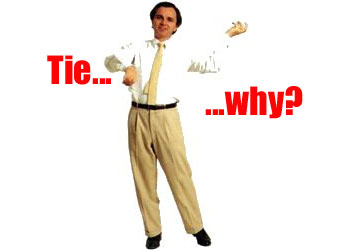
Here's another top-xxx list that leaves out most of the people who should be on it. They're talking about key innovators in the last 15 years. Let's see, 15 years ago is 1990. Uhh, shouldn't someone from Microsoft should be on that list? Why is Dan Bricklin there? (I know, everyone likes him, but his innovations were in the late 70s, not after the early 90s.) What about TBL and his colleagues at CERN? Ben and Mena? Yes, they sure are cute, but they're copiers, not innovators. How about Jean-Louis Gassee and the people of Be? Otherwise the list is interesting, and surely helps the Demo conference promote, because their main participants are secret until the show. And it's absolutely great to see Stewart back in the emcee role after passing off to David Coursey so many years ago. (BTW, if you're premiering a product at Demo and want some advance publicity let me know. I love sneaking stuff.) What's the story with ties? It's one of the few (only?) pieces of clothing that appears to serve no functional purpose. Why do people wear ties? Do you wear one? Why? Do they hold something up, or together? I never wear ties, and I don't think I'm missing anything. Am I? Straight Dope: "The wearing of neck cloths dates back at least to the time of the Roman legions, when soldiers wore a neck band to catch the sweat or block the cold, depending on the season." New York pictures and movies Pictures taken in Times Square this afternoon. Movie #1: Watching television at home. More movies: Watching television in Times Square. One more Times Square TV movie. Lexington Avenue downtown local, pulling into Grand Central.
Wednesday, February 02, 2005I'm not watching the State of the Union tonight. I'll read about it tomorrow. Instead I'm going to read Philip Roth's new novel about a US where FDR lost the 1940 election to Charles Lindburgh.
There's a bit of buzz about social networks and RSS aggregators -- I wondered if they were similar to feeds.scripting.com. I haven't looked at the application in quite a while, but it's still running. I'm going to check out its features over the next few days and point to them as I do. We're coming around to the one year anniversary of the site. 1PM Eastern: Next stop New York City. (Arrived 6PM.) Rogers Cadenhead: "Jacksonville is a foul-smelling city." Julie Leung responds at length to the NY Times article about parents blogging about their infant children. When everyone is media, no one is 1. Everything these days is media. 2. All media is technology and vice versa. The convergence everyone was buzzing about in the early 90s has happened. It's behind us. There is no separation between media and technology. 3. Professional reporters all work for media companies. And they all work for tech companies. 4. Professional reporters won't criticize their employers. Ask any reporter. Could you run a story about your employer that was negative? If you can actually get them to answer the question, the answer is no. Most likely they'll deflect the question by saying something personal, about you! These are the same people who wax endlessly about accountability in politicians and leaders of tech companies. But for some reason they never seem to challenge the leaders of media companies. (Sorry for the sarcasm, they don't because they'd be fired if they did.) 5. But even tech companies are media these days. Check out this bit on Engadget about Microsoft, iPods, the Microsoft music store and Scoble. Scoble is media. Just ask him. He'll say yes. And there are things he won't say about his employer. (Disclaimer: He's my friend.) The music store is media too. 6. Microsoft employs reporters, lots of them, at MSNBC. 7. Any reporter who won't criticize his employer, also won't criticize his employer's competitors, because they could be his next employer. 8. Basically reporters can only criticize people who will never employ them. That's why their role is shrinking all the time. Wait until Best Buy buys out Engadget. Eventually reporters will only be able to take shots at bloggers, and probably Microsoft (because they seem to put up with it). Don't try criticizing Steve Jobs, or even talking about him until he's ready for you to. 9. In the end we'll all be bloggers, because the idea of a media company will seem as silly as the idea of a telephone company will be in a few years, or an airline is today. A heads-up I keep getting emails from people who assume I'm doing a podcasting business, and this is reasonable, since last time I spoke publicly about it, I was. So here's a little news. There may be businesses in and around podcasting, and there are certainly areas where I would like to make a contribution (more on that in the coming weeks), but I'm not going to be part of a podcasting business any time in the immediate future. My current thinking is that podcasting is part of what I'm doing, but not in itself a business, or not one for me. But I'll wait for a few days before explaining my thinking, so as not to confuse. A long-winded acceptance speech Dragon Gathering names Scripting News Blog of the Year. Thanks! Interesting timing. I was thinking of starting a club, all the blogs that weren't nominated for a Bloggie award. There are some pretty good ones. Now that the begging and pandering for endorsements has reached the fevered pitch of an NPR pledge drive, wouldn't it be interesting to see a list somewhere of all the blogs that weren't nominated. (And thereby retain some dignity.) And then Daniel Bushman gives me that award, and gets me thinking. His award actually means much more to me, because he gets who I am. Read his story. When software works, paradoxically, people don't think much of it. That's exactly what we should be valuing in software, imho. Anyway, yesterday I spent the day working on my open source outliner. It was a lot of fun, a throw back to getting Frontier ready to ship in the early-mid 90s, but different, because I'm sketching out something simple and user-oriented, like ThinkTank or Ready (not quite as broad as MORE). I was really enjoying it. The more users I can connect with, I think the more I will enjoy it. A long-winded wait for a haircut While I'm still in Boston I went for a haircut at the place I used to go while I lived here. This time there was only one barber on duty, so I had to wait while two people who were ahead of me got their hair cut. So I read the magazines, one trashy and one, by comparison, not so trashy. The trashy one, The Star, reminded me of Andrew Orlowski at The Register. I generally try to avoid reading his articles about me, where he calls me Harvard Man (btw, I don't work there any more, Andrew), but I do occasionally see quotes from his pieces on weblogs. Anyway, in case you're reading this Andrew, I didn't think Madge Weinstein was born female. You could have called me to verify, or sent an email. I understand from NY Times managing editor Jill Abramson that real reporters verify stuff before running it. Had you checked, I would have explained that I lived in the San Francisco Bay Area for 22 years. I've seen my share of transvestites. My image of Madge, before I saw a picture, was of a short, stocky Jewish guy with a five-o'clock shadow, dressed in a mini-skirt and a blonde wig smoking a cigar. An image derived from the Hyakugojyuuichi shockwave that was floating aorund the net for so many years. What bummed me out was that Madge was an imitation of that, not an imitation of a woman. Anyway, I wouldn't say anything at all, because I assumed that Orlowski was an imitation of a reporter, but I learned at a recent conference at Harvard (he could be called Harvard Man, actually) that he wants to be taken seriously! The longer you live the more amazing the world gets.
Tuesday, February 01, 2005Mark Glaser follows up on the open archive issue discussed at the BJC. Unlike other sites that were nominated for a Bloggie award, Scripting News doesn't tell you who to vote for, or even hint at who you should vote for. Vote for anyone you like. We respect your right to choose. I knew something didn't feel quite right about Google's "Founders Award" that John Battelle is fawning over. News.com: Google gets rights as Web site registrar. My chin dropped when I saw my miserable little quote alongside those from such bastions of wisdom as the NY Times, AP, News.com. If I had known, I would have said something intelligent! (Nahh.) Better Bad News satirizes a "recent conference examining blogging, credibility and journalism." Hilarious. Reading this ZDNet page, you'd think Yahoo had the main or dominant or first or best aggregator. Hey if enough people play that way, you know what, it'll happen (all but the last two). Hey I didn't think of ego-surfing MSN's new search until Boing Boing's Xeni Jardin did it (it suggested "bling bling"). Hey you gotta love a search engine that thinks I'm the #1 Dave, and my RSS is the #1 RSS. It's also pretty smart in figuring out that I don't really own John Doerr. Postscript: I may not own John Doerr, but I do own Phil Ringnalda.
I just tripped across this old tutorial from the very early days of scripting.com. Wired piece on "folksonomies." BBC: "Microsoft is keen to make its home-grown search engine a significant rival to Google." Fawning: "To exhibit affection or attempt to please, as a dog does by wagging its tail, whining, or cringing."
|
 
|
||||||||||||||||||||||||||||||||||||||||||||||||||||||||||||||||||||||||||||||||||||||||||||||||||||||||||||||||||||||||||
|
© Copyright 1997-2006 Dave Winer. Previous/Next |
|||||||||||||||||||||||||||||||||||||||||||||||||||||||||||||||||||||||||||||||||||||||||||||||||||||||||||||||||||||||||||






 Marissa is saying something very important when she says she's providing features for users. She's telling you that Google doesn't see authors and publishers as a constituency they need to be concerned about. You're not even a third party, it may be your content they came to read, but only Google and the user matter. (And I suspect users don't really matter, except to the extent that Google can sell their attention to advertisers.)
 The local NPR



 I had a long phone talk this evening with
 Draft:


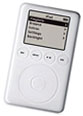 For five hours this afternoon I was convinced that I had lost my iPod. It was very emotional. Really bummed me out. I kept going back to my car and looking in different places, amazed that it was nowhere to be found. On my return from my afternoon walk, I looked one more time, and in exasperation, I leaned on the car, put my head on the roof, and took a very deep agonized breath. I opened my eyes and couldn't believe what I saw. There was the iPod on the roof of the car! Un fucking real. I had put it on the roof as I was getting my stuff out of the car and into the hotel, and had forgotten to put it in its pocket in my napsack. That it was still there was amazing. The sucker is charging now. I really was feeling lost without it.


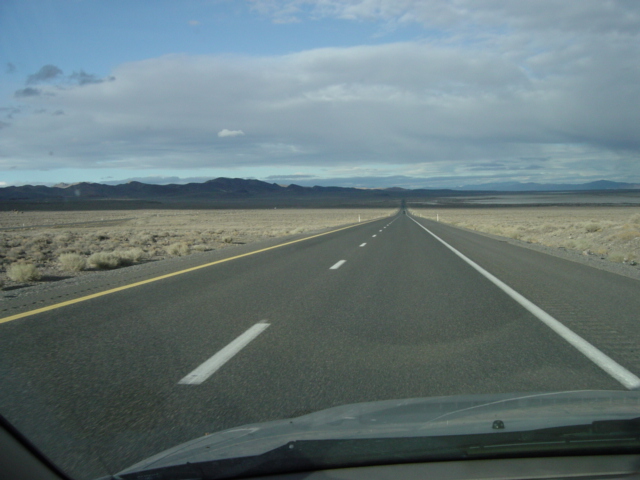
 Four years ago:
 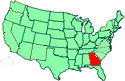 BTW, it's great to see how many people are including
  I don't use any toolbars, Yahoo, Google or otherwise, so I don't have any first-hand experience with the new feature in the Google Toolbar that
  Yesterday I had a meeting with about a dozen editorial people at the Herald-Journal, to talk about blogging. I had prepared the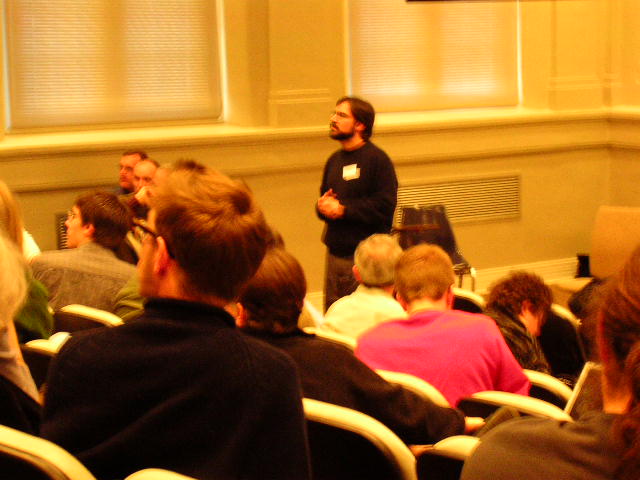
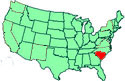 Yesterday and today I'm visiting with the

 At 4PM Eastern, I'm back in my hotel, the conference is over. On balance, it was lovely. A room filled with a mix of bloggers and newbies. Lots of journalists. I'd guess a little over 100 people. Heated discussions. Warm weather. Ed Cone is a great moderator, much more relaxed here among his own people. Lots more to say later.
  Ruby Sinreich of
 There's been a lot of buzz outside Greensboro about their move to citizen journalism using blogs. They have some big plans, but still most have not been implemented at this time. For example, the managing editor plans to document her choices for the front page in a blog. The editor of the editorial page wants to discuss his thoughts before the editorials run in the print paper. These are remarkable ideas to hear from professional journalists, and very visionary, and just some of the ideas we discussed last night. Now actually doing these things will make the difference, other publications argue that they can't document these things publicly, but you don't hear those arguments in Greensboro, quite the opposite, they welcome the ideas, and once implemented they will have an unprecedented degree of transparency, and should earn (and deserve) more trust from the community they serve.
  I just booked my




 Correction please. I don't mind if
 I made my travel plan for the next week or so. Tomorrow I drive to Washington, spend four nights, and would like to do a Scripting News dinner on Sunday night, after the Super Bowl. Then I spend three nights in Greensboro, North Carolina, going to school on their citizen journalism project. On Wednesday the 9th I'm going to lead a discussion at the News and Record, with bloggers and pros, 7PM at
  South Carolina newspaper owned by the New York Times. Andy is doing some very innovative hush-hush stuff that I want to help with. From there, somewhere I can be a programmer-in-residence, where I can do some focused work on my new outliner.
  One critique of the aggregator developer community is that they don't steal each others' (good) ideas, that's why most of them suck, and most users aren't getting much benefit from using RSS. Seriously. It's one of the paradoxes of our time. I know that Mitch Kapor used VisiCalc, for example. Steve Jobs visited Xerox PARC. Bill Gates used a Mac.
  But before I do that let me tell you a story about my friend Dave Jacobs, a Jew from San Francisco with a new kidney. In all the time I've known Dave he's always been known as Big Dave. Nowadays when you ask him how he is, he says Great! That's new behavior. He's never been the kind of guy to say he feels excellent. That's probably because he's always had bad kidney disease, that just kept getting worse. I guess he still has kidney disease, but now he's climbing hills in San Francisco and saying he's doing great. So when you
  The server that was causing so much trouble yesterday has