|
||||||||||||||||||||||||||||||||||||||||||||||||||||||||||||||||||||||||||||||||||||||||||||||||||||||||||||||||||||||||||||||||||
Monday, October 31, 2005MarketWatch: Microsoft to push into Web software. Today's developments in OPML-land.
I was observed live-blogging at TagCamp on Saturday. Another interesting OPML feed, this one is dynamic, in that it changes every day to point back in time to Scripting News on this day in 2004, 2003, 2002, etc. Seattle Mind Camp is a camp-like event, following in the tradtition of BarCamp, and this weekend's TagCamp in Palo Alto. They have an OPML feed listing the RSS feeds of the participants, which I've included in the Community Directory in the right margin on Scripting News. Kevin Burton on the OPML Validator.
Sunday, October 30, 2005What if Scooter Libby were a guest on Law & Order? Scoble, before the XML geeks swoop down and start picking this to death, the point is that, as a non-technical user, you're right to insist that RSS work well for your users. You want to provide them with full feeds, you want to be able to view your feed, and have some idea of what's going on when you look. That's what I get from your message. Weird things like CDATA, while they're valid and definitely not funky (in a technical sense) are confusing. I support you in what you want, although other techies will say there's no reason for the technology to be transparent to you, I disagree. People don't use things they don't understand, and it's certainly possible to do it in a way that you can understand, without giving up any of the power and depth that geeks like so much. I'd also be happy to work with Matt to make you happy. I'm pretty sure I know what you want. Keep on truckin. Dave Pito Salas on his experience with the OPML Validator. Linux World: "Just as the inventor of the automobile doubtless had no intention of facilitating the one-night stand, neither did Dave Winer set out to foment Reckless, Stupid Syndication." We need a beautiful icon for valid OPML. Norm Augustinus has some good OPML badge material! Amyloo has an animated badge for OPML. Nice. Kosso's is the prettiest so far. Every once in a while I remind people that there's a PDA version of Scripting News. Nick Bradbury's comments on the OPML Validator. Mike Arrington's first podcast, recorded at TagCamp. I had trouble sleeping last night, so I stayed up to watch the clock go from 1:59AM to 1AM on my Mac. Maybe I couldn't sleep because I watched Monster's Ball, an excellent movie that started on death row, but in the end was a beautiful romance about redemption and forgiveness. Excellent acting by Halle Berry, believe it or not. Highly recommended. Okay, another thing I did while I couldn't sleep was buy a new toy at apple.com. A dual CPU, 2.3Ghz, 2GB RAM, 500GB drive, 23 inch cinema display. About $5K. It should be a pretty nice computer. And I deserve it. The people of the pod Cyrus Farivar (pronounced suh-roos far-ih-var), the author of the original NY Times podcasting piece, reminds us that Anne Eisenberg's From Your Living Room was the fourth NY Times piece on podcasting. True, but it's still a good thing that they ran it, because it's getting closer to the real story of podcasting, the people of the pod. Look at who they wrote about. Not Tod Maffin, but his wife Kim who is podcasting about MS, and providing comfort and information to thousands of people who are afflicted with the disease. Lisa Williams, who did the kickass tutorial about podcasting, and does a weekly show about the meals she prepares for her Watertown family (Lisa is a regular at the Berkman Thursday group, we've worked together a bunch of times). Michael Geoghegan, a largely unsung hero of podcasting, who does an excellent movie review podcast, Reel Reviews. Eisenberg set out to learn how people make media that was previously thought to only be accessible to corporations with millions of dollars to invest. While Cyrus wrote the initial milestone piece, announcing the exciting beginning of a new technology with potential to become a medium, which, in a very short period, has. Even so, next year, and the year after, we will have to take another look at where podcasting is, and let's hope the Times continues to run a string of insightful slices in time that give us a realistic look. Even the Markoff puff piece about Silicon Valley's visions of podcasting profit, was worth it, in hindsight, if only to see the Times getting back on course with this piece about the people of podcasting. Emphatically, we are not a get-rich-quick scheme for serial entrepreneurs looking to flip their pre-IPO Web 2.0 Ajax web-app bubble-ware for the Long Tail. We are people with hearts, lives, families, aspirations, hope and something to say. That's by far the more interesting story, and it has legs, it's going somewhere, unlike the tail, which is a vestige of times gone by, when you could count on people to be idiotic couch potatoes, ready to be harvested by advertisers with their intrusive and mindless "messages." The baby of the pod When I was in Toronto in July, I had dinner with Shannon and Ray Slakinski. Ray is co-author of iPodderX, one of the first podcasting clients for the Macintosh (and now Windows too). Shannon was visibly pregnant and due in November. Aidan McLaughlan Slakinski was born on Oct 23, a few weeks early. Here are some pictures of the baby and the proud family.
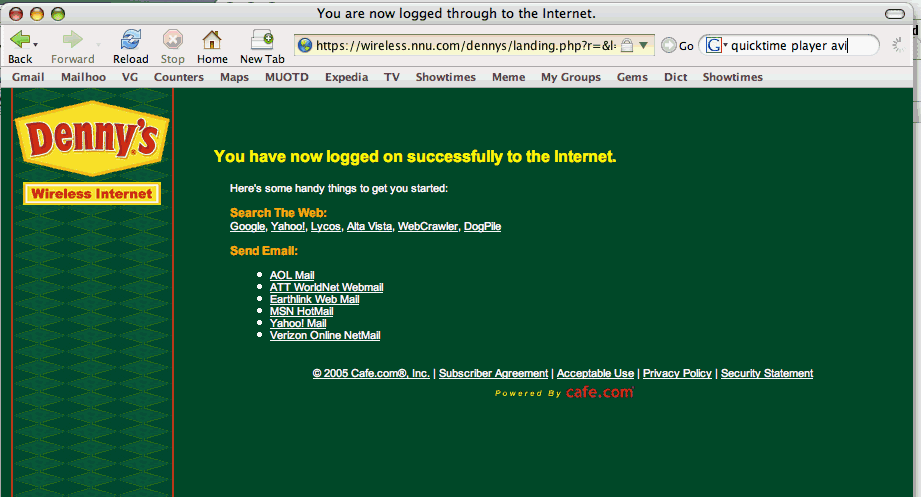
Saturday, October 29, 2005In tomorrow's NY Times: "I love podcasting because it turns us all into investigative journalists of our own lives." "Investigative journalists of our own lives" was something I was saving for a special occasion, and I think Anne Eisenberg did a great job, and it was especially nice to have my parents included in the story because the podcast I did with them is one of our favorites. It's a family thing, and that's what makes the new medium so great, you can experience things here that you can't experience anywhere else. It turns us all, if we want it to, into media hackers. An update to the OPML validator to fix a bug, a new test case, and the beginning of a roadmap. Great pic of Mike Arrington. Rohit shares his philosophy of mail lists. Great teeth! Adam Marsh explains the Long Tail in a graph about tags. Biz Stone explains what it's like working at Google. Tara explains Riya, but try not to look (stare) at her T-shirt. Dalton Caldwell talks with Rohit Khare about semi-permeable blogs and podcasting. Next Mac question. Can I configure iPhoto to write selected pictures to a folder? That's the key to my CMS. Or maybe there's a command that does it? The "Long Tail" makes me want to barf. I'm not in anyone's tail. I'm a head, a heart, if I must choose an organ, kidneys or lungs. Anyone who calls bloggers a tail of anything has his head up his ass. Anita Wilhelm in the spirit of TagCamp. Dave McClure is pimping SimplyHired.com. Danah Boyd pauses for lunch at the camp. Rohit Khare is complaining that the picture I took of him in Amsterdam is not the number one hit for his name. Denny's has excellent free wifi. Next Mac question. Where do you get the codec needed to get the QuickTime player to play AVIs? I'm going to be at TagCamp again this morning. Last night was fun, lots of old familiar faces. Funny that Computerware has been replaced with a Quiznos. I guess there's something symbolic about that, but I don't know what it is. Kin Rowan takes a look at the OPML Validator Beta. A bunch of comments on the validator, bugs reported. Hey we're having a Old Farts Genius Network breakfast at Denny's in Palo Alto, tomorow at 9:30AM. You don't have to be a club member to join the party. Don't forget to turn your clocks back tomorrow morning.
Friday, October 28, 2005Okay, here's the first beta of my OPML Validator. I've been crunching on the validator to announce in time for the Tagcamp meetup, tonight, in Palo Alto. It looks like I made it. Hey! We're back in business. Now this one is very very geeky, but much in demand. Guaranteed to be popular. But it's beta, that means you shouldn't depend on the results. "Nice and easy does it, every time," sings Shirley Horne. Photos from last night's Nashville blogger meetup. I saw this iPod vending machine on Concourse A in Atlanta's airport, and like Gizmodo, I wondered how it would work. Buy a blank iPod just in time to hop on a flight? Hmmm. Maybe it'll make sense when they come up with a wifi-capable iPod, because the wifi on Concourse A is pretty good, especially near that machine. Dave Slusher: "The only people I ever hear talking about how the public won't listen to anything but slick programming are people that produce slick programming." Amyloo is impressed with VeriSign. Mike Arrington's new stream Most of you know Mike as the editor of TechCrunch, a phenomenal new weblog that tells the story of new web services, written from the heart of SiliconValley. I met him for the first time in a meeting in NY, in May, when we got together to talk about the sale of weblogs.com. Today Mike starts a new blog, called CrunchNotes by telling the story of how TechCrunch got started. He credits me with being an inspiration, and if it's really true, he's taken it so far and done it so well, all the credit belongs to him. Really. What he says is so true. Too many software developers wander into the market without knowing what's been tried before, what worked, what didn't. Often the users know more about the history of the category than the designer of the software. What Mike does, by writing up every product and service that he sees, is the beginning of a process that we must develop; but is itself a revisit of something that used to be done thoroughly and systematically, but because of the quick pace of boom and bust in the tech business, is an art that now needs to be reinvented, a bootup that's actually a reboot. Mike is a lawyer. Laws have precedents. When it was thought that Harriet Miers believed in a constitutional right to privacy, many inferred that she was a choice advocate. One position implies another because legal decisions are based on previous decisions. Sometimes a higher court changes direction and overturns a precedent, this is necessary because the context changes over time. It's true in technology too. In 1985 we designed software to run in 640K; today my machine had more than 500 times that amount of memory, but in order to make it run adequately, I had to double it. Laws that made sense in 1985 clearly need another look in 2005. In software, I call this system of precedents design by prior art. To really make it work, we need to go back and scour the past for lost art. It's not enough to just chronicle what's coming online now (although I'm glad we're doing that). Maybe the next step is for Mike and I to visit Michael Miller, who, as editor-in-chief of InfoWorld and then PC Mag (where he still is, I believe) put in place a system for looking at software over time. That was a system of prior art in software. There's another reason it's a good idea to study the past in software -- anything that was designed or implemented before software patents forms a prior art defense against the patent system of the 21st century. Mike, being both a lawyer and a student of technology, is in a great position to lead us here. In any case, congratulations to my friend Mike, for doing this work so well. It's great when someone so talented and motivated finds something that suits him so well. How lucky for him, but then we're lucky too, because we get the full benefit of his brilliance, without having to do the work!
Thursday, October 27, 2005Is there a way to run Mac OS 9 apps on Mac OS X?
Tagcamp is tomorrow and Saturday in Palo Alto. I think I'll book a room in Palo Alto and go hang out with the campers. Maybe I'll provide the music. "Go to the mirror boy!" For 18 points, guess the significance of the location. Kevin Burton: "Here's one of the things that bothers me about AJAX." 1/4/01: "In the centralized model for the Internet, your browser makes requests of a server that could be very far away, or slow for other reasons. Now imagine that the server is very close and you don't have to share it with anyone, it's yours and yours alone. It would be fast!" BBC: "People are underestimating what Microsoft is doing with search technology, says Bill Gates." Harriet Miers withdraws Just heard this on NPR. Harriet Miers has withdrawn as a Supreme Court nominee. Fascinating. Can't wait to see how Bush moves. AP story on MSNBC. Science, art, voodoo and luck Ben and Mena Trott explain why they're having performance trouble on their Typepad service. Maybe our theory about putting the content management on the workstation wasn't so bad after all. That's the approach Radio took in 2002. After a while it became clear people preferred to have someone else manage the content management for them. I'm sure SixApart will get the problems sorted out, but no one should underestimate how hard it is to keep a service like TypePad running as it's growing. I sure don't, having lived with EditThisPage.com and Weblogs.com. Scaling is a science, an art, voodoo, and more than a little luck, as Ben's story reveals. Perfect OPML I've been working with John Roberts at CNET to make his OPML perfect. All the attributes conform to the validation guidelines, and work perfectly with the OPML Editor. Faster Mac In yesterday's thread where I explored buying a new Mac with a dozen awesome Mac experts. Brian Criscuolo found a way to make my current Mac perform as it was designed to. Here's what I did that made the difference: 1. Create a new user with full Administrator priviledges. 2. Log off. Log on as the new user. 3. Do some stuff. 4. Log off. Log on as the old user. Voila. Fast Mac! Zzzzzip. Amazing. I kind of thought this was an easy to use computer? Oh well. Verdens beste blogger Okay I have no idea what this means, but a big site in Norway thinks Scripting News belongs on a list of ten blogs (pretty good company). Jack Foster Mancilla translates: "The Worlds best blogs. Blogs have taken over the net, and many of them are among the worlds largest websites. See are all the best here, and make your own." About Scripting News: "This blog is written by Dave Winer, an is one of the most influential tech-blogs in the world. Dave Winer is some times a controversia figure, but at the same time he is deeply respected." I asked Jack for context. "This particular article is using the blogs mentioned as examples, for a purpose. TV2 has just launched Nettblogg. That will give everyone who wants one, a free blog space. The good articles from these blogs will be published on the NetAvisen website as real articles."
Wednesday, October 26, 2005Nashville blogger meetup, tomorrow, 5:30PM. A funny bit about White Sox baseball from a Cubs fan. It's something like what a Mets fan might say about the Yankees, except a Mets fan would never, ever, ever root for the Yankees. It could never happen. A fate worse than death! I'm listening to Richard Clarke on Fresh Air. He's fantastic. They should give him his own show. Okay I give up. It's time to buy a new Mac, something in the $3-$5K range. I think I want a desktop. Tell me what to buy, and I'll order it today! I got 9/10 correct on the 8th grade math test. Good thing cause I skipped 8th grade. Next Tues, Nov 1, Microsoft is briefing press and analysts on a new strategy. The two presenters are Bill Gates and Ray Ozzie. Thanks for the invite, I'll be there. Registration is open for Podcastercon, January 7, in Chapel Hill, NC. I signed up and donated $100. The Podcasters In Leather 2006 calendar. Internet Identity Workshop today and tomorrow in Berkeley. Right in the neighborhood. These things really need to get publicized better. First I heard about it was yesterday, and I subscribe to the blogs of a couple of the organizers. Weird.
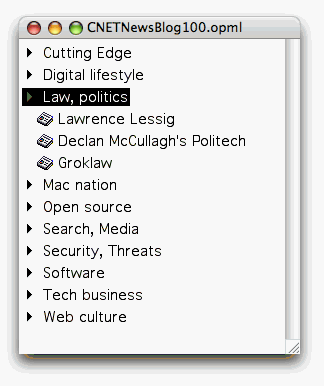
Tuesday, October 25, 2005CNET has an OPML feed for its top 100 blogs. I've linked it in to the box in the right margin.
Yahoo is looking for an RSS product manager. Play an accordion, go to prison. That's the law! I had a really cool idea. I'm going to open a service called Elgoog that scrapes every page on Google and displays it without their ads. Of course to pay for the service I'm going to have to insert my own ads. Fair is fair. Google can opt out if they insist (how clueless can you get) but they have to send a lawyer over to my house and once a lawyer has been used to opt out for one page, that's it, if you want to opt out for another page, you need to send over another lawyer. And if Google complains, I'm going to make the lawyers come over naked, and I won't let Sergey and Larry come to FU Camp. Of course no lawyers are needed if they get with the program and let me have all their content for free and don't whine about it too much. Stanford Daily report on podcasting. Niall Kennedy took a closeup of my Archos while it was recording last night's Morning Coffee Notes. Kaboodle is "the easiest way to get all your web choices on one page!" Dare Obasanjo: "Google is multi-billion dollar, multinational corporation. However whenever its executives speak, they do an excellent job of portraying the company as if it is the altruistic side project of a bunch of geeky college kids." Sleight of hand Watch Alex Macgillivray's hands carefully in this quote from a Wired News piece today. "The world would be a much worse place if the card catalog in a library only contained the books that the publisher had come by and put in," said Alex Macgillivray, an attorney at Google. Of course, that makes sense, you nod your head, how true, but then you realize that the analogy doesn't work. If card catalogs were as good at selling books as Google claims Google Print will be, they'd batch-submit all their publications using the marvel of computer technology (they know how to write scripts in NY too, or in a pinch, they can hire a wizard from California). No one has to "come by" in the age of the Internet. How quaint. And misleading. The likely reason they insist on opt-out instead of giving an inch and letting it be opt-in -- very few publishers would opt-in, and at least some would forget to opt-out. (And, have they explained how opt-out works?) Maybe the publishers want to operate their own search engine? After all, they did pay the authors advances on royalties, and marketed the books, they have a major investment in the books, and Google has no investment at all. (I was reminded of this perspective listening to Tim O'Reilly's NerdTV interview, where he explains why his books aren't freely available, as Richard Stallman insists they should be.) Anyway, like any sleight of hand, the trick is to get you to focus on what's least relevant, and ignore what is most relevant. Another perspective Can you imagine that Steve Jobs got the music companies to let him build the iTunes music store with the kind of legal strong-arm tactics that Google is using with the publishing industry? Second question. If Google prevails, what's to stop them from doing the same with the music industry? I don't doubt for a moment that Google is on a path to compete with Apple in this area. How convenient it would be for them if they didn't have to listen to the music industry. We live in interesting times, folks.
Monday, October 24, 2005Geek dinner tonight in Berkeley, 7:45PM. Mike Kaltschnee: "I post anything I find interesting, and it turns out 100,000 people a month find it interesting, too." 37 Signals: "Google has reintroduced their Google Web Accelerator with a vengeance. It was evil enough the first time around, but this time it's downright scary." Tim O'Reilly: "It's too bad that we can't have a real debate about ideas, rather than cynical rhetoric that creates heat without shedding much light." Niall Kennedy explains how Google supports spam bloggers. Lots of links to yesterday's rambling rant on Silicon Valley.
Sunday, October 23, 2005Listening to Meet the Press today, it's fairly clear that Karl Rove and others will be indicted. A Republican senator, Kay Bailey Hutchinson, was spinning like this: Innocent until proven guilty. She hopes the charges aren't perjury or obstruction of justice, the kind of charges (she says) that you file when you can't prove your primary case. Those also happen to be the charges that President Clinton was impeached on, funny how standards change, eh. Democrat Art Schumer said he would accept whatever the prosecutor decided to do. Sounds reasonable, if you assume he's not partisan, but of course everything he says is totally partisan. So he knows the indictments are coming. This week it was exceptionally easy to read the tea-leaves. The conference website for this week's invite-only Google Zeitgeist conference. If you have a password for the site that you'd like to share, I'd love to take a look. Right now, it's closed. I also sent an email to Google asking for access to the site. Hey if you never ask they can never say yes. Like a BloggerCon In her writeup, Sylvia Paull compares Friday's BBQ to early BMUG meetings. If Woz were there, he might compare it to the Homebrew club that met at Stanford in the early days of the PC. We all have our points of reference. To me, it was like the first BloggerCon. But all these events have something important in common, something that's very much like the web, they are inclusive and open to all. How ironic that a conference called Web 2.0 was invite-only. It's so un-weblike to say who can come and who can't. That's not what the web says. It says anyone can come. Even so, there is a price of admission. To get to the BBQ, or the Homebrew Club, BMUG or BloggerCon, you had to have a ride. To get on the web you have to have a computer and a net connection.
My experience with these shows is that if you trust the universe, it will take good care of you. In all three cases, exactly the right number of people showed up. Every seat was filled, a few people had to stand, there were enough lunches, lively discussions, all the goals were achieved. Now we didn't get people who only come when an event is invite-only, but I say that's good! Those people don't come because they love ideas and want to learn and share, they come for other reasons and they change the character of the event, not in a good way, imho. People who come to open events are true web people -- there's no difference between 1.0 or 2.0 -- it's a constant. You come, like Enoch Choi, to share his story of helping people in a destroyed city (it's a geek story, surprisingly, and a smart one). You come because your three-person startup is achieving success and has big plans for the future, and you want to tell people about how excited you are to be creating something useful, beautiful and empowering. You come because you're young and happy to be alive. Or old and happy to see all the happy young people. You come because this is the good stuff. You come because this is totally 1.0. This is why I came to Silicon Valley in 1979, when I was 24 years old. In Madison there were people writing software, smart people (some) but I wanted to make software at a different level. I wanted to make stuff that changed everything, that opened closed doors, that gave people power that used to only belong to the rich and old. Like an open conference, I needed to give something up to get there. But there was no gatekeeper at the door to Silicon Valley telling me I needed an invite. The door was open because not only is that a value of the web, but it's also a value of Silicon Valley, even if some people usurp that. Later this week Google will have their invite-only Zeitgeist conference. It's as closed as a conference can be. And this is the company we lifted on our shoulders and held up as a shining example of the web at its best. We were wrong to do that, but forgive us for having hope. At some core level Google did understand the web, but there was also a lot about Google that was against the web, and now that's most of what they are. This is the struggle we are constantly dealing with in the tech business. For a while we send up a beacon, a shining star, and it's exciting! Then they forget their values, where they came from, what made it work for them, and we follow them down into bad years. You'd think we could learn, but apparently we can't. Now can we survive their downfall? That's a good question, and one I don't know the answer to. The excitement today has an element of panic to it. In our gut we can see that the growth is likely to end almost before it gets started. We see Google doing what we knew in our hearts they would do, pick fights with powerful industries that we have nothing against. The publishing industry has done more to support my vision that Google ever has, in fact Google has fought me, at a petty, immature level, based on being incompatible, if you can imagine that, where the publishing industry adopted RSS as-is, without trying to change it or break it. They say the publishers are clueless, I think it's Google's management that desperately needs to find its place in the world. I criticize the NY Times, god knows they deserve it, but when I call Martin Nisenholtz, he takes the call, and we work together, in productive ways. This is the east coast way of doing things. It's something Silicon Valley, which is run by immature men, needs to learn. We don't have to agree on everything to work together. In fact we must work together, and honor our differences with respect. There is cause for hope. Google isn't the only act in town. Yahoo could challenge their dominance. I hope they do, and I hope they don't do it by being like Google. Embrace the world instead of picking fights with it. Work together because it's the right thing to do and because it's good for business. Point off-site, share the flow, come to BBQs and BloggerCons, know that the bright eyes of happy independent developers are the source of the ideas that drive this place, and make sure there's always a sense that this place is come as you are, no invite required and totally 1.0 Dowd vs Miller Like Jeff Jarvis, I read Maureen Dowd's column about NY Times reporter Judith Miller in yesterday's paper. I have a few (blunt) comments. 1. This is why the Times needs a blogger columnist on its op-ed page, to catch situations like this long before they melt down at the level the Miller case has melted down. And I don't mean a columnist with a blog, I mean a blogger who is given regular space on the op-ed page. 2. If you think this is an unusual situation for the Times, think again. We know that at least some Times reporters aren't actually reporters any more than Miller was, they have the hubris to think they should shape the events they cover, that their point of view is what matters. I tried in so many ways to explain this at the Blogging, Journalism and Credibility conference at Harvard in January of this year, but the Times editorial people, as always, dismiss this criticism with arrogance. This is going to cause more problems in the future. People outside of the Times can see the problem more clearly than your insiders can. 3. Bravo to Dowd for seeing that her position can help the Times by getting them to think. 4. Please publish her op-ed outside the firewall (try the front page) so we can point to it.
Saturday, October 22, 2005For 25 points, who was Jim "Mad Money" Cramer's college roommate? We're having a geek dinner in Berkeley on Monday evening, October 24, 7:45PM at Fellini's on University and Acton, to honor our guest from up north, Robert Scoble. Click here to RSVP. Tara Hunt got a picture of me with Mike Arrington. If you look closely you'll see my fly is open. (Actually you don't have took that closely.) I've gotten a few requests for an MP3 of my talk last night. If you know of a recording, please let me know. People were surprised last night to find out that I own tagcamp.com and tagsr.us. It turns out Matt owns blogsr.us. I suggested we do a JV, with Bessemer capitalizating an LBO of SixApart and Technorati. We all had a good laugh. Using simple arithmetic, Cringely illustrates how exuberant Google and its competitors are. "That's a heck of a lot of ads," says he. Jake Savin explains how UserLand's products implement OPML. Last night's TechCrunch meetup in at Mike Arrington's was awesome. There were easily 200 people there. Incredible energy. Very Gnomedexish. I gave a kickass keynote if I do say so myself.
Friday, October 21, 2005Keynote: Build to flip the Flickr of evrything. Carmine Gallo: "If you truly want to capture the hearts and minds of your listeners, then maintain eye contact during your presentation, talk, or speech." Matt Mullenweg is leaving CNET and going out on his own. I hope to see him tonight at the TechCrunch BBQ, and we're having dinner one night next week. I've got a bunch of ideas for things we can do together.
Wired News takes a look at Memorandum. Of course I discovered the article on Memorandum, which tempts me not to point to it, unless I have something to say. Now having said it, I can stop, because no doubt Memeorandum will link to this witless and information-less post and at the same time will move the Wired News article up the ladder. Meanwhile, my ultra-witty keynote, above, which has only been linked to by TechCrunch (calling it The Flickr of Keynotes), didn't make the grade on Memeorandum at all. I could have sent out emails asking for links and it probably would have shown up, but that seems really tacky. One more thing, people complain the site is too ugly, and there should be a sports version, I have another complaint. The name has too many syllables and it's hard to remember how to spell it, and it's too long, and screws up word-wrap on my posts. Here's a deep probing question. Would people be happier with Flock if it were called Flockr? And am I spamming Memeorandum right now, as I type this? One more question. Is Flock the Flickr of Flocks? Open Media Summit: "By invitation only." Open? Tom Friedman has a fantastic column today in the NY Times about podcasting in China. It's not about making people rich, it's about enabling the people to create media, a very 21st century thing. I can't point to Friedman's column because it's behind a very 20th century for-pay firewall. BTW, congratulations to Evan Williams for finally figuring out that the main significance of podcasting is not that it gives a new channel to commercial broadcasters (which it does), but rather it allows people to create media (see above). My guess is that this epiphany was brought about by a 20-million-ton frieght train called iTunes. Ross Rader advises that Jon Postel died on Oct 16, not the 19th.
Thursday, October 20, 2005Ernie the Attorney is back in New Orleans. Editorial: A turning point for the web? I haven't said anything as Google moved into indexing printed books, but as their spin campaign took shape, my opinion formed. We must realize that Google is no longer the little company we used to love. They're now a huge company that pushes individuals around like a lot of other huge companies. They need some balance to their power. It's ridiculous to blindly take their side on every issue. Sometimes they're wrong, and I believe this is one of those times. Ryan Tate on search engine architecture. Vikas Karmat: "Librarians are typically female, typically are well read, have good English language skills, and typically underpaid. The programmers are typically male, typically have poor writing skills, spell poorly, and are overpaid." Interesting. Now I know why I like librarians so much. Let's see. Yes, I am male. I think I write fairly well, and I have almost-perfect spelling. Until a few weeks ago I'd have said I was grossly underpaid, but then I had a really nice payday, so I don't get to complain about that anymore. A tear and a cheer Today marks the passing of an era, in a way. In late 1999, I wrote an application called subhonker2, that caused some stir in the then-tiny blogging world. I got an email from Wes Felter saying people were freaking because one of my servers was checking their sites every hour or so (or sometimes more often, the code had bugs, of course). That was the very first incarnation of what was to become weblogs.com. Between then and now there have been dozens of releases of the software, as the network of weblogs grew to thousands and then hundreds of thousands and millions of blogs. And now today, it's not running on my servers at all! I imagine this is how parents feel when a kid finally reaches college age and leaves home. All of a sudden it's a lot quieter around here. Anyway, the three special sub-domains still point where they're supposed to. audio.weblogs.com is showing new podcasts. It looks like VeriSign did a good transition. As we say here when things fall into place: Bing! Sphere pass 1 It's really hard to review a search engine if I can't point to results of queries. Hmmm. Maybe I can. This morning I did a search on "Wilma" in the last day. It's a breaking story, twenty four hours ago it was a tropical storm, since then it has become the largest storm ever observed. Pretty amazing transition. What did the blogosphere have to say about that? This is the question that Sphere claims to answer, because it is a blog search engine. I saved the search result to a local folder and uploaded it so you can look at it, even if you don't have access to the beta site. At the same time, the Politics page on Memeorandum gives a view into the Wilma story in blogs, but not just blogs, the top item that glues the category together is a NY Times article. Anyhow, here's the conclusion. I don't want specialized search engines, I want better search engines. That's the nature of search, I want to go one place, ask a question and have the network do the searching. The more places I have to go the less it's search. Think about it. Perhaps Google and the other major SEs should have some kind of plug-in architecture that lets us build our own search engine out of components we like. Then I could add Sphere to MSN, or Mememorandum to Yahoo search, and they could do their magic without being bought by one or the other. This is a time when "build to flip" may be a viable strategy, until we get an architecture for searching, assuming it's actually possible to do one. I've heard from developers inside the SEs that such an architecture is impossible. Maybe so, or maybe just for SEs that were built before architecture was a requirement (assuming it is one now). How to get more women I know that's a provocative title, but I have an idea, a possible solution to a problem that women of our industry raise often and passionately -- how to get more women in leadership positions, not just a few, but a good balance to the men. Sylvia asks this question in a post on her blog yesterday, which started an interesting thread. Here's the idea. Let's find industries whose conferences are horribly un-gender-balaced the other way (mostly women, almost no men) and consider merging with them. For example, what's the intersection between Web 2.0 and librarians? (Assuming most librarians are women.) If we find one that works, that's the begining of a gender-balanced tech industry. Have a conference where we discuss the confluence of technology and librarians (I'm sure there are already such conferences, how many tech industry people go to them?) Are there conferences where they bemoan the lack of men? Interesting question. I can't imagine the men complaining too much about it, actually. In any case, I suspect most men in the tech industry would be happy to have more women. Believe it or not, many of us like women. There's nothing more dull than a conference with 100 men and 2 women. You need a good mix to keep things interesting. The Greensboro blogging conference earlier this month was more interesting because there were far more black people there than I've ever seen at a tech industry conference. How did this happen? They chose North Carolina A&T, a state college that's largely black, to host the event. The professors and students were all black, as were many participants of the community. There's a big lesson in that. If you want change, like Dorothy, you have to leave Kansas, you can't expect change to come to you, you have to go there. BTW, there's a pretty constant flamer in the comments in Sylvia's post, someone who acts like she knows me (she hasn't got a clue), and says some pretty bad things. I'm pointing anyway, lest you think (as my pal Amyloo does) that women behave better than men on the net. My experience is that women can be pretty nasty to men on the net. Maybe we should try to counteract some of that too. As I said some men genuinely like women, and if you're a pro-woman woman, it seems you should support that. Of course I'll probably be attacked for saying that too, but what the heck. Namaste y'all!
Wednesday, October 19, 2005There are hotels in New Orleans taking reservations for later this month. I had a thought that I might travel there for a few days, with a camera, to see for myself what's going on. I wonder how crazy that idea is. I got a demo of Sphere today, and have a password to access the test site. I haven't had a chance yet to formulate an opinion about it. They're going to be at the TechCrunch BBQ on Friday night, where, btw, I will keynote. Yes, it's kind of strange to have a keynote speaker at a BBQ, but these are strange times! (And strange is gooood.)
Hurricane Wilma will turn toward south Florida on a path to Camden in time for PopTech. Scoble will be my guest in Berkeley early next week. I bet that means there will be an East Bay geek dinner, maybe two. On this day in 1998, Jon Postel died. Sylvia Paull wonders where the women were at Web 2.0. Mike Arrington picks the top five venture capitalists who invest in new web companies. Rex Hammock: "No Joi Ito?" 11:30AM: I installed another 500MB memory on my iBook G4. Good news, it didn't miss a single keystroke in the last sentence. It does fall behind (something no 2005 Windows machine does, sorry guys, just reporting the facts here), but whew, it's much better, so far, knock wood, praise Murphy, I am not an attorney, etc. Alex Barnett: 7 reasons 2006 will be a big year for OPML. Apparently I went on a train ride today in Italia with my friend Paolo. I bet we were sitting in the smoking section. (Postscript: I'd lose the bet. Paolo says Italia has quit smoking.) Lots of email on the bit below. I'll try getting some more memory for my iBook G4. I don't even know how to pop the lid on one of these babies. (Turns out popping the lid is easy. There are tabs to the right of the Esc key and to the left of F12. Squeeze them both at the same time and the keyboard pops off.) A step by step guide with pictures to upgrade RAM on an iBook G4. Chris Pirillo chooses uTorrent over Azureus as his Windows BitTorrent client. Five years ago on this day, a dinner with Ed Cone and Brent Simmons yields a story about transcendental money. It's funny because Brent now is much closer to having TM (he may actually have it, I don't really know) and Ed, after writing the Wired piece he was researching, went on to be the founder of the Greensboro blogging community, which has become so powerful that it can now host a conference (which I just participated in, at the same time Brent was making his TM). It seems the three of us may be in a common eddy in the River of Life. Amyloo questions the math in my post about morons and idiots on mail lists and wikis. She makes some good points. Charles Cooper cites it as gospel. Can you go 18 hours without food? I went for colonoscopy number two yesterday, the first was five years ago. From this point I'll be a regular at the surgery center. Not much to say about it, the procedure itself takes 20 minutes, and you're so pumped with sedative that you don't even notice it, except at first it's a little painful. They say the worst part is the prep, and it's pretty gross and takes a long time, but you can do it, and I don't think it's really the worst part, which is the moment when they tell you if they found anything. But for me, even that's not so bad. I've already been through the worst of that, three years ago, and survived. Maybe someday the news will be "There's no treatment for what you have, settle up your affairs." Then, I hope I can do it with the grace and humor that Warren Zevon showed, singing "My ride's here." One thing that was great was that all the doctors, nurses and attendants, except for one, were women. I never felt so cared for, and totally enjoyed all the attention. And the one guy there, an orderly who wheeled me out, was one of the happiest guys you'll ever meet. No surprise there. Again, I noticed that people who spend all day every day helping others have the best jobs in the world. I think humans were designed to help each other, and when that's all we do, we're happy. Programming on an empty stomach I rented a bunch of movies, but only watched one, Spanglish, which I enjoyed a lot. I'm a sucker for romantic comedy, and this one is funny and sweet and the main characters are a ton of fun, all of them, and there are lots. I guess I knew I'd like it when I saw that it was directed by the same guy who did As Good As It Gets, which is one of my all-time favorites. I also rented Motorcycle Diaries, which I'll watch as soon as I finish my mid-night posting. You'd think programming without any food might be a bit hard, given that programming is accomplished by shutting out all real-world distractions, and a grumbling stomach and a mind thinking every moment of raiding the fridge, or driving to Togo's, would make it hard to focus on the ones and zeros, but not so, it turns out. I did some great work while fasting and making quick runs to the loo. All this programming made me realize that I need a faster machine. This iBook G4 isn't really fast enough for email and it totally sucks for programming. Mac users like to say that CPU speeds on the Mac aren't comparable to those on Windows, but they should try Windows sometime. The machines are so much faster. Which is to say that an entry-level Mac is unacceptably slow. It literally misses keystrokes while I'm typing. Makes creative writing a slow process, and makes programming more error-prone (which is the last thing you need). Regardless, I like the user interface enough that I'm willing to throw some money at the problem. Not sure if I should buy a desktop or a new high speed laptop, and I really like the iBook form factor, it's rugged and attractive. But the machine is ridiculously slow.
Tuesday, October 18, 2005Northwest Airlines supports RSS. Mike Arrington announces a TechCrunch party this Friday in Atherton. I'll be there for sure. Nick Bradbury discusses the Reading Lists idea. Podcastercon is on for Jan 7 in Chapel Hill, NC.
Don Park: " I can't help wondering how Technorati determines whether a blog is fake or not."
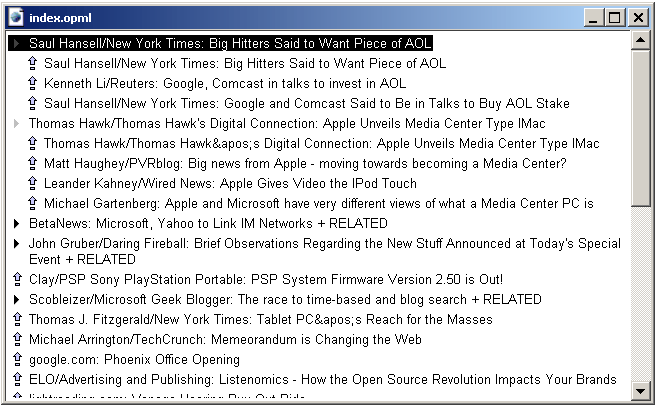
Monday, October 17, 2005Mike Graves on the (now announced) VeriSign acquisition of Moreover. He also posted tech notes on the switch to their server for weblogs.com which will take place on Thursday (it's still running on one of my servers). A must-read for developers who ping. PaidContent's Staci Kramer interviewed execs from VeriSign and Moreover. Fortune profile of BitTorrent's Bram Cohen. Doc Searls says we've got a monoculture problem, and we need to look beyond Google to solve the link-spam problem. But which Google? The one that's the source of the link-spam or the destination? Even if it doesn't have their full attention yet, it will when (what Steve Gillmor cleverly calls) Brin-rank stops working. The first destinations that broke aren't Google's. But they're the goal of the spammers who probably don't care very much about Feedster or PubSub. The prize is Google. I need to do a podcast to explain in more detail how Google has spent the last five years walking out on a very long plank, one that has certainly generated many billions of 20th Century style dollars, by monetizing eyeballs, and how precarious their position is. An empire based on the sanctity of the link. Intrusive ads, the ones that Google sells, are so so tired. Feeds containing commercial information people want, are wired. Cristian Vidmar on OPML reading list scenarios. OFGN gets a mention on Ben Barren's. Julian Bond did an OPML browser in PHP. Here's how it displays the Scripting News directory in the box in the right margin, which of course, is an OPML file. Mike Arrington, Fred Oliveira and Brian Benzinger on OPML reading lists. Worse is Better : "One way to do something, no matter how flawed that way is, is better than two, no matter how much better the second way is." Four years ago today I won the Wired tech geek of the year award for SOAP. This DaveNet piece, written in July 1998, contained the germ of the idea. A lot of what people call Web 2.0 today is in this piece written over seven years ago at the beginning of the previous bubble. Did you know there was even a mascot for this stuff? Seriously. (Well, actually not seriously.)
Sunday, October 16, 2005A tiny change makes the Mac versions of Firefox and the OPML Editor work together. The Shanghai Daily supports RSS. Nick Bradbury's Web 2.01 release notes.
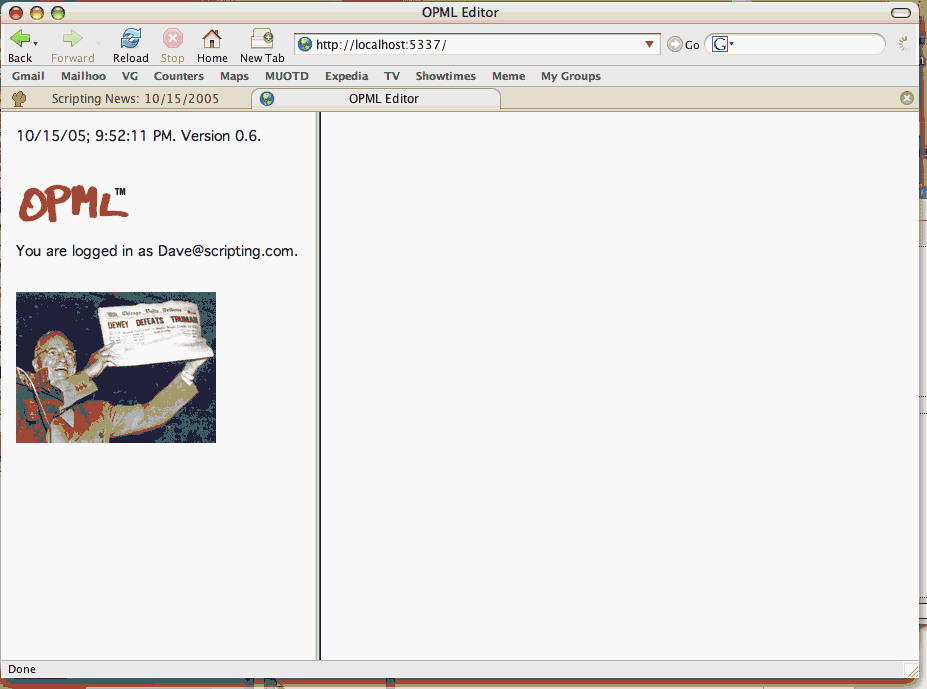
Terry Heaton is facing surgery without insurance and has a surprising story to tell about it. We take care of each other when the need is great. That's why the world works, most people are good, most of the time, and adversity often brings out the best in us. The always-quotable Chris Pirillo: "Blogspot has become nothing but a crapfarm..." Tim Bray: "We have an emergency on our hands." Taskable is a "new kind of RSS and OPML browser built into the Windows taskbar notification area." I predict the TechCrunch guys will really like Taskable, it's the Flickr of Windows toolbar gadgets. (BTW, Sean, it's called inclusion, not transclusion.) Amyloo is trying Taskable and offers an idea for the Great RSS Icon Debate. Reminds me of a question Staci Kramer, another OPML blogger asked a week ago. Why isn't her OPML blog showing up in various places you'd think it would show up. Turns out I forgot to ping weblogs.com on behalf of the OPML bloggers. How about that. The guy who wrote weblogs.com forgets to ping it. Life sure is funny. Note to those who think the white-on-orange XML icon isn't suitable for international use, consider that the People's Daily, of the People's Republic of China, uses the icon, as-is, without reinventing it. I figure if it's good enough for the Chinese, it should be good enough for Microsoft. I was poking around in my browser trying to find the web server built into the OPML Editor, and you could have knocked me over with a feather when Harry Truman showed up on my Mac desktop, looking just like he did on my Sony Vaio, holding the newspaper, reminding us that the media sometimes garbles the story in transmission. Harry was a great media hacker, and now he's on the Mac. He told the truth and they thought it was hell. So, the big question, does the Mac, the great graphic computer that it is, the home of the classic -- MacPaint, come with a paint program? I just want something that lets me resize graphics and type some text on them, you know the usual Scripting News type graphic illustrations. Nothing too fancy. Don't tell me I'm going to have to buy PhotoShop because that will make me angry. Make me happy and tell me there's something simple and fast already on my hard disk! Where is it? I don't need Garage Band or Dot-Mac, or any of that crap. Give me a paint program or else. Hehe. Sorry. Randy Geise and Adam Hansen send, via email, a great piece of advice. If my Mac comes with AppleWorks, it has a simple Paint program built in. Well my Mac came with AppleWorks. I launched it, created a Paint document and then created a test document. It did what I wanted it to do, until it came time to save the document. First, it didn't have GIF as a format option, but it did have JPEG, which I chose, but it foolishly insisted on giving the file a .PNG extension. That's a deal-stopper. I must have either GIF or JPEG. For pictures JPEG is good, but for these screen diagrams, GIF is better. I suppose there is a way to configure it so it works properly. I'll try again. Lots of people suggest Graphic Converter, but my Mac doesn't seem to have it. I'm going to try to make AppleWorks do what I want. It seems to be really close. Last year on this day: "Watching the Yankees clean the Red Sox's clock." Haha joke's on you Dave. The Red Sox won. Everything. Famous Last Words. You chump. Love, Dave of the future. Two years ago today I wrote publicly that I refuse to be angry with O'Reilly. I renew that pledge again today.
Saturday, October 15, 2005On my daily walk today a little bird landed on my shoulder and whispered something in my ear. "Next week Tim O'Reilly will announce a venture capital fund for Web 2.0 companies," the bird said. Wow. Web 2.0 is big, I thought to myself. Could this be the Flickr of venture funds? I continued on my walk. Jay Rosen is analyzing the NY Times's Judith Miller report. Back in May, when I was still in Florida, I outlined a design for browser-based subscriptions. Microsoft asked me not to publish the design, but now the whole issue is public, and the design is more relevant than ever. John Robb: The Open-Source War. Remember the Yahoo movie trailers feed that had an XML error, but otherwise was interesting and innovative? Well, yesterday I got an email from its product manager saying they would fix it, and this morning, it's fixed. Bing! But... When I click on the link for the movie trailer, I wait a minute and nothing happens. This reminds me of a podcast interview I heard with Ron Bloom, one of the founders of a podcasting network. He says, emphatically, that technology doesn't matter. That's the kind of thing I'm likely to say myself, except when technology does matter. This is one of those times. Suggest to Ron that he ask his partner Adam to explain this, and listen Ron -- because technology can make the difference between a user watching a trailer for a movie, and shutting the window after wasting too much time waiting. AOL has it's own "mini" blogger, an anonymous employee blogging about his or her employer.
Friday, October 14, 2005Mike Arrington got a look at Sphere today. Guidelines for validating OPML. Preparing to write a validator for OPML, I started taking notes about the conventions of OPML, and it turned into an interesting document. If you have a comment, please post it on your blog, and let's see if Memeorandum picks it up. Maybe we can keep the discussion on the high road that way. Or... maybe not. eWeek: "OPML is one of the aspects of Gada.be that make it stand out from existing metasearch engines." TechCrunch: Podtech and SolutionWatch join the Web 2.0 WorkGroup. With an inaugural podcast.
John Gruber examines the life of an independent software developer through the experience of Brent & Sheila Simmons, NetNewsWire and NewsGator. Probably the single most aggravating thing about using a Mac after using Windows for so many years is the location of the clock. My eyes are always looking in the lower-right corner to find out the time, and it's not there, it's in the upper-right corner. The other thing that's vexing is the need for forced-restarts. It happened again today. I suspect this is because I am using the El Cheapo model Mac and am probably pushing it too hard. But I still haven't ruled out the possibility that I'm getting trapped in some mode that I don't know how to get out of. Without doubt the best cat picture ever. Randy Charles Morin figured out how to get a pure blog search from Yahoo's mixed news-and-blog search. Stephen Baker, who writes for Business Week, explains how a for-print article of his was hacked to reduce it from three columns to one.
The 2WW blog is moving to a faster server today. It'll take two hours for the move to complete.
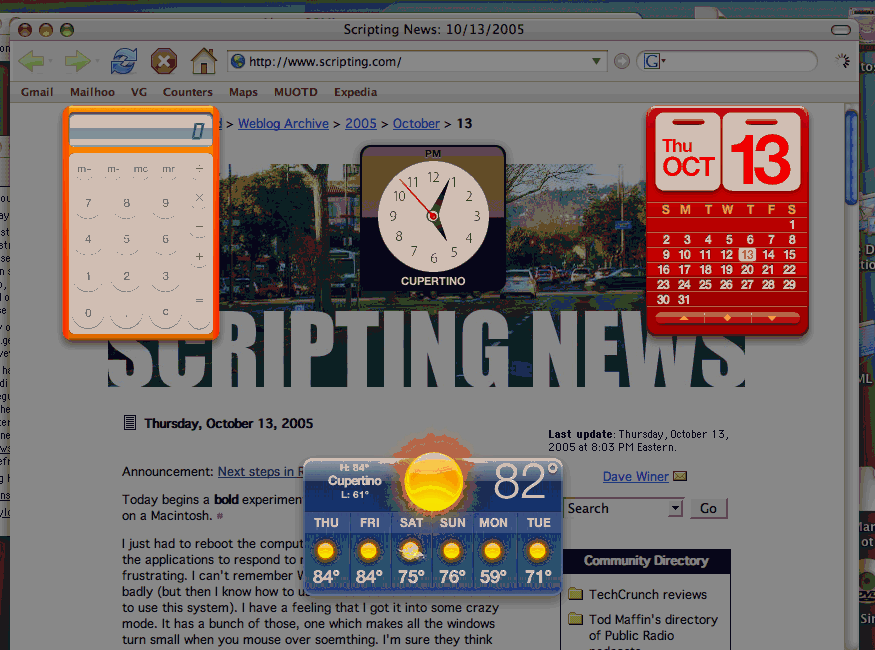
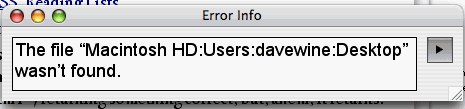
Thursday, October 13, 2005Announcement: Next steps in RSS, Reading Lists. Today begins a bold experiment. I started editing Scripting News on a Macintosh. Sydney Morning-Herald: iPod 'doomed,' says expert. Mark Cuban says Disney chairman Iger saved TV by making his deal with Apple. He makes a good point, network programming was already available for handheld devices. You can download episodes of any TV show you want. Now at least one network has a way to be paid for some of its programming. It's about time one of the companies took the pragmatic view and decided to participate instead of being in denial. Kottke reports that Apple has an RSS feed for movie trailers. Nice, but... The links all point to the main trailers page. I was hoping to see permalinks to a reviews page for the movie, and an enclosure containing the trailer itself. Now that Apple has a video iPod, they could be covering some new ground by doing video enclosures. I'm sure they'll be doing it soon enough. Meanwhile Yahoo is closer to nirvana with their RSS feed for new movie trailers, but even they don't yet have enclosures. (Postscript: Unfortunately Yahoo's feed isn't valid XML. They don't define the "media" namespace. An XML-conformant aggregator won't accept the feed. Oy.) I just had to reboot the computer because I couldn't get any of the applications to respond to mouse clicks or keystrokes. Really frustrating. I can't remember Windows ever getting tied up so badly (but then I know how to use Windows and have no clue how to use this system). I have a feeling that I got it into some crazy mode. It has a bunch of those, one which makes all the windows turn small when you mouse over soemthing. I'm sure they think it's really powerful, but for a newbie, it's horribly disturbing. Also, it's way too easy to eject a disk, and no clear way to get it to come back (other than restarting). It's also incredibly easy to find out what time it is in Cupertino and what the temperature is. If I lived somewhere cold it'd piss me off (but I live pretty close to Cupertino). BTW, for those of you who watched the NerdTV interview, this paragraph is an example of the kind of narrative that Mitch Kapor used to do. Tell me what you really think about the software, don't spare my feelings. I want to know how it burnt your braincells and how I can stop it from doing that. Now of course begins the process of debugging all the scripts that ran on Windows that don't run on the Mac. Heh. For example, file.getSpecialFolderPath depends on sys.unixShellCommand ("who am i") returning something correct, but, ahem, it returns: "davewine tty?? Oct 13 16:08 \n" which causes this lovely error. It's hard to convey how much talent was at dinner last night at Jing Jing's in Palo Alto. I mentioned a bunch of them in the Reading Lists announcement above. But I didn't mention that Gabe Rivera, the author of Memeorandum was there too. I've become a regular user, subscribed to its RSS feed, and several times a day I visit the site and use it as an aggregator of what's happening in the tech blogosphere. It's become a totally essential tool, in just a few weeks. All the while I'm thinking it would work much better in OPML than it does in RSS, so before our meeting yesterday, I asked Gabe for an OPML readout, and this morning there is one. I've linked it into my community box at the right, so you can browse it in HTML, but more important to me is that I can browse it in my outliner. It's very much a beginning, because I immediately think of features I need to make it really work (like a Refresh button, for example). But we're off to a good start. Blog Herald: A short history of blogging. Transcript of my NerdTV interview. Not sure where the permalink to the show is. MP3 of the interview. Amyloo says the interview is "Must-see TV." I'm blushing.
Wednesday, October 12, 2005Rogers's memoir of his brief reign as the King of Pings.
Don't miss the irony that they named their alliance after a failed initiative of the 80s and 90s that was supposed to trouble Microsoft but instead flushed the proponents down the Toilet Of History. The Two Way Web joins The Web 2.0 Workgroup. I'm over at the Web 2.0 Workgroup at Mike Arrington's, and if you can believe this, none of these guys have read Microserfs. Totally 1.0. Unfuckingreal. BART supports RSS.
Cristian Vidmar taught the Textpattern blogging tool how to emit a categorized OPML readout of his site. Very nice! Can you see where this is going? The step after this is to have the stories emitted in OPML, then you could browse a blog, as if it were a single document, in an OPML browser. Sure there aren't many OPML browsers in 2005, just like there weren't many RSS aggregators in 1999, or podcasting clients in 2004. Just takes one to get the ball rolling, if the idea is sexy enough. Last year on this day Adam Curry and I did a Trade Secrets podcast. I'm going to listen to this one to see if they are funny or sad, a year later (or something else). The WSJ said (erroneously) that Trade Secrets was the first podcast, but it's a creative fiction, because it gives equal credit to both of us, which is fair. portforward.com clues you in on port forwarding.
Tuesday, October 11, 2005
2WW: Yahoo News Search, Day 2. Breakfast with the Daves My breakfast with Dave Slusher in Greensboro on Sunday was outstanding. He's another one of those guys whose values are so close a match to my own that I don't think we disagree on anything. After the Yahoo announcement of their podcasting site, I got an email from Ray Slakinski from iPodderX, and I thought of Dave Slusher, and these are two big-hearted guys who have put a lot into building the podcasting world, and neither of them are in the loop with the bigco's here in the valley. What a waste. And I wondered what we could do about it and once I asked the question I immediately had the answer. When you get non-disclosed about something, you are explicitly allowed to share the information with people in your own company with a need to know. So if one member of a product team goes to visit a platform vendoer, the whole team is actually being briefed, which saves travel expenses, and is efficient and good. So there's the answer. Form a corporation, with highly trustworthy developers, bloggers and podcasters, for the purpose of sharing information about new product releases, the same way professional news organizations and professional software developers do. I may just do this, because I'm tired of only getting superficial coverage of new products when they're released. The people whose opinions I really care about never get briefed before-hand and therefore never have a chance to help make the product better before it's too late.
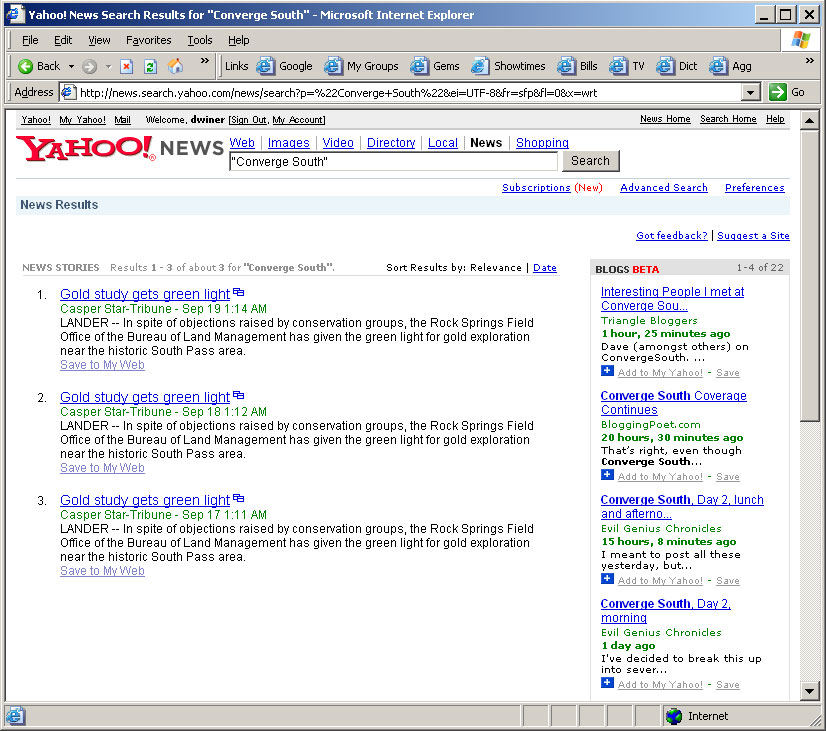
Monday, October 10, 2005Yahoo News Search with blogs. Okay now we're talking. Yahoo doesn't put blogs in the kiddies section, instead we're indexed along with the grownups. Screen shot. That's good. Now, why did they just roll it out with the mainstream business press? Come on guys, that's half-clueful, now let's go all the way. When you roll something out, include us in the roll out, esp when the service relates to blogs. Major site launch: http://gada.be/. See Chris Pirillo's comments, and TechCrunch preview. I think it's intriguing and really appreciate the excellent OPML support. PDF of WSJ article about podcasting. 4:14PM Pacific: Arrived safely at SFO. Checking in from Gate A22 at Atlanta Hartsfield Airport. Excellent TMobile here. The airport has Boingo service and there's a Laptop Lane with Wayport. To Tom Forenski: I would have sold weblogs.com a couple of years ago and any time inbetween for the right price to a tech company capable of operating it better than I could. Not really too complicated. This layer is ready, time to build another layer. (BTW, UserLand, which I remain a major shareholder of, would like to sell some of its assets too.) Oy vey! There's another major site launch coming, this one at 3PM Eastern today. I'll miss that one too, probably -- today's a travel day, from Greensboro back to SFO. Don't worry there aren't any more submerged deals to leak out while I'm traveling. I think. podcasts.yahoo.com Major site launch: http://podcasts.yahoo.com/. I got an advance look at the site and had a chance to sit down with the team on Sept 21 in Sunnyvale, CA. We talked about formats, protocols, how to work with the community at a content and technical level, and linking into the community directory. At this point, I'm not sure how much of this Yahoo did, we'll be diving in over the next few days for sure. But they were the first podcasting network site to do this, Odeo didn't do it, nor did Apple or Podshow. No matter what Yahoo did, at least they talked, listened and trusted, and that's a start. To Apple and the others, we didn't leak their product, we respected their right to keep it confidential. Anyway, net-net, it's great to have Yahoo in this ballgame. Last week Scoble was trying to guess what this product was, he figured that Yahoo had to have something to announce -- he said Yahoo is not Steve Jobs, and I kept thinking, so true, and I'm so glad. We need more steady leadership from the big companies, less flash, less attention-hogging. This leaves room for new ideas to get a chance from individuals and small companies, which is, btw, where new ideas actually come from, Steve. 9/2705: "Yahoo is rapidly becoming the statesman-like technology company I've been hoping would emerge. Too many tech companies throw their weight around, and try to act like scrappy upstarts, when taking the long-term big-picture view would serve themselves and the community much better." 1/9/04: "Hey Steve, you just had a really great idea!" Yahoo also briefed Andrew Grumet and John Furrier, so look for comments there. Amazing grace With very few exceptions, maybe just two or three, the response of the blogging world to the Verisign deal for weblogs.com has been universally positive, collegial, appreciative, happy, and wonderful. And remarkable, in the truest sense, there are remarks to be made about it. I was expecting something different, I guess I expected a flameout extraodinaire. I decided we could go through it, for the principle and yes, for the money. I'd be willing to endure some virtual flames for a couple of million dollars. But what I didn't expect, and now find most gratifying, is that people seem genuinely happy about the deal. I have a guess why, it goes like this. Hope. If Dave can do it, so can I. It's not so much money that you can't imagine yourself making it (these days, after taxes, it buys a modest family home in the Bay Area). More important, weblogs.com is the kind of thing a person can do, in his spare time, while doing other things (like writing a blog, running a company, driving around the country, recovering from major surgery). It's not exactly like a hobby, but then again, it's not exactly not like a hobby either. I think news, good or bad, is always received this way: "What if it were me?" And this idea fits well into people's minds that way. It actually could be me, they think, and I think that's great. We need more people starting projects for the community, that build the community, and then have the perseverence to stick with it, in the hope that there will be a payday someday.
Sunday, October 09, 2005Rex Hammock can't figure out how to use Google's RSS reader. Don Park is giving up on blog search engines. Stay tuned for a major site launch tonight at midnight Eastern time. I'll have a link here if I'm still up, otherwise tune in tomorrow morning. Saw Serenity this afternoon. Big thumb down. I'm tired of Star Wars remakes. Bore-ring. How about something new in sci-fi. (Wish I had gone to Wallace & Gromit.) Now that Jason Calacanis blogs from inside a big media company, does that mean we'll get visibility into how that company works? The same kind of transparency that we get through Mini Microsoft, for example, would be refreshing. This is one dusty corner of our civilization, we never get a good look at the inner workings of the media industry, because their reporters rarely if ever go there.
An indication of how podcasting has changed conference-going for me. I had a choice between three sessions yesterday morning, and decided to go to a discussion led by Jimmy Wales about Wikipedia. As he started, it became clear that he wasn't actually going to lead a discussion, he was giving a talk, with slides. He said he would be informal and let us ask questions during the talk instead of at the end. I listened for five minutes, and all the while it seemed as if I was listening to a podcast. If my only job is to listen, I don't need to actually be there. Instead I went to a session led by Tiffany Brown about blogging from the outside. It was a raucous, interesting, multi-racial and multi-gender discussion about the usual thing, how we can all get heard more. There were even a few people nearing retirement age. It got intense at times, but at the end we were all friends, I think. I've been doing most of my travel by car lately, which is much slower, but has the advantage of steady time zone changes. It's 5AM for me, but 8AM for everyone else here in Nawth Cahlina. Anyway, I'm having a podcast reunion breakfast with the Evil Genius himself, Dave Slusher, and then on to Chapel Hill for more Cacalacky style schmoozin!
Saturday, October 08, 2005Today's session on blogging tools was great. Kevin Howarth took notes, it's all there, and he welcomes comments. This conference was notable in that there were many African-Americans. Usually we lament the lack of color in tech conferences. Not this time. Microsoft asks for feedback on their RSS icon. My feedback: a big thumb down. Use the white on orange XML icon and stop re-inventing. Unfortunately the wifi situation at the ConvergeSouth conference is spotty so today will be another no-blogging day for Uncle Dave. I'll see you this evening, until then, take care. I tried the Google news reader again, this morning, after it had loaded all my feeds (it seems to take quite a few hours to do that).This is the second blog-related product they've come out with recently that appears not to have been touched by human beings before it was introduced to the world (the other was the ridiculous blog search). I think they need to start using their own stuff before releasing it. And maybe look at the competition for ideas. When you're first into a market there's an excuse for being so wrong. But the first of this kind of software shipped six years ago. To give you a comparison, Visicalc shipped in 1979. By 1985 we had been through two generations of spreadsheets with Lotus 1-2-3 and Excel. Google's reader is a huge step backward from what was available in 1999. The arrogance is catching up with them. Then again, in 1985 we also had Lotus Jazz. Remember that? It was its own bubble, supposedly was going to completely wipe out Microsoft (who Steve Jobs didn't like, even then) and every dipshit little Mac software outfit (like my own company). I remember opening the box on Jazz when it shipped, admiring the soft vinyl diskette sleeves and stylish box and manual. The software sucked. Bigtime. Hugely. In every way. Laughingly. Excel went on to rule the roost. Proving that all that glitters is not gold. And the emperor has no clothes. Just like today.
There are three significant factual errors in this brief piece about the deal with Verisign. 1. weblogs.com was a ping center before it was a weblog host (and before that it polled for changes). 2. It doesn't use RSS except in the most superficial way (changes.xml is also availble in RSS). 3. It doesn't send pings, it receives them. They said it backwards. It's like saying a power plant consumes electricity. They really need to get some people covering this stuff who have some kind of vague idea of how it all works. Edgeio will "give you the ability to do new and (we think) really exciting things with your blog." Marc at O'Reilly says if everyone thinks it's a bubble then it isn't a bubble. Hmmm. Not sure. Maybe it's a kind of weird mutant bubble, not exactly like the last one, but then still a bubble after all? Surprisingly, mutant bubble is not a Googlewhack.
Jason Calacanis: "What does a marathon runner do when the marathon ends?"
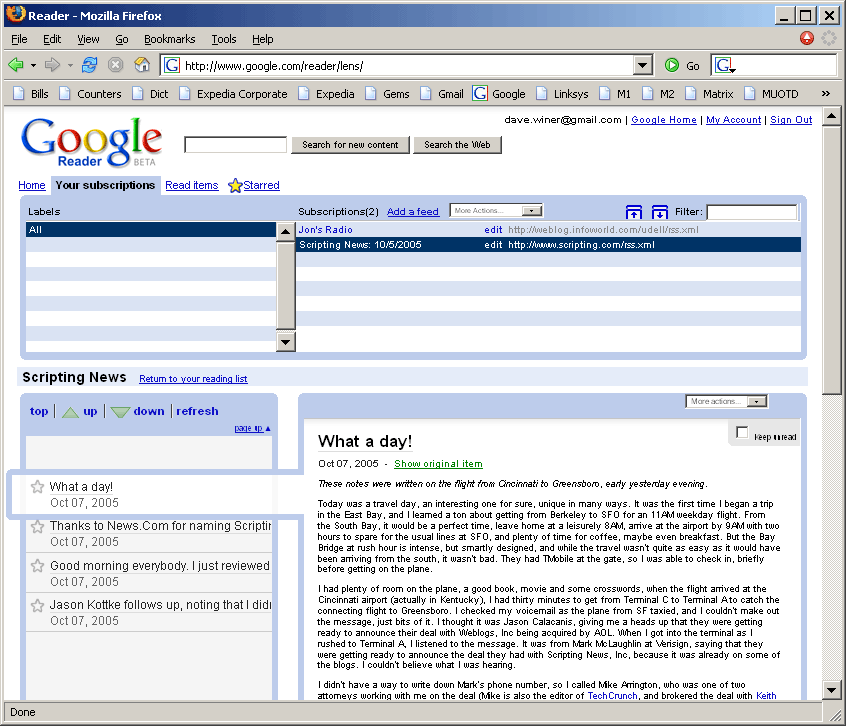
Friday, October 07, 2005Mike Arrington: "OPML is awesome." Yahoo publishes a must-read report on RSS usage. Google surprises no one and releases a very nicely done RSS reader. What an amazing week. I've barely had a chance to try it out, but obviously this is a market-changer. Screen shot. It supports OPML import-export. Jon Udell explores the (for most people) unknown world of ping servers. It's great that the deal has sparked interest in how this stuff works. I'd like to help document the flow of pings through the blogging world. I obviously know quite a bit about how it works. And now I have to go to dinner. I'm starving. I'm going to skip the BBQ tonight so I can catch up on all that I missed on the Internet. What a day. Good morning everybody. I just reviewed all that I could find about the weblogs.com deal. It's the top item on Memeorandum this morning. Screen shot. Everyone is being so cool about it. Thanks for all the kind words. Mike Graves wrote an incredible piece, it couldn't possibly have been better. And believe me, no one planned for it to go this way. Sometimes Murphy's Law works in the opposite way. Knock wood, I am not a lawyer, my mother loves me and all other disclaimers. Thanks to News.Com for naming Scripting News one of their Blog 100. What a day! These notes were written on the flight from Cincinnati to Greensboro, early yesterday evening.
I had plenty of room on the plane, a good book, movie and some crosswords, when the flight arrived at the Cincinnati airport (actually in Kentucky), I had thirty minutes to get from Terminal C to Terminal A to catch the connecting flight to Greensboro. I checked my voicemail as the plane from SF taxied, and I couldn't make out the message, just bits of it. I thought it was Jason Calacanis, giving me a heads up that they were getting ready to announce their deal with Weblogs, Inc being acquired by AOL. When I got into the terminal as I rushed to Terminal A, I listened to the message. It was from Mark McLaughlin at Verisign, saying that they were getting ready to announce the deal they had with Scripting News, Inc, because it was already on some of the blogs. I couldn't believe what I was hearing. I didn't have a way to write down Mark's phone number, so I called Mike Arrington, who was one of two attorneys working with me on the deal (Mike is also the editor of TechCrunch, and brokered the deal with Keith Teare, his partner in Edgio, a company you'll be hearing great things about shortly, I'm sure). Mike didn't answer, so I tried Mike Graves, one of the guys I worked with at Verisign, no luck there iether. Both are at the Web 2.0 conference in SF. As I was approching the gate for my outbound flight, Staci Kramer of PaidContent called, asking if I could confirm that there was a deal. I asked her what she had, and she said she had read something on Kottke, but so far just had rumors. I said I couldn't confirm, she asked if I'd call her back if I could, and I said I would. I've worked with Staci on a few stories in the past, and I will indeed call her back, she'll be the first reporter I talk to about this deal. When I finally got on the nearly empty plane to Greensboro, I listened to the voicemail again, got Mark McG's number, called him, got filled in, asked him to hold off announcing anything until I had a chance to see what had been reported, then I hung up, tried Arrington again, still no answer, then I called Scoble, and he read me Kottke's piece. Not bad! He got the number wrong, but otherwise more or less understood why I wanted to do the deal, and raised a very valid question about BigCo's and Verisign, and so forth. No doubt we'll have an interesting discussion about this in the blogosphere, and I hope a productive one, and that we'll all find a way to work with Verisign. I think there's reason to believe they can and will do a much better job of running the ping center than I have been able to, and this is the perfect example of individual innovators (myself in this case) working with large companies in ways that leverage the strength of both. The bootstrap of weblogs.com is something a bigco should not attempt, it's hard to make it go, and most bootstraps don't, and it requires trust, something an individual is more likely able to inspire than a big company. On the other hand, running a serivce that other bigco's depend on (like Google, and Microsoft, to name two) is not something a person like myself should attempt. I think Verisign is the perfect company to do it. Their name servers, I hear, respond to 250,000 requests per second at peak loads. In comparison, weblogs.com's 1-2 million pings a day seems a drop in the bucket. Further, it will require great resources to tackle the ping-spam issue, and there Verisign's expertise, not just what's visible today, but what's coming down the road, will make all the difference. I was in no posiiton to do this on my own. And belive me, the Technorait's and PubSub's, even Feedster and Bloglines, weren't helping out very much. I belive they'll respect Verisign much more than they respected me. And this deal will free me up to work on new ideas around blogging, RSS, OPML, web services, podcasting, etc. I'm good at digging holes, I have to pass off to others to make the trains run on time when the service grows as big as weblogs.com has. Anyway, the plane has just entered North Carolina in preparation for landing in Greensboro. Writing this essay has been an excellent way to pass the time. When I get off the plane I'm going to look for a phone, call my friends at Verisign, and encourage them to go ahead and make the announcement. When they have made the announcement, I will upload this document to Scripting News, and we can continue the dialog from the ground in Greensboro. Namaste y'all! Dave Winer 10/6/05; 4:38:34 PM Pacific
Thursday, October 06, 2005Mike Graves: "Word is out, and it’s true: VeriSign has acquired the assets of Dave Winer’s weblogs.com." The three sub-domains of weblogs.com that are run by other people are not part of the deal: 1. scoble.weblogs.com, 2. doc.weblogs.com and 3. radio.weblogs.com. VeriSign will continue to map them to the places the currenty point. None of these sites are actually on my servers (they were at one time). In other words, no changes. audio.weblogs.com is part of the deal. So VeriSign becomes part of the infrastructure of the podcasting community. I wrote notes on the philosophy of the deal and the events of the day from my point of view. I'll be posting them shortly. 10:53PM Eastern: Arrived safely in Greenboro, NC; where it is raining like a mofo. And there was some interesting voicemail for me when my plane from San Francisco landed in Cincinnati. Greetings from near Gate 40, Terminal 1 at SFO. Excellent TMobile connection. Interesting -- they have a deal that gives free access to the Wall Street Journal if you're connected through TMobile. I've never seen the for-pay version of the WSJ on the web before. Don't really have much time to read here, my breakfast is coming shortly. Western omelette without tomatos, coffee, ice water. Yummy!
Somehow it seems appropriate that NerdTV taped interviews with Tim O'Reilly and myself on the same day last week. Tim's interview is on the site now, mine will be up next Tuesday. About me they say: "Though best known these days as the father of RSS and weblogging, Dave Winer has been in the software industry since the days he worked with Mitch Kapor before Lotus 1-2-3." I did say what's on my mind (as they explain on the site) but no need to watch out, I said nice things about everyone. Well, almost everyone. Wired: "What are the best methods for getting your tag taxonomy in order?" A heads-up from Chris Pirillo about a new web app he's ready to roll out any hour. I've been following its development, it's very sweet. At 1AM Pacific, listening to Chris Lydon on KQED. Catching up on reports from the Web 2.0 conference. Five years ago I had dinner with Doug Engelbart.
Wednesday, October 05, 2005PaidContent reports that AOL is buying Weblogs, Inc. Rex Hammock: How 1999 2.0 is different from 1999 1.0. Ryan Tate: "I'm still waiting for someone to start a Fuck You newspaper." Harold Johnson on Alice's Restaurant, a song that proposed to spawn a movement of its own in the 60's. He includes an excerpt. NerdTV has a podcast feed. Movie: Driving on Shattuck Avenue in Berkeley. The song is Sunshine Life for Me, performed by Ringo Starr. A rough design for RSS integration in search engines.
Yahoo announces they've acquired Upcoming.org. TagCamp in Palo Alto, October 28 is "an open, welcoming event for geeks to camp out overnight, get wired on Halloween candy and think really fast about tagging, its applications, and implications." I thought these pictures were pretty sweet!
Tuesday, October 04, 2005Editorial: Ning harkens back to 1999. Editorial: Google diversifies, opportunity for upstarts. Note to Amyloo: None of us look as good as we'd like. Never got a response from Technorati on why Scripting News isn't in the Top 100. Took another look today, and it seems we should be in the Top 10 now, just before Kottke. Weird. I totally don't understand what's going on. What else is new?
5/16/05: "It seems inevitable that they'll buy a Mac news reader product, they would probably like to buy NetNewsWire, and it would be hard to imagine Brent wouldn't take a reasonable offer." TechDirt: "Sun Welcomes You To 1999 With Its Google Non-Announcement." David Arbogast: "Can you just imagine how people would be screaming if installing the .NET libraries also installed the MSN Toolbar?" Ning is a "free online service for building and using social applications." Jason Lefkowitz is having fun with Bush's latest Supreme Court nomination. A refreshing perspective on the news of the day. Two years ago today was day one of BloggerCon I. Five years ago: "OK, the Mets didn't win today. That doesn't mean they lost."
Monday, October 03, 2005To whom it may concern, "Yahoo is planning on featuring your podcast this week on a Yahoo media property." 60 Minutes, a CBS News magazine, is now also a podcast. The Toronto Star supports RSS 2.0. Brian Cantoni sends word that Cal does have a feed for Berkeley sports. How about that. It's also a very weird hybrid of RSS 1.0 and 2.0, leaning toward 2.0. Looks like someone was on the fence. I'm having lunch tomorrow with Chris Nolan (whose face is, the current header graphic) to discuss her new hush-hush project called Spot-On. My favorite fast food these days is Naked Protein Zone. It's a little sweet, very refreshing, and a wee bit gritty. Food you drink. Among Gartner's key emerging technologies are podcasting, RSS and blogging. This is pretty remarkable that these three are now established to the point where corporate IT analysts are covering them.
Here are the notes from the talk, above. Rick Segal: "Enough already with this Web 2.0 nonsense." Josh Hallett is betting on Web 2.1, or Web 3.0. Web 2.1: A brain jam for the rest of us. Scoble's wife Maryam, is blogging. Scoble: "I've created a monster." NPR: "President Bush chooses White House Counsel Harriet Miers to succeed Sandra Day O'Connor on the Supreme Court. The 60-year-old nominee is a former Dallas lawyer." NY Times: "Ms Miers, 60, a longtime confidant of the president's, has never been a judge, and therefore lacks a long history of judicial rulings that could reveal ideological tendencies. Her positions on such ideologically charged issues as abortion and affirmative action are not clear." When I read this piece, I heard: "Scoble wants a relational database." After figuring out how to find my misplaced phone yesterday; today the damned thing won't boot up. I thought it the battery, but I charged it overnight, still won't boot. Serves me right for being so pleased with myself yesterday.
Sunday, October 02, 2005On Crooks & Liars, ABC host George Stephanopoulous cites a source saying that Bush and Cheney were involved in Plamegate. Ed Cone: Rise of the Blog. Chris Anderson: Business Blogging != Executive Blogging. How to find a cell phone that's missing but not lost. Launch Skype, make sure you have enough Skypeout credits for at least one call. Enter the number of your cell phone and press Return. Wait a few seconds. Listen for ringtone, it will lead you to the phone. It works. Dan Farber asks Scoble why he didn't send an email to ask for the checkbook, and Scoble explains: "You gotta get how big a deal RSS is inside Microsoft to understand that. I bet a lot of people who I wanted to reach get the message via RSS before they get it via email." Jeff Powell sent a screen shot that shows a display glitch in the TechCrunch directory in the right margin. I think I fixed the glitch by adding a valign="top" in the right place in the code.
Saturday, October 01, 2005Tim O'Reilly joins the What is Web 2.0 discussion. Haven't had a chance to carefully read the piece, but did skim it. It's nice that finally O'Reilly allows me my role in creating RSS. Good to put that piece of acrimony behind us. However most of the ideas in his piece could be found in the back-issues of DaveNet, starting in late 1994. The Web he descirbes was evolved during the dot-com boom. XML-RPC started in 1998, and RSS in 1997, OPML in 2000. The people that go to his conference weren't thinking about the web as a platform for the people, but as it turns out, that's what it was (and is). The O'Reilly piece appears good, the only thing left is for them to drop the exclusivity of his conference, that's what makes his Web 2.0 totally not about the web. The web is anti-exclusive. Scoble wants to borrow Microsoft's checkbook. BetterBadNews wishes the EFF a happy 15th birthday. Here's a site that could really use RSS. Jason Calacanis is glad to see the "old guard" blogs "fall off" Technorati's list of popular blogs. I reaaaaally don't care about these lists, but of course I had to see if I was one of the blogs that had been booted. Gulp. It seems so. So, I wanted to see how bad it was, how unpopular had Scripting News become. I checked to see how many sites were linking to me in the new scheme, and found that there were 4778, which seems would place Scripting at #19, if I have any clue how their rankings work. I must be missing something. In any case you could get rid of the lsits altogether and I wouldn't mind, I don't compete with the top sites on that list. I want to be respected for what I do, and I'm definitely not trying to be the most mass of the mass market. Note there are no ads here. I understand why Jason cares, btw. And there's a strong argument to be made that the number one site (Jason's Engadget is number two) gamed the process. Johannes Ernst suggests that FOAF embrace RSS. I'm working on a new module for the OPML Community Server, and am revisiting a question we answered in Manila and before that in the website framework in Frontier. Should we rely entirely on the physical structure of the data for the URLs, or should we allow the designer to overlay a logical structure, basically rewriting URLs to separate what's presented to the reader and what the implementor sees. Of course there are tradeoffs. I found I used the feature in Manila but not in the WSF (I'm pretty sure the former is built on the latter). Anyway, I wonder what people who developed sites in Manila or the WSF would think about this. Om Malik: Google Confirms Free San Francisco WiFi Plans. Don Hopkins has an OPML directory feed for his Drupal blog. Last night I taped an episode of NerdTV with Robert X Cringeley here in Berkeley. It was great fun. The show will be available for download a week from Tuesday. Everyone get your BitTorrent clients ready. Had he lived, today would have been my uncle's 60th birthday. Happy Birthday to Vava on the great hippie dope smoking beach in the sky. Say hi to Lucy, Dot and Pumpkin for me. Hope you and Rudy made peace. How's Hymie Stutz? Ray Fox? Cousin Joey? We really miss you! :-( Make-believe stories Suppose you have a sharp pain in the lower-right abdomen. The pain is getting worse, so you visit a doctor, who explains what a mess most operating rooms are. He adds that he doesn't actually understand how they work, he blames the documentation. Did you know you can die in surgery, he asks. So what do you do? This might be appendicitis. I'd see another doctor, preferably one who isn't scared of operating rooms. Another story. You're wrongly accused of murder, in jail, but unfortunately the circumstantial evindence is pretty bad. The bloody murder weapon was found in your house. You had a motive. You were the last person to see the victim alive. But you didn't do it. The lawyer they assign to your case comes to visit and volunteers that he doesn't really like court rooms, they're so drafty and there are all these criminals there. Judges are so unfair. It's not his fault he had to take the bar exam five times before he passed. So, do you believe this guy and take your chances, or do you ask for another lawyer?
|
 
|
|||||||||||||||||||||||||||||||||||||||||||||||||||||||||||||||||||||||||||||||||||||||||||||||||||||||||||||||||||||||||||||||||
|
© Copyright 1997-2006 Dave Winer. Previous/Next |
||||||||||||||||||||||||||||||||||||||||||||||||||||||||||||||||||||||||||||||||||||||||||||||||||||||||||||||||||||||||||||||||||




 Every Thursday morning a group of between 20 and 50 Berkeley nerds gets together for breakfast at

 One thing I want to say in my BBQ keynote tonight is that one good thing that's happening is that people are trying out new ideas again. That should be a constant in the tech industry, in good times and in bad. There should always be money for new ideas because you never know which one will turn into the next Visicalc, Wordstar, Mac OS, Excel, Web or whatever. Too many years of drought between the years of wine and roses.
 For once Orlowski gets the
  It's important to note that it's not weblogs that are under attack, just services that concentrate and redistribute weblog content. You won't likely see pointers to spam blogs on Scripting News, even if the search engines are jammed up with them. If you subscribe to
  Since coming back to the Bay Area, most weekends when I'm in town I have breakfast with Steve Gillmor on Saturday morning. A few weeks ago, I asked a couple of other people to join us, and maybe soon I'll ask more. Not sure how to do this, but it's becoming interesting. Sort of an old farts genius network or something like that. OFGN. Whatever. Anyway, I invited a young fart, Mike Arrington, to join us yesterday, and of course an interesting two-hour discussion
  I was interviewed yesterday by Mike Vizard and
  I wasn't at Web 2.0 last week, but I know some of the jargon that developed there. People were walking around saying this is the Flickr of that, and that is the Flickr of this. I got this from Mike Arrington, who says I drive the
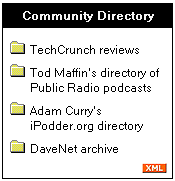

 Just listened to Meet The Press as I toured downtown Greensboro on foot. A few observations. Greensboro has a FW Woolworth
  So if I were hanging out with Eric Schmidt, maybe in a hot tub, drinking a glass of Cabernet or Chardonnay, talking about politics, the weather and such, and then Eric says, "Dave you seem to have a lot to say about Google and our industry, tell me, in your heart of hearts, with no hidden agendas, what would you like Google to do?" I would say Eric, since you asked so nicely, I'll tell you exactly what I think. First, start a blog, and talk about your favorite baseball team, what it was like taking your kids to the playground today, where you like to ski, who you voted for in every presidential election. Take a bit of time to catch up on the other blogs, get a sense of where your complany fits in among the other creative people on the web. Then stop shipping stuff for a while, and tell everyone you're not scared of Microsoft, and they have nothing to fear from you. At work, have two meetings every week with the people who work on the search engine you reach from the home page at google.com. Tell them what you like and don't like about the product, every week, and tell them how you like the improvements they've made. And then in the second meeting, invite a user to meet with you and the team, and ask them to do the same. Be creative in the kinds of users you include in the process. Steadily improve the search engine in response to their wants. This prescription will help shore you up against the true danger to Google, it's own arrogance and sense of self-reliance. You aren't an island unto yourself, the fountain of all wisdom, and your ship is floundering, but I'd guess you can't see it. That's the first thing to fix Eric, you have to see it as we do. Then you might actually make technology history and not be another mere flash in the pan like so many that came before.





 If I were giving a talk at Web 2.0,