|
|||||||||||||||||||||||||||||||||||||||||||||||||||||||||||||||||||||||||||||||||||||||||||||||||||||||||||||||||||||||||||||||||||||||||||||||||||||||||||||||||||||||||||||||||||||||||||||
Behlendorf is CTO of Collabnet and president of the Apache Foundation. He was responding to Friday's DaveNet. Guy Kawasaki: "Investors are looking for four qualities: hard-core science and technology; a strong core of a management team with experience; identifiable potential customers with money; and a believable business model. In the past, if you were missing some of these qualities, you could still get funded. Now, you have to have just about everyone of them." Heartfelt condolences to O'Reilly Associates who lost one of their best to a heart attack. O'Reilly: In Memory of Frank Willison. "Don't spend the whole summer inside writing code." Linux Today: AbiWord 0.9.0 Released. Today's song: "Then one night in the lobby of the Commodore Hotel, I chanced to meet a bartender who said he knew her well. And as he handed me a drink he began to hum a song. And all the boys there, at the bar, began to sign along." Steve Ballmer on Hailstorm: "People say, ooh, is there some big plot here?''' Look at how Ballmer phrases it as a question. He doesn't say there isn't a plot, he just says that people are asking if there is one. (And he kind of mocks them.) That's straight out of the Microsoft double-talk playbook. Try turning the question around. "OK Steve, I'll bite, is there a big plot here?" If so, oooh. News.Com: "Amazon.com is quietly scaling back its once high-profile online auction business." Standard: "Curl just might revolutionize the way Web sites are made. Who thinks so? Tim Berners-Lee." Confusing BigCo juju ComputerWorld: UDDI Floundering. "Kurt and Munter said they expect thousands, if not millions, of companies to be registered in the directory by this time next year." Either the BigCo's don't want SOAP to gain traction, or they have no clue how to develop a community around a new platform. They throw confusing juju all around, they confuse themselves and each other, leaving random developers to say "Let us know when you figure it out." In fact, SOAP is ready today. There are 68 implementations covering most scripting environments, operating systems, source code philosophies. There's an easy path through the confusing maze of specs. Just build distributed applications, and be proud to be on the leading edge. We're three years into a 20-year-endeavor, just like Unix or Mac, or Windows. A new sub-platform of the Internet. Use your imagination. That's what matters.
This morning I was thinking about new web services for the weblog community. This afternoon I'm thinking of a new state-of-the-art equivalent of Perl's CPAN. I almost made it through a whole day without mentioning You-Know-Who. Deborah Branscum: "You May Already Be a Wiener." Third Age: Hip Rabbi Says We 'Need' to Mate. "The author of the best-seller sensation Kosher Sex goes as far as claiming that singles should embrace the concept of 'needing' a man or woman to complete their lives." It's not so silly! Zimran Ahmed: "UNIX and C, built on the 'worse is better' philosophy are still going strong." Have you noticed that everyone is vetting. I just vetted this. Glad to hear you're vetting now. "Five years old and he's still vetting his bed!" My Polish grandfather used to go to vettings, where he would see the groom kiss the bride. Vetting, vetting, vetting. OK, now I've caught up. Stewart Alsop: "Real entrepreneurs never let money out the door for any reason that doesn't strictly advance the business of the company." Tatoo that on your forehead. Today's Scripting News is like a Talking Heads song. "It's only the river, it's only the river." John Robb: "The total cost of ownership (TCO) of a Website is more than the purchase price of a content management system." John got some feedback from Jim Roepcke, which he returns with confidence. "TCO is not a game most of these big players like to play. Cost is not a factor they want to address right now. So far, CMS land has been owned by the Enterprise players. The time is ripe for affordable departmental CMSs to eat their lunch. Cost is a line of attack." Washington Post: "By all indications, James is taking a tough line with America's most famous monopoly. A series of legal and personnel decisions signals that James is prepared to continue the Justice Department's most formidable battle. And while all of this could be posturing for settlement talks, that also doesn't appear to be the case." New Bryan Bell Theme: Kidlets. News.Com: "The Four Seasons Resort, long known for pampering guests with Jack Nicklaus golf courses and French buffets, hopes to spoil business travelers with its newest luxury: wireless Internet access." Thanks to Brian Kelly for the pointer to the Frontier 6 game! 4/2/98: "We want people developing in Frontier to be the most powerful developers on the Internet." If you run Windows NT or Windows 2000 and Microsoft's Internet Information Server (IIS) Web server software, please read this alert. Lawrence Lessig: "Something is going terribly wrong with copyright law in America." Welcome to the "public draft of a new book by David Weinberger." Wired: "MIT's Media Lab is experimenting with a tool for indexing the most popular hypertext links across thousands of weblogs and has ambitious plans to turn it into a resource for the mass media." Congrats to PHP Everywhere for reaching the 1 million hit mark. All the top-ten sites UserLand-hosted Manila sites are over a million hits now. It's worth a moment's reflection. These are not static sites, every hit goes all the way down the stack, and then comes back up. Congratulations to Doug Baron and Andre Radke for all the good work they did to get Frontier 24-by-7. The damn thing works! (Knock on wood and Praise Murphy.)
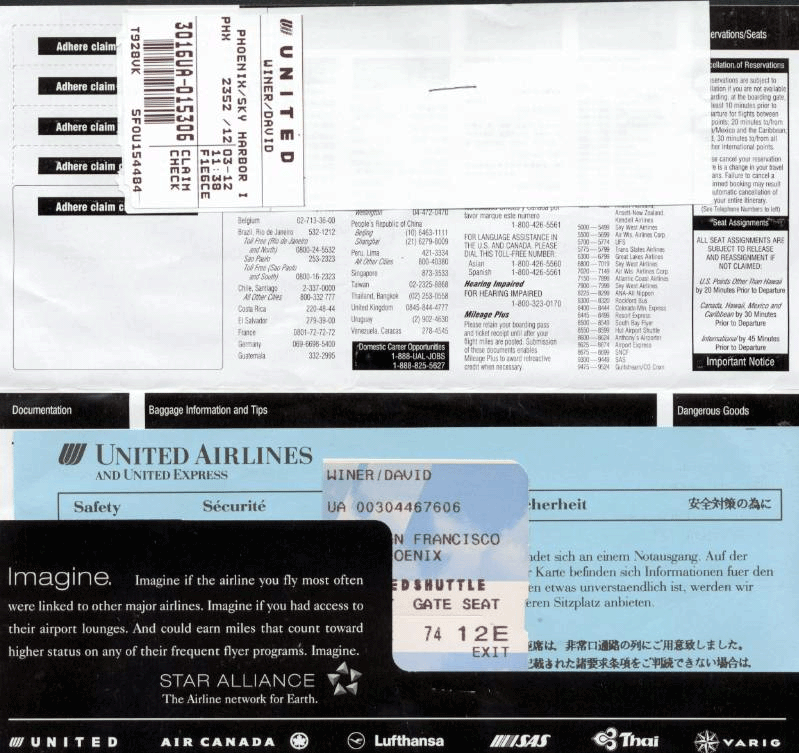
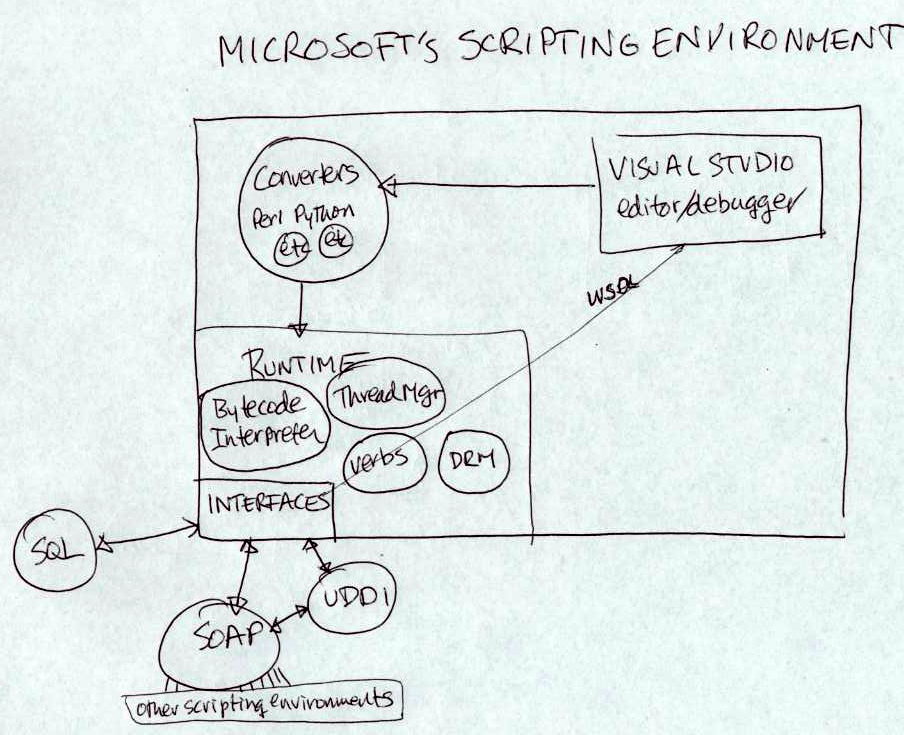
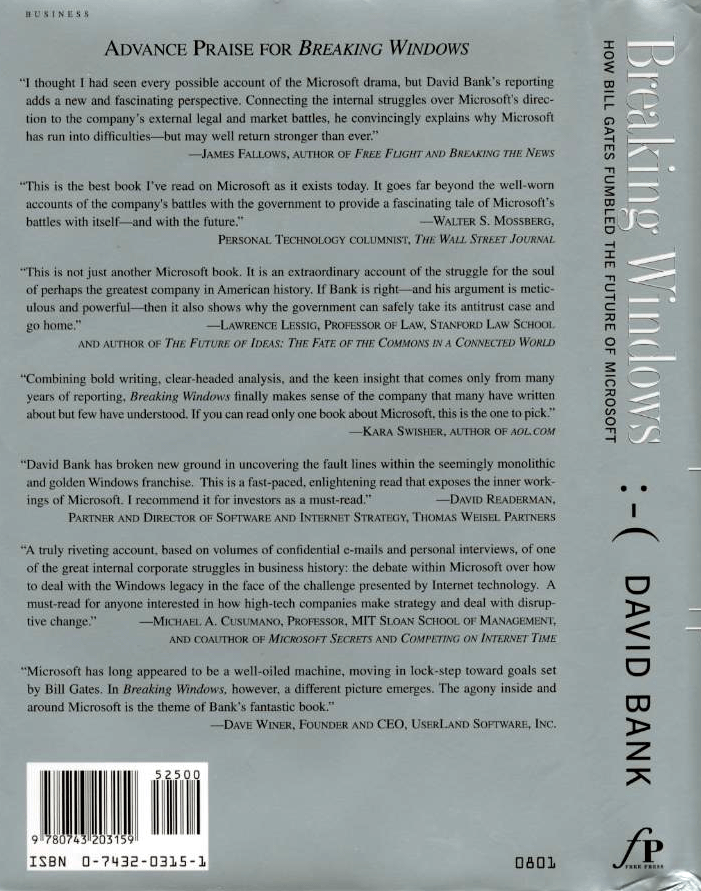
Rev 3 of the Microsoft Scripting Environment block diagram. Tim O'Reilly: "We are entering a new era, not of just open source but of profound technological changes." Craig Mundie: "It is extremely difficult for a software company to generate revenue by distributing a program if everyone has the right to distribute unlimited copies of the same program free of charge." BTW, numerous people have sent email saying that Breaking Windows is shipping. Imho, any analysis of Microsoft's public postings must be evaluated against the backdrop of what Bank's book tells us about their internal philosophy. Craig Burton: "I have no idea what it would be like to wander around life with my irony meter limping at zero." I do! Don Hopkins: Pie Menu Fasteroids. Happy 54th birthday to Papa Doc. Formats and protocols Sitting in the lobby of the hotel in San Diego with Doc Searls and Craig Burton on Tuesday, I did a quick tutorial for Doc on formats and protocols. Here's how it went. I took the hotel key envelope out of my left back pocket and opened it. The envelope has a form on it, it says what the room number is, has the checkout date, and a place for you to enter information rating the hotel's service. I said to Doc: "That's a format." I took the key out of the envelope, and made an in-out gesture with it. "When I go to my room I slide the card in and out of the slot quickly, a green light comes on, and I flip the door handle, push the door open and enter the room," I said. "That's a protocol." Exercise for the reader. How many formats and protocols can you spot in this used airline ticket? No higher praise possible Elliotte Rusty Harold: "XML-RPC is a clear case of the triumph of worse is better. It bit off the 90% of the problem that gave developers the features they actually needed. It ignored the 10% of the problem that caused 90% of the complexity in previous RPC systems." Thanks. There's no higher praise possible. Perhaps I should retire now? Nahh. Now at the same time he cuts me a new asshole in the SOAP chapter for a strategic mistake in the XML-RPC spec, viewed from the perspective of 3+ years in the future. In retrospect, I wish I had never typed in the word "ascii" when explaining what a string is. He's right, there is little justification for this limit. When I wrote the spec, I didn't think it was a limit, I thought it was explanatory. He's also right that I didn't know much about XML in early 1998, but in all fairness, few people did. But that's it, and that that was the major mistake in a reasonably complex bit of technology is something I'm fairly proud of. Net-net: XML-RPC and SOAP are different things. One is frozen, so its limits are well-known. The other is afloat in a sea of W3C working groups, doing their best to not break it too badly. I love them both, and am still working to make both more useful. A note to Harold, I think our Busy Developer's Guide to SOAP 1.1 deserves a mention in one or both of the chapters. It is far more detailed in its explanation of encoding than the XML-RPC spec. Yet it retains the simplicity of XML-RPC while adding the advantages of SOAP 1.1. It was written three years after the XML-RPC spec, and incorporates a lot that we learned. It's a good balance, a good way to get interop with Microsoft and IBM and other BigCo's, and not commit to eighteen years of evolution. Another feature of the BDG which, imho, will eventually make Python developers love SOAP is that the BDG has null values. Monolithic formats and protocols Harold also has a chapter on RSS. It's pretty balanced, unlike many of the supposed histories, he just gives the facts and tells it like it is. I agree with much of his appraisal. Harold uses a term I had not heard before: monolithic. Here's the case for monolithic specs. XML 1.0 is very nice, well-specified, and has the answers to most questions that come up when building applications. However, the work that came after the 1.0 spec is nowhere near as useful, and totally not stable, so I build specs that do not depend on them, whenever possible. That's what "monolithic" means in this context. It's a strategic decision, and because RSS is monolithic, we adopted it at UserLand and nutured and developed it as if it were our own. Then, last August, a fork erupted, and unfortunately took the name of the monolithic format we believe in. That was bad news. Since then we have not been able to recommend the format without reservation. Ugh. A new form of literature BTW, a hat-tip to Harold. This is the way to write a book. Put the chapters on the Web as you write them, inviting pushback, and perhaps incorporating that into the book as it develops. It also gets the book pointed to, gets the readers involved, giving them a sense of ownership, and therefore are more likely to buy it when it appears in print. And don't overlook the importance of having it indexed by the search engines. In a few months when the book is out, it will probably appear near the top of Google searches for RSS, XML-RPC and SOAP, among other key words. I know that a pointer from Scripting News is a good reference for the ranking algorithms on Google. Just put a Buy Now button in the template. It's a good way to make a book a standard reference, and make more money at the same time. It's also a sophisticated and courageous way to publish books. I've encouraged others to do it, and I'm pleased to see Harold do it so well. Congratulations and best wishes for much success with the Web-like approach to book-writing. Moosing around Talking Moose: "Lots of people seem to think I'm Scoble." Meanwhile the Moose, who is clearly not a programmer, talks about motivating programmers. Oy. Hellllp. If you want a clue Mr. Moose, please read this piece I wrote in 1997. "When a programmer catches fire it's because he or she groks the system, its underlying truth has been revealed. I've seen this happen many times, a programmer languishes for months, chipping at the edges of a problem. Then all of a sudden, a breakthrough happens, the pieces start fitting together. A few months later the software works, and you go forward." There's not a lot of room in that process for marketing guys "motivating." Now, since the Moose is obviously a marketing guy, let me blast back with some advice from a geek to marketers. And if you want programmers to be happy get people like Elliotte Rusty Harold to write glowing praise of our work. Like all people, programmers like to be appreciated. And since we're mostly men, we like what men like -- to be thought of as heroes, fighting the good fight for the Folks Back Home. It's pretty simple. Appreciate the work for what it is (we can tell if you don't Get it), and help everyone else understand how nice and smart we are. 10/7/95: "I handed the note back to Kawasaki. I told him that I wanted to meet Mr. Gassee. An executive that actually uses software. What a concept! I had to find out what one looks like." And yes, a quiet place to work and not too many meetings, and an occasional outing and some personal time, and you've got yourself One Happy Geek. (Or OHG -- don't forget that programmers love acronyms.) And also please don't forget to buy us lunch on Tuesdays.
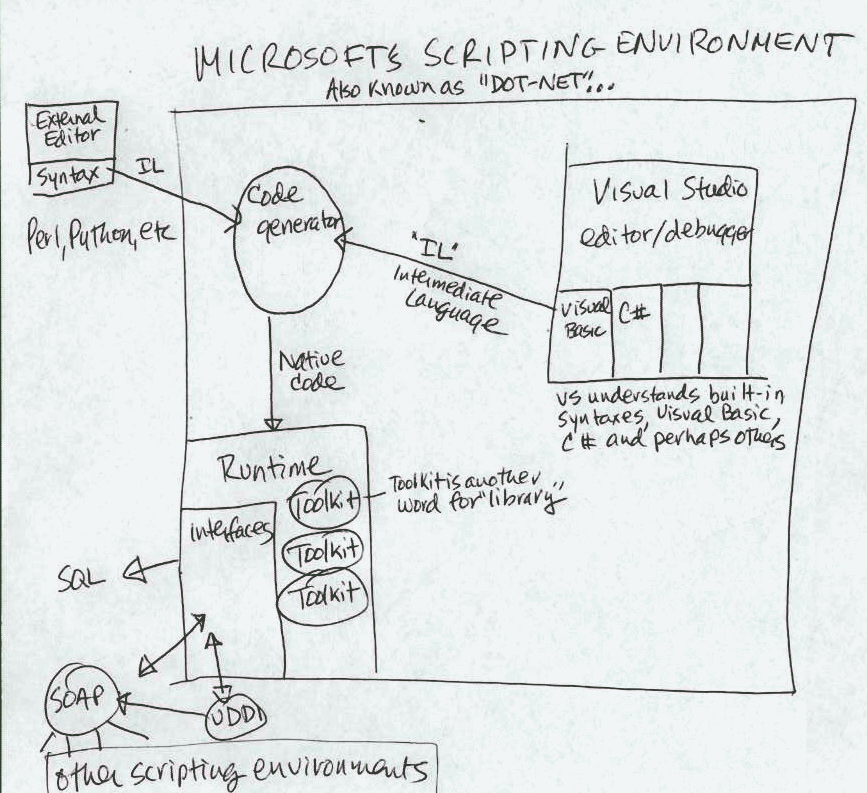
Dori Smith: "Neither the Weblog Filter nor the Weblog Favourites have updated in the last two days. I suspect there's a problem with the Weblogs.com XML files." Dori, there was a problem, I think I fixed it. The apps that are reading the XML files should start updating again after the 8PM scan. Craig Burton: "He he he. I love irony." Remember the old maps of the New World. In the 1500s the coastlines weren't well understood and it was a long time before they even knew there was a western coast. In that spirit, here's a hand-drawn map of Microsoft's scripting environment circa July 2001. Now that I have a scanner it's easier for me to do these. Tell me what's wrong or missing in the picture. At the same time, I'm working on a map of what I'm calling The Open Scripting Environment. In that map there's no single rectangle containing the goodness. A different philosophy, a zig to the zag. Thanks to Simon Fell for the pushback on the presence of the JIT compiler. Here's rev 2 of the hand-drawn map eliminating the bytecode interpreter. Note that some old maps of planet earth had the Garden of Eden. Nicholas Petreley: Microsoft's Bait and Switch. "I believe that Miguel de Icaza's enthusiasm for porting the Microsoft .NET development environment to open source as a project called Mono to be naive and potentially dangerous to the open-source movement." I share the same concern and expressed it to Miguel last week. However, if we can also link up diverse scripting environments with SOAP and XML-RPC, there's no reason to worry. Choice is key. Most non-Microsoft scripting languages will never run well inside Microsoft's environment. Make it easy for Perl programmers to participate in SOAP networks without leaving home. Same with Java, Python, Tcl, and everything else. Progress report. Python is on board. Things are looking good with Perl. We've started talking with Sun about baking SOAP and XML-RPC into Java. And there are more behind-the-scenes things that I can't talk about at this time that will alleviate Petreley's fear. Focus on the protocols, that's what's important. As long as we invest in diversity, Microsoft can't control. Instead of a one-party-system, let's have an n-party-system. That's how we guarantee choice, eliminate lock-in, and maintain forward motion. BTW, an interesting detail came out at the open source summit. Dick Hardt of ActiveState reports that Perl does not run well in Microsoft's environment. The problem is that Microsoft's virtual machine is designed to run C-like code, but Perl is not like that. Now I know the solution, we need a DLL-based open scripting architecture, that allows environments to compile and run scripts and have them call back into the environment, much like the architecture we developed on the Mac in the early 90s. Back then it wasn't so interesting because scripting was still pretty small, it was just us and Apple playing with OSA. Ten years later there's been an explosion, and there's another way, beyond XML-RPC, that's needed to integrate. It can be a tough sell to each individual community, as XML-RPC is, because the benefit is that it makes it easy to bridge to other environments. Most communities tend not to see too well outside their borders. But the larger world wants choice. No matter how great your scripting environment, you will eventually meet someone you want to work with who works in a different environment. I posted a subset of these comments on the Slashdot thread for Petreley's article. On this day last year Napster got a reprieve and I was happy!!
DaveNet: A $10 cab ride apart. Brandon Wiley: Freenet XML-RPC Interface. News.Com: "Digital rights management company ContentGuard said Friday it has received a patent for a 'digital ticket,' which lets copyright holders distribute and track people's access to digital goods such as music, video, e-books and images." Brad Templeton: "DRM allows a degree of control over publishing that's far beyond what existed in the paper world." 2/21/95: "I call these Great Hair days." 10/19/00: "How much money do you need to feel secure?" The Talking Heads: "They say they don't need money. They're living on nuts and berries." The Talking Moose lives on nuts and berries? BlackHoleBrain: "I'm sofa-king sick of hearing the phrase 'Gary Condit, who is not a suspect...' -- so SHUDDUP already!!!" BTW, there is a sofa-king.com. It's funny! The XML Bastard, aka Tom Bradford, strikes a blow for something, not sure what. I got my advance copy of Breaking Windows, and my quote made it onto the back cover. Thanks! Flangy: "Feel free to remove reports of my death." Upside: AOL wants to confiscate your Passport. Washington Post: AOL Might Join Identity Service Battle. Today's word: outliers. “Outliers make statistical analyses difficult.” MSNBC: "Microsoft Corp. will cut back dramatically on hiring in the coming year as part of a cost-cutting drive just as the software giant begins a major new product cycle that executives hope will reignite sluggish personal computer sales." Register: Symantec fails to stop SirCam. Doc: "I pause to observe that there are few pleasures more civilized than blogging naked over a fat line from a well-connected room in a fine hotel." Apparently I've been rated by the PTypes weblog as a hedonist. Coool!
New terminology thanks to a Doc-Dave collaboration. When you hear "ecosystem" instead say "egosystem" and see if it still works. Amazingly, it often does! New Scripting News sub-motto: "Destroying the English language for over four years!" National Post: "Ian Johnstone made his 17,500-kilometre trip from Australia intending to propose to Amy Dolby. But at the same time she was on her way from England to Sydney." Craig Burton's notes from day three at the Catalyst conference. Here are my notes from the open source summit on Tuesday and the Catalyst conference on Wednesday. Deborah Branscum: "Next to the soda machine sat the hot dog grill where a single swollen wiener rotated slowly in a greasy tribute to all the dogs that had come before it." PS: There's a Scoble-spotting in Deborah's essay. Yes yes he's still alive and kicking butt. Doc blogged the Craig Mundie speech in real time. Dan Gillmor blogged it too. And both got Slashdotted. Jeff Kandt built a clone of Manila's discussion group in Zope. Jon Udell: Kenamea's Application Network. Washington Post: "AOL Time Warner Inc. is moving aggressively to take advantage of Microsoft Corp.'s tenuous legal standing, seeking deals with computer makers to target consumers with subtle and direct marketing pitches that would help AOL grab more control of the computer desktop." Wired: "They were blinded by their love for open source -- and that kind of thing, no matter how happy it makes you, can't be good for a movement."
SAML, which I had not heard about before today, was much-discussed at the Catalyst conference. Borland: "Kylix Open Edition is the version of Kylix specifically designed for open-source development and for building applications that are distributed under the GPL." Paul Boutin is a senior editor at Wired magazine with a Manila weblog. Dan Gillmor spotted Mitch Kapor at the Open Source Convention. Evhead: "A dozen more SirCam emails today. I think the only way this thing is going to stop is if we create a disinfectant virus and release it the same way." Peter Gabriel: "Real is anything you see." (With apologies for mangling the quote. Gabriel doesn't actually say that. But that's what I heard.) Morning notes Good morning, rise and shine! Today's probably going to be a pretty light day on Scripting News. I'm giving a 25 minute talk on the state of distributed computing at The Burton Group Catalyst conference. That's a pretty awesome task, but then I realize it isn't. First, I'll explain why I wanted to have an open distributed computing protocol in 1998. Here's how that goes. We had just finished porting our scripting environment from Mac to Windows. Frontier and networking was always a big deal, but until we had a Windows version we could just use Apple's networking, and we did. We could have used Microsoft's networking, DCOM, but that would have had several disadvantages. First, we didn't know DCOM. Second that wouldn't help if you had a mixed network of Macs and Windows machines, and third, it was against our religion. By that time we had learned the lesson of the locked trunk very well. In 1998 we were Internet developers. The platform with no platform vendor. Like many other developers, in early 1998, I was playing around with XML, trying different ideas out and seeing what would stick. I was also very happy with HTTP, such a simple way to move information from one machine to another, so it was only natural to combine the two to create a distributed computing protocol. To make a long story short, I created a protocol, published an essay, Microsoft asked if we wanted to work with them, I said yes (of course) and the result was XML-RPC. We continued to work because they wanted more than that, and then came SOAP. Both protocols are in wide use now. This is a good time to review the state of distributed computing because it's not totally messed up yet. The Internet favors simple low-tech protocols and formats. The BigCos prefer (for whatever reason) very rich and constantly evolving protocols and formats. To me, distributed computing is all about choice and no lock-in. As the CEO of a SmallCo, I can afford to say this. I win if lots of other people win. To me, distributed computing is about apps that are implemented on Linux, Windows, Mac, Palm, and PodunkOS. Small and diverse is good. Use the best tool for each part of the job. We offer far more freedom to the user than any other way of doing it. To me, the key philosophy is inclusion. Remarkably, XML-RPC can work in every environment we've tried to make it work in. That is not true of SOAP, which has constraints that cannot be met by every scripting environment. And it is most definitely not true of SOAP plus WSDL. It's not much of a surprise, perhaps, that WSDL steers you into Microsoft's and IBM's favored environments. Microsoft and IBM developed WSDL behind closed doors and didn't include independent developers in the design process. This is why, to me, the distributed computing stack stops at SOAP. That's enough. For details see What is XML-RPC? in the foreword to O'Reilly's XML-RPC book.
AOL: "The Screen Name Service lets you create a single, consistent Screen Name, as your personal "ID", which you can use to safely, securely and conveniently access and personalize sites across the Web." BetaNews: "America Online is quietly rolling out a new unified sign-in service, similar to Microsoft's Passport, across its properties and partner sites. Codenamed 'Magic Carpet' and currently promoted as the 'Screen Name Service,' visitors will be able to sign in with a single click and seamlessly browse sites supporting the new technology." News.Com: AOL, Amazon join forces. Today's all-day meeting was exhausting but really good. It was a summit of leaders of the open source community. Lots of famous people there. Things are really changing there and here. Inclusion is the word of the day. Let's get developers included and working together, including the ones we're scared of. There's no time like now. Stefan Rinner: XML-RPC client for Lingo. John Robb: "Here is an e-mail UserLand just got from a developer at a large multinational." The Flangy News is still updating and The Talking Moose took a chance, though he's not talking about what it is. Glenn Fleishman: "The SirCam virus continue to send me more pieces of other people's lives." Zeldman's glamourous life: Coptown. Daniel Lundin: "XML-RPC client implementation in emacs lisp, capable of both synchronous and asynchronous method calls." Had a long dinner last night with Doc and Craig. We talked about kids, intimacy, sexuality, lessons that life has taught us, and would-haves and should-haves and if-onlys of years-gone-by. Craig and Doc and I are quite a combo. Yes yes it was about technology. I was telling a friend the other day that as life goes forward (we're in our 40s and 50s now) it gets richer. The insecurities that defined us in our youth are still there, but now we can see them, and there's a chance to take a deep breath, see what's really going on, and go through the fear. What's on the other side is even more responsibility, more fear-evoking, but worth it. We agreed (or seemed to) that inclusion is the watchword for the next steps. Make sure everyone who wants to play, can. Craig has a report on the dinner, and our brief conversation with Eric Raymond. Reminder to Craig and Doc, let's create a good name for the format we talked about. Hey Craig says he loves me. Right on and back at ya. I'm glad I got a new cellphone. As with the Macarena, I am the last person on the block to get a cheap phone that fits in your pocket. It's fun. I've found that I can send an email to a friend and say "be one of the first people to call me on my new cellphone," and they do it! I'm still learning. Last night Doc said "Your phone is ringing." I had heard it ring, but hadn't yet been trained to think "Is that my phone?" Now I wish the phone had an XML-RPC or SOAP interface, so I could keep my address book in Radio's outliner and write a script that transmitted it to the phone. I don't think the technology would be hard. When will I be able to buy a phone that does this? (Maybe never, as far as I'm concerned there still isn't a good Draw program for Windows, or a scanner that's simply an HTTP server.) If you work for a cellphone vendor consider this a feature request from a geekish newbie. Brent: "The worst thing I ever saw -- and I saw this many times -- was a well-dressed man and a woman leaving their table, man first -- and then the woman grabs a few dollars from the tip lying there on the table and squirrels it away. Her petty grab is unseen by the man, who's invariably smiling and leading the way to the door. A good joe, prolly."
Updates will be sporadic through Wednesday. I'm in San Diego for The Burton Group Catalyst conference where I will speak about SOAP and XML-RPC on Wednesday. I will also be at the private Open Source summit-within-a-summit tomorrow. I just spent two hours talking with Craig Burton and Doc Searls. I had never met Craig face-to-face, and it had been too long since I had seen Doc. We're going to get a group of people together tonight for more plotting and scheming. I've gotten a few requests for a Scripting News dinner in San Diego, but it doesn't look like it's going to come together. Tonight I'm having dinner with Doc and Craig and Eric Raymond, and maybe Scott Sweeney who's a webmaster at microsoft.com. Tomorrow I'll be over in O'Reilly-Land, not sure when the meeting is over so I can't plan a dinner. Also, I will not be able to make the Identity BOF at O'Reilly on Wednesday night, I'll be back in the Bay Area by then, but if you're at their conference, I encourage people to go and continue (as Doc would say) the conversation. Lawrence Lessig: The Limits of Credibility. Chris Ashley: Weblogging -- Another Kind of Website. Wired: What if Napster was the answer? "Doubts are so strong about the future that some record industry bigwigs are wistfully longing for the good old days of Napster." Jerome Camus lives in Italy, comments on the events in Genoa and Lance Knoble has experience running Genoa-like events.
Even though The Flangy News has been operating for over a year, I just found out about it in the last few days and made my way through the archives, finding a very interesting glimpse into the life of a random Microsoft person, Adam Vandenberg. It's beautifully written, reminds me of Microserfs, simple and personal and programmerish. Vandenberg doesn't want his documents stored in the cloud, he's not awed by the celebrity of Microsoft's leaders, and wonders out loud if they have a clue about anything. I sent an email yesterday asking if he was concerned if I point to his site, and he said go for it. BTW, welcome to the new world, I hope. When people ask what's next, I quote last Sunday's Times Magazine article where they talk about hierarchies vs pancakes. In the next rev of business, it's going to be less hierarchic. Do I see it returning to "normal" after the dotcom mess. No, in my heart, I don't. The weirdness isn't over, if anything it's going to get even more weird. Sean Gallagher: "Adobe's behavior is, while within its legal rights, reprehensible from a human rights standpoint and demonstrative of how big software companies plan to use the DMCA to let loose the power of the state on smaller companies that get in their way."
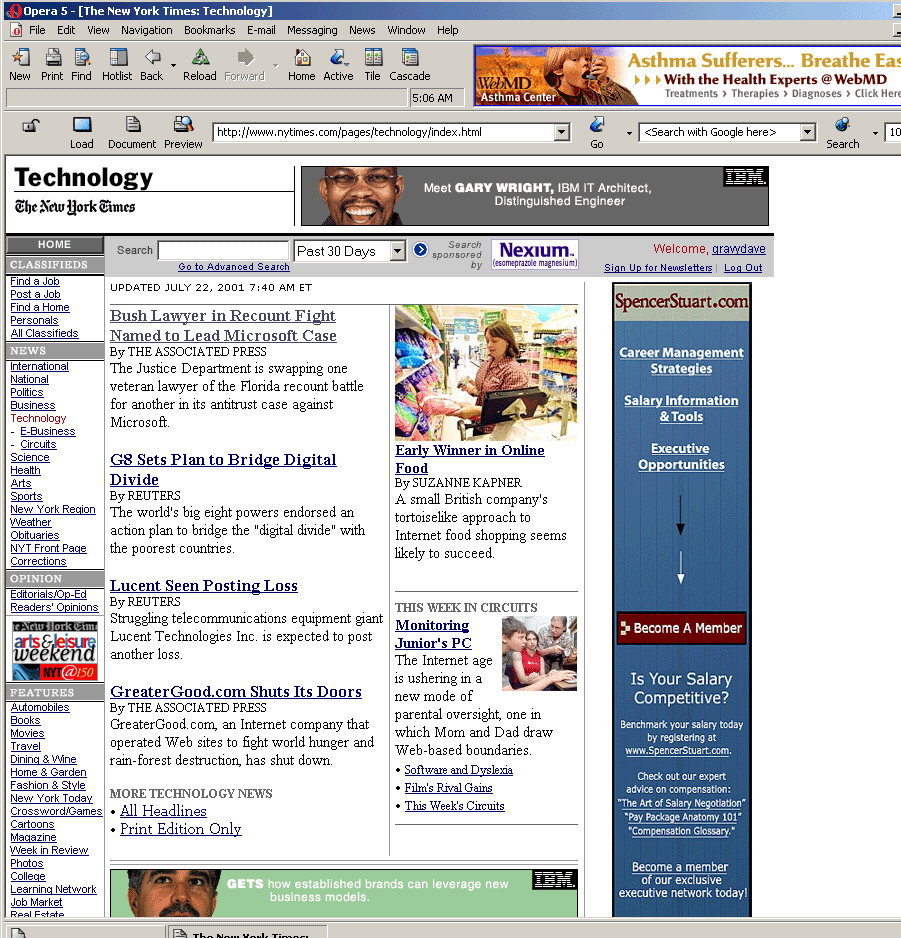
JFK: "And so my fellow Americans, ask not what your country can do for you, ask what you can do for your country." Tevye: "Lord, who made the lion and the lamb, you decreed I should be what I am. Would it spoil some vast eternal plan if I were a wealthy man?" Random question. Which was more interesting, AI the network of fake websites, or AI the movie, starring Haley Joel Osment. Isn't it weird that you can ask a question and omit the question mark. A Doc-rant on venture capital in the Valley during the boom with a link to this Dave Barry article with a Jeff MacNelly cartoon that's as good a bookmark for the lunacy as any I've seen. The Talking Moose's post-dot-com Marketing Manifesto. Something changed at the NY Times. Look at all the ads. Now look at the articles. Reuters, Associated Press. Old boring articles in the right margin. After the recent redesign, the quality is really suffering. I can get the same stuff anywhere. I have a sinking feeling that there's some new original content in today's print edition. Oy. I smell a premium service coming, which sucks, because I can't point into premium services. One year ago today, a great essay from ex-Softie Joel Spolsky. It's also worth noting the huge high that was coming one year ago, from the newly accesible music thanks to the now-virtually-defunct Napster. "When the music industry comes to its senses, and decides to like their users again, they can make it up to us by shipping CDs with MP3s on them. Help the hardware industry transition to the new format. Sales will double. What a relief, we're not at war anymore." Simon Fell: "Obviously, Dave is the Talking Moose." Brent: "It turns out that Simon Fell is the Talking Moose!" Without much fanfare Microsoft released the source code for Windows CE. As Jake said when I got my new cellphone, I wonder if hell has frozen over too. The license, which is quite short, and makes no mention of the GPL (I was surprised about this) provides a clue to the motive behind Microsoft's new "shared source" policy -- patents. "If you sue anyone over patents that you think may apply to the Software for a person's use of the Software, your license to the Software ends automatically." Men are from Mars.. I'm re-reading Men are from Mars, Women are from Venus. It's certainly a thought-provoking book. Mostly a how-to, but buried between the checklists is a bit of wisdom. Martians run in cycles of wanting intimacy and not wanting it. This is disturbing to the Venutians, who have a different cycle, for a while they feel good, then they don't feel good, but they want intimacy all the time. It can be hard for a Martian to listen when the Venutian is feeling bad, largely because we don't understand how they use the language. Feelings hurt, to the core, the Martian goes into his cave and the Venutian drops into her well, neither feels appreciated, trusted, cared for, supported or loved. Enough times through this loop and each gives up and accepts a normalcy which is dull, isolated and unhappy. Now here's the wisdom. There's a lot of this going on. Anyway, it's a lovely book, a reminder of how imprecise language is, and how raging feelings of insecurity are underneath our masks, at times. It's admirable to desire independence, for sure, but we are, realistically, dependent on others for a sense of self-esteem and self-love. We seek out mirrors to tell us that we are visible and deserving of love. This book is such a mirror. Now men may be from Mars and women from Venus, but John Gray's website is from hell. It's one of the most over-designed dotcom-boom-era tragedies of popup windows and useless hierarchy. I feel unloved. I'm going into my cave now.
Essay for the 20th Anniversary of the PC: "[In 1983] I was working on the Apple II, and totally confined by its 48K memory limit and 140K floppy drives. When I got my first PC it was a huge feeling of liberation." Talking Moose: "Let's assume I had $100 million to invest. Where would I put it?" The Head Lemur: "Photoshop, Illustrator and Pagemaker are very good tools. But they are not the only tools out there." IBM UDDI Registry is a "UDDI-compliant registry for Web services in a private intranet environment." MP3 Newswire: Napster Clones Crush Napster. "Ever since Napster started filtering songs from its service, users began exploring alternative file trade programs." Phil Jones explains what the Genoa protests are about in terms that make sense to me. Thanks Phil. One thing I've learned in the last few years is that the US is viewed in Europe much as Microsoft is viewed here, that's why Phil's analogy works so well for me. Like a random Microsoft employee we're supposed to know more, our brands dominate, there's much resentment of us, and our errors are amplified. And like Microsoft, there's a diversity in the US that may not be easily visible if the only sources of information are the BigPubs. They love to put bloody bodies on the home page, but often dumb-it-down to omit the real issues, which seem, these days, to revolve around freedom. Surprise: "The thousands of peaceful men and women, who came not to destroy but to demonstrate, are used by people who are driven by hate. The peaceful demonstrators have become living shields for them. The police has a very difficult task. All the important questions around globalisation have become secondary. Violence is first. Why and again why?" Now about Microsoft and the diversity it contains, I've been emailing with David Bank, the author of Breaking Windows, which is due out next month. The book was written from transcripts of emails that were made public in the antitrust trial, and offer a glimpse of how Microsoft works, in the words of Bill Gates, Steve Ballmer, Jim Allchin, Brad Silverberg, Adam Bosworth, Paul Maritz, Ben Slivka and hundreds of other Microsoft people, while the wars with Sun, Netscape, and the US government were raging. Sometime in the next couple of weeks an excerpt of the book will appear in the Wall Street Journal, and David has kindly allowed us to run an excerpt on Scripting News after that. Now I've been working in the same ecosystem as Microsoft since 1979, and even so, this book opened my eyes in a new way. I gave my review copy to a friend I trust, who also watches Microsoft, and his eyes opened too. Now I have more meaningful conversations with current and ex-Microsoft people. I have a better idea of how their sausage factory works. But most people outside Microsoft remain as clueless as ever. In many ways Bank's book is a clearer roadmap of what awaits the technology industry than any keynote given by Bill Gates. If you want to understand how the technology economy works, it's a must-read. I started a new mail list to discuss Bank's book. Wired: Adobe Tries to Quell Protest. "Even if Adobe has a surprising change of heart, the U.S. Attorney for Northern California would need to be convinced to drop the charges. He happens to be Robert Mueller, President Bush's pick announced earlier this month to succeed Louis Freeh as FBI director." Patrick Scoble: "Welcome to the Internet Hut."
It's Friday and that means several things, including freedom from You-Know-Who. I swear this will be the only mention on this page today of that big attention-hogging company from Seeee-atttt-le.
Reuters: "China has shut down nearly 2,000 Internet cafes across the country and has ordered 6,000 to suspend operations and make changes, state media said on Friday." Internet Librarian conference, Nov 2001, Pasadena, CA. Tim Jarrett: "HTML allowed people to share information easily and enabled people to get connected to each other on the Internet. Just as HTML described how to allow people to access information in an intuitive, graphical way, so XML-RPC describes how to allow different computer programs to talk to each other across the Internet. It's scalable and robust, it's an emerging standard. And Apple is baking it into the OS at a very low level." It's Friday so here's a casual survey. "Do you want freedom from You-Know-Who?" David Weinberger: "CoolBoard has no way to export the messages on a board. So, to preserve the contents, I have to open every message and do a manual copy and paste." NY Times: "The record industry's largely successful effort to cripple Napster, the online music site turned social phenomenon, has left it facing something potentially worse: a new generation of music-swapping sites, more numerous and much harder to police." Lots of people recommend Audio Galaxy. I haven't installed it yet. I'm thinking of giving it a try. Gilles Lalonde: Spyware-infested software. Audio Galaxy is on the list. WinMX is a "free file-sharing program like no other." Edd Dumbill: "Sun is big enough and nasty enough to slug this one out for itself." Exactly. ZDNet: "Tony Goodhew, a program manager in [You-Know-Who]'s developer products group, has warned that licensing problems might result if open source code is mixed with [You-Know-Who]'s .Net software." WebReview: PythonWorks 1.2. "PythonWorks Pro is quite a bit different than most any IDE or text editor you've used before. Its use of docked panes is somewhat reminiscent of the style of [You-Know-Who] Visual Studio, but the dominant metaphor is of a Web browser." News.Com: "Almost 12,000 Web servers have been infected by a new Internet worm that takes advantage of a security flaw in [You-Know-Who] software to deface sites, security experts said Wednesday. The worm could also help attackers identify infected computers and gain control of them." We run Frontier and Apache at UserLand. Eastside Journal: "[You-Know-Who] was on red alert yesterday, tracking down a new Internet virus that was launched to attack the White House Web site." Now, I'm pretty sure that Brent is not the Talking Moose, but.. Brent: "I'm the Talking Moose." It's even worse than it appears.. Mike Donellan: "I AM the *real* talking moose!!!" Speaking of moose, I had a friend a long time ago who was very tall and skinny, so I gave him a funny nickname, Moose. He was anything but a moose. Another long-lost friend, Ray Coop, and I used to have a routine about Moose. I'd ask "Have you heard from Moose lately?" Ray would say "Yes, and he says you owe him money." So I wonder what became of Ray Coop. I don't want to know what happened with Moose.
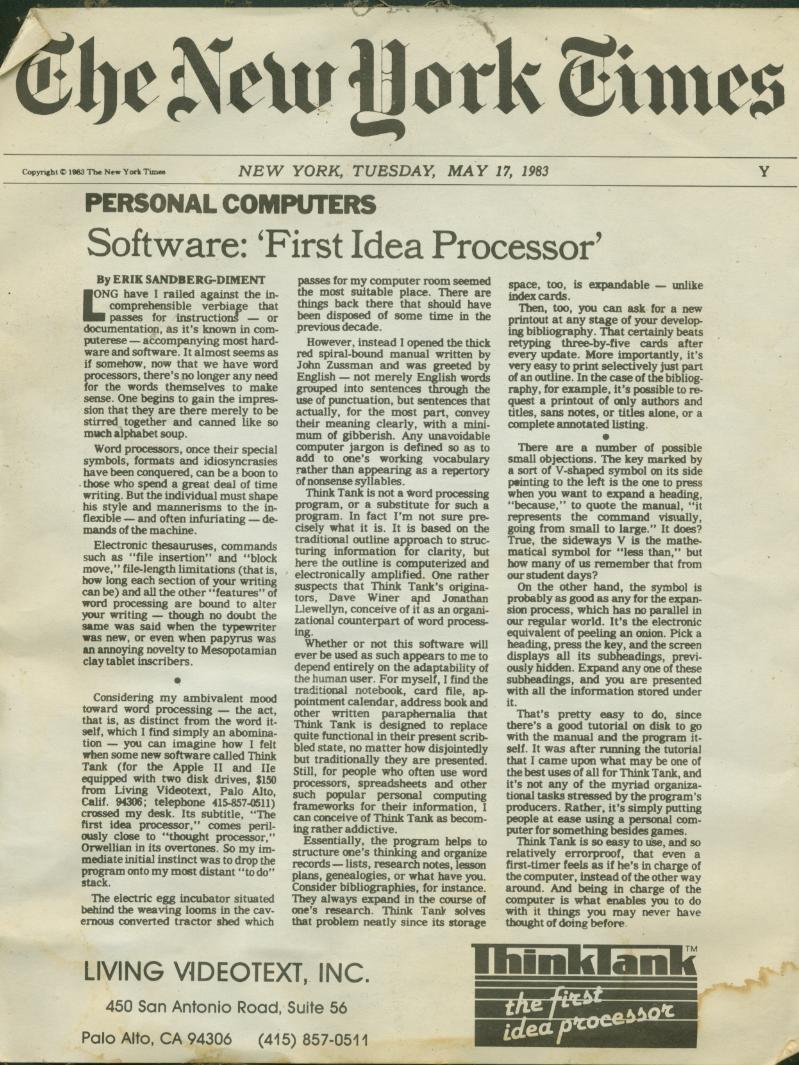
On this day in 1999: The Bees Are Back. "Every year I write about them when they reappear. Every year they teach a different lesson." Update for Bee Season 2001. We had a few bees at a BBQ on Sunday, but it wasn't too bad. They're not really here yet. BTW, it's great to have a working telephone, but it turns out that the repair guy from PacBell who broke the phone yesterday also gave me some other person's business card. A friend called him yesterday when I published (briefly) the phone number on Scripting News. Let me repeat that so it sinks in. He gave me someone else's business card! Wow. I got my new cellphone today, and at the same time I got a working scanner. The first thing I scanned was a NY Times review of ThinkTank from 1983. Hey it's legible.
Webby: 2001 winner speeches. (All are five words or less.) Ananova: "A married couple in China ended up brawling after realising they had unwittingly courted each other over the internet."
Clay Shirky wants the Windows OEMs to bundle Java. Survey: Is the Java VM essential? BTW, I disagree with Dan and Clay. I am in favor of blowing the holy bundle of Windows+MSIE+Java+Flash to bits. This would create room for new networked environments. Edd Dumbill: "With a large body of implementation experience, surely the time is ripe to slim SOAP down, throw away the bits nobody can understand, and be done with it." Maybe Edd would be interested in A Busy Developer's Guide to SOAP 1.1. Instead of going to the Webby awards last night I watched Any Given Sunday, and really liked it. It was all about teamwork. Young people working with old people. People being true to themselves and winning because of it. Bill Seitz: "I am not the Talking Moose." Last year on this day I threw in the towel and went crazy along with everyone else. I eventually got over it.
NY Times: Microsoft asks court for rehearing. "The company asked the court to reconsider its conclusion that Microsoft had improperly commingled software code between its Internet Explorer browser and its Windows operating system in such a way as to make it functionally difficult to remove the browser." DaveNet: Microsoft blinks in antitrust case. "Can Microsoft continue to control the Web through the browser or will they end up losing their monopoly in this key area?" 7/12/01: Restoring competition to the browser market. The rest of today's news DaveNet: Apple on Board! Steve Zellers posts more info on Apple's SOAP and XML-RPC work. Talking Moose: Acquisition Madness. BoycottAdobe.Com: "Adobe helps graphic designers turn ideas into art. Adobe also helps turn security experts into felons." Dmitry Sklyarov's presentation at Def Con Nine.
AP: "Britannica.com will soon start charging $5 a month, or $50 a year, for access to the full encyclopedia, which has been available for free online since the site launched in October 1999." ApacheToday: mod_xmlrpc. Bill Seitz: "Sometimes recent Microsoft behavior seems like a conspiracy to totally discredit the Dept of Justice by engaging in unbelievably outrageous behavior, daring them to take action. It's like somebody actually raping Kitty Dukakis on camera, watching Mike to see what he would do." News.Com: "Apple Computer Chief Executive Steve Jobs unveiled speedier iMacs and Power Macs during his keynote speech Wednesday at the Macworld Expo here, though the announcements lacked the punch he usually offers at the trade show." Wired: "The battle between teaching students how to cover a sewer commission meeting and/or teaching them Dreamweaver Web page production has opened some deep fissures." News.Com: Tellme cuts staff, loses co-founder. "The action marks the second round of layoffs in the course of the company's gradual shift in business strategy away from consumers and toward large companies such as airlines and telecommunications companies." Dan Gillmor is totally rolling today. Pablo Picasso: "Computers are useless, they can only give you answers." Kuro5hin: "Late one college night after sharing a couple pitchers of beer, a friend of mine told me straight-faced that the Smurfs - those lovable blue nice looking troll types - were actually communists." Patrick Scoble, age 7, came for a visit on Sunday with his father Robert. Patrick is impressed with the squirrels in my forest. He wanted to know if the they take their orders from me. I said no, they don't even know I exist, and if they did they certainly wouldn't care what I think. BetaNews: Microsoft XML Parser 4.0. More news feeds on the Newsfeeds weblog. Andreas Neumann: Comparing Flash and SVG formats.
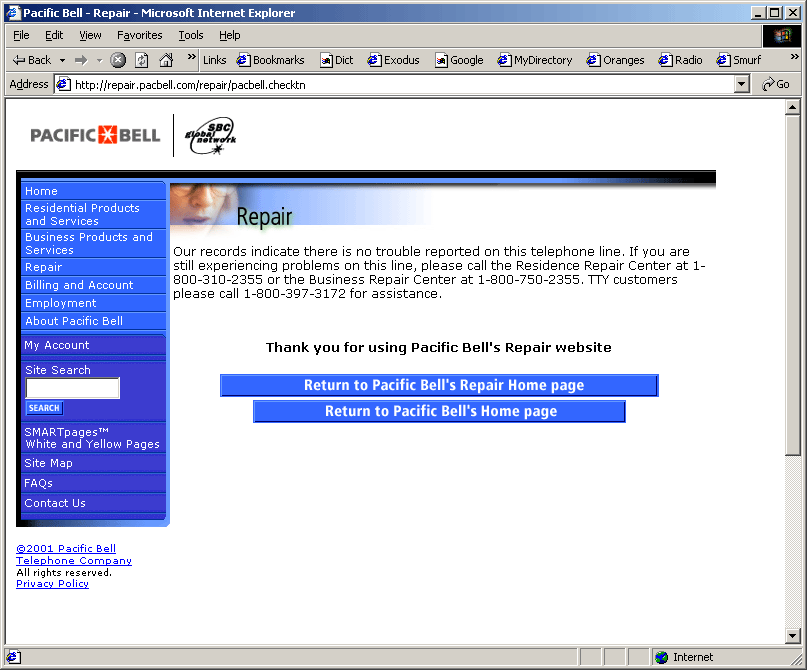
DaveNet: Distributed Membership and Preferences. If you have comments re today's DaveNet piece, please post them on the XML-RPC discussion group for all to read. Or you can post comments on Slashdot. WSJ: Microsoft unbundles Java. "Microsoft Corp. is quietly pulling back support for Java in its new products, dealing a new blow to a rival technology that played a starring role in the software giant’s continuing antitrust battle with the government." News.Com: "The FBI took a Russian encryption expert into custody Monday at his hotel in Las Vegas for allegedly publishing software that cracks a variety of methods used to secure e-books." Joel Spolsky: Good software takes ten years. "Now the trouble comes when you can't think of any new features, so you put in the paperclip, and then you take out the paperclip, and you try to charge people both times, and they aren't falling for it." Oy my phone line is totally dead, and the only option PacBell's website offers is that I call them. Oy oy oy. Adam Barr: "What Microsoft is proposing is that people take information stored on their local machines (accessible for free), put it up on a server, and start paying money to access it. Does this make sense?" Hugh Peebles: "During a recent move I came across two articles, published several years ago, with predictions and suggestions about the future of the Mac." Benjamin Franklin: "Three may keep a secret, if two of them are dead." Metafilter thread on TopText, a successor to Smart Tags for most insidious hack to the Web of 2001. Harrumph: "When I was eighteen, I sat down and wrote a letter to myself, to open on the eve of my thirtieth birthday." Dan and John
Now the philosophy. We all have things to apologize for, but how many of us actually do it? None of us are perfect. What was Doerr supposed to do when the public went crazy for Internet stocks? (Another valid spin on the events.) Tell them no? That would have taken a lot of courage, and his partners would have encouraged an early retirement for John, no doubt about that. Look at how the Netscape strategy was focused on software sales and profitability before their landmark IPO. Doerr, as a director at Netscape, was applying earlier precedents to the valuation of the company. But the market valued Netscape for much more than their earnings and revenue. So he was just part of a ouija board, and when I go looking for blame I come up empty-handed. In other words, Doerr was being generous, and philosophically, when someone is generous, accept it and thank them. Yesterday I sent an email to Doerr saying exactly that, and also saying that the work that Netscape started is unfinished, and that might be a good theme for the restarting of the Silicon Valley technology engine. 5/4/95: "I forgive you!"
Good morning and Happy Monday! Henry Norr: "A Web browser is really just an application, not -- or at least not necessarily -- an operating-system function. That should have been obvious all along, but Microsoft did its best to hide it under a torrent of nonsense about technical necessities and user convenience." SJ Merc: "Silicon Valley's highest-profile venture capitalist, John Doerr, publicly apologized Sunday for his famous statement that characterized the Internet as 'the largest legal creation of wealth in the history of the planet.'" News.Com: "The big question is whether Apple will have the flat-panel model ready in time for CEO Steve Jobs to introduce it during his keynote speech Wednesday morning." NY Times: Online journalism comes of age. "But readers still rely heavily on professional editors from trusted news organizations to provide them with local, national and global context." Heh, I wonder if one of the Times' editors added that sentence? Seriously, when you read an article in a BigPub, don't assume that the person whose name is on the article said or even believes what the article says. There's a mechanism called Dumbing It Down or (more positively) Everyone Needs An Editor that keeps weird ideas out. No wonder people are doing it for themselves. Somehow the BP's always miss this angle. You don't even have to write an article for a BigPub to see this. I recently was mentioned in US News and World Report. Exchanging emails with the author after publication, he told me about an intermediate edit of the article that mangled my position so much as to flip it around not quite but close to 180 degrees. They had me as being in favor of something I am totally against (the split of Microsoft into an apps company and OS company). It wasn't intentional, so the story goes, it's a print pub and they needed to shorten the article. I was lucky that the author of the article is also a weblogger, and a reader of Scripting News. He knew I would have just about exploded if they ran the quote the way they almost did. WSJ: "If settlement talks resume, the government will hold a strong hand as a result of the June 29 appeals-court ruling. The court upheld the core of the government case, finding that Microsoft acted illegally to protect its Windows monopoly, even as it reversed a court-ordered breakup and removed the trial judge." IBM: An overview of the reliable HTTP protocol. ComputerWire: "Stutz said that Microsoft supports Ximian's work, which he called a 'testament to the openness and viability' of the .NET platform. He said that Ximian's work potentially gives developers a choice of .NET platforms - Microsoft or Mono." I've been invited to participate in the next Open Source Summit, on July 24 in San Diego. So now, when I criticize the leadership of the open source community, I'll have more objectivity, because to some extent I'll be criticizing myself. All kidding aside, I'm very appreciative. Now that the kimono is opening, I can see that I owe a lot of gratitude to Eric Raymond, who said XML-RPC is a "good example of the open source model working effectively." That's how I see it too. Nicholas Riley: WebDAV filewriter for Frontier. Sjoerd: Event handlers and callback functions. NY Times: Microsoft Adversary to become FTC Official. Things are really rockin in DeveloperLand. People seem to like the DMAP doc. Stan Krute, an ex-Microsoft person pointed out that I have a strung a bunch of these together, but please don't miss that there's a spec behind DMAP. A lot of people saw the need for a unified model for membership on the Web, but we need a catalyst to drive unification, and that's Microsoft. The key is interfaces. LDAP, XNS, Manila, even Passport, can all fit behind a common interface for membership and prefs. Unification does not need to happen at any lower level. It should be easy for any network app to have membership and prefs. That's the point. There's more coming. Membership and preferences are just part of the roadmap for XML-RPC and SOAP. On this day in 1935, the first parking meter was installed in Oklahoma City, USA. NY Times: "AskMe soon found that it was able to tell a lot about a company from its approach to the new software. In pyramid-shaped hierarchical organizations, the bosses tended to appoint themselves or a few select subordinates as the 'experts.' Questions rose from the bottom of the organization, the answers flowed down from the top and the original hierarchy was preserved, even reinforced. In less-hierarchical pancake-shaped companies, the bosses used the software to create a network of all the company's employees and to tap intelligence wherever in that network it happened to be. That way, anyone in the company could answer anyone else's questions. Anyone could be the expert. Of course, it didn't exactly inspire awe in the ranks to see the intern answering a question posed by the vice president for strategic planning. But many companies decided that a bit of flattening was a small price to pay to tap into the collective knowledge bank." Yet another Scripting News satire. It's nice to be so loved.
Welcome to Children's Day on Scripting News! NY Times: "The Internet was enabling a great status upheaval and a subversion of all manner of social norms. And the people quickest to seize on its powers were the young." Good point. Yesterday I was in Blockbuster renting movies of course, and there were tons of young people, all kinds and shapes, but they all had one thing in common -- cell phones. This is something new for me. I tried to imagine how my grandfather would parse this. They're all talking to people they're going to watch movies with, presumably. Or talking about the date they're going to have, or just had. Their consciousness is not really in the video store. Now back when I was a teenager we didn't have video stores or cellphones. Just the three standards: sex, drugs and rock and roll. As they say, we made our own entertainment! I think every generation says that when they reach my advanced age. (46) John Robb: "Marie wants her Yahoo mail. Aaron wants to go onto Battlenet. Good thing my three youngest daughters aren't online yet, but that will change and I will be even deeper in shit."
New document! Distributed Membership and Preferences. "Developers are now faced with a choice -- support Microsoft's membership system, and thereby feed customers to them, or develop an open, clonable and decentralized system, so that membership is a competitive space, not owned by one or two large companies." XNS is on our radar. While I was writing the DMAP article, linked above, I was also emailing with developers of XNS, Adam Engst and Drummond Reed. At the same time Wes was digging into the site, looking for specs, and came up with bupkis. I posted the emails from Engst and Reed on Wes's site. Reed says "Dave's message is revealing that MS must know this is inevitable." That deserves an explanation. In an earlier email that Reed received forwarded from David Strom originally sent to David Farber and Dan Gillmor (hence it was clearly a public utterance), I said "This is one of those places where Microsoft may knowingly be a catalyst. In 1997 I had numerous meetings, emails and phone conversations with Microsoft people about exactly this issue. It's possible that they would support a decentralized approach, but realistically, until they moved, there would have never been a critical mass of interest in solving this problem." US News: "Chairman Bill Gates, a bridge enthusiast, has never been one to show all his cards." Robert Loch: "Hailstorm can be described as a lot of things. Me? I would characterise it as the most ambitions attempt ever by a wolf to slip into sheep clothing." Talking Moose: "I'm just a stupid old Moose sitting in a mud bog in Wyoming. What do I know?" Move your moose around on Don Hopkins' Run On Sentence.
MSNBC: "The Justice Department asked the U.S. Appeals Court Friday to fast track the new hearings in the Microsoft antitrust trial, and immediately send the case back to the lower court to decide whether Microsoft should be broken up." Mike Donnelan: "Why aren't writers suing the public libraries? Maybe the more important question is why do people still buy books?" Oliver Breidenbach is running his own Mac OS X server and Manila and his weblog. Evan Williams: "I wasn't terribly surprised to learn that 83.6% of Blogger visitors use IE5.x." Portable.Net: "The goal of this project is to build a suite of open source tools to build and execute .NET applications, including a C# compiler, assembler, disassembler, and runtime engine. The initial target platform is Linux, with other platforms to follow in the future." A question for people who know Perl and Python. Kenyett Avery: "XML-RPC is important not because it offers new features, but because it makes using the existing features painless. Sure, I could write a CGI script and a custom client, and it wouldn't even be hard. But I don't *want* to. I'd much rather write a couple of procedures and let the XML-RPC library handle the details, leaving me free to concentrate on the real work." The Perl community is considering integrating XML-RPC into its standard installation. I've been emailing with Nathan Torkington who's leading the discussion on behalf of XML-RPC. We're also updating the list of deployed Web services implemented in XML-RPC. To be clear, we would like to see Perl support both XML-RPC and SOAP 1.1. Choosing one over the other is largely a religious matter, both have substantial installed bases, and Perl developers are likely to want to use both in the future. I also learned that PHP includes XML-RPC support in its standard installation. Add to the list, which includes our own Frontier and Radio UserLand, and (coming soon) Python. It would be great to add Perl. Sjoerd: Higher order programming in JavaScript. Victor Stone: "I worked in the recording industry for huge record companies for 12 years before I worked for huge software companies for 15 years. I feel confident in saying that (with the possible exception of campaign financing) few arrangement are a better example of legalized corruption than a recording contract. A lot of civil disobedience is required to get back to sanity." Miguel de Icaza: "Microsoft Passport is a centralized database hosted by Microsoft that enhances the consumer experience with the Web by providing a single logon system that they can use across a number of participant web sites." Stewart Alsop: "Insidiously, incrementally, Microsoft is getting more and more of me." This article on OS Opinion is likely to start a valuable discussion. Can you compete in a world with Microsoft with no roadmap, no articulated vision, and no product marketing? Miguel's piece on Passport, linked above, is a beginning for product marketing for open source. I wrote an essay earlier this week that gets the ball rolling too. The Halloween memo: "When describing this problem to JimAll, he provided the perfect analogy of 'chasing tail lights.' The easiest way to get coordinated behavior from a large, semi-organized mob is to point them at a known target. Having the taillights provides concreteness to a fuzzy vision. In such situations, having a taillight to follow is a proxy for having strong central leadership." I sent Miguel an email yesterday saying (among other things) that we owe a debt of gratitude to Microsoft for helping us find a way to work together. We all have some taillight-chasing to do now, but there is a zig to Microsoft's zag. One more time, with feeling, Let's Work Together, that's the zig. Interestingly all the mottos apply. Let's Have Fun; Ask not what the Internet can do for you, ask what you can do for the Internet; It's even worse than it appears; and There's no time like now. Annie Lenox: "You can have it all but you still won't be satisfied." This is the perfect song. I could have quoted eighteen different lines. They all add up to the same thing. Jump off the cliff, leave the parachute behind. It's worth noting that the NY Times has finally said something on its editorial page about Smart Tags, but they haven't told their readers why they are so alarming. Again, the Times has taken a back seat, and also gotten the facts wrong. Smart Tags are not an "aspect of Windows XP" and they are not an "application" -- they are a feature of IE 6, their withdrawal has been promised, but I'm from Missouri, until they're actually out I'm not a believer. Reuters: "Brazil's most famous playboy -- a bon vivant who in his heyday seduced beauties like Marilyn Monroe and Rita Hayworth -- is on the skids and taking his first job at the age of 85."
DaveNet: Restoring competition to the browser market.
I bet Aladdin will sell a lot of these. JD Lasica: "When should webloggers freely quote from private e-mails they've received?" Rich Santalesa: The war over 802.11x security. "With a utility like Marius Milner's nicely done Network Stumbler, pinpointing and cataloging any [access point] in the area is child's play." Gotta love it. Mike Swaine has a new macro. Where ever he would type "Microsoft" he now types "Illegal monopolist Microsoft." I wonder if he could program the temporarily defunct "Smart Tags" to do that substitution for him? Jon Udell: Web namespace design. "As I was writing last week's column, I checked my homepage for a reference to an earlier column, but the link was broken. Say what? I soon found, as some of you have also found, that a planned migration of Byte.com (from TechWeb's content management system to Dr. Dobb's CMS) had altered the former namespace." InternetWeek: "Customers of Exodus Communications are creating contingency plans as the Web hosting provider prepares to report results that underscore its declining financial health." Dan Gillmor: "Years after it would have made a difference, Microsoft is offering something that its own executives have called meaningless. If this is progress toward a competitive marketplace, I'm Steve Ballmer." He went on to say: "You can put makeup on Dracula, but he's still Dracula." Jim Roepcke said: "In a related story, He will no longer require rain in the weather forecast." MetaTalk: What's an RSS Channel?, and Why? Douglas Rushkoff: "The Internet is for amateurs." Joni Mitchell: "It always seems so righteous at the start, when there's so much laughter, when there's so much spark, when there's so much sweetness in the dark."
DaveNet: Bear Stearns and Me. Eric Raymond: "Fredrik Lundh's xmlrpclib was checked into the CVS tree for Python 2.2 this morning after about the fastest and most unanimous endorsement I have ever seen on python-dev. I am writing the library documentation even as we speak." The discussion on the python-dev list is fascinating. Fwiw, I would like to see Python include both XML-RPC and SOAP 1.1. I agree with Raymond that it's good politics, it's almost entirely a political thing to offer users choice in connecting components across all kinds of boundaries. Today's song: "Give us a wink and make me think of you." eWeek: BEA to acquire Crossgain. Inside.Com: "Facing a cash crunch, probable Nasdaq delisting and a stock price which values the entire company at under $2 million, Salon Media Group, Inc. -- the renamed parent of Salon.com -- would appear to have all the ingredients needed for a takeover attempt done on the fly. As it happens, one arrived last week from doppelganger corporation Salon Holdings LLC -- a one-man shell company that would buy Salon, fire the majority of the 37-member editorial staff and replace them with syndicated articles from magazines like the Atlantic Monthly and the New Yorker." Evan Williams: "Sitting here, I feel like the new guy who just started a new job. Except, I don't have to do anything. Actually, I have to do a lot of things, just not with these people. And I don't get paid like I had a new job. But did I mention the view?" Reuters: Microsoft to allow Windows alterations. "Microsoft Corp. said on Wednesday it is changing how it licenses its Windows operating system to computer makers, allowing them to remove its Web browser and make other changes." Key question: Can the OEMs remove Passport? Microsoft's press release. I almost got a BigPub to run my proposed remedy calling for a separate BrowserCo and for Microsoft to take responsibility for WINE. Now another pub has expressed interest. The proposal could be distilled into 500 words. Today's plan from Microsoft would have solved the problem in 1996, but it's too late now, a much stronger remedy is needed to restore competition to the browser market. Jeremie Miller started a mail list to work on using Jabber to transport remote procedure calls. David Reeves: "In your dotcom survivor survey, you forgot to include a choice for 'people who now work for the BigCo that acquired their dot-com.'" What is DotGnu? Guardian: Moreover chief steps down. On the FoRK list, Clay Shirky posts conclusions about XML-RPC as compared to HTTP, Mark Baker responds, and Dave Winer (that's me) amplifies. Jeff Walsh: "The other day, I went to order my venti soy chai tea latte and something amazing happened, I heard two people sitting in Starbucks discussing.. a book." Last night I went to the EFF party in SF. I stopped going to tech parties in SF around the time of the Pet-Food-Portal craze. "This is not high-tech anymore," I said to myself and anyone would listen. People talked about how their IPO was coming through any day, or if they were "pre-IPO" (had these people never heard of Murphy?) how they just raised $50 million for the next thing after pet food, without a clue what that was. That was late 1999 I think. So now there's been a hiatus, and the question I hoped to answer last night is "Will it come back?" I had hoped to see Howard Rheingold or Justin Hall or Mitch Kapor or Nat Goldhaber or Louis Rossetto -- but they weren't there. But there were a lot of familiar faces, and hugs and high-fives. After the MBAs and VCs we still have a culture. Sure there are more lines on the faces, more gray in the beards, but there still is a soul and a heart ticking. The EFF is a nice place for a reunion because while there is talk about money, it's about money for freedom, and if that ain't the heart of the Web, well, go sell some pet food to someone who cares. Highly recommended: Startup.Com.
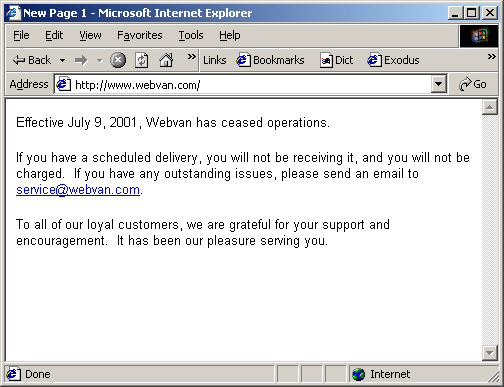
Survey: Are you a dot-com survivor? I talked with my dear friend Gretchen Dianda today, she's got a new job at CNET Radio, and she loves it. She played some of her tapes, giggling all the time. So cool, years ago she was the helicopter reporter for KGO covering earthquakes and mass murders, stuff like that. Hey it's wonderful to see my friends getting back on their feet. Gretch lost a lot in the dotcom bust, but her spirit came back alive and kickin. That's the cool thing about people, we're good at moving on. There's hope for San Francisco. I also talked with Eric Raymond this morning for the first time. It was a good chat. We have a two-step plan. First, he's going to help get XML-RPC baked into the distribution of his favorite scripting language. I'm not going to get into the politics there only to say that I obviously think it's a good idea. Then I'm going to write a spec that describes a simple SOAP-and-XML-RPC-based membership system and per Eric's request, license it as open source. Then we're going to work at getting it deployed in a lot of places. This is the beginning of a new level of working together. It's good it's good. Victor Stone: Crash and Trash. Shelley Powers: "In February I returned to Boston from a vacation in Tucson. I ended up taking three different flights and was very tired when I got home. I walked through the door of my apartment and was immediately met with the news: my employer, Skyfish.com, had closed its doors." Did you know that the Wall Street Journal has a weblog? This morning a rewrite and rename of yesterday's piece. I had to cut a lot to get to the point more quickly. If you're a member of a non-Microsoft scripting community, your environment can be boosted to .NET-competitive status simply by making SOAP 1.1 and XML-RPC a standard part of the install. There's no reason to switch or freeze or wait. Randy Stevens has a question about Python and XML-RPC. Aaron Swartz explains what's going on. Press release: Microsoft and VeriSign announce alliance. Register: Windows XP activation decoded. Wired: Why Webvan drove off a cliff. "When Webvan began making incredibly aggressive investments, that's exactly what investors were telling it to do," Cassar said. "Then Wall Street one day changed its mind, and Webvan suddenly found itself with an extraordinary amount of infrastructure and without the ability to get to profitability." A moment in time, worth preserving. Survey: "Are you going to more or fewer conferences this year as compared to previous years?" Pooh is "ready to explore the wild frontier. Irresistible to big kids and small. Imported."
DaveNet: Miguel de Icaza. Miguel de Icaza explains why he's interested in .NET. By the way, I don't usually name my essays after people, but with a name like that, how could I resist? Also I'm holding the piece until later tonight or tomorrow. I want to do some more thinking before releasing it. The Asher Group: site.wide.dig. "The goal is to create a web service demonstration, and a module for the ACS that would let any site call over to an ACS site and ask that ACS site to 'search itself' for something." Paul Andrews: "I also have a Real Job, freelancing for U.S. News & World Report." Computers say the darndest things. Jason van Zyl proposes that Helma XML-RPC for Java be included with Apache's Jakarta. Amazon has an order page for Windows XP. $99. This morning we did a conference call for analysts, venture capitalists and investment bankers with Chris Kwak of Bear Stearns. The subject was SOAP, XML-RPC, Web services, Passport, Hailstorm, Windows, scripting, developers, AOL, application servers, Frontier, Radio, etc. You can hear a replay of the call by dialing 888-888-9540 in the US, International 402-220-9917, PIN: 3336, through July 16. News.Com: Can Microsoft weather its HailStorm? Henry Norr: "An appeals court that showed little deference to Jackson during oral arguments ended up accepting (unanimously, at that) his Findings of Fact and Conclusions of Law." In the NY Times, Microsoft spins vindication. Ximian's Mono project is announced. I gave them a glowing endorsement. I think it's good for everyone. I expect Microsoft to support this. Let's see if I correctly understand their roadmap. Opera 5.12 is out. Reuters: WebVan declares bankruptcy, shuts down. Brent was a WebVan user. "Super-bummer." The W3C XML Protocols working group published a working draft for "SOAP 1.2". TeachesMe.Com is a framework for creating web sites from the very simple to the most complex that are designed for teachers.
Dan Gillmor: "Reflection means asking ourselves some questions and reassessing our fundamental assumptions: Are we doing the right thing? How does what we do affect others? Do we care?" That's good. Reflection is how we avoid loops. I wrote about this in 1996. Worth a re-run, imho. 10/26/96: "Here's an invitation to truly embrace the creativity of others. Instead of beating your breast about how great you are, try saying how great someone else is. Look for win-wins, make that your new religion. Establish a policy that nothing will be announced unless it can be shown that someone else will win because of what you're doing. How much happier we would be if instead of crippling each other with fear, we competed to empower each others' creativity." Luke Tymowski reviews "The Hacker Ethic." The only philosophy that works, imho, is inclusion. Every other way forward is just more of the same. Rahul Dave: "While I would entirely agree with you on the above statement, I wanted to ask, how is commercial software any more inclusive then the GPL?" My answer: Commercial software isn't a cause and it isn't the proponent of inclusion, although it can be a party to it. Commercial software is not more inclusive than the GPL. But other things, like SOAP and XML-RPC are sources of inclusion. They don't care whether you code in your pajamas or work for the DEA. Everyone can participate in the networks they define, regardless of economic philosophy or operating system choice. They totally subvert the locked-trunks. You can put any kind of service behind such interfaces, and it's hard to see what Microsoft or Stallman could do about it. And in Microsoft's case, at some level, they're commited to this. What about Stallman? To Craig Burton who pushes back on Microsoft-Free-Fridays, he misses the point, and others may as well. It's not a protest, and it's not meant to get Microsoft's attention, or to punish them. The purpose of MFFs is to develop other browsers, and to help get our sites working with them properly, and to help identify and fix bugs. We need choice, so we have a stake in developing other browsers. We've neglected them for too long, assuming for some reason that we could trust a single vendor with the Web. We're lucky that the other browser developers stuck with us, so now we actually have some choice. We want them to be better so the choice means more. Speaking of choice, here are my choices for the keynote at Seybold on September 26 in SF. Adam Curry, Craig Burton, Jeremie Miller and Justin Hall. I'll explain more later. They have all confirmed they will be there. We're going to talk about our ideas for the next technology revolution. NY Times: "Almost everybody treats e-mail as if it was private — like real mail. But it's not."
News.Com: MSN outage enters fifth day. "MSN Messenger users started experiencing trouble Tuesday, with the most commonly reported glitches being connection problems and missing buddy lists of friends. Microsoft temporarily took MSN Messenger offline around 3 p.m. PDT Thursday in an attempt to fix the problem. Although the company had partially restored the service in many countries by Friday morning, at 10 a.m. PDT Saturday problems still plagued as many as one third of its users." Miguel de Icaza: "Recently, I have become addicted to reading your Scripting News and related sites." That's cool! Sean McGrath: How many XML gurus does it take to change a light bulb? Sometimes it works better if you don't bring the ideas to the XML gurus. That's been the experience with XML-RPC and SOAP, you can see the difference, one was frozen in 1998, and the other only stopped being a moving target in 2001. (Knock on wood.) They started in the same place but with XML-RPC we were able to get apps going immediately, although it took quite a few months to figure out how to do it. By the spring of 1999, while working on the first release of Manila, we did a web services preferences system, which unlike Microsoft's Passport, is distributed. We've been using it ever since. When you do a survey here you're using that preferences system, for example. I'm sure we're not the only ones with such a prefs system, for example all the Yahoo sites are tied together in a common membership system, but we did our work based on a public specification, XML-RPC, and now are ready to bring it into SOAP. Check out this spec, published on 8/11/99. "We're doing something new with preferences on UserLand.Com, we're distributing the database from a central machine where the user goes to change his or her prefs. We then XML-RPC the prefs to other servers ('affiliates') that generate pages so that user preferences can be applied to rendering the pages." Important note: We changed the implementation that's described in the spec, we no longer depend on a Batch Job Server. Instead we added asynchronous messaging to Frontier. Also, at the end of the doc I say we're going to do the same thing with story flow in My.UserLand. We tried it, and it scaled awfully, so we went to an all-static distributed approach in Radio UserLand, which works really well, no problems scaling, so far. (Praise Murphy.) We also implemented RPC handlers for membership in Frontier so that clients could be created in non-HTML environments. I really like the On This Day In feature more and more. Last year's Scripting News for 7/7 was really kickass, if I say so myself.
DaveNet: The Micro Channel Architecture. Wow. I'm on the list of the Top 100 technology experts, industry leaders, etc at Enterprise Systems Journal, except they said I wrote Visicalc. Oy. Maybe this isn't such an honor? On balance I guess it's OK, they did spell my name correctly. Survey: "Now that Napster as-we-knew-it is gone, are you buying more or less music than you did before Napster came along?"
Images of New Orleans musicians. From Henry Norr at the SF Chronicle: "Huh? EISA today is as much a historical curiosity as MCA. It was never widely adopted, and when Intel developed PCI, that cleared the field." Mea culpa. Serves me right for talking about buses. I defer to Henry who knows what he's talking about, obviously. On-the-wire fact-checking. Douglas Rushkoff: "The Internet is back. That's right: alive and well. Not slumping or waning, slowing up or winding down. It may be a little shell-shocked, but that's only because it's just won a war." Right on. News.Com: "On Thursday, MSN Messenger product manager Sarah Lefko attributed the outage to 'a hardware failure,' adding that 'up to approximately a third' of MSN Messenger customers were not able to make full use of the service." Danny Goodman: "Imagine my surprise when I installed Microsoft Train Simulator and tried to register the product on-line. On-line registration is possible only if you also install Passport." BTW, today is Friday, so if you want to redirect your readers to Opera, OmniWeb, iCab, Mozilla or Netscape, it's totally OK to do that. Paul Simon: "The thought that life could be better is woven indelibly into our hearts and our brains." Thanks to Meg for the pointer to NetFlix. What a great idea. Deborah Branscum: "Time to ink those 'proud to be a blogger' tattoos." What is WSUI? I sent an email to Microsoft PR asking if these screen shots are for real. They say it's a hoax. Robert Bork, Kenneth Starr: "Microsoft is hardly a leading innovator. It bought the technologies for its major products. Its genius has been in business and predation, not innovation." Walt Mossberg: "If you're one of the millions of consumers with multiple PCs in your household, and you plan on upgrading them to Microsoft's forthcoming Windows XP operating system, you're in for a rude surprise." Speaking of rude surprises, I'm up at 3:13AM because I live in the woods and have a tile roof. For the last few nights there have been very strange loud animal sounds on the roof over my head. The first night I thought it involved death. Two animals. One weak and squealing and resisting, the other growling, chasing and attacking. They race around on the roof, and then onto the sidewalk and then back onto the roof. Tonight I think it's love. Same sounds followed by cooing and gurgling. I can't see any of it, it's all in my ears and the rest in my imagination. It's really neat to see Jason Levine reveal more of himself on his weblog. I read his site every time it updates. There's an observable change. "I've decided that it feels just fine right now to wait." I think I know what he's talking about, if only it were so simple! So here's a song for Jason and all others who are waiting. Brent: "I'm so used to Web sites being perpetually 'under construction' -- because that's the way they're supposed to be, they're supposed to be always changing and new. So it feels extra weird to have a finished site." Roy Rogers died on this day in 1998.
Simon Fell is working on an xmlStorageSystem clone. And of course we support that. Prediction, if open source developers go it alone against Microsoft they'll flop over like a dead daisy. Makes for good headlines, lousy strategy. Inclusion inclusion inclusion. When I read about open source militancy on Slashdot I laugh. It's not militant to post messages on a bulletin board. Creating software that makes users happy might be considered militant, but that's not exactly the word I'd use. A first for me. On Monday I'm going to be interviewed on a conference call for investment bankers and venture capitalists about Microsoft HailStorm, Passport and .NET. Bear Stearns is hosting the event. If you're a financial person, send me an email and I'll make sure you get an invite. I just did a rehearsal one-on-one with Chris Kwak who runs the show, and the question came up, will developers use Microsoft's .NET runtime and development tools. He seemed to think a lot of developers will. I don't think so. After battling with developers over freedom for much of the 90s, today, more than anything, we want independence from Microsoft. That's a big problem for them, don't underestimate how much developers make decisions based on freedom. Another angle. What are developers? When Microsoft talks about support from developers, are they talking about people who could compete with Excel or MSIE? I don't think so. They don't even bother to lie about The Chinese Wall anymore. When I think of a developer, I think of someone who creates whole products that may in turn have their own developer communities. Microsoft does not support that view. That's one of the reasons Java got support from developers, and then, when Sun seemed to have the same attitude about developers as MS, the open source approach started getting serious support. Hey if you can't get paid to play, at least you can play the game for free. Neither Microsoft or Sun are willing to let a thousand flowers boom. So we keep looking for new ways to get what we want. That's what I have in common with all independent developers, not just open source independent developers. I don't want to be locked in any trunks or told what to do. That's one of my objections to the open source philosophy. They're too picky about who they work with. I have the opposite approach. I'll happily work with Microsoft, as I have in the past, but I know that when you start excluding people you lose power. That's where Microsoft is weak. But if you want to zig to their zag, you have to really do it, you can't fake it. Here's another angle. In 1993, I can tell you from personal experience, everyone thought Bill Gates knew where the software industry was going. If you stood up and said "Some random person you've never heard of actually is going to define where the industry is going," everyone at Stewart's or Esther's would have laughed, what a silly idea, that's not how the world really works. But get this -- that was the right answer then, as it is now. Yet another angle. The analysts seem to only be concerned about the antitrust trial because it could cause MS to be broken up. I think the impact of the guilty verdict is greater than people think. The culture in the US is basically law-abiding, with some exceptions, such as drug and sex laws. However, I don't think we are that relaxed, as a culture, about laws that restrain monopolists from destroying markets out of greed. We also understand that it's subjective, somewhat, but geez, these guys got caught red-handed after lying for years. Yes yes, Netscape was incompetent, but in destroying them MS was also destroying the hopes of developers. I doubt if many are going to willingly come back for more. It just doesn't make sense to me. Yesterday I started working on a big-picture roadmap for XML storage, membership and other cool related stuff. It's a technical, economic and political document. It's not wussy. A declaration of independence from our Friends Up North. We can't get locked in the trunk with the rest of our friends, there's simply not enough room for comfort. We like lots of space. Maybe the theme song for XSS should be Don't Fence Me In. A truly American song if there ever was one. This reminds me of another song. And another.. Joan Baez: "Yes I loved you dearly. And if you're offering me diamonds and rust, I've already paid." On the Smart Tags list: "When we lose to Microsoft it's not only because they are hugely agressive, it's also because the rest of us are hugely passive." From Mick Jagger and Keith Richards, via Adam Curry: "Hey you, get off of my cloud!" Lance: "Who wants to be a subject when they can be a citizen?" Exactly.
NY Times editorial quotes US Supreme Court Justice Sandra Day O'Connor: "If statistics are any indication, the system may well be allowing some innocent defendants to be executed." Salon: "O'Connor not only raised concerns over whether the innocent are being executed, she also acknowledged that there have been serious due process questions in at least some capital cases, noting that defendants with more money get better lawyers."
And maybe in this story is a clue to how to celebrate our nation's birthday -- with forgiveness. 5/26/01: "A U.S. appeals panel overturned a publication ban Friday on a black writer's parody of the epic novel of the Old South Gone With The Wind, written from the point of view of black slaves instead of southern aristocrats."
My personal declaration of independence, I stopped watching TV on January 1, over six months have passed, and I totally don't miss it. TV wastes time. Without TV you get bored, from time to time. And that's OK. Adbusters: Independence Day Flag Jam. Sheila: "I absolutely cannot agree with the position that the American flag has 'been a corporate doormat for years'. That's not what it means to me. I say it's time for real personal responsibility. Quit crying about the big mean companies running your life and just stop letting them. It's not that hard. Just don't buy their stuff. And if you don't like what's happening in politics, figure out something real to do about it. Don't just show me an ugly defacement of a symbol that means alot to most Americans. Do something really revolutionary, not just something 'clever'. If the federal government seems too big and too much under the influence of corporations, try doing something to improve your local community. Try helping your neighbors, instead of just insulting them and then wondering why they won't listen to you. Anyway Happy Independence Day, I celebrate and am endlessly thankful for your right to be idiotic." Why I love Sheila in three words: She's A Revolutionary. 5/7/97: "Anger is a very powerful force. If it's allowed to release naturally, it can be a thing of beauty. It can be safe. A source of movement. It makes things happen. I believe that anything that expresses our true nature is beautiful, so when anger comes from inside, it's a source of beauty." Brent has a great list of American things and people that he admires. Dylan Tweney: "It would be nice to think that conference organizers schedule their content without regard for sponsorships, but it just ain't so. Time and again speakers, panelists, and so forth are consistently chosen from among the ranks of silver, gold, and platinum sponsors." It's nice, for once, to say Lance is full of it. (I usually agree with everything he says.) Yeah, the US totally sucks. We kill our own citizens, we abuse the environment, consume far too much, and we're complacent as hell. But the UK is pretty screwed up too. And we did win the war. I owe this observation to Lucas Gonze. Some days it seems everything on the Net can be reduced down to this two word phrase: Neener neener! And yes my dear, there is a NeenerNeener.Net.
7/4/1776: "We hold these truths to be self-evident.." What people hold truths to be self-evident, in our day and age? What's worth fighting for today? Who has a really good idea that's as good for everyone else as it is for themself? We've spent so much time fussing over Microsoft, if it were possible to work with others to get our independence from them, would you do it? Maybe this should be our new motto: What would you be willing to give up today? Sometimes you don't know what people get and don't get. I always thought it was self-evident why the xmlStorageSystem spec was an open answer to Microsoft's HailStorm. Well, emailing with Sjoerd today, I found the missing bit of information that helps illuminate the idea. With two sentences from me to Sjoerd, who's a very smart man, he got what I was thinking. I'm going to write up the vision. It's time there was an alternative to the megalomania. This is as new and simple as XML-RPC was three years ago. It's worth making another investment in our freedom. That will be my contribution to your freedom. All I ask in return is that you consider supporting the proposal and when Microsoft asks you to store all your info in their cloud, remember that you could do it for yourself. Eastside Journal: "The judges did not reverse Jackson's ruling. They vacated and remanded it back to the district court. That means, if the government and Microsoft don't settle the case as is widely expected, a new district court judge will have to start all over with the question of whether it was anticompetitive for Microsoft to build Internet Explorer into Windows." Eric Raymond: "Congratulations. Your brain is now infected with the 'I have seen shared source' virus." Wes Felter: "Stutz says the license is non-viral, but (not surprisingly) no one is giving MS the benefit of the doubt." A new Bryan Bell theme for school teachers. More on Scoble, as if I haven't already said enough. Yesterday there was a second eWeek article quoting him saying not-nice things about Microsoft, and then I could see it from his employer's point of view. Every company, large and small, wants to control the flow of news coming out of it. When a random non-executive all of a sudden starts speaking for the company (that's the company view) it turns things upside down. I remember the feeling, when Brent started his weblog, even though I had been encouraging him to do so, it freaked me out. I got over it, as I suspect many employers will learn to. How do you talk to an employee who also runs his own publication, esp if you're in the publishing business? Oy such problems! But I believe the benefit outweighs the cost, if the employee is trustworthy and intelligent and uses his or her weblog responsibly, as Brent is and does. So what's the benefit? There's a lot to explain there, but basically you have a more valuable person on your team. Weblogs aren't as they may appear, one-way things -- they're multi-way. A person who runs a good blog is not only a source of ideas, pov and information, they are also a receiver of all of that. Fawcette is blessed because they have a natural-born-blogger on their staff, one of the best I've ever seen. Can they find a way to turn that into an advantage for their conferences, magazines and websites? Weblogs run by UserLand employees. Brent Simmons, Jake Savin, Lawrence Lee, John Robb, and of course yours truly. Another company that has embraced weblogs is O'Reilly. Look down the left edge of this page for the growing list of O'Reilly people, each with their own publishing platform. Then you cross another line, when the people in your company become the subject of articles in other publications. I frequently quote Brent, Jake and John in Scripting News. But then there was an article in Wired about Jake and his adventures with Google. Another time to gulp. And while John is an officer of the company, he says things that I may not want said. C'est la vie. Even in a small company we don't march like an army, and the randomness of everything can upset even the best-made plans. But the benefits outweigh the cost, imho. You can now buy a PC that runs at 1.8 Ghz. Wow. Asian Bastard: "I don't want some guy running up to me at the mall and slapping a Gap sticker on my back as I walk around." Happy birthday to Marek! Speech speech! If you're new to Scripting News then you possibly don't know about the "Take a Programmer to Lunch on Tuesday" tradition which came before Microsoft-Free-Fridays. All we ask is that once a week you take a programmer to lunch. There are many good reasons to do this. First and foremost it gets programmers fed and outdoors at least once a week. Now what's in it for you? Information! You could ask your new friend the programmer to explain any number of confusing new technologies. Hey, but there aren't any! OK, so ask about confusing old technologies. How does a Web server really work? What's the difference between Perl and Python (that'll get them going for sure). Try this one out: Is Microsoft really an Open Source Company? BTW, when I think of a prototype for a programmer, I think of Steve Zellers. Steve works at Apple, before that Sun, Berkeley Systems and (where I first met him) Symantec. He writes great code, always has great ideas, and he delivers. He might even be free for lunch today!
Brett Glass: Silenced by Microsoft? An example of one of Glass' columns at Infoworld. Adam Curry: A new RSS client. "The application is built in Director and works with the latest Shockwave player (so it's standalone)." Jake Savin on Reed College: "While I was there, you could still get P.E. credit for skydiving or bowling. There were even persistent rumors that there was a student who got P.E. credit for sex, but I never found out if the rumors were true, and didn't have enough sex myself to test the system." Paul Kulchenko: The evolution of SOAP::LITE. The Age: "A Melbourne man has patented the wheel." Del Miller: "I felt that peculiar sort of discomfort one always feels whenever diseased marsupials approach." Will Cate likes the 602 Office software suite. Luke Tymowski on Windows 2000 magazine. "We got an office subscription, but most everyone continued to buy their own copies either because they were impatient waiting for the subscription copy to arrive or for their turn to read it. Now none of us read the magazine and we've let the office subscription lapse. Why?" Non sequitur: What happened to freedom of the press? Mary Jo Foley: "''My best revenge: I've outlasted a number of the Microsofties I've covered during my tenure (including at least one executive who tried to have me removed from my job)." US News: "Sometimes it helps to have big enemies." FYI, I've known Brett Glass for almost twenty years. He was a member of the LBBS community, which I ran out of my apartment in Menlo Park in the early 80s. He worked for me briefly at Living Videotext in the mid-80s. Even when he worked for me I never doubted that Brett spoke clearly about his beliefs. I wouldn't have had it any other way. I can also vouch for the integrity of Rachel Parker, who appears in Brett's story. I worked with her many times in the 80s when she was an editor of Infoworld, and, as a vendor, always got fair treatment and was never concerned about her integrity. What is it about Infoworld that they attracted such a high caliber of professionals, and what happened to change that? Here's a list of Infoworld alums off the top of my head. Stewart Alsop, John Dvorak, John Markoff, Jim Fawcette, Paul Freiberger, Denise Caruso, Laurie Flynn, Doug and Denise Green, Deborah Branscum, Michael Swaine, Scott Mace, Maggie Canon. Another Ole and Lena joke. Lena has passed away. Ole calls the funeral home. "I need you to come and pick up my Lena. I live on Eucalyptus Street." "Would you spell that for us?" says the woman at the home. Silence. "Hello, are you there?" Ole says, "Ohhh never mind, I'll just drag her over to Oak Street and you can pick her up there."
Dan Gillmor: Freedom from Microsoft. "I probably wouldn't switch entirely to free software even if I could. The profit motive has produced some excellent products. I want to continue to support non-Microsoft developers who produce competitive products, even as I support the community of volunteers." Luke Tymowski: "I resolved long ago to free myself from Microsoft's clutches at home." Excellent piece. The first step towards reinvigorating the software industry is to review software. Software developers used to live by the reviews. An easy to use module for Apache that implements Microsoft-Free-Fridays. Nice! Now an Ole and Lena joke. Ole and Lena were on a trip and had a little quarrel along the way. As they passed a farm, Lena spotted a jackass grazing along the fence. Calling Ole's attention to it, she asked, "Relative of yours?" "Of course," said Ole. "By marriage." Larry Staton Jr: "Freedom is a grand thing." In the Online Journalism Review piece on inexpensive content management, the author says Radio is "in an extended beta state." We always are working on new versions of our products, and that's certainly true of Radio, but the current release of Radio, 7.0.1, is not a beta. I received an email from Dori Smith yesterday saying she had read that Radio is in beta. It's not true. NY Times: "Mr. McGeady said the company told him that if he cooperated with the investigation he would be fired." The Scoble Story I sent an email yesterday to two contacts at Microsoft to find out what if anything happened from their side in the silencing of Scoble's site. A hypothetical story.. "I know how to press his button," a random person at Microsoft says. A phone call is made, or an email is sent, it doesn't have to say much, and someone loses their job. In the current economic environment that's a lot of power. I think it's a pretty common thing for people who work at companies that depend on Microsoft, as Scoble's employer does. Send me email if you've seen that happen. I've already gotten a few. Do you run a weblog in your spare time, and worry what happens if your employer sees what you're writing? Does your company do business with Microsoft in any way, or hope to? How would your CEO react if he or she got a call from "Microsoft" saying that they have trouble working with your company as long as this weblog is running? How would you choose between your blog and your job? A common Microsoft defense is that this is how our industry works, but it's not much of a defense, even though it's true. In the early 90s a manager at Apple called UserLand and asked to speak to the person in charge. I was out of the office, and so was the general manager of the company at the time, so this person talked with one of our support people and explained how the relationship between UserLand and Apple was compromised by the things Dave Winer says. She tried to explain to him that I own the company and that she couldn't discipline me, but he kept right on going. But what if I had not been in such a solid position in my own company? In other words, I've seen it happen, first-hand. I have so much to say about this. How do I reconcile the fact that I know people who have integrity who work at Microsoft with the unethical way the company participates in the software industry? How do they reconcile it? It's flattering when a person who works at such a big and famous company thinks your opinion matters. But then the smoking guns come out in a court case, how do the honest people at Microsoft reconcile it or compartmentalize it? If you work at Microsoft, does it mean anything that your company has been convicted of breaking the law, repeatedly? Have you ever sent an email telling Bill and Steve that you can't stand working at a company who has so little respect for people who develop for, support and use their products? Why is Microsoft so important that it is the cultural gatekeeper? And what did Scoble do to so offend Microsoft? He didn't say they did anything wrong and what if he had? That's just someone's opinion. These are all important questions to consider as Microsoft tries to grow into a new space where they will have, if they are successful, a lot more control over the information that flows between people. If they abuse the power now, what do we have to look forward to in the future? Never has their motto, Where do you want to go today?, been more relevant. One more note. In all the years I've been a critic of Microsoft, and have worked collaboratively with Microsoft, they have never threatened me, or anyone who works for me, or any investor in my company. It has never happened. In my experience, Microsoft is the exemplar of good humor in face of blistering criticism. That I enjoy such a special position tells you something about the heart of Microsoft -- there is one. But this spirit of generosity doesn't seem to apply to many others. (On the other hand there are powerful people, not at Microsoft, who respond less generously to criticism, even when it's delivered with a soft touch. To expose that now could do serious damage to something I care a lot about and have a lot invested in so I choose not to. So the same thing is happening right here on Scripting News, and I don't (think) I have to tell you how much I hate it.)
|
 
|
||||||||||||||||||||||||||||||||||||||||||||||||||||||||||||||||||||||||||||||||||||||||||||||||||||||||||||||||||||||||||||||||||||||||||||||||||||||||||||||||||||||||||||||||||||||||||||
|
© Copyright 1997-2006 Dave Winer. Previous/Next |
|||||||||||||||||||||||||||||||||||||||||||||||||||||||||||||||||||||||||||||||||||||||||||||||||||||||||||||||||||||||||||||||||||||||||||||||||||||||||||||||||||||||||||||||||||||||||||||