|
|||||||||||||||||||||||||||||||||||||||||||||||||||||||||||||||||||||||||||||||||||||||||||||||||||||||||||||||||||||||||||||||||||||||||||||||||||||||||||||||||||||||||||||||||||||||||||||
DaveNet: Microsoft's Scripting Strategy. Responses to today's essay from Sylvia Paull, Barry Cohen. Josh Lucas: "It's really tough to put into words how I feel because part of me understands why this had to be done. I mean if the company I work for doesn't have any assets then we won't be in business very long. On the other hand, watching code go from open to 'gated' leaves a bad taste in my mouth." Josh works at CollabNet. Lennon Day-Reynolds: "After reading the docs on jabber.org, I was all fired up to give it a shot and then I tried to compile the server daemon on OS-X." A funny story about Bill Gates and Satan from 1997. I didn't write it and I didn't remember it. But it was quite prescient. How aging works, for the benefit of young and old alike. When you're young, "the future" translates mostly to "my future." As you get older, the future gains independence. You start thinking about things you won't participate in. As you get older you can think in larger chunks of time. Not sure why this is so, experience may have something to do with it. BTW, older people talking about aging is another of the taboo topics of our day. More taboo-talk. Say this to a 20-something. "I've learned a lot since I was your age." The idea doesn't go in easily. Try another tack. "Remember when you were 14. How much have you learned since then?" Oh they can go on and on about that. "OK, cool, do you think learning stops at 23?" It's like hitting a brick wall. Now I think they think I'm saying something like Respect your elders (maybe I am) with all the connotations of subservience that come with that (I am not doing that). Hey I wish I had the body I had in my 20s (I should dig up a picture). But I have learned a lot since then.
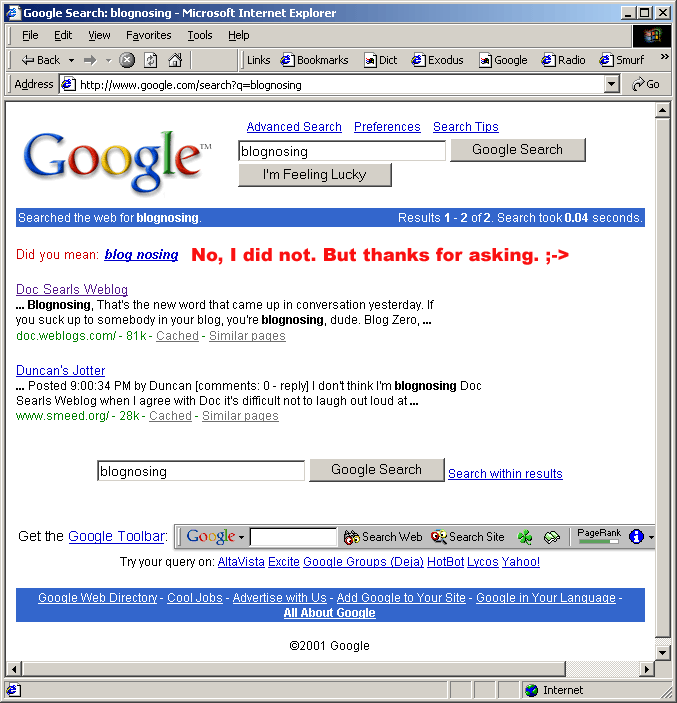
I listened to an interview with Katherine Graham where she talked about turning 80. I found a lot I could relate to, but then again, there's the fear. She said she could never visualize herself as an old woman, but she realized that she was now exactly that. At some level it never occurred to her that she would get old. (BTW, Graham was a total taboo-buster. She took over the Washington Post when her husband commited suicide in 1963.) Maybe there's a point in life where you start really listening to people who are much older. I don't think I've quite reached that point yet, but I'm getting there. I think how much better my life would have been if I had sought out a roadmap of what was ahead. Somehow I couldn't imagine that any of it applied to me. But I'm learning as I go that it all applies. We create all these segments and labels, young, old, male, female, geek, PHB, etc, and think we're all so different from each other, but in the end, I think we're remarkably alike inside. Back to what Kirk Douglas was saying. When you're in your 80s every moment counts, you don't have much future at all, and if you're paying attention you know that. Now if some of that can go back to younger people (like me!) well, what an incredible gift. That's why it's worth listening. (That's all respect means to me, let people speak for themselves, it's harder to do, to really do, that it might seem it should be.) Now you might ask, why do I keep busting taboos instead of being a good boy. I do it because I want to meet other people who like busting taboos. Those are the people I can work with. People of all genders, all ages, all whatever. It's an algorithm, a filter. Survey: Are you a taboo-buster? Zeldman shoots the Moose. They're both right, we absolutely need designers. They're just working too hard. I'd love to get Zeldman and Bryan Bell together for a demo. It would be worth flying to NY for. My little experiment in Google worked. Scripting News is now the top entry when you search for blognosing. The little things that entertain my little mind. John Anderson: "You're probably hear this from about a million people, but the BSD in FreeBSD stands for Berkeley Standard Distribution." Uhhh apparently it actually stands for Berkeley Software Distribution. Four years ago today Princess Diana died.
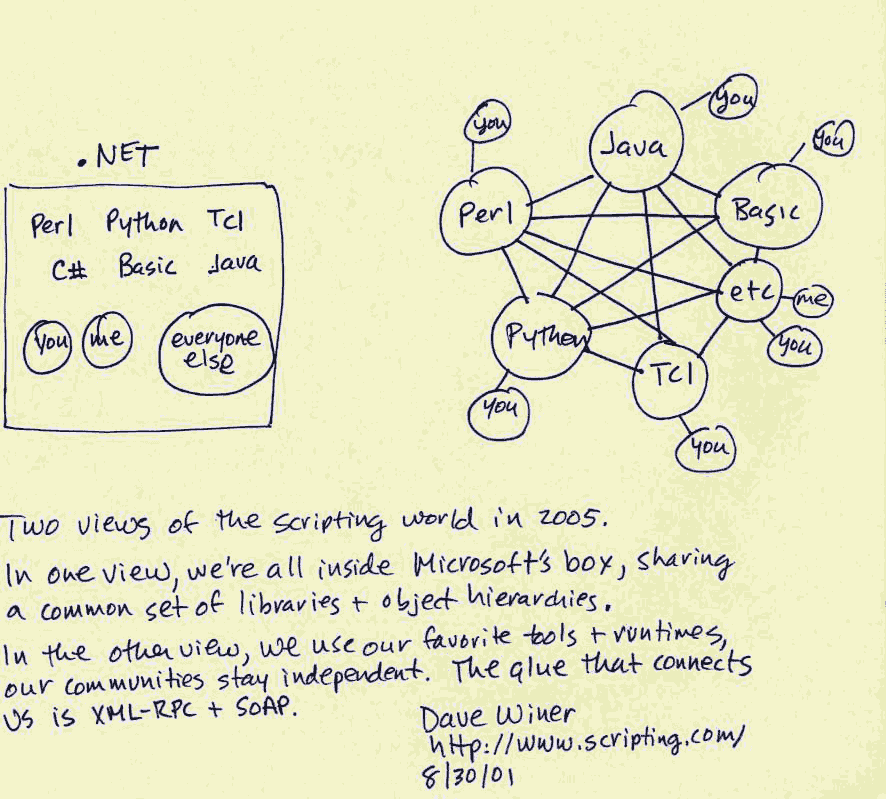
Two views of the scripting world of 2005. In one view, we're all inside Microsoft's box, sharing a common set of libraries and object hierarchies. In the other view, we use our favorite tools and runtimes, our communities stay independent. The glue that connects us is XML-RPC and SOAP. Daypop is a current events search engine. Very nice! Krishna Kotecha: "Corporate developers don't compete in the software wars. We're customers who want to build reliable systems quickly to deliver value to our clients. Ultimately, the politics of the platform wars don't really matter. Mercenary? Yes, but that's business." GeekNews: "It seems there's already a hack for Windows XP 2600 to convert it into the nag-free, crack free, authentication-free Corporate Version." Maybe I'm missing something but this article in the SJ Merc appears to be total nonsense. Why should Quicken for Mac OS X not be able to talk to financial services that Quicken for Windows can? How is that the operating system's fault? Hello earth to the Merc. Here's a survey. If I think someone is an idiot, should I say so? Interesting results. At first the Yes votes dominated the No's, but then the No's caught up and all afternoon they've been running in an absolute dead heat. As I write this at 6PM, there are 66 Yes's and 66 No's. FYI, I voted No. It's not polite to call someone an idiot, even if there's no doubt about it. Aside from that it's impractical, I just checked, and today alone there would be an uncountable number of idiots (e.g. all the people who went long on RHAT in late 1999). Daniel Berlinger is having an email exchange with the author of the Merc piece. It really does appear that no one is home over at the Merc. If I were going to use the I-word, this would be the time to do it. But I'll resist. BTW, I got some pushback from people reading my comments the other day about OSes getting in front of the apps. Here's a good example of that. The reporter is so confused that he puts the OS in front about a technical issue when it totally is not. Part of the reason Apple has this problem is that its product is not the OS, it's Steve Jobs. They're probably right that Steve is incompatible with a broad inclusive strategy, but the OS doesn't have that bug. In the end, does it matter that there's a difference between Steve and the platform? This thought may be a little sophisticated for some of my less intelligent readers. DJ Adams: "Yay! Interop starts here." BTW, this is the first time I've pointed to the Jabber-RPC list from Scripting News. I wanted to give it a chance to get started before inviting lots of people to join. I'm still struggling to understand how Jabber works. I want a BDG-style document for it. When I grok it I will write it. BTW, at first I thought DJ Adams and David Adams were the same person. When I introduced myself to DJ at JabberCon it was with this assumption. David Adams is an XML-RPC developer. DJ is one of the leaders of the Jabber community and also an XML-RPC developer. I asked DJ what the D stands for, and he said David. See how strange life is! I wonder if the J in DJ stands for Jabber? David Adams pushed back when, in 10/99, I questioned Red Hat's market cap of $5.8 billion. I asked if it was smoke and mirrors. He called it hate and paranoia. Hmmm. Here's what I said. "When you sell a commodity you're very open to price competition. Distribution is a thin business model. In the shakeout that followed one of the CEOs of one of the leading distributers likened it to flying at a thousand miles an hour two feet off the ground. You feel the bumps." Red Hat today is worth a mere $600 million Still overvalued, imho. BTW, this is why Amazon is in the dumps too. Distribution is a tough tough business. NewsForge: "VA Linux, the greatest opening hit in stock market history, is now worth one half of one percent of its peak market capitalization." News.Com: "Even Allchin is unclear on HailStorm's business model and its revenue-generating potential." Linus Torvalds. "If Microsoft is going to tax everyone on the Internet, don't think the governments will watch their monopoly on tax collection go by." NY Times: US May Help Chinese Evade Net Censorship. "The agency is in advanced discussions with Safeweb, a small company based in Emeryville, Calif., which has received financing from the venture capital arm of the Central Intelligence Agency, In-Q-Tel." 2/4/00: "An A-plus for the professor." Interesting responses to yesterday's piece.
DaveNet: Gender balance in high tech. The readers of the NY Times discuss the failure of E-books to gain traction in the market. My own two cents. As a forty-something, my eyes are getting weaker, so I would love to use this technology if it allows me to adjust the size of the type. I tend to favor books with larger type, they're easier for me to read. The reason I haven't adopted it is two-fold. 1. I don't like how they've been marketed, mostly as a solution to problems that the publishers have (extensive copy protection) and 2. my belief that most books are not available for the readers. Bjorn Sundstrom: "On software for librarians: they have amazingly high standards for response time and usability. They want free-text searches of the Library of Congress in three seconds round-trip. From anywhere in the world. And they really mean it. It's amazingly fun to build software for them." Eric Hancock: "Male-to-female ratios are exactly the opposite in the non-profit world." Here's an experiment. Make a list of positive things about men, as a gender. Go ahead make some generalizations. Relax about it. What are the good qualities of men. People seem able to recite the good things about women. See if you have the same goodwill for men. Whitepaper: Microsoft's scripting strategy. "Sorry no migration of existing code. It's a one-way street. The developers come in, but they can't bring their code with them." A sign of penetration. Yahoo is syndicating DaveNet. Jeff Barr: "I've been working with a senior development director at CNET to help them make this content available in syndicated form. He did the work, I supplied encouragement and feedback." Bravo! RSSify "takes your web page and turns it into RSS 0.92." Michael Dertouzos: "We made a big mistake 300 years ago when we separated technology and humanism. It's time to put the two back together." He died Monday at 64. O'Reilly's new Java and XML book has a chapter on SOAP. Minotaur is an "extension which can be used from Tcl, Python, or Perl to run scripts in any of the other languages." News.Com interviews IBM's visionary for the Internet. What's his vision? An Internet defined by IBM and Microsoft. Feh. Jim Allchin: "I mean, Oh my gosh, we added a line of code. Ooh, boy, this line of code--you know, I don't know; maybe we used too many variable letters or something. It's very, very hard to know--which will eventually play out here--beyond people in this room how that'll play out." Allchin is the exec in charge of Windows at Microsoft. Netslaves: The Failure of Tech Journalism. "If PC Magazine wants to shill for every crappy Microsoft product and conform their coverage to Microsoft's marketing aims, that is their right. However, it doesn't' have anything to do with reality, fairness or the standards to which journalists should be held to." News.Com: Microsoft.Net -- a new monopoly? "Are we willing to cede control of the Internet for the sake of convenience and usability?" Chris Langreiter has a Flash client for Blogger. The Dutch edition of Infoworld has a review of Frontier along with other content management systems. Gender balanced sexual humor Scoble sent me this pic. Heh heh. Been there for sure. On the other hand women do it too.. Allman Brothers: "Woman, you got those come and go blues. Yeah, you got those come and go blues, yes, you do, oh and you got me feelin' like a fool." Ooops!
On HTP: "The idea of integrating different languages in a single runtime has no appeal to me. I've already made my choice of scripting language, and I'm never going to switch. And if I eat my words, I'm surely never going to switch to Microsoft." Adam Vandenberg explains that each language will change as it gets absorbed into .NET. This is not at all a surprise. It's great that Adam, who works at Microsoft and runs Flangy News, is willing to fill in the blanks for us. Here's why this is important to understand now. Today this question -- "What is Python?" -- has a simple answer. Shortly, that will no longer be true. There will be Python as defined by Guido and friends, and Microsoft's Python. They will be different. Code from one will not work in the runtime of the other. Now before you freak out, there's stuff we can do about this. I have to write a short whitepaper on this now. We're at the point where people must understand in clear terms that they have options. It's going to get muddier soon. Here's good news. This search turned up nothing menacing on microsoft.com. Today. What about a year from now? And of course I'm just using Python as an example. There's Perl too. And guess what, I don't believe Microsoft has given up on Java. And what about running Apache modules? You gotta believe the CLR is going to do that too. Philip Greenspun, in a offlist email said "I like .NET because it will let me program in Lisp again." To which I asked "Can't we find you a nice way to program in Lisp again without leading the young folk of our industry to their intellectual death?" More comments on Philip's discussion group Jim Winstead is implementing the Blogger API, server-side. Mike Amundsen: "More than a year after the initial pronouncements of language equality, only a small handful of non-Microsoft languages are actually available." ZDNet: Microsoft patents a threat to open source. News.Com: Industry Standard Bankrupt. Jericho is a "Java-based weblogging tool which interfaces with the Blogger and Manila XML-RPC interface." Internet News: Loudcloud Soars on Qwest Deal. "The announcement sent Loudcloud stock soaring 35 percent in early trading Tuesday, adding 49 cents a share to hit $1.88 by mid-morning."
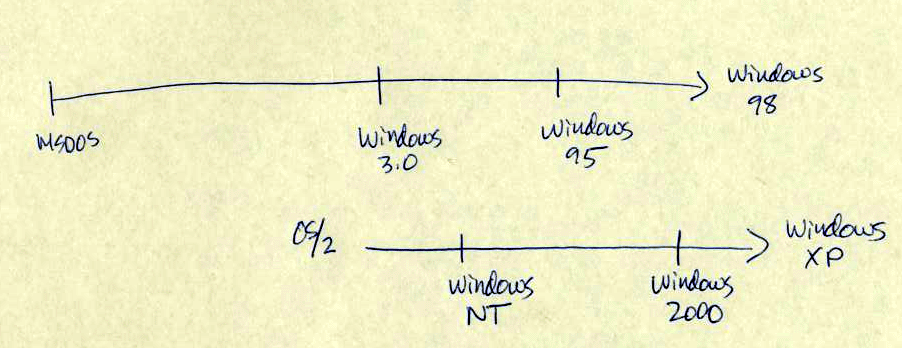
Jon Udell makes something simple way too complicated. The business model for Web Services is choice. The reason to use a publicly-defined protocol with wide support to connect components is that we can swap in different implementations when we want to. There's not much more to it. You could call it freedom, or choice, or freedom of choice. We provide a Web Services interface to Manila to make the product more attractive. It's an important feature for our users, or will be, because it means they can migrate if they want to. Intelligent users and developers migrate to systems that don't lock them in, not away from them. These are the people we want. Last night I saw a poorly executed movie with an incredible cast and an even better plot. I watched it twice just to revel in its mediocrity. In movies it's not such a big deal. You waste three hours and even then feel good. In software we waste years, sometimes decades, on poorly executed movies with decent plots. Speaking of wasted decades, an observation on Windows XP that has gone mostly unnoticed. Microsoft has reached the end of the evolution of the MS-DOS codebase. This is good news because XP is built off the codebase that started with NT and continued through Windows 2000. People will like XP because it doesn't crash. Engineers at Microsoft will probably like it too. Maintaining two codebases certainly was inefficient. A hand-drawn timeline of Windows evolution. Ignore the scale, it's just for conceptual use. Another random observation. In the old days, apps drove sales of OSes. Visicalc sold Apple IIs. Lotus sold PCs. Pagemaker sold Macs. The OS was an less important. Nowadays, the thing Linux and Windows have in common is developers are mere Value Adders. Apps don't drive the platform. I'm not sure it has to be this way for Linux, btw. What about the Mac? Read Doc's essay from 1997 for a clue to how it works. On the Mac, even the OS isn't the product -- it's the design, the art that's up front. Lunch Tuesday -- lunch with a programmer. Today I'm having lunch with Jim Allchin from Microsoft. I had a fried oyster sandwich with cole slaw and french fries and iced coffee. I read an article in the NY Times magazine about jury duty. Both the article and sandwich were quite good, as was the weather, so I sat outside. Twenty minutes after the meeting was supposed to start I got a call from the PR firm saying that they'd be twenty minutes late. "So they'll be here now," I said. "No, twenty minutes from now." Uhhh. That's when I ordered. After finishing, 45 minutes after the lunch was supposed to start, I left, with no additionial information about Microsoft's operating system strategy.
The XML-RPC HowTo has been ported to Japanese. Scott Hacker: He Who Controls the Bootloader. Dave Rothgery: "Apress is quickly becoming the source for .NET books." News.Com: Sun renews Web Services effort. I did some writing over the weekend about Web Services, and realized that the term is vague, and it probably isn't what we do. I couldn't make it work. We already had a good term that explains why we have been investing in SOAP and XML-RPC, and I think we'll stick with it. Flounder: "Netscape, since going into hibernation and feature freeze all those years ago, remains the girl's blouse of browsers." This could be the end for ExciteAtHome. Internet News: "Palm tapped David C. Nagel, chief technology officer of AT&T Corp. and president of AT&T Labs, to serve as president of the Palm OS platform subsidiary." Nagel was Apple's chief product guy in the early 90s. Gender balancing high tech Donna Romer: "There is no doubt in my mind that gender balanced engineering teams are a very, very good thing." Amy Wohl: "I don't like the condecension of thinking that men will have to build computers that women will find accessible. I know too many great women programmers and development managers and systems architects and big company VP's (to say nothing of analysts) to believe that women somehow can't get it." Amy -- for the sake of argument -- what if a man invented a type of software that somehow worked better with a woman's mind than a man's. Would you accept it, or would you want to wait for a woman to invent it? She responded. "I hope that I am civilized enough to thank people who do good things -- for me or for anyone else -- male or female. In my world, there are many more men than women. It's just the way it is. It's okay and we get along. Do sommething great -- or even something pretty good -- and I'll try to notice and say thanks. It makes the world work better." About the male mind. Acceptance, appreciation and trust from women are things we value very highly. When women withhold this, men get grouchy. Try it sometime with a nearby male. "You did a really great job on that project, congratulations. (And for extra credit) You made my job so much easier." The man, if he's not a psycho, will just glow. (But please don't say it if you don't mean it.) John Robb: "Women and technology. Normally, I wouldn't touch a topic like this with a ten foot pole, but Dave and Scoble hung it out, so I should too." Open source disarray Philip Greenspun: "Microsoft .NET is simultaneously the most advanced development environment for programmers and also opens the door to a new practical age of distributed computing." What a shame that Greenspun tells young developers to climb into the Microsoft trunk. Be more careful. It would make much more sense to invest in your favorite scripting environment, it can give you something that Microsoft never will -- freedom. Even after Microsoft ships, if they have features that other scripting environments don't, just add them as you need them. I watch in dismay as the leaders of the open source world crumble. The first to tip over was Marc Andreessen, who flushed our main hope for independence down the open source toilet bowl, spouting on the rollout day of .NET that his new company LoudCloud was going to lead in Microsoft-compatible services. People were supposed to be shocked -- the poster boy of the Web generation yields to pragmatism. But by then most knew he was just a puffer, not a real leader. And then Miguel de Icaza decided to clone .NET, a bad strategy for sure, leaving developers to wonder if they wouldn't be better off with the real thing. Even the idealogical purist Eric Raymond says that open source without free money from public markets can't sell into corporations. They're hip (he says they're stupid) -- heh -- why should they pay for something they can download for free? Craig Burton: "I guess VA Linux shareholders can just be happy Richard Stallman isn't driving this strategy eh?" Open source is cool, has a place, always has. Want to set a standard? It's a good idea to release some source so people can deploy without fear. And if you're on Unix where previously the only way to integrate was at the source level, consider using the new connective glue, SOAP or XML-RPC, to integrate without combining code bases. Stori for Tori
An animal apparently crawled into my stove and died. What a stink. So I looked in the yellow pages for a home appliance repair service who can come get rid of the dead thing. The first one I called had a receptionist who could barely speak English. Same with the second and third. I called back the first company. I asked if they actually do this job. The poor woman had no idea what I was asking. Instead the guy is coming out here so I can ask if this is a job they do. Why does he have to drive all the way out here to find that out? (I'm waiting, so I'm not happy either.) It didn't used to be this way in Silicon Valley. Most people spoke English if their jobs included talking to people on the phone. Opportunities must exist here for a bright person such as yourself who is fluent in the language of our country. Postscript: The repair guy showed up an hour late. I waited four hours. No help, he doesn't speak English either. I live in Latin America. Weblogs, HailStorm and Magic Carpet As we were porting the Blogger API into Manila, we found a connection between weblogs and centralized identity and preferences systems such as Microsoft HailStorm and AOL Magic Carpet. Here's the crucial call -- blogger.getUsersBlogs. It returns a set of descriptors for a user's Blogger-managed sites. Evan can do this because there is a single database containing information about all their sites. We can't easily implement it because Manila is not centralized, it runs on many different servers, at UserLand and at our customers' sites. Then I wondered if there will be other Blogger servers in the future, in other words, will this call continue to work for Blogger? That led me to centralized identity and preferences systems. We may want to drive toward this, since they seem to be coming online, and there are least two vendors in the space. Evan Williams: "There *will* be more Blogger servers in the future -- hopefully, the near future. Decentralization is something I've been working on for quite a while." Old slogans still work "Ask not what the Internet can do for you, ask what you can do for the Internet."
Libdex: "This is a list of library-related weblogs." A stirring story about women in high-tech, by a woman, who asked that her name not be used. Luke Tymowski: "I don’t believe there is any male conspiracy to keep women out of technical positions." Scott Hansen: "The situation in Germany is probably worse, since there are so many factors against working women in general, especially those with children." Note: I want to continue covering this where ever it goes. I winced as I read Luke's piece, but I included it because it's a valid part of the conversation. I wouldn't like it if someone wrote something like that about a subject I cared about. After reading the anonymous story, I'm not sure I'd agree that there isn't a male conspiracy to keep women out of tech jobs. I want to be clear on one thing -- I like working with women, I always have. I also don't want women to change who they are to fit in to the workplace. This may sound idealistic, but remember that I'm a man, so if you're looking for a champion, you got one. I said that awkardly in the essay I wrote yesterday that caused such a stir. Now, causing a stir is what I do. So it's working. I'm getting tons of email on this. That's good too. The JabNews weblog has a new Bryan Bell theme. You are cordially invited to actively participate in the 2002 International World Wide Web Conference May 7-11 in Honolulu, Hawaii, USA. ForwardGarden: "A man and his dog were walking along a road. The man was enjoying the scenery, when it suddenly occurred to him that he was dead." Jacob Levy reviews Netscape 6.1. "One sentence -- I love it!" openBox Software: "Utilizing the XML-RPC PHP 'glue' from Useful Inc. and the Blogger API, Parabola aims to allow you to perform nearly all aspects of blogging from this one central web interface." David Jacques: Something Missing From Open Source. ZDNet: Ximian to offer shrinkwrap Linux PIM. "Ximian will offer its Evolution application, an e-mail management, calendar and to-do list manager, as a package with documentation in a $29.95 standard edition and $49.95 professional edition." Three years ago today -- All About Bees. Scoble's brother: "To top it off, he used our toilet during the job, left the seat up and did not flush. Imagine coming home to that!" Born blogger. In honor of women in our industry, Craig Burton is working on a new XML-RPC action hero. And guess what, she's a woman. No shit. He doesn't want to show his work in progress, so I'll honor that. Then I got a pointer to a site with pictures of beautiful women, and thought perhaps this one could be our spokesmodel for SOAP. 4/16/01: The XML-RPC Man. Arf arf! Over to Scoble Scoble: "One day last year my seven-year-old son and I were talking about school and such and girls and computers, and he blurted out: 'Oh, dad, everyone knows girls don't use computers.' Now, I certainly didn't teach him this. Where did he learn this?" Something to consider. Perhaps today's computers are male things. Baseball mitts are also mostly used by men. As are jockstraps and action comics. Men are cavedwellers. Are today's computers electronic caves? Perhaps we have yet to create an application for computers that handles the multi-tasking and organizational abilities that are special to women. Perhaps it's up to the men to create this for them. I've had that theory for quite a while. Into taboo Scoble also says: "I feel uncomfortable as a man discussing the issue cause I know that no matter what I say I'll be attacked and we won't work together to find a way to address the problem." He speaks for me. I go into this area with great trepidation. I recognize the despair that Lessing describes, inside myself. It's better to say nothing, I learned at a young age. But inside, even at a young age, I burned with desire to set things straight. "I am not who you say I am." Sylvia Paull, in an overnight email said "You guys don't need to fight for equality in the industry that you own." I pushed back. "In no sense do I own this industry." See how this works. The woman's mind tells us who we are, instead of asking and listening. I think Sylvia should be able to figure this out for herself, but sheez, at least ask who we are. I am not Larry Ellison, Bill Gates, Scott McNealy or any of a hundred or so people with penises who keep us in the dark ages, fighting for control of us and leaving us with no choice. Sylvia, we have more in common than you think. Why not accept that and use it. However, I don't see problems, just opportunities. On the decentralization mail list I asked if the P in XML-RPC is People. The discussion up till now has been very male-oriented, about the finer points of plumbing. Only a man could find this interesting (disclaimer: I am a man). But I also think the purpose of this technology is to empower people. The plumbing could up the quality of the tools (male energy) and allow us to organize more effectively (female). I asked the same question about P2P (the P is for people). There's a door to open here. If you're a woman in technology, think about how your mind could be added to the discussion. Under what terms would you feel safe expressing what you see and what you think? So far all I've heard is harsh condemnation from women, dismissal and condescention. Scoble calls this an attack, but I don't see it that way. I'm just looking at a barrier. When Meg looks at me she sees a sexist. Of course I don't see myself that way. And I see Meg as fearful of something. Me too, possibly the flipside of the same thing. At least she has the guts to put it out there. Most women seem not to have the courage. Is staying silent is a female thing too? How can we work together if you don't even show up? Here's a fact. I am dissatisfied with the way our industry works. I think we can make it better by including the fifty percent of our species that seems not to be participating. Here's a question. How can we open this door? My goal: Full employment for all minds that want to contribute to innovation and freedom in our industry. Since "equality" seems to be the word that women use for this, let's add that to our collective todo list. "Just say yes." Wrong, wrong, wrong, wrong, wrong Meg pushes back and reminds me of a joke that men find funny and women often don't. If a man says something in a forest and there are no women present is he still wrong? Wrong, wrong, wrong, wrong, wrong. Meg says I'm wrong. That is so boring. Of course I understand I'm making generalizations. Male and female energy come in all kinds of packages. But how can one have a conversation about genders without generalizing. Every statement would have to come with a dozen disclaimers. I know they're there. Instead of proving how wrong I am, look for bugs in your own system of beliefs. Why do you pick at the details and miss the big picture. Why aren't any women participating in the discussion on new technologies on the Internet. And if they are, where are they? Further, I made an offer. What's the answer? What if a man offered to help? Dori Smith: "This won't change until women start writing to conference organizers and saying 'I'm not going to your show because I object to your practice of having [no women/only one token woman] on your list of speakers.'" Why can't men write saying the same thing? Why does she only want help from women? What if a man offered to help? I saw something similar in Sylvia's pitch. She asks: "What is it that makes most men think they are superior to women?" How does she know that most men think this. What if they don't. What if it's the other way around. What if most men feel inferior to women? Sylvia, Dori and Meg -- try an experiment and ask a few male friends if they feel superior to women. You might be shocked at what you hear. It's not that simple. Today's song: "If you love somebody, set them free." BTW, to Dori and Meg, I was talking about gender balancing the attendees of a conference, not the speakers, although one would naturally follow from the other, imho.
Paul Boutin is blogging from Burning Man! LA Times op-ed: "Then we have Microsoft. No choice, no spice, no soul, no pleasure." Eric Raymond: "If we were still in a boom time, we might still have the luxury of perfect doctrinal purity." Ugh. WSJ: PC sales continue to fall. "For the first time in 15 years, world-wide personal-computer sales will likely be lower this year than last." Ruben Daniels has an XML-RPC client for JavaScript. Andreas Bolka has an XML-RPC to POP gateway. Women in our industry JabberCon was great, but like all geek conferences, the male-female ratio was about 50-to-1. On the drive to Keystone I had an idea. There must be conferences where the ratio is reversed. So let's pair conferences? A librarian conference at the same facility as a developer conference. They'd get better software and we'd get more users and kinder feedback? I really like making software for librarians. I wish they knew. Megnut read the piece I had here earlier, and provides a fantastic demo of the attitude Doris Lessing talked about in her Guardian interview. I've put my essay back online so you can read it. I agree with Meg that there should be more women in the leadership of our industry (that's what my essay was about) but work with us, don't dismiss our pov just because we're men. You can't win by becoming the pigs you despise. I've had a lot of talks about this with friends who are powerful women in our industry, notably Sylvia Paul, who founded Gracenet. Women are great organizers. You'll never see a Gracenet for men in high tech. We stink at promoting our gender and supporting each other. But some of us do appreciate the big picture and are tired of life on the low road. Let's work for win-wins. Sylvia knows I mean it. Meg, if you've really been reading my site, you know it too. Allchin, Gillmor and Fahrni I'm having lunch with Microsoft's Jim Allchin on Tuesday. Dan Gillmor was invited too, but can't make it because he's beginning a round-the-world trip today. Have a great trip Dan. He promises to update us from the road. So, what will we talk about on Tuesday. You can help there. I had a phone talk with a Microsoft PR guy yesterday to prep for the meeting. I said I'm looking for win-wins. I was opposed to breaking up Microsoft for a long time, but they didn't show any will for self-restraint, and I didn't see any way for independent developers to win with Microsoft. But nothing's that simple. I appreciate Microsoft. While the open source bluster was wrecking my market, Microsoft invested in us, by helping create SOAP. They were friendly to us when others left us for dead. I don't forget this. I also spoke with Dan yesterday. He said he was very excited about what's going on between Jabber and Blogger with XML-RPC. I can work with that, for sure. At least the conversation is off Microsoft for a few minutes. I like that. Now, of course it immediately swung to Microsoft, as all conversations in the software industry quickly do. I asked Dan to consider approaching them from a different angle, and I'm going to ask all of you to do that as well. Remember that it's a 45K person company. Read Breaking Windows. You can see that there are a lot of threads inside Microsoft. They don't all march in lock-step to the will of Bill. When Dan condemns Microsoft, he's disempowering those at Microsoft who want the company to change, who remember what a fast-growing software ecology looks like, and understand how stifled the market is by Microsoft's dominance. I got a great email yesterday from Rob Fahrni, who works at Microsoft on Visio. We exchanged a little email after he helped me by Visio-izing my hand-drawn block diagram. Here's what he said. "What you guys are doing reminds me of the early days at Visio. Back when we just slammed code and got stuff done! I'm really excited about this stuff. I'm trying to steal time at night to work on a C++ implementation to post to Blogger, and now Manila! Thanks for creating XML-RPC, it's way slick!" So don't tell me Microsoft is evil because my friend Rob works there. Now, so do other people who have no appreciation for the kind of joyful creativity that only free developers can practice. I want to help Rob if I can, and others at Microsoft, those who remain, with bright eyes, who think that creativity happens outside the confines of Microsoft. So I asked Dan to state his terms for approval of Microsoft. What would they have to do in order for you to become a fan, instead of a constant critic? Then I realized I should do what I asked Dan to do. State my terms. So here I go again. To the leadership at Microsoft, here's what I want from you. First, go talk to Rob. Ask him why he's excited. Let that guide you -- what can you do to grow the software industry today? Right now, imho, the best thing you can do is pull out of areas that you control exclusively and let the market do its job. Offer choice everywhere you don't. We know you know how to do APIs. Make the identity server in XP subject to user choice. Give developers an API and give the user choice. This makes the UI a little more complex, but it will foster growth, and as the largest entity in the software industry, growth at this level is necessary to your growth and survival. The ecosystem is horribly out of balance. To restore balance, you must get out of the way. Decouple the evolution of the browser from the operating system and the apps. This is where you got nailed by the Appeals Court. Eight judges say you screwed up, and this developer says you screwed up too. In the past you've made the mistake of dissing both developers and judges. Now it's caught up with you. But it's not such a bad deal, now you're so big, you don't need the protection that tied monopolies give you. You don't even have to be the best to win, just good enough. Most people don't realize this, but Microsoft isn't as smart as it used to be. The average Softie today doesn't remember what it was like to win through competition. They're more adept at dealing with internal politics than they are at understanding ecosystems and fostering network effects. I may have a unique view into this because I live in the ecosystem, I've never worked at a company big enough to create the kind of internal noise that a 45K person company can, and I've somewhat successfully navigated the politics at Microsoft, as an outsider. Today's Microsoft reminds me more of Apple of the late 80s than it does of Microsoft of the late 80s. It also has a lot of the IBM of the early 80s. To the leadership at Microsoft, you need us to figure out where to go next. Your overhead is stifling to itself. Let's get it to stop stifling those who don't work at Microsoft. And drop the patents, it's OK to trade them with other BigCo's, can't stop that, but don't accelerate the war. You'll be blamed for that. The threat that Mundie made to the open source developers is unseemly for a company of Microsoft's size and stature. Net-net, Microsoft has made a total mess of its relationship with independent developers. The gaffe in OpenSourceLand is only the latest outrage. The fight with Java developers over WORA, the locked trunk that killed the HTML developer world was another. Depriving other platforms of air supply may be a good short term tactic, but if you want the trust of developers, stop the threats, treat us like a market, give us what we want, and help us drive markets. We've been through this so many times before. Stop and think, and ask if you believe that a super-BigCo can create all the growth you need, and if you really think it through, you'll realize that it can't.
Good morning sports fans! Reuters: "A federal appeals court sent Microsoft Corp.'s antitrust case on Friday back to a lower court to determine what remedies should be imposed on the software giant."
A new XML-RPC implementation this morning, for PHP, from Stefan Saasen. We're up to 42 implementations. The Blogger XML-RPC community keeps growing. And we're reaching new milestones with the Jabber developers. Bing. Here's #43. "It's an XML-RPC message builder, written in JavaScript. It takes JavaScript data objects and converts them into an XML-RPC message." Just say yes. pyBlogger 0.8 can post to Manila sites. Branscum: "Blognosing... is all the rage." Watch it grow. Talking Moose: "Using Linux must pay. This license plate was on a Porsche that costs about $110,000." Manila supports the Blogger API One week ago, last Friday, I started work on bloggerApi.root, a guest database that, when installed alongside Manila, implements support for the Blogger API. While I was in Colorado, while the Jabber guys were breaking through with Blogger, Jake was finishing bloggerApi.root. We did it in two steps. First, we implemented a set of ManilaRPC methods that do functionally what the Blogger API does. (Docs will follow on these). Then we implemented connective glue in bloggerApi.root that calls these methods, and deployed it quietly on all our servers. We then told the Jabber guys how to call it. It worked. So now we're ready to release this code to Frontier developers.
Now the next pointer. Emulating Blogger in Manila. On that page you'll find a link to bloggerApi.root, and an explanation of how the Blogger API is implemented in Manila. This is important if you're running Manila sites or if you're implementing the client side of the Blogger API and want to work with Manila. The interface is transparent, Manila works exactly as Blogger does, but if you're making assumptions about blogId's and postId's you may want to see how they work in Manila. Also others who are cloning the Blogger API may want to look here for prior art. Jabber, Blogger and Manila JabNews: "I just successfully posted a message to a Manila-based test site with my Jabber client -- the Jabber Blogging Agent is slowly getting better. I'm planning to get a version into production on jabber.org by the end of next week." Now, let me explain what's going on there. Dave Smith, who posted that message, typed that text into a Jabber client, where it was routed to his Manila site through the Blogger API. He could just as easily have used it to post to a Blogger site. In other words, we've reached the milestone -- we now have the Blogger API working for news-item-oriented Manila sites. This means that if you have a toolkit for Blogger, you should be able to use it to get, post, edit and delete items on a Manila site.
Thanks to Rob Fahrni of Microsoft for the beautiful Visio rendering of my hand-drawn block diagram. My poor mind My head is spinning with all the combinations that are opening up. I want to thank both Blogger and Jabber for the Many Mind Bombs (MMBs) that are now erupting in my head. This is why I do software, and why collaborative development is so much fun. Thanks!
Today's song: Lean on Me. "So just call on me brother, when you need a hand. We all need somebody to lean on. I just might have a problem that you'd understand. We all need somebody to lean on." DJ Adams has an implementation of Jabber-RPC in Perl. Bing! Jeffrey Czerniak has AppleScript connecting to Blogger. Simon Kittle did a Live Journal version of the Blogger API. On this day two years ago Blogger launched. Still excellent! This morning there's a new method in the Blogger API, blogger.getRecentPosts. Updated: Connecting with Blogger. Added glue to connect to blogger.getRecentPosts. Announcement on the XML-RPC list of work on Jabber-RPC. USA Today: "Cash-strapped Exodus Communications said Wednesday that it is open to takeover offers after three board members abruptly quit the Web-hosting pioneer for 'personal reasons.'" My Jabber handle is daveuserland@jabber.com. But please don't use it unless it's absolutely necessary. I'm still not an IM guy. I'm going to use this account for testing of software that communicates over the Jabber network. WebReference: Hiermenus Go Forth XXII. RESTwiki: "Are you using XML-RPC or SOAP (in an RPC way), and wonder how you might use REST instead?" Microsoft's domination of the Web Nick Denton: "Microsoft's domination of the web has become first inevitable and, now, even convenient. Critics such as Dave Winer, an independent software developer and the opinionated author of the Scripting.com website, are isolated. And pragmatists, such as myself, have learned to love Microsoft." He goes on to say "Microsoft has long had a hostile relationship with independent developers" -- which is true. And Nick, people wrote articles like yours about IBM as the Apple II and Visicalc were coming in the back door. Yes, Microsoft kicked Netscape's butt, but that was easy since Netscape went it alone. Today there are a lot more programmers outside of Microsoft than inside. Internet.Com: Microsoft Supported by Dead People. PS: Thanks to the Guardian for the link! PPS: It's darkest before dawn. Living rooms I finished the book on the flu epidemic of 1918. Learned something important. Before the mid-1800s death was far more commonplace. Epidemics would sweep through cities, often wiping out half the population. New people would come from the countryside to take their place. The idea of a "living room" is relatively new too. Reader's Digest suggested that we rename our parlors, which were used to display the dead before burial, to give it a new purpose -- for the living. If I had been around in those days, running a weblog, I would have supported this idea. So how to apply this idea at the dawn of the 21st century? Instead of thinking of independent developers as dead, we could think of them as living. We might get some new software that way. (We would, because it already exists, people just have to open their eyes.) Back to Nick, he says Microsoft is the driving force behind Web services. Wrong. Scripting News has facilitated far more open, deployed, and public web services than all the BigCo's combined. It will always be that way because this technology is about choice, not lock-in. No matter how hard they try, unless Microsoft gets behind developer freedom in a serious way, they have as little chance of gaining traction with developers as IBM did with the Micro Channel Architecture. 6/6/01: "We simply didn't understand what they were talking about."
Good morning sports fans! This is my pre-coffee post for the day. (Coffee is the next thing on my to-do-list.) Of course I had a fantastic time in Colorado, but it's great to be back home, where the air is thick as soup. Now I'm going to start announcing what we accomplished at JabberCon earlier this week. But first, the news.. Today's news Karl Martino: jEdit and Manila. Screen shots that show Karl editing a Manila site. Looks like I'm having lunch with Microsoft's Jim Allchin next Tuesday, 8/28. Also, reading tea leaves, it looks like he's going to be at Linux World. Hey this could turn out to be quite a photo op. Something like Nixon visiting China in 1972? Today's song: That Lonesome Road. Motley Fool: "A Southern District of New York Senior Judge threw out a class action lawsuit against Morgan Stanley Internet analyst Mary Meeker yesterday, calling it, among other things, in 'bad taste.'" Do a view-source on this page to see the US House of Representatives in XML. Rogers Cadenhead: "You might want to take a look at how often Webclipping.com's robot is hitting your servers. Five percent of my hits on Cadenhead.org came from that robot, and it appears that I'm not getting any benefit at all from that bandwidth." Doris Lessing: "We have many wonderful, clever, powerful women everywhere, but what is happening to men?" Craig Burton has a narrative (with pictures) of yesterday's session at JabberCon. It's great stuff, except for one thing I'd like to set straight. I never had any doubt of the value that Jabber could bring to our world. NY Times: "The shower's water droplets decelerate under the influence of aerodynamic drag, transferring energy to the bathtub's air, which begins to twist like a miniature hurricane turned on its side." An artricle by Zimran Ahmed has Joe Mahoney riled up. Blognose A new term, coined by Craig and quickly adopted by Doc. To blognose is to brownnose, on a weblog. brown-nose, verb: "To curry favor with in an obsequious manner; fawn on." An example of blognosing can be found below. Gotta love Google. Blognosing is already in their index. Tunneling XML-RPC with Jabber We had a session yesterday, just a little over an hour, where we designed a new thing, a way of combining the power of Jabber to tunnel across firewalls and NATs with the ability to link programs across the Internet through XML-RPC. It's almost as if the two protocols, XML-RPC and Jabber, were designed to be integrated. We share similar philosophies, simplicity comes first, and both are totally open, and most important, the people involved in both protocols have a let's-get-it-done-now attitude. Further, Jabber has not (to my surprise) evolved to include the functionality of XML-RPC, and XML-RPC, if it's to be as powerful as instant messaging, has to have someway to traverse NATs and firewalls. So we came up with something called Jabber-RPC, which carries messages that are formatted according to the XML-RPC spec over a new transport -- Jabber. DJ Adams says, "It's not that this hasn't been done before - it has, multiple times - but until now we have neither known about each other's work nor used the same techniques. So in order to be able to work together and have our code interoperate, we've come up with a formalisation upon which we all agree." And that was the cool thing -- agreement was reached in a little over one hour! What a community. A new writing surface for blogging OK, the second thing we accomplished, which is not related to the Tunneling described above, is the connect between Jabber instant messaging and weblogs. Apparently, totally independent of the developments in Blogger's XML-RPC API, which started on August 8, this month the Jabber community discovered weblogs. Murphy works in strange ways. This lead to a one-off weblogging tool called Jogger, a proof of concept -- leading to the next step, a connection with the tools that are focused on weblogging -- Blogger, Manila, and (we hope soon) LiveJournal and others. Here's the sequence of events. We have a very large XML-RPC interface for Manila which is the basis for the connection between Radio and Manila. It allows you to edit all parts of a Manila site with Radio's outliner. It's very powerful (and complex for newbies). In early August, Evan Williams at Blogger started putting a public XML-RPC interface on Blogger. It's quite simple (that's good). As soon as I got back from NY we started implementing the client side, so Radio could be used to edit Blogger sites. It worked, and we released the code, and others are using it now. Then late last week I started cloning the Blogger API so that any tools that were created for Blogger could also be used with Manila. I didn't get all the way there, but while I was in Colorado, Jake Savin finished it and deployed it on one of our servers. (We'll announce the location and put up a public demo site later today.) On Monday night, DizzyD (aka Dave Smith), one of the Jabber developers, lead a team who made it so that Jabber's instant messaging user interface could be used to post items to a Blogger blog using this interface. This is the block diagram Jeremie and I put together that Craig documented on his site. Basically here's how it works. A connection is created in the Jabber server that knows how to post to a specific weblog. It stores the URL of the site, the username and password, and whatever other information is needed. Then when the user enters an item that begins with a magic string, it routes the text to the weblog. People who live in the IM interface, who see it as their primary writing surface, now have a totally comfortable way to post to a weblog. Now, because we have also implemented the Blogger API for Manila, the same code in the Jabber cloud can be used to post to a news-item-oriented Manila site. Later today Dizzy and Jake, working together, will demonstrate this, and of course you'll hear all about it here on Scripting News. Now a bit of philosophy. This is called bootstrapping. It's the way new functionality gets into all our products. It's the way the pure engineering mind works. It's how we create magic by working together. A new slogan Doc gave a fantastic presentation. I had never seen one of his slide shows. I really hope we get it on the Web in some meaningful way so you all can see that not only is Doc one of our best writers, he's also one of our best public speakers. After his presentation we had a public conversation, me and Doc, and as usual I don't know who to attribute this to -- call it a Doc-Dave collaboration. Here's the slogan -- Just Say Yes -- it's a flip on Nancy Reagan's admonition about illegal drugs. When you get a proposal from another developer to be compatible, your knee-jerk reaction should be this: Yes. We need this reminder, because so often the knee-jerk reaction is the opposite. Now here's why I love the Jabber community: They didn't need to hear this. It was already their philosophy. Now let's spread the gospel! I love SOAP Already I have gotten an email saying "You obviously support XML-RPC, but seem to be cautious about SOAP - what it is about SOAP that you feel can't be implemented on all platforms?" I love human minds. Absent facts they fill in the blanks -- and draw an incorrect conclusion. The Jabber and Blogger communities both chose XML-RPC over SOAP. You can ask them if you want, but I didn't steer them one way or the other. I didn't say "You should do SOAP" when they chose XML-RPC. Either are great. I love them both, as a father might love both his children. I encourage everyone to use SOAP. I encourage everyone to use XML-RPC. I have set it up so that my company doesn't care which one you use. But please wire up your Internet applications so they can be scripted in this manner so the magic can happen. Do it sooner than later. Just say yes.
Good morning sports fans! Live from Keystone, via 802.11b, the high bandwidth version of Scripting News. Thunderstorms all day yesterday. Really extravagant weather. We had big golfball sized hail yesterday. Yeah it was a HailStorm. Yaha! Jabber to Blogger Today we got Jabber talking to Blogger over XML-RPC. There will be a lot more information about this but in the meantime here's the Blogger site that we were posting to through Jabber instant messaging. Realtime blog Doc Jabber fit At 11:20AM Doc Searls is giving a slide presentation at JabberCon. Maybe I'll realtime blog it? "Metaphor is everywhere, even in bullshit." "A brand is this idea we got from the cattle industry." News from JabberCon Craig Burton has pics from the first day. We're working on a Jabber-to-XML-RPC project. Murphy-willing we should be able to demo it at 2PM today (Mountain Time). A picture of Jeremie and me working out the details of the project. And here's the block diagram. This was done before the afternoon hailstorm. I'm sitting next to Doc right now while Jeremie O'Jabber is giving his State of the Bulb presentation. Sorry Doc, we run a PG-rated blog. (Most of the time.) On a break, Peter Bryant from InfoPop asked for a pointer to our distributed membership and preferences spec from 1999. Here it is Peter. Other stuff Lance is back. Scoble is back. One year ago today we asked What is RDF? Kvetchy mail servers I have a really fast 802.11b connection here at JabberCOn, and I can receive email but can't send it. My mail server doesn't allow mail coming from the IP address my machine is using now, and I've tried a bunch of other servers, but they won't accept my email address. This is for a good cause, spam elimination, but makes it impossible to move around. But there must be a workaround because other people in the room are able to send mail. Postscript: Craig Burton solved the probleme. He let me use his mail server. Here's the trick. His server requires a logon. So the spammers can't get through that. And he can use it where ever he is. I want to get the UserLand mail server to work this way. Brian Mulvaney: "Another solution is to run a SMTP process locally. I use a tiny freeware mail server from Argosoft because I'm on the road a lot, connecting from different networks. All you need to do to configure it is to give it the name of a DNS server (any reliable one should do) and turn on relaying. You then set your email client to send mail to the local machine (127.0.0.1). That's it. It's kind of fun to watch the log for the mail server as it makes connections and gets the mail out. I don't leave it running for long periods of time if I'm on a fixed IP address because of the open relay, but that's generally not an issue when I'm on the road." Kvetch: "To complain persistently and whiningly."
It's going to be a very light day today -- the networking here is not very good, and it's quite expensive. I spent a few hours last night talking with people from Jabber-the-Company. This is the hard part of open source, they're marketing a technology, and there's a community, and the company has to make money if it's going to continue to exist. I am going to do a lot of listening, my goal is to understand how various open source projects can coordinate so that there's a roadmap that connects them together, and some kind of vision that makes sense to customers, and profitable businesses coming out of that. Somehow the customers must understand that open source is a feature, and that it's still software, and if they want viable companies backing the products, the software must cost money. On the other hand, the individual contributor has to make a living too. Eric Kidd (see below) did a beautiful job of creating an XML-RPC toolkit for C and C++. Somehow, it seems, he should be able to pay the rent and buy groceries by continuing to work on that. But.. Eric Kidd: "I'm less than enthused about the number of people who use my XFree86-licensed code in their proprietary software, contribute no money or code to my efforts, and then have the gall to ask for free consulting advice." On the Decentralization list, Tim O'Reilly explains his pov of the value of open source. I'll be seeing Tim later today and I expect we'll talk some about this. In the meantime a little pushback. The Mac creamed the IBM PC, not the other way around, because it had a better memory model than the PC. Sure the PC was more open, but that lead to competing methods of extending its memory. The market went with the Mac which had no such confusion. Of course then it swung back around to Windows, but I think that's because Microsoft did a better job of moving their platform while Apple was stagnating.
Another light day as I go back into travel mode. I'm off to Denver, to geek out with the Jabber folk. Jeremie Miller is picking me up at the Denver airport, and he and I and Craig Burton will drive together to Keystone. Now that should be one interesting car ride. Both Jeremie and Craig are on my panel at Seybold where we'll talk about what we think the next revolution will be. I chose Jeremie because he's a visionary, and dedicated, and thoughtful. I chose Craig because he's all those things, and he's experienced. I learn from both these guys. Jeremie reminds me of what can be done with a pureness of purpose, and Craig reminds me that it requires patience, generosity and finesse to see your vision take hold in the world. Two other people will be on the panel at Seybold, Adam Curry and Justin Hall. I'm sure you all know Adam, he's become one of my best friends. What a surprise that a guy with perpetual great hair who's famous for being a mouthpiece could turn out to have such a powerful mind and is driven to break the machine that made him so famous. And Justin was such a surprise when I got to hang out with him in Copenhagen. I thought he was a snotty sarcastic Joey Anuff hanger-on. (Justin was at Wired at the same time I was.) Nope, he's a thoughtful, very highly intelligent world traveler. Wasn't distracted by all the dotcom michegas. Am I interested in knowing what he thinks the next revolution will be? You bet.
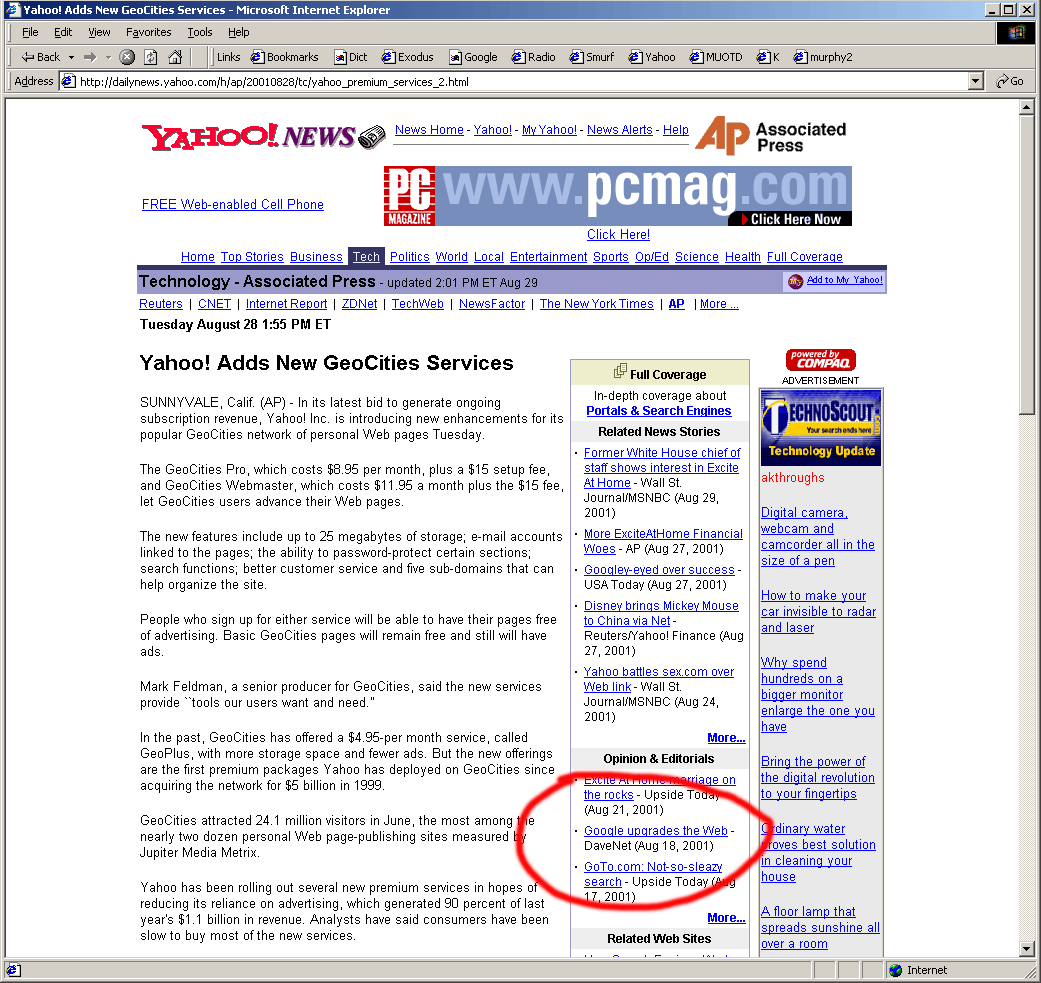
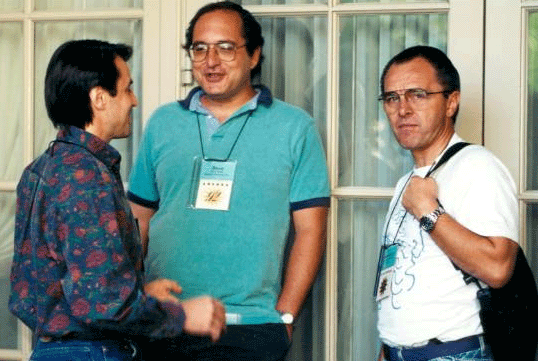
DaveNet: Google upgrades the Web. Lawrence Lee: "I first noticed this earlier this week when I did a search for a phrase mentioned on Joel Spolsky's article and noticed it was one of the top hits and it was just published two days earlier." Apparently the Code Red worm is causing various ISPs to turn off access to port 80 for their users. I started work on XML-RPC handlers that emulate Blogger's scripting interface for news-item-oriented Manila sites. I thought it could be done in a couple of sessions, but it became clear that it'll have to wait until I get back from JabberCon to be released. Two years ago today: What is Scripting News? Thirty-four years ago: My sixth grade class pic. (I'm in the middle of the top row.) A picture of David Szetela, me (with no beard) and Jean Louis-Gassee, probably from 1993 or 1994. Standard & Be I am surprised to see all the ink over the demise of the Industry Standard. For example, it's the top item on the editorial page of today's NY Times. I didn't think it was that important a publication. In the era of electronic publishing, when networking came to the masses, what sense did it make to launch a new paper magazine to cover the network? I only went to one Standard "roof party" and thought it was interesting, but not interesting enough to go back. Lots of MBA carpetbaggers with eyes glazed over about their business models, newly minted mega-millionaires (been there done that) -- there was no soul there. I thought the coincident demise of Be is more portentous of what's-to-come. The Standard was a magazine. Yeah it was thick. IDG thought it was a loser so they shut it down. Double-click on "more portentous of what's-to-come." When the software industry goes into a tailspin, huge amounts of technology gets flushed. The software industry was in terrible shape before the Web happened. Yes, the Web is wonderful, but.. We flushed a lot of user interface know-how in the move to the Web. My fear is that the same will happen again. Preserving technology now is a high priority. When the industry comes back (Murphy-willing) there will be a new twist, patents. If we don't at least archive what we know, it will be a lawyer-dominated wasteland, even more lunatic than the dotcom boom. Without good archives we'll be defenseless. I wonder if the owners of the Standard would allow their website to be archived and the domain mapped to another server? When MacWEEK shut down we lost a lot of data as all the links went bad. Maybe it seems insensitive to worry about that now, but it would be a final act of kindness to the Web to keep the URLs live even after the magazine has ceased to publish. Exploring the blues Mental health tip. If you ever get the blues, try getting your car washed. Just getting out of the house sometimes makes it better. And what's not to like about a clean car! 12/2/96: "Here's a recipe for curing the blues, or at least giving them a chance to recede." So then I followed the pointer to The Little Bird piece. I wrote it before there were weblogs, when the only kind of feedback I got was through email. When I wrote pieces like that some people would share their personal stories and I liked that a lot. These days there are more young people around so I mostly stick to technology, thinking stuff, because that's what younger people seem to like, they often seem threatened by "personal" stuff even if it isn't really personal. Today, most people in the weblog world probably would think "Oh there goes Dave again." OK, coool, here I go again! Here's a story. There's this huge gap, starting at the age of five or eight when people have this illusion that they've grown up. Many people never wake up from the illusion. But get this -- no one here is grown up. Like the ogre in Shrek, we're layered like onions, we're every age we've ever been every moment. Inside our bodies we swoosh through time, through all our experiences, applying the patterns we learned, against what our senses say is happening right now. Then we live the memory not the moment. Guess what I'm dreaming now, and guess what, so are you. None of what you think is happening is actually happening. Same here. (That's the problem with thinking so much.) Now some people wake up to this around age forty or so. I have a theory why the wakeup happens at forty, based on an old wives tale of sorts that says for every year in a relationship you have to spend a year on the other side healing from it. So if you're in a three year relationship, you'll be over it three years after its over. Now most people leave their parents' home at around 18 or so, give or take. And of course all your adult relationships are merely replays of the primary relations that formed your strategies in life, the ones with your parents (or adult caregiver), brothers, sisters -- whoever was around when you were an infant. So about 18 years after you break up with them you'll be ready to live your life for real, assuming you didn't just hop from one mess into another that's just like it. It's kind of depressing to think that you spend your childhood developing these horrible dependencies, and then it takes another childhood-span of time to get over it. But it seems to match my experience, and others. Around forty, esp if there's been some kind of disruption, a breakup, an illness or death of someone close to you, some kind of failure -- the bottom drops out, reality starts showing up (just a little), and like a child waking from a nightmare all you want is to back to sleep. And most of the time that's what life is -- a dream, sweet, or bad or otherwise. So here's why the algorithm for getting out of a funky mood works. The blues are your inner four year old feeling unloved and in danger of being abandoned by The Other (your adult caregiver, the person who, if they abandoned you, would cause your death). Doing something nice for yourself tricks the child into thinking that The Other loves you and is caring for you. The inner child has no idea who got the car washed, or even what a car is. It just knows that it feels cared for. And that's all he or she wants, that's all it needs -- the feeling that death is not imminent. (And by the way you're not really fooling the child, by doing something nice for yourself you are actually showing that you care for yourself.) And one more thing, don't dis the child. While it is primitive and helpless, it also drives your life. Your conscious will is like one of those scooters the kids like these days. Your subconscious, the inner child, is an 18-wheel semi-trailer going 120 miles per hour down a one-lane road. You gotta work with it if you want to stay on the road.
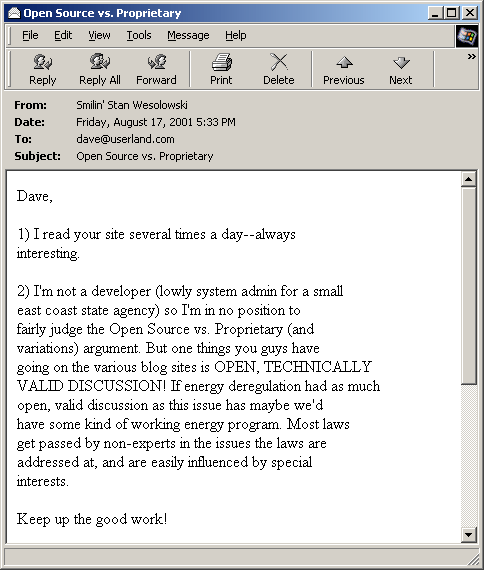
Jacob Levy: "I'm fed up with Stallman too." I love getting this kind of email. Thanks Stan, your message made my day! O'Reilly: Danny Goodman talks about Hypercard. Cringely: "Goodbye EMBED." BlogMe is "a simple interactive posting-only command-line Blogger client for Linux." InfoWorld: Passport 2.0 ready for a stamp. Just A Tip sends "free, anonymous email to your friends telling them about their annoying problems." Miguel de Icaza: "Today is GNOME's fourth birthday! The excitment grows around the globe!"
Internet News: "This patent enhances Oracle's intellectual property portfolio and complements our leading marketplace products," said Kevin Miller, Oracle vice president for Internet procurement and exchange products. John Robb: "I love Audio Galaxy. Unfortunately.." Business Week: "The .Net business model depends heavily on companies that want to do business on the Web hooking up with Microsoft, but the company's long history of leaving a trail of battered partners makes this a difficult proposition." Meanwhile a debate between Stallman and O'Reilly reveals that "We in the Free Software Movement are not opposed to business. But we have seen what happens when a software business has the 'freedom' to impose arbitrary rules on the users of software. Microsoft's conduct illustrates where that power leads." Hey thanks a lot. (Sorry for the sarcasm.) Some of us have ethics and values, most software developers value freedom for everyone. Microsoft is not our role model. Your argument is getting pretty stale Richard. Eric Raymond: "I don't have to use Bates's bloatware." Continuing my fantasy from yesterday's piece -- if I ever do a developer conference, I'm going to call up Annie Lennox and ask her to do a special version of one of her songs. It'll be called "Developers Are Doing It For Themselves." Our motto will be "Thank you I'll get it myself." (For ten points, guess who says that.) John VanDyk has been having a similar fantasy. PS: I'd like to lead a one-day tutorial The World Outline, how it works, and what it can do for us. Yes Virginia, there's a naked person of indeterminate gender reflected in this teapot. My fifth grade class picture (everyone's wearing clothes as far as I know).
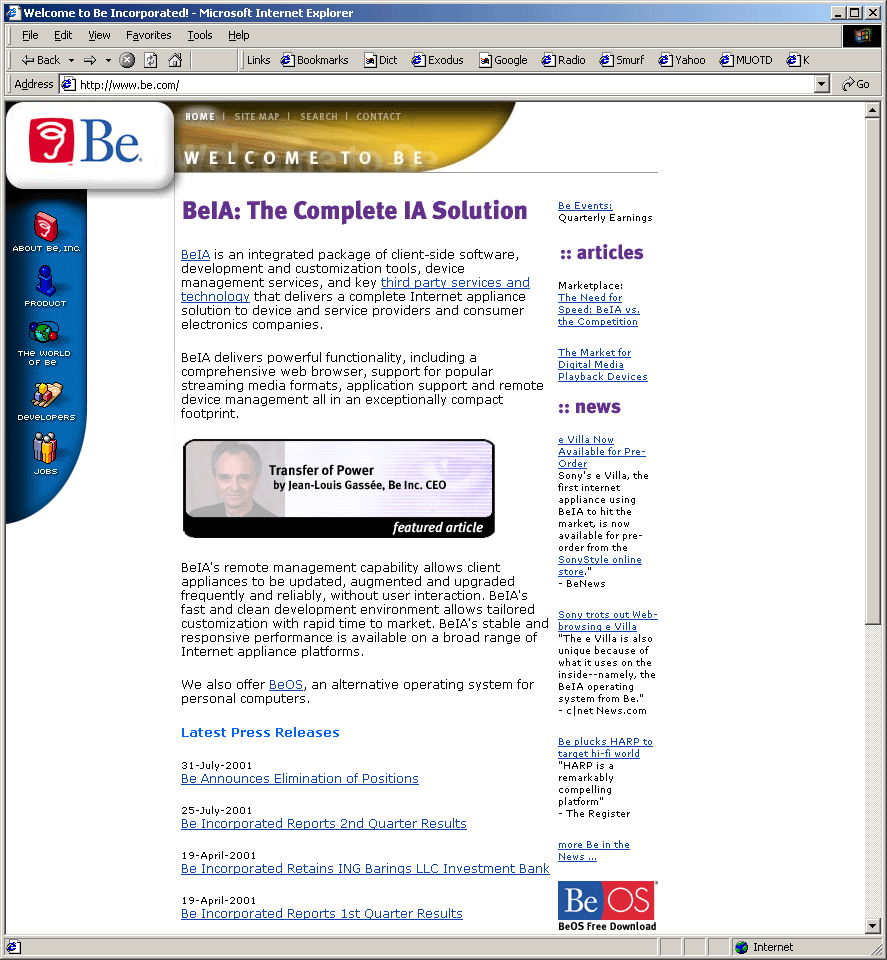
DaveNet: An Epitaph for Be. "He is the best harvester of love I've ever seen." Mon-Tue next week I'll be in Colorado at JabberCon. Hey Doc is going too and so is Craig. I bet we have a couple of pretty interesting discussions. And I bet the night sky is pretty nice up there in the Rockies in the summer. Standard: The Industry Standard Suspends Publication. JD Lasica: "I nearly veered off the road this afternoon when I heard, via NPR, that the Industry Standard is folding and will file for bankruptcy next week." Google is indexing us more frequently it seems. blogger.deletePost. "This, um, deletes a post." Our glue scripts table is updated to include support for the deletePost method. blogBuddy is a "small application written in Delphi which enables remote control of blogs on blogger.com." Craig Burton: "There is a consensus with management and legal at Microsoft is that GPL is Kryptonite." Kryptonite is a "fragment of the exploded planet Krypton, home world of Superman." My fourth grade class picture. (I'm third from the right in the top row.) Joni Mitchell: "Oh, won't you stay? We'll put on the day and we'll talk in present tenses." Be pointers Press release: Palm Acquires Assets and Hires Key Talent From Be. $11 million. Be's market cap at yesterday's close was almost $17 million. A snapshot of the Be home page on Acquisition Day. Be stories: Standard, TheStreet.Com, Dan Gillmor, News.Com. Leo Laporte: The BeOS -- Beautiful, Elegant, Doomed. News.Com, 1/6/97: Where are they now? 10/7/95: "Welcome Back Jean-Louis. We were missing you." Beasts of burden? I don't remember where I heard this idea, it could have been in NY. It goes like this. We think of ourselves as creatures of free will, the only conscious beings on this planet. We wonder if we're the only conscious beings in the universe. But there's another view of who we are -- beasts of burden for our genes. We carry them and propogate them, or let others propogate into ourselves, only to create more beasts driven to propogate their genes. In that view of the world, the genes are a higher form of life than we are. Who knows what drives them? Richard Dawkins: The Selfish Gene. Brett Glass: "Actually, I think we've stopped being beasts of burden for genes and are now beasts of burden for memes."
DaveNet: Apache. "As a platform for independent developers neither of the BigCo's half-hearted attempts to offer developers freedom is convincing." I'm reading a book about the flu epidemic of 1918. Bert Garcia: "Who uses all the applications in the MS Office suite? In a small business of let's say 15 employees, maybe 10 have to type up a letter, two do occasional spreadsheets, one brave salesperson attempts a presentation and none want to tackle a database. Seems like a waste of disk space, not to mention license fees." Good point. Dan Gillmor: Big Blue places $1 billion bet on Linux. Today is Scoble's first day as a UserLander. Welcome! It's confirmed. The correct pronunciation of Mitch Kapor's last name is, as I thought, Kay-pour not Kuh-pour. Florence must be a great place for a creativity workshop. Jogger is a Jabber-powered weblog system. Let's get this working through Manila and Blogger too. Giles Turnbull: A new direction for weblogs -- pornography. Sometimes I can't believe the words that are defined on dictionary.com. Great job, whoever's doing it. 2/9/97: "Listening is still a precious commodity. Nothing's changed there. If you want to make a contribution to making the world a better place, please listen to someone today, tomorrow -- every day. Have the courage to let them exceed your expectations." (More 1997 life quotes.) Edd Dumbill: "Perhaps some of the uneasiness is due to the fact that web services proponents have never demonstrated how to do any more than retrieve a stock quote." Jeremy Bowers did a fact-sheet on the DMCA. Thanks! Frank Field: "I have a bunch of stuff on DMCA, from a variety of sources, that my be useful." Yesterday I took a nasty fall getting into the hot tub. Bruised my side, totally sore this morning. Had a scary thought. In twenty years that's going to be a broken hip. Better go out and get some of those bathtub traction creator thingies. Alice Cooper: "I got a baby's brain and an old man's heart. Took eighteen years to get this far."
DaveNet: Excerpt from Breaking Windows. "In this excerpt Bank tells the story of Microsoft's decision to comply with a judge's order to open up Windows to other browsers by breaking Windows, an act of self-defacement that illustrates how far Microsoft will go before bending to authority."
I'm going to write a rebuttal to this piece tomorrow. Interesting point of view. No need for the open source world to throw in the towel so quickly. New feature: "With a little setup you can post to a Blogger weblog through email from Radio or Frontier." Paul Nakada: "Here's a screenshot of my AOL instant messenger window with a list of updated UserLand weblogs pushed out to me every 15 minutes." Chris Langreiter: "My lil' Jabber bot is now able to blog, thanks to Blogger's recently published XML-RPC interface." Josh Lucas: "I have implemented the Blogger XML-RPC API into a Java class." Steve Zellers has Blogger working with AppleScript. The transcript of the discussion at the O'Reilly conference is up. The part about patents starts on page 3. The question from the audience about patents is on page 5. Microsoft's rep said "Well, at the end of the day, if you have a patent, you enforce the patent if it's valuable to you. And so I think that Microsoft and other people who have patents will ultimately decide to enforce those patents." After all these years, the truth comes out. "Rory J. O'Connor and Laurie Flynn were the first two columnists under the Robert X. Cringely name." Future Positive: "There are too many of us." WSJ: "A few dot-coms are actually making money." Phil Wainewright: "In recent years, the granting of U.S. technology patents has become big business, fueled by the massive tide of venture capital funding. Since a central tenet of VC philosophy is that all successful technology ventures are founded on proprietary ownership of a unique and fully defensible intellectual asset, huge funds have flowed into the coffers of patent lawyers." Clips from 1997 Judge Jackson issued his order on 12/11/97, Microsoft responded on 12/15/97. I went through the Scripting News archives for that period, and used Google to find articles dating back to those events. Unhappily many of them were gone. News.Com, which has so far been great at maintaining archives is starting to slip. And all the links to the SJ Merc are gone, which is bad, esp considering that Dan Gillmor was quoted in the excerpt, terming Microsoft's response "Compliance with a raised middle finger." I only link to those pages that still exist. (Postscript: Dan put his column on his weblog. Thanks Dan!) John Dvorak, 11/3/97: "Apparently, Microsoft doesn't see the Justice Department as much more than a bug that simply needs to be brushed off its arm or sprayed with DDT. At least that appears to be the case considering the way Microsoft keeps using publicity to its advantage. Unfortunately, that publicity tends to mock government bureaucrats, and that's not a good long-term strategy. Neither is the strategy of proclaiming Internet Explorer to be part of the operating system. That's just plain silly. What other part of the OS, for example, runs on a Mac?" Dan Gillmor, 12/16/97: "The company accurately brags that it employs some of the most capable programmers on the planet. It might consider asking them to use their talents to comply with the spirit of the order, too." ZDNet, 12/17/97: "Last week, U.S. District Judge Thomas Penfield Jackson ordered Microsoft to stop requiring hardware vendors to include IE on their machines as a condition of installing Windows. Earlier this week, Microsoft appealed the preliminary injunction, while offering a plan to put the company in compliance. This plan consisted of offering OEMs the option of licensing the original release of Windows 95, which did not include integrated IE 3.0 files. Microsoft's competitors and market analysts have questioned whether such an unattractive option is within the bounds of compliance." DaveNet, 12/17/97: "Bill Gates is more than a competitor now. What's his vision for us? What's his vision for his company and for himself?" Business Week, 12/18/97: "In a move that flaunted the injunction, Microsoft dreamed up this 'choice'': PC makers can delete Internet Explorer files from Windows 95--not a very viable option since Microsoft warns that doing so could render the operating system useless. Or they can ship their PCs with a version of the operating system that is more than two years old and lacks the browser as well as key enhancements added to Windows since then. Or stick with the latest version of Windows with Internet Explorer, for the same price. It's not hard to figure out which option PC makers will choose. The Justice Dept. was not amused by this maneuver. On Dec. 17, it filed a contempt motion." NY Times, 12/22/97: "Last week, after winning a court order that forces the company to unbundle the two software programs, [Joel Klein] escalated the fight when he asked a judge to hold Microsoft in contempt. He also asked the court to give him the unusual authority to review future Microsoft products to make sure that they are not attempts to corner new markets." DaveNet, 12/22/97: "It's time for Microsoft to make a choice -- to lead, to become a great company; or continue to struggle and put off the growth." NY Times, 12/24/97: "Microsoft's stubborn position that it cannot comply with a Federal judge's order to unbundle its World Wide Web browser software from its popular Windows 95 operating system -- at least not without damaging recent versions of Windows -- may be stirring a backlash against the company." Jeff Veen: Ten Ways to Make Browsers Better. 1997 DaveNet quotes re Microsoft.
DaveNet: Connecting with Blogger. Frontier site: Glue that connects Blogger with UserLand scripting environments. A sub-directory on XML-RPC.Com for Blogger scripting.
Posting to Blogger in Radio's outliner. Greg Pierce points out that Conversant has an XML-RPC interface that predates Blogger's. Let's give credit where credit is due. There's also a fantastic XML-RPC spell checker, and O'Reilly's Meerkat. What makes Blogger unique is that it's quickly driving developer and user adoption of XML-RPC. It's as close to a killer app as we're likely to get. There's already Python glue and Perl glue that connects with Blogger. There will be all kinds of connections. We'll continue to promote all web apps that support XML-RPC, and celebrate them, but Blogger getting on board is a BFD in XML-RPC-land. We've received permission to run an excerpt from David Bank's Breaking Windows, pages 113-122. I'm working on the intro and digging through archives to find links related to the section we're running. MIT Tech Review compares Zaplet and Groove. Mark Pilgrim: "Groove is an overkill solution in search of a problem." IBM thinks web services is about weird prosthetic devices. I prefer programming on the wire. Wired: "A cultural icon from the early days of personal computing is making a comeback on Mac OS X." Web Standards Project: "All we've asked Macromedia to do is ship Dreamweaver with the ability to create standards-compliant pages. It can't be that difficult; as you've seen, the technology is already there." BBC Windows XP prepares to storm the desktop. Register: Bill Gates spells out the future. Salon: "Teen girls flash some skin on their 'cam sites,' and fans shower them with gifts. Who's exploiting whom?"
I'm playing with Blogger's new XML-RPC interface using the sample script Jake wrote. I think I'm going to hook it up to the Radio outliner in a crude way. Should be fun.
AP: "Microsoft Corp has agreed to change its new Windows XP operating system to address a complaint that it steered users of Eastman Kodak digital cameras away from Kodak software and services." Talking Moose: "What happens if I'm at a big company and Solitaire is in the top spot? Think that'll go over well with management?" A particularly insidious kind of spam. It looks like a friend sent a greeting card. Click on the link and you go to a page where it says you need to upgrade in order to get the card. They walk you through the install process. Don't do it -- this puts code on your machine, certainly adware, maybe spyware, maybe worse. Now for experienced programmers this is pretty transparent, but what about less technical users. Oy what a mess. What does the future hold? Jakob Nielsen: "To design an easy-to-use interface, pay attention to what users do, not what they say." Steven Levy: "When it comes to protecting the business plans of those who publish books and music, academic freedom and free speech are apparently expendable." LA Times: "God, what I wouldn't give to taste Frosted Flakes again." The full text of the Cluetrain Manifesto is available on the Web. Good move. Now the search engines will pick it up. More people will read excerpts and will become familiar with the book and the excellent ideas and writing it contains. When they're browsing in the bookstore and come across the title they'll think "I've heard good things about that book," not remembering where, and more people will buy a copy.
Now for the first web picture of Rudy Kiesler. I'm the kid he's holding, and my uncle, The Great VaVaVoom, is the chubby pre-hippy kid to the right. My third grade class picture.
Happiness is a mail server that works. Happiness is (also) a new Bryan Bell theme. John Robb: "Does anyone have a Asian language version of Frontier running? Has anyone built a Weblog for view by an I-mode phone? If yes, contact me right away." Aaron Straup Cope pushes back on the Talking Moose's latest rant about designers and Aaron is right about this much -- Designers aren't obsolete. (The rest of his stuff, well, some people don't program, and for them, yes, they can have the benefit of content management, but that's another subject.) Now, I think this is what the Moose meant to say: designers without content management are working too hard. And doing menial work. No designer wants to hear that they have to manually reflow the content of an entire site through the templates just to change GreatCompany.Com to The Great Company. Let the users do it themselves. Designers are using moose-drawn carriages. Content management gives them automatic transmission and a luxurious rocket-powered ride -- it lets them do more with less time, and keeps them doing stuff they like to do -- designing, and no time doing what scripts like to do -- mindless moose-like poop. Craig Burton: My RSS Channel No Longer Sucks. News.Com: “Sun can’t have it both ways,” he said. “They don’t want Microsoft to have monopolistic control, but at the same time they want to control their Java.” XMLRPC-J is a "Java-based implementation of the XML-RPC protocol." Microsoft's transcript of the panel discussion at the Twentieth Anniversary of the PC dinner on Wednesday. While I was in NY this video clip of Microsoft's Steve Ballmer made the rounds. Back in 1996 I suggested that Netscape hire him. He has the energy to win. Imagine if Netscape had been able to recruit him. One might wonder if that video was an accident or was released intentionally by Microsoft. I'd bet it was intentional. So much attention has been focused on Bill Gates, who's shy and ironic, even a little whiny, when he appears in public. Ballmer, with all due respect, is clearly a fan of professional wrestling. I got a clue to this when he talked about what would happen to Microsoft if Dot-Net doesn't work. He said they'd be in a World of Hurt, which I looked up in Google and found was a professional wrestling show. I have some kind of virus that makes this highly irritating ad pop up all the time. It replicates itself every five minutes, filling my screen with pulsating ads for web gambling. I don't have that particular vice, so I will never use their product. I didn't ask for this, I have no idea how it got there. I've tried restarting the computer, but it still comes up. How do I get rid of it? I tried running AdAware, but the virus persisted. For a while I thought it was coming from Opera, but not -- I quit it, and the ads just popped up again. Now an ad for Sears air conditioning is popping up ad infinitum. You can be sure I'll never buy anything at Sears, even if they were the only place in town that had what I wanted. I'd do without. Jamie Zawinski: "I think my standards have lowered enough that now I think 'good design'' is when the page doesn't irritate the living fuck out of me." After a little bit of wrangling we received permission from the publisher to run an excerpt of Breaking Windows through DaveNet. Now we have to figure out which part to excerpt. My second grade class picture. A distant relative of mine, Ron Schecter, is keeping a website about the town where (I think) my maternal grandfather, Rudy Kiesler, was born. Thanks to Eirikur Hallgrimsson for the pointer to these full-color pre-revolutionary pictures from Russia.
We're moving some servers today, so there will be a pretty big outage. It won't affect many of the hosted Manila sites, but the Frontier, Samples, Search, and a few other sites will be off the air, and mail to and from UserLand will be out during the move. We'll do it as quickly as we can. Dig we must! 8:06PM: Update on the outage. The sites are back, but the mail server is still out. I've been nominated for the Top Rave at Wired, and it's nice to get recognition for the role I played in SOAP, of all things. Wow. Thank you. It's a people's choice thing, so you get to vote. Please do.
Gary Oliver: Agenda FAQ. A controversy I forgot to ask him about. Is his name pronounced Kay-pour or Ka-poor. I'm pretty sure I asked him this once a long time ago, most people go for the second pronunciation, but I think it's the first. Number of members of the New York mail list: 59. Is the next stop Salt Lake City? I'm thinking about driving to hang out with Craig Burton in his hometown. August is a great month for a long auto trip through the high desert. I wonder how many people would come to a dinner next week in Salt Lake? Microsoft has "developed a tool that eliminates the obvious damage that is caused by the Code Red II worm." Register: "Given than NCompass’ prices were competitive with other vendors in the market such as BroadVision, Vignette and so on, how much of a bombshell will this sort of price cut have on the market?" SF Chronicle: "Longtime Salon investor Bill Hambrecht and Adobe Systems founder John Warnock are leading a group of 11 investors in putting $2.5 million into the struggling online magazine and may add another $1.5 million during the next month, Salon chief executive Michael O'Donnell said." Glenn Fleishman: "Here's a fun set of graphs I like to look at that helps me understand who is coming from where (and then I try to figure out why)." Byte: Distributed OSs. "Some experts define a distributed operating system as an OS that manages a collection of independent computers and makes them appear to the users of the system as a single computer." workspace.userlandSamples.blogger connects Frontier and Radio to Blogger through its new XML-RPC interface. A new look for the Talking Moose site. Nice! Register: "As patent owners Microsoft can not only demand royalty payments but also refuse to issue a licence altogether and simply demand that use of the application using the patented software be stopped immediately." DRM, or Digital Rights Management, is one of the major themes of Windows XP. It's a loop back to the 1980s when copy protected software was the norm. Most of the articles from this period are not on the Web, but luckily my mom kept a copy of this 9/28/86 NY Times article that I was quoted in during the copy protection rebellion. "'The users have taken control of the business,' said David Winer, president of Living Videotext, a software company in Mountain View, Calif., best know [sic] for ThinkTank, a program used to draft outlines." We can expect articles like this one to come back too -- in 2002 or 2003. At the time, most Microsoft software was not copy protected, so most of the users' ire was directed at Lotus, which was then the leading software company. Lotus' 1-2-3 spreadsheet program was copy protected. Renato Iannella: Digital Rights Management Architectures.
DaveNet: Dinners on Two Coasts. A mail list for New York. "We had a great dinner in NY on August 6, and some people asked 'When are you coming back?' and I said 'You don't have to wait for me to come back.' So let's see if we can get some new tech stuff happening in NY. We've got lots of resources, lots of geeks, and a few marketing people. I'll get the word around that the list started, and you guys and gals take it from there. I'm behind you all the way. Let's Go New York!" On Tuesday, the next day, I had a long strategic meeting with a new partner. There were so many opportunities. Leaving the meeting I thought of all the really smart people who came to the dinner on Monday night. Somehow between the two meetings there's something going to happen. It's a very interesting puzzle. That it's happening in NY is a nice bennie, because I enjoy visiting NY so much. Eastside Journal: Was Gates forced out of top job?
Glenn Fleishman: "Strangely and wonderfully, Qwest called my father up out of the blue. They wondered if all was well, and offered to fax him the instructions. Holy cow. This almost made me weep." BloggerCOM is a COM object used to submit entries to Blogger. I also joined the BloggerDev mail list. Talking Moose: "Bryan Bell is leading the way." Bruce Schneier: "The DMCA is unconstitutional, but until it's ruled as such, the industry wins." Business 2.0 puffs about SOAP. "No longer just a medium for individuals to get information stored somewhere else, the Net is becoming a platform for applications that interact with each other online -- opening the way to dramatic new lines of business for companies like Microsoft, IBM, and Sun." As usual they worship the BigCo's. What have they done for us lately? Matt Neuburg wrote docs on the recently added Tools architecture to Radio and Frontier. He says "This is excellent because unlike earlier implementations of such packaging, like suites and plain guest databases, there is no need to run an installation script or to restart Frontier in order to get your functionality to take hold - it just starts working as soon as the guest database is dropped into the Tools folder." News.Com: "Microsoft has given PC makers the go-ahead to ship Windows XP as much as one full month before the operating system's official Oct. 25 launch date." News.Com: Execs reminisce on 20 years of the PC. Surprise: "Laughing is so important, it reduces stress, it can heal and it allows more creativity!" Amen. Bob Dylan: "It's your brand new leopard-skin pill-box hat." Derek Powazek: Five tips for online community. Solution to yesterday's puzzle. Now you should be able to spot me in the first grade class picture. People always ask "Where were you when Kennedy was shot?" This is where I was, in Mrs. Ruffino's first grade class. She ran out of the room crying. They let us out early. My mother told me as we walked home. The President is dead. She told me about Johnson. "Who's he?" I wondered. Kennedy was the only president I had ever been aware of. That's how kids' minds work. There's no past, no future, just now. Could someone other than Kennedy be president. That didn't make sense to Dave's Young Mind. BTW, I know the date on the picture is 1962, not 1963, the year Kennedy was killed. Maybe one of the other curious things about the young mind is that it has an imperfect memory. 1968: RFK Funeral Train. Another pic from the 60s that I find fascinating.
Welcome back to California, Dave! Sebastian Delmont: Photos from Scripting News Dinner in NY. Of course I was much cuter in 1961. I asked some friends to guess which one is me at age five, and they're all getting it wrong. Then I asked them which one was my girlfriend and they're all getting that right. What does that mean? I wish I knew! Talking Moose: "Today I had a chat with Jim Allchin." John Robb: "Another thing I heard recently: Web services are a return to ASP land or a return to huge Websites that integrate functionality for end users. No way." James Spahr: "This is a very simple tool for Radio Userland. It publishes your Userland On the Desktop content to a website that is ideal for Avantgo Channels. It basically puts Userland On the Desktop on your Palm." O'Reilly: Mac Open Source Directory. Dan Gillmor: "The Feds should force Microsoft into showdown over Windows XP." Eric Schmidt: "If you write a story and it goes up on the Web and gets onto Google in the next couple of days. Wouldn't you like it to be accessible right now?" Yes. 9/7/96: "Search engines take too long." Aaron Straup Cope wrote a SOAP-to-Jabber gateway in Perl. Evan Williams: Blogger API in XML-RPC. Mark Pilgrim: Python interface to Blogger.
Dear friends and family and lurkers. My trip to NY is in its last hours. Today I had breakfast with a reporter, went to a long meeting at a partner company, and met with a famous blogger. I have adjusted to the slow Internet line, have configured my emailer to not download attachments (thanks for all the suggestions) and have even learned to use my laptop on my lap. I spent a lot of time with family and no one yelled at anyone. We're getting older, maybe wiser and more forgiving too. My mom gave me an album of pictures of my early life, including every class picture from kindergarten through grade nine. I feel a real sense of accomplishment. I'm going to do one more run to the 2nd Avenue Deli for a roast beef on rye with lettuce and mayo, then walk around the city. Tomorrow morning I fly back to California, in time for the 20th anniversary of the PC reunion in San Jose. This NY trip has been great. Thanks to all the NYers who made it so! Frontier Developers You Can HIre. Many of our newest customers are not programmers, yet still want customizations for their Manila servers, so we started a registry for developers who know how to program in our environment. AP: "McAfee.com has won a patent for its system of delivering security-related software and services over the Internet, giving it a potential leg up in the emerging trend of subscription-based software." ZDNet interview with Microsoft's Jim Allchin on Smart Tags, among other things. FWIW, I don't think we misunderstood what they were. Craig Burton: History is Soon Forgotten. AP: "Russian computer programmer Dmitry Sklyarov was released on $50,000 bond Monday and ordered to stay in Northern California while he awaits what could be a landmark trial on alleged copyright violations." Mr. Wannachai Wannasawade, your computer is infected with a virus and is sending me dozens of big enclosures and I'm on a very slow line and I wish you would shut your computer off. Also, to the vendor of my emailer, Mr. Allchin's employer, is there a way to tell Outlook Express not to download enclosures? It's either a user interface problem, or your priorities are misplaced. I'm highly motivated. Looked several times, and couldn't find a way to tell the emailer to leave the enclosures on the server. This is basic stuff.
Tonight's Scripting News dinner is at Vincent's, 8PM. 119 Mott St, at Hester St (212-226-8133). "Little Italy restaurant serving fresh, cheap and spicy seafood dishes – clams, mussels and squid." RSVP here. Great dinner tonight. About forty people, lots of networking. New York wants its own mail list, and dinners even when I'm not in town. That's excellent.
Slashdot thread on Breaking Windows. The helicopter ride was great but short and quite expensive. NY is overwhelming. Sorry for the lack of new posts, slow net connection, my mind is elsewhere. Hope everyone's having a great weekend. Read the review of Breaking Windows, and get a copy for yourself. Everyone who's in the tech business in some way, even people who just use the stuff, should know how the industry really works. Another subject we're going to cover in more detail is the case of the Russian programmer who's in an American jail for breaking the Digital Milennium Copyright Act. The act makes it illegal to write software that unlocks a copy protection scheme. It's an interesting philosophy, and a loop back to the 80s when such software was not only legal, but was instrumental in getting software publishers to see that copy protection was anti-user. There were several major software companies in the 80s in the US in the business of creating and updating such software to work around successively more complex copy protection schemes. They won awards from the PC software magazines. The leading company, Central Point Software, merged with Symantec. These were considered indispensible utilities. Now there are arguments on both sides. I know the publisher's side, because I was on that side in the 80s. The position is that users can't be trusted to do the right thing, to pay for the software they use. Before you laugh, there are lots of people who use computers, many more today than in the 80s, who can't be trusted in this way. They will take the software they want and not pay for it. On the other side are users who do pay, whether or not there are copy protection hurdles. They argue that they shouldn't have to give up functionality, or put up with time-wasting nuisances, because other people are dishonest. Now there's a counter to that argument. What else is new? (I'm in NY, after all.) You may someday miss a plane because of a long line at airport security. Life is filled with annoyances like that. On the other hand, the users say this is not a matter of life and death, the worst that happens is that some rich software company is deprived of their revenue. (But most software companies are not rich.) Why should they care about that? And if you make piracy illegal, isn't that enough? And is it safe computing to not have a good backup of your work and the programs use to access the data? And does the punishment fit the crime? In the United States, where we value freedom above all else (or used to) do we really want to put programmers in jail for writing software that users want? In the 80s I argued with users about this, and then woke up and realized that I didn't have much of a business if I was arguing with my users. The DMCA is a terrible law, it's un-American, anti-user, and beneath us, and restraining of free speech, and probably won't stand a constitutionality test, much as the Communication Decency Act didn't. It's true that the Internet introduces some new challenges, but we must have a clear philosophy, and putting programmers in jail should raise everyone's awareness to what's coming in the future. More of this, for sure. Would you be willing to go to jail for your beliefs?
One of the latest home page-flips in recent memory. Not much to say. Spent the day with NY family members and my Jamaican uncle. Toured various old neighborhoods, went bowling, spoke Italian, ate deli food, had a great time. Today the computer industry can take care of itself. And my email is working again. Tomorrow I want to go on a helicopter ride, I've always wanted to see NY from the air.
I'm outta here. Don't forget Monday dinner. Already 25 confirmations. Great to hear that NY is alive and well. Seeya soon. I made it to NY. It's hot here. Easy flight. Saw a great movie on the plane, Shrek. It's a total love story. Like all guys the leading man is an ogre. He falls in love with the beautiful princess, and she with him. It turns out she's an ogre too, but he thinks she's beautiful and they live happily ever after. This got me all fehklempt. It occurs to me that I just gave away the ending. Oh la. If you see the movie it's not exactly a surprise. One thing to do if you have your emailer set to check every five minutes -- turn it off before you leave. Now all my new email is accumulating on the computer back in California. So if you sent me a message today I won't see it until I get back to California. You can re-send it tomorrow or wait. Your choice. Anyway, it's 11:30PM in NY and it's time to go roaming for.. PIZZA, of course. BTW, I like NY. I feel at home here. Over and out.
MobileStar is Starbuck's service provider. Looking through their website I see that they have service a block from the hotel I'll be staying at in NY. Just for fun I checked on the Starbuck's site to see how they explain their wireless service, and came up with nothing. (I did note that they do their membership with Passport, and list the NY Times as a partner on their home page.) Standard: "Since 90 percent of Starbucks customers are heavy Net users, it makes sense to offer wireless access to gadget-toting coffee drinkers. But don't use the c-word. 'This is not going to become a cyber-café,' Starbucks chairman Howard Schultz told the Wall Street Journal. 'Internet cafes are dark, cold places - everything we're not,' echoed another Starbucks exec in a Forbes.com article, adding that the store's wireless access points won't be obvious. (Let's hope for usability's sake they're not completely hidden.)" Dan Gillmor: Government should block XP release. Three years ago today News.Com asked Is Push Still Dead?
BetaNews: MS CMS 2001. "Businesses can purchase a fully licensed copy for $39,901. A fully enabled 120-day evaluation version is also available." Register: Be takeover imminent. "The job cuts the company announced this week are an efforts to streamline the workforce to meet the conditions laid down by the buyer, who as yet remains known only to senior Be executives." News.Com: "After months of operating in stealth mode, reunited Netscape alumni will launch their peer-to-peer content distribution company early next week." WebReview: Designing for Usability on a Shoestring.
Julien Moorrees: "I have built a web service which you can use to add a Messenger (like ICQ , MSN Messenger, America Online Instant Messenger) to your applications."
Bob Dylan: "Mama's in the factory, she ain't got no shoes. Daddy's in the alley he's lookin for a fuse. I'm in the kitchen with the tombstone blues." Scratch the bit about Evan not tackling controversy. He says "I can't invest in Microsoft anymore." That's how I feel too. Bill Seitz wrote a narrative of his experience with Frontier starting in 1995. I find these kinds of stories fascinating. News.Com: Appeals court rejects Microsoft, DOJ requests. Monday dinner plans Uno momento por favor. I'm on the phone with Vincent now. I told him that there would be a party of 30 at 8PM. I'm going to give him a call on Monday morning to confirm. He says we'll get tables of eight or ten. That's how it worked in Amsterdam in May. It's not as convenient as one big table, it's hard to have a discussion among everyone. RSVP: Dinner in NY on Monday. Vincent's Clam Bar, 119 Mott St, at Hester St (212-226-8133). "Little Italy restaurant serving fresh, cheap and spicy seafood dishes – clams, mussels and squid." OK a couple of jokes A woman gives birth to twins and names them Juan and Amal and then gives them up for adoption to different families in different parts of the world. Twenty years later she gets a letter from Juan with his picture. "What a handsome young man!" the woman says. "I just wish I had a picture of my other son," she continued tearfully. "It wouldn't matter," says her husband "because if you've seen Juan, you've seen Amal." A hotel manager sees two people playing chess on one of those couches by the elevator that no one is supposed to sit on. He walks up to the pair and asks what they're doing. "We're just playing chess dammit, and we're playing it very well!" says one of them. He notices that the other has a crazy look in his eyes. He walks away in a huff. One of maids, after seeing the whole thing asks "Why are you so angry?" He says "I just can't stand chess nuts boasting in an open foyer!" Now for today's serious stuff.. Microsoft's poisoned ecosystem Based on email, people are confused about yesterday's section about Microsoft and patents. Let me try to clear it up. Microsoft files and gets lots of patents. Last week for the first time they said they will use patents to limit competition. That means if you produce software that uses some technique that Microsoft has patented, they'll either make you take the feature out or send you a bill. Now suppose you're an open source developer, doing it for love, not money. They're going to shut you down. Let's say you're a small commercial developer trying to prove an idea so you can get funding. Yup, you're out of the game too. Maybe you're IBM with a huge hoard of cash and patents. No problem. You pay the bill or trade patents. As Microsoft's reps acknowledged last week, there's no room in their plan for independent developers. In their vision of the software ecosystem, you have to get a job working at a BigCo if you want to make software. The possibilities for abuse are fantastic. Microsoft may send a bill to UserLand, but not to Blogger, perhaps because I say things about them here that they don't like, and Evan sticks to lighter themes. Or I might get a bill in the mail, refuse to pay it, and every time I criticize them they up the ante legally. It wouldn't take too long before the cost of criticizing Microsoft was too high, and there goes free speech. All it takes is one BigCo to spoil the whole thing. Of course the USPTO should never have allowed patenting of software, it's too close to patenting speech, and that's the first sacred freedom guaranteed by the US Constitution. I think ultimately that's how we'll get rid of this problem. (BTW, in general, lawyers have been of no help on this. I've tried to get Lessig to look at this angle, but I don't think he understands how close software is to speech.) 7/30/00: Software and the First Amendment. Tim O'Reilly pointed out that Microsoft has benefited from a lot of non-patented art that it ripped off, citing the Macintosh as an example. It's much worse than that. I designed features of Word, Excel, PowerPoint and the Windows file system browser. My lawyers suggested that we file a patent on these inventions, but I felt then as I feel now that it is unethical for a software developer to try to prevent competition that way. I let Microsoft use the ideas for free because I thought it was better for progress in the software business. (In 1985, when the outlining feature was going into Word, they didn't hide that they were studying ThinkTank and Ready. The subject of licensing the design of our user interface never came up in the discussions we had with them, and we didn't raise the issue after Word-with-outlining shipped. Same with PowerPoint, which eventually adopted many of the features of MORE. I had a meeting with Microsoft's Pete Higgins where I explained how outlining would work in spreadsheets. Shortly thereafter the feature appeared in Excel. Again, no problem sharing the idea, I didn't have a spreadsheet to put it into, they did, so I gave them the idea. The same free sharing of ideas happened in 1998-2000 when we worked with them on SOAP, based on prior work at both Microsoft and UserLand. Getting Microsoft on board was important. We made a significant contribution to their product strategy.) BTW, I asked John Montgomery of Microsoft, while SOAP was in development, to confirm that they had not filed any patents on this technology, and I got confirmation that they hadn't. The red flag was raised by Sun, in a private meeting, who claimed that they knew that Microsoft had filed patents in this area. The BigCo's play a pretty nasty game, I learned at the time.
DaveNet: Big Blank Machine. Hey I've been nominated for an award by Wired as a Tech Renegade. "Mavericks, geniuses, and intellectual outlaws. A person whose ideas are changing the world." Guess I'd better get busy doing all that. If it's happening in NY, let me know. I'll be in the Big Apple Saturday through Tuesday. Bringing my laptop and cellphone and staying at the Grammercy Park, as usual. Want to have a dinner on Monday night? But of course. RSVP: Dinner in NY on Monday. This time I want to have the dinner in Little Italy. How about Vincent's Clam Bar, 119 Mott St, at Hester St (212-226-8133). "Little Italy restaurant serving fresh, cheap and spicy seafood dishes – clams, mussels and squid." Dori Smith found a THINK sign on eBay. Jeff Gilbert found another. On Wes's DG, Robert Scoble makes a brief appearance and drops two big turds. Is he the Talking Moose? There still is some doubt about that. Did we hire him as our new Director of Marketing? No doubt about that. He starts on August 15, and we already have a stack of work for him to do. Brent: "Don't call me an artist." Adam Curry: "Folks want to talk about MTV's 20th anniversary, which is today." Kodak vs Microsoft In this confusing News.Com article about Kodak vs Microsoft, there's one nugget. Kodak wants to control the experience for users of Kodak digital cameras. Their business model apparently depends on being able to make money from processing photos. Microsoft, on the other hand, wants to offer users choice, but of course there's a catch. They make money on all the processing. Kodak says this is a tax on the Internet. It's easy to see why they think this is unfair. But how often will we print photos in the future, when the Web is so much more efficient and cheaper? A shift in perspective Kodak is now a Microsoft developer and dealing with the kinds of conundrums and steady narrowing of the playing field that we've all been dealing with. Welcome Kodak, seriously. But Kodak had options other developers don't. In 1996, when Apple was in play and Sun was rumored to be buying them, anyone with $4 billion in market cap could have bought Apple and created an open zig to Microsoft's constantly-closing-box zag. Why didn't they think strategically? Didn't they see this day coming? And who is thinking strategically today? What about Apple? Today, Apple's market cap is about $6 billion. However even though we like Mac OS X, Apple's position has eroded substantially since 1996. Their operating system strategy is not at a stable point, and with Microsoft about to ship Windows XP, the first consumer OS that doesn't blue-screen all the time, the classic Mac OS is about to be totally nailed, and Mac OS X is too rough to be a realistic competitor to Windows XP. Watch the video Last night I watched the video of the shoot out at the open source summit last week. I highly recommend watching the debate portion, it's about a half-hour, and if you think patents aren't going to be a big part of the landscape of the future of software, you owe it to yourself to hear from the Microsoft spokesperson, Craig Mundie, that you're wrong. If you believe patents are protecting little guys from the BigCo's, think again. Please, to the O'Reilly people, let's get the transcript of this discussion on the Web asap. In the Q&A section, Mundie said you can always challenge a patent in court. A developer in the audience said that costs a lot of money. Mundie said "Get your money." Great, so it's about money and lawyers now. When you hear Microsoft talk about innovation, complaining about judges running the software industry, remember that. I had not heard this line of reasoning before. I thought there were some levels that Microsoft would not stoop to. Apparently there was room to go even lower. Three people made outstanding contributions on that panel. Brian Behlendorf, who explained clearly why "shared source" isn't much help; Mitchell Baker from Mozilla, who eloquently said that one huge company is a bad ecosystem; and Tim O'Reilly who spoke on behalf of independent developers who just want to create cool software. I sent an email this morning to the participants in the Open Source Summit process.
|
 
|
||||||||||||||||||||||||||||||||||||||||||||||||||||||||||||||||||||||||||||||||||||||||||||||||||||||||||||||||||||||||||||||||||||||||||||||||||||||||||||||||||||||||||||||||||||||||||||
|
© Copyright 1997-2006 Dave Winer. Previous/Next |
|||||||||||||||||||||||||||||||||||||||||||||||||||||||||||||||||||||||||||||||||||||||||||||||||||||||||||||||||||||||||||||||||||||||||||||||||||||||||||||||||||||||||||||||||||||||||||||







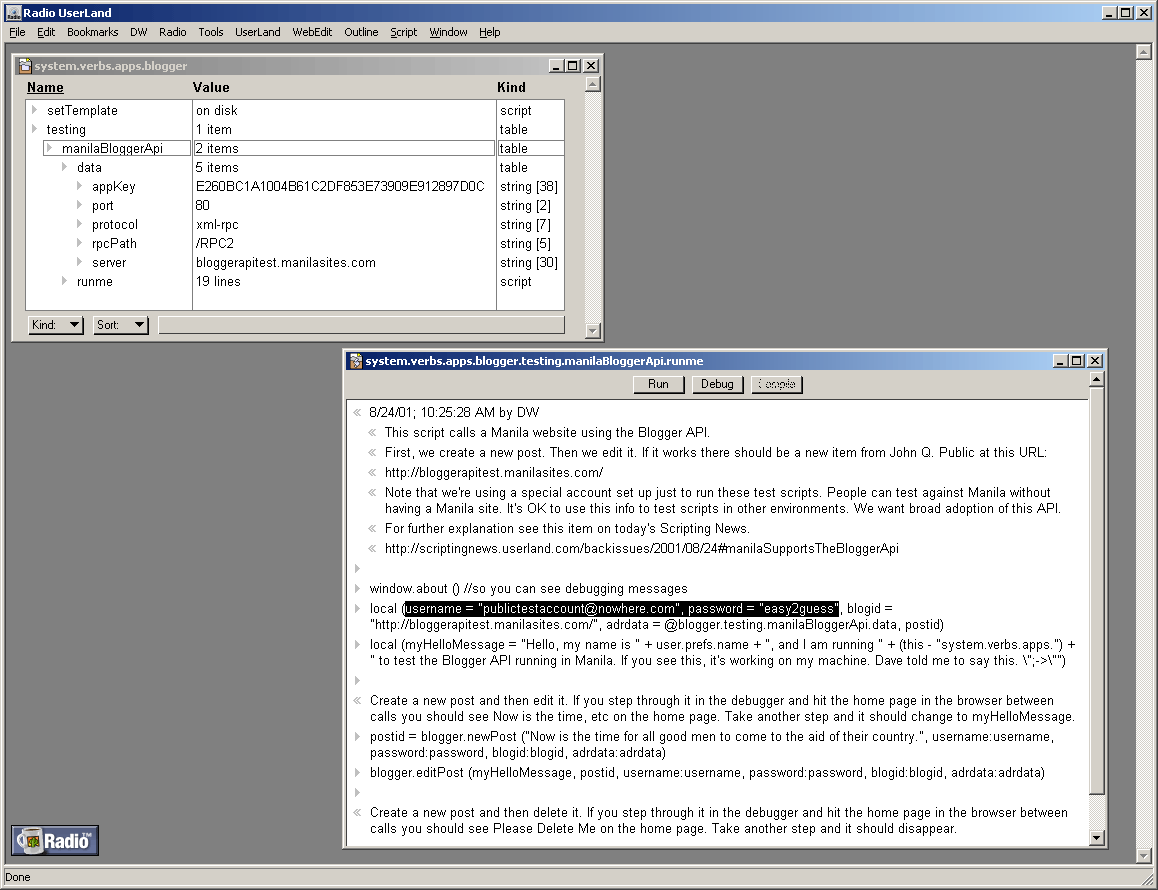
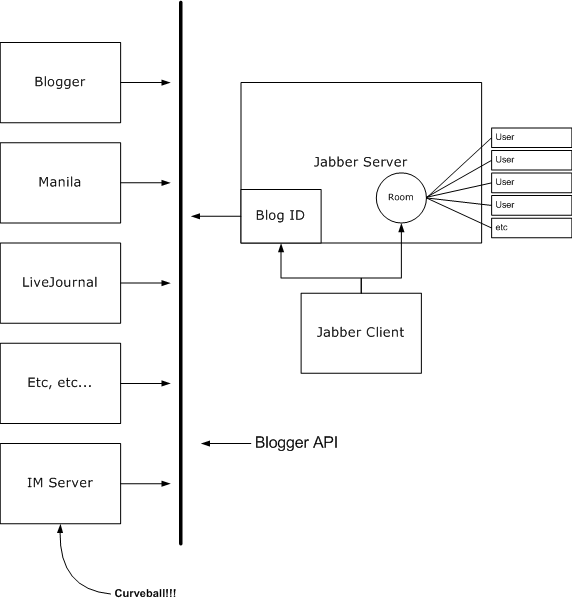

 This afternoon I got another