|
|||||||||||||||||||||||||||||||||||||||||||||||||||||||||||||||||||||||||||||||||||||||||||||||||||||||||||||||||||||||||||||||||||||||||||||||||||||||||||||||||||||||||||||||||||||||
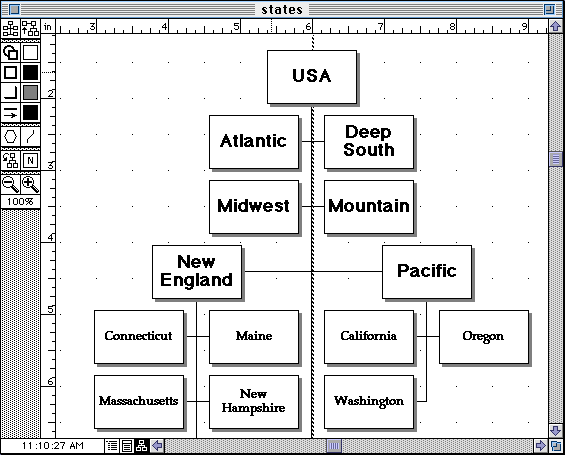
Good morning everyone. How's it going? Last day of February. Payroll day. Not a leap year. Springtime in California. What else to say? Only time will tell. Pause and take a moment out of your busy day to read this story by Shane McChesney. Mike Godwin: "A central goal of Hollywood's lobbying effort is to prevent unencrypted and unwatermarked content from being circulated on the Net." Ominous words from Steve Zellers for developers who use AppleEvents (like us). "A future release of the AppleEvent Manager in OS X may break some applications." Oy. Rob Fahrni, one of the Visio developers at Microsoft, is rendering OPML as a tree chart. It's a good idea, we did something like that with MORE in 1986. Since then I think it's been a lost art. It's cool that Rob is reviving it. The next step is to get PowerPoint to render and emit OPML. Hey Frank, I have a better idea, ignore the Big's and make software and sell it to users, and stick to the principles of no lock-in and user choice, and you'll win.
Special Report: What they're saying about Rob Enderle. I was hoping that Dvorak+Enderle would be a Googlewhack, but alas, they intersect at quite a few points.
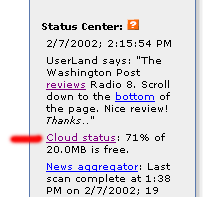
Ciam Sawyer sends this pointer to a simple version of Google, very lightweight. Thanks! Mike Gray found an even lighter Google. Excellent! Chris Locke one of the Cluetrain guys explains what the Manifesto actually says, as opposed to what people who didn't read it think it says. Sam Ruby: "One of the more interesting personalities at the interop event is Keith Ballinger." Dan Gillmor: "Does the technology industry need Hollywood's permission to innovate?" Annalee Newitz: "Blogs have turned me into a nervous person." Russ Lipton explains how to update Radio. Reading this piece will give you a peek at how software subscriptions work. Today we started linking Russ's tutorials into the directory on the Radio site. Wired: "A software upgrade that shut down the Morpheus file-trading network -- a network supposedly immune from such troubles -- could be bad news for people who like to download free music." Dvorak redux According to Chris Pirillo, via Evhead, the main issue for Dvorak is whether blogging is new or not. This is an old story, imho, settled long ago. The weblog idea is as old as the Web itself, which is to say it's pretty new. Why is this concept getting so much press now? The question goes back to Dvorak. Why did you focus so much attention on the browser wars, the Java wars, etc, and not focus on what people were doing with the Web? The story was available starting in 1992. It developed through the early years of the commercialization of the Web. All we're doing is lowering the barrier to entry, giving more power to users, and at the same time they're learning more, getting comfortable with the technology that was so new just a few years ago. Nothing changed, except 15 years of progress, Moore's Law and the addition easy to use networking. Basically he's got some catching up to do. Nothing more, apparently, and that's fine. But I don't like that he entered our world with incorrect and irrelevant accusations about thoughtful people who share their ideas so generously. There's some air to clear here. I'll feel awkward pointing to Dvorak's blog, when it appears, knowing that he's treated these good people in such a shabby way. It's been quiet here Sorry this week I've been heads-down on a big project. We're working with some new partners on new ways to use and sell Radio. Some great ideas flowing in all directions. Not everyone knows everyone else, but if any of it comes to fruition there are going to be a lot more Radio users soon. "A nice problem to have," you might think, and I agree, but -- to turn the next corner, we have to package the cloud-side of Radio, so that other organizations can run their own communities. To do that we have to bootstrap a new community, so we can test the software. Corner-turns and bootstraps are the hardest things about what we do. But that's my job now, and it has been for the last three weeks, and probably will be my job for the next couple of months. But pretty soon my other flows, the other places I'm writing will be visible, and the flow of ideas through Scripting News will get back to its normal sipping-from-the-firehose mode. As someone said once, Still Diggin! Frontier 8 A necessary foundation for the "community server" product is Frontier 8.0. Doug and Brent are working on that, and have a final-final candidate will be on the support site by 11AM Pacific (if you're a licensee you know where that is). At one point I thought we'd do an overhaul of the configuration system for Frontier 8, based on what we know now about browser-based content management. But we couldn't muster the effort, given all that's on our plate, so Frontier 8 will ship tomorrow, Murphy-willing, to be quickly followed by the software described above. What's the difference? A frequently asked question is What's the difference between Frontier and Radio? Radio is our desktop product, it includes weblogging software, a news aggregator, and features that put a friendly face on XML-based services over the Internet. Radio is designed for people, the same way personal computers took the essential capabilities of a mainframe computer and made it easy to use, for people.
The difference are what apps ship with each product. Frontier is configured to serve lots of users. Radio is configured to serve one user. Frontier is $899. Radio is $39.95.
John Hiller: "Whether or not people even know what a weblog is, blogs are already having a massive impact on the lives of almost all Web users." The BlogSisters. Gotta point to em. Just got an email. "Never trust anyone over 30." Nodded my head in agreement. Essay-in-Progress: Desktop Content Management. News.Com: "StreamCast Networks' Morpheus--a file-swapping service that many have said would be impossible for courts to shut down--shut out most of its users Tuesday, citing 'technical problems.'"
NY Times: Apple Gets a Grammy. "The academy noted that Apple's products, starting with the Macintosh computer, have made it easier and less expensive for a musician to single-handedly compose, edit and mix music." DIY.
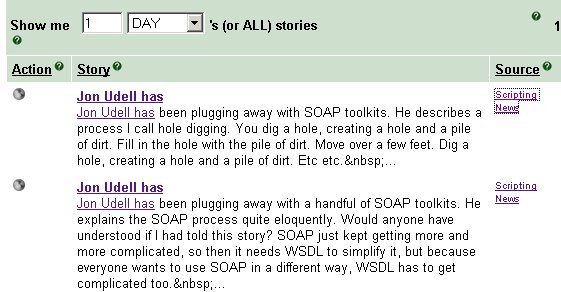
On this day four years ago, I wrote an essay that really got things moving. "It's RPC over HTTP via XML. I believe it's the next protocol for runtimes." Got a call from Bob Atkinson at Microsoft; then Don Box, Mohsen Al-Ghosein, Bob and myself designed XML-RPC, which later became SOAP. It was a big day in my life, led to lots of good things. On this day this year, a group of SOAP developers is meeting in Boston to work out interop in WSDL. Greetings to my brothers. UserLand could not be there because we're digging new holes (and filling in old ones) with XML-RPC and SOAP shovels. We're app developers, we got what we need in the simple XML-RPC spec, and the Busy Developer's Guide profile for SOAP 1.1. At the same time, I support all developers everywhere who are working for interop. A couple of Radio blogs are at the meeting in Boston, and we'll call the play-by-play, best as we can, based on what we understand. (How about doing a WSDL for Weblogs.Com? It's about as simple an interface as you can find on the Internet today.) Adam Curry: "After reading how Andrew Sullivan pulled down $27,000 from donations to his weblog I have to try out the donation system for myself. This particular experiment will be interesting because I'm already a multi-millionaire. Do you still feel inclined to donate?" 10/19/00: "In California you can hardly throw a pot sticker into a crowd without hitting a billionaire." Bill Bumgarner reviews Mac OS X. Craig Burton: "Novell continues to wallow in irrelevancy." InfoWorld: "Microsoft announced a licensing agreement with IMlogic to embed instant messaging archiving technology into future versions of its enterprise-level IM products."
Newsbytes: "Lawyers for makers of the file-sharing applications Morpheus and Grokster say that, if their clients can be held responsible for illegal copies of music and motion pictures, then so too should companies such as Microsoft and AOL Time Warner, whose software and Internet connectivity are essential to building networks of file traders." Until reading this ZDNet article interviewing Don Box, it had not occurred to me that HTTP isn't everything we could want it to be. No sarcasm. People are jumping all over this story, but sheez, he makes some good points.
Heads-up and a bit of a tease. Last night we released a few parts for Radio 8 that generalize the connection between the desktop and the community server. This will make it easier, in the future, to switch to a new server, with new features for communities. More than one Weblogs.Com? Behind a firewall? Private workgroups? Write your own cloud-apps? All of that, and more. There's even a technical term for this. Federation. Inch by inch.
Le Monde: Le Web et moi, et moi, et moi. The FrontPage Weblog explains how to color your scrollbars with (of course) FrontPage. The philosophy of DIY is inclusive. Everyone can do it. xmlhack covers the W3C's patent policy changes. Jimmy Guterman reports from the TED conference. I gotta say this. Having a librarian in our midst is fantastic. I worshipped librarians as a kid. They are so happy to help, and so damned smart! Adam Curry, who was named an honorary librarian today (see above), says "Links are the only true currency of the web." Amen brother. If you don't link you're still ink-stained. Amy Wohl: "I don't include recipes (for cookies or anything else) because I have another website for that." Screen shot of an elusive all-blue site. I've not visited any of the links on this site. Here's a surprise. I just skimmed this new Dan Bricklin essay on weblogging, and all the links were blue, including the pointer to my site. Nice. Last night talking with Jake, after working out our plan for the evening, I said Let's Do It! and realized this is the followup to Just Do It (which is kind of bitchy and controlling, but still cool) which followed DIY, which is optimistic and powerful. The beauty of Let's Do It is that it's about working together, where the previous two were about doing it yourself. There's still a Y in Let's Do It, but we both agree to DI, which is more fun.
One more note before signing off for the night. One of the advantages the pros are supposed to have over amateurs is the time and skills they have to carefully research a topic. According to the legend, weblog people shoot from the hip, there's no time to research. This is an incorrect idea. In fact the best webloggers are domain experts. They spend their whole professional lives gathering knowledge and experience in their fields. A fantastic example of this is Glenn Fleishman, who pours his intelligence out to the Web in vast quantities. He doesn't take any shortcuts. The quality of his writing, and his integrity is in your face. Another example, with all possible humility, I've spent 25 years becoming an expert in several areas of software development. When I write about software, really, there's nothing shallow about it. I've got the scars to prove it. I wonder when some reporter is going to connect XML-RPC, SOAP, RSS and Radio to my weblog. Could any of these things have happened without the ability to communicate directly to users and developers? Don't they see the economic revolution. We've cut out a middleman who was subtracting value. It must be hard for them to see because the reporters are the middlemen. How can you explain a new idea when the reporters won't believe or even express the ideas behind the software. Therefore no new ideas get out. Until the Web. No more exclusive access to people's minds. A route-around. Lots more to say about this. Lightbulbs going on everywhere. BTW, there was a time when reporters got on top of a technology story, and some still do. My career in software was launched by a NY Times reporter almost 20 years ago. I'll never forget it. OK, just one more note. I need an icon for Aunt Mary. Holding a beautiful plate of fresh-baked cookies. It's going on my todo list. Hold on. Stop the presses. Burning Bird shows her face. Hey, she could be Aunt Mary! Ducking. Doc points out that Andrew Sullivan's blogging piece doesn't contain any links. Same was true of this morning's NY Times piece, and Saturday's National Post piece. Maybe this is a fundamental difference between bloggers and pros. Worth considering. We point to them, but they don't point back? John and I have a theory about all these Aunt Mary's cookie recipe stories. The reporters talk to Evan first. He tells them about Aunt Mary and her cookie recipes. Bing. Instant story. Megnut, a weblog pioneer, has a great rant on the spate of recent weblogging articles. (Meg also has a couple of recipes on her weblog, proving that it is possible to have a mind and something to say and also like to make soup and rigatoni.) Jon Udell: "There are levels of truth. Marketing literature can be true, at one level. Journalism can be true at another. Technical literature can be at yet another. All too often these levels operate in isolation, never connecting. When awareness flows across levels, a richer and more nuanced version of the truth can emerge." Two articles by James LaRue about outliners.
Jack Valenti: "The reason pitifully few films are legitimately available on the Internet is not producer hoarding. It is that those valuable creative works can't be adequately protected from theft." Loser. Russ Lipton: What is Publish and Subscribe? Question -- how can you review weblog technology in February 2002 and not cover publish and subscribe? Dan Gillmor: "Weblogs certainly are helping to fill the void in one arena -- technology journalism. It's an economic depression, not a recession, in that field." I don't think I said that Apache is the only alternative to .Net (I don't believe it is) so they must be talking about some other Dave on the Cocoon mail list, in this thread entitled "Crushing UserLand." Heh. I know how much work they have to do to do that. BWT, we use Apache in our system. They could look on the bright side and see Radio as a fantastic application of Apache. Finally, I gave them numerous heads-ups that Apache was falling behind, in public, on this site. Davezilla: "Control Freaks. We all have to work with at least one. You’re reading a blog by one right now." Blogzilla is a weblog about Mozilla. Andrew Sullivan: A Blogger Manifesto. Move the cursor to the top line of the outline. Press return. Enter "Morning coffee notes" and then Enter. Click on the line below. Shift-click and hold it down. Scroll to the last line and click. Control-R. Click on Morning Coffee Notes. Double-click to collapse. Control-D to move it down. Control-S to save. Morning coffee notes The NY Times asks "Is Weblog Technology Here to Stay or Just Another Fad?" Wouldn't it be something if they really attempted to answer the question. The answer is of course it's here to stay, as they asked the same question in the late 80s about desktop publishing. Publishing software is getting easier to use, always, and the people are getting smarter about it, always. The BigPubs often cover this stuff with their ink-stained conflict of interest producing exactly the same story. Aunt Martha with her cookie recipes is no threat to what they do. But there are probably 100 bloggers who could write a more insightful and accurate story about weblogs than Tedeschi's. Here's why the economics work. People want more info, not less. But the BigPubs are laying off reporters as their business model erodes. Weblogs fill the void. DIY. From that premise, interview some analysts and some technology vendors. Have the guts to tell the readers your jobs are truly in jeopardy. Or let them make their own minds up. (Which they do anyway.) A good case in point. John Dvorak takes PC Mag into the blogging world. With both guns blazing. Sure you can make the Cluetrain authors sound like bozos if you're willing to be a bozo yourself. As Dvorak admits in his discussion board for the column "This is something of an attention-getting exercise." Toward what end? Improved flow? That'll work for a while, and then get old. Then what? Will his column cover the technology? He's never seen a blog be critical of another blog? He must not read Scripting News. Net-net, the BigPub's are not handling this very well. Properly dealt with, with an embrace and extend strategy, they can deliver the benefits of amateur journalism to their readers and earn a place in the publishing world of the future. Running incomplete or pissy pieces that demean the idea, only reflects poorly on them, and calls attention to the competition. I'm sure Dvorak remembers how Jim Manzi parsed Windows. He's doing the same thing. Glenn Fleishman: "Another ass-backwards story on blogging."
Tim Jarrett documents an undocumented Manila-RPC call. David Berry uses Radio to support Front Page. I want a way to query DirecTv's listings. Show me all commercial-free movies on channels I subscribe to airing in the next 30 days that were nominated for or won an Academy Award. David Reed endorses my theory of DG's vs weblogs. When was the last time you visited a weblog where none of the links were visited? So we have blog-this and blog-that, basically everything has been blogified except one thing. We don't have an official theme song. How would it go? I have no idea. It turns out my evil twin has an opinion about that. "He's just as proud as he can be of his an-at-o-my. He's goin' give us a peek." He he. Brent Ashley now has BlogChat working in his Manila site. You have to see it to get it. Michael Fraase blogs Joho blogging TED12. MacCentral: Photoshop 7.0 for Mac OS X. Quentin Stafford-Fraser continues integrating Radio w/PHP.
Of course I'm getting a lot of pushback on this. I waited a while before commenting. I think it's important, not a small thing. I'm sure there's a lot of discussion about this inside Google, if not, there should be. In any case, it's my opinion, and it's OK to disagree. You may be surprised that I have an opinion about this, and surprise is good, otherwise the world would be flat and hohum. Mark Paschal has a suite of tools for Radio 8 called "Kit." Julian Bond: "I'm still amazed by the clarity, precision and elegance of the early RFCs. They feel like polished and cut diamonds that have had everything extraneous stripped away. Just enough to get the job done and no more. I think we could do worse than go back and review the RFC process and style and apply it to the current efforts." 8/22/95: "Once you understand the platform concept, you now have all the concepts you need to understand the Internet. It's just a system for inventing new platforms. You could call the Internet a meta-platform, or a platform machine, because it contains all the collaboration tools a platform proponent needs to define and deploy new platforms. Got an idea that no one has thought of yet? Put out a RFC paper. Boom. It's a platform!" This editor's note by the NY Times shows how seriously they take integrity. One of their contributing writers wrote a fictional piece presented as factual, breaking Rule 2, he knowingly said something that was not true. The Times says they did not break rule 2, because they trusted the writer, and fact-checking was difficult given the subject matter. They said something that wasn't true, but they didn't know. But when they found out they fired the author. "The Times's policies prohibit falsifying a news account or using fictional devices in factual material. Mr. Finkel has been under contract to the magazine as a contributing writer, but the editors have informed him that he will not receive further assignments." I wonder if the Times' policies are on the Web, and if the policies for the magazine are different from other parts of the publication.
National Post: "On Sept. 11, however, there was no appetite for debating the merits of Web scripting tools, nor for discussion of Microsoft's questionable business practices. Instead, Winer posted news updates, first-person reports from the streets of New York and links to articles about everything from the history of the World Trade Center to a discussion of the knives the terrorists used." Scripting News archive for 9/11/01. Blogging John blogging me in July 2000. 802.11b News: "Wireless network advocate and writer Rob Flickenger took a spill from two stories up while installing some 802.11b equipment. He was immediately taken to a hospital and operated on for internal injuries, but is now in stable condition and is expected to be released in a week."
Steven Garrity has an essay on the state of the Web, and uses my content base as an example, but it's much worse than it appears. I put markup in every day's Scripting News, and in the all the docs we write at UserLand. In this way we're no different from anyone else. Other than that, I want to let Garrity's essay stand alone. He asks some good questions, dives into the history (which is central), and confronts head-on the migration question. A well-written thoughtful essay, well worth a read. Brent Ashley: BlogChat 1.0. Jake's Brainpan: "Here's a new little lick for all you Radio people: You can now get a counter for the number of comments people have posted, in response to your weblog posts." Fredrik Lundh: "This is a simple XML-RPC echo service. If called with a single argument, it returns that argument as is. If called with multiple arguments, it returns all arguments as an array." Follow-up on yesterday's note about standards-compliance at the websites of W3C members. Mark Bernstein: Effectively Bad Writing. "She's got the voice of a former athlete who's having a good time, a good drink, and enjoying The Game with some people who have been there, too." Morning coffee notes To members of the press, it makes no sense to cast our recent discussion of CSS as a battle. It's not a battle. If I were anti-CSS (as if that made any sense) I would say nothing. How much CSS has been deployed because of this discussion? Lots. Even more important there's been lots of learning. When an issue is exposed esp one as murky as CSS, there's an opportunity to air various positions, and people can make up their own minds. I'm still trying to understand. I never go for the sit down and shut up argument, as presented by Scott Andrew. Maybe another side-benefit is that people will sharpen their debating and evangelism skills. Maybe they'll also learn how installed bases work. Also, imho, the Web is the DIY environment. Please, no high priests lecturing from the mountain. BTW, don't overlook Matt Bridges comments, linked to yesterday. I think he nailed it. We're looking at a Don's Amazing Puzzle type situation, I think most people aren't looking for victory, because if they were they'd see that they had already won. Why fart around with the relatively complex job of converting all those old minds to do it the way you want them to. Hard job. Rolling a big rock up a big hill. But there's already so much support for various XML formats. Every Radio weblog, for example, is available both in HTML and in XML. Render it any way you want. Let's party down. Totally Semantic Web type stuff. If you've been waiting for nirvana, wait no more. And it's even worse than it appears, check this out. Scripting News is available in OPML, which is a very fine format (I designed it myself), no rendering information whatsoever, just content. Very accessible. Another party waiting to happen. This is the bait our designer friends refuse to take. Everything has to come from the W3C (infidels) through the "browser vendors" (mostly Microsoft), otherwise they aren't "standards." That's a big bug. Rick Ross at the Java Lobby is thinking about getting lots of Java weblogs going, and of course I think this is a great idea. Just skimming the thread, it's clear that some of the people there don't understand why weblogs are superior to discussion groups. Briefly, DGs are like mail lists. All it takes is one stinker to grind the whole thing to a halt. If everyone has their own weblog, people can flame all they want in their own space, but mostly they just attract other losers. And people are less likely to whine in their own lonely space. It's got their name on it (unless they do it anonymously which is even more boring, probably just a competitor without the guts to say so), and it reflects poorly on them, more than it does on the people they're complaining about.
Wired: "In a stunning turnaround, a district court judge ruled Friday that the five major record labels must prove they own thousands of music copyrights. And prove those copyrights weren't used to monopolize and stifle the distribution of digital music."
Earlier today I downloaded and installed Music City from Morpheus. John Robb has been telling me about them. Over 60 million users. Bigger than Napster at its peak. We're going to learn more about what they're doing, what protocols they use, perhaps find a way to connect up with our software. We got a nice mention on TechTV's ScreenSavers show, and there are lots of new Radio 8 users tonight. Shane McChesney: "I agree wholeheartedly with Miguel." Arthur O Sulzberger: "While Internet traffic goes up, people still love newspapers." Matt Bridges: "XML is the holy grail in separation of style from content." Oliver Wrede: "This simple Plug-In installs XML-RPC handlers to post news items to a Manila site and retrieve a department list of that site." Macrobyte: "Formz is a set of UserTalk scripts for creating, managing, and rendering HTML forms." I'll be offline till about 3PM today. Going to move some servers around. Should be fun. Morning coffee notes No coffee yet. The first thing pre-coffee notes are becoming a tradtition. First story of the day. I go to Zeldman, find a new List Apart article that's going to teach us how to write a weblog. Click on the link. Read the first screen. There's no scrollbar. The article is in some kind of a frame. I can't figure out for the life of me how to get past the first screen. I'm using IE6 on Windows. Helllp. I need help. (Screen shot.) Postscript: It's a known bug in IE6. One reader said "Dave you're going to love this." I suppose in a way I do feel vindicated. It's always bothered me that the standards crowd is depending on the good intentions of Microsoft. It's also bothered me that they're so willing to kick MS's competitors in the butt. If I were Omni I'd be pretty pissed off. Yesterday Robert Occhialini said we need another browser that we can love, not just Microsoft's. Ideally we should be able to love a dozen browsers. Not that that would ever get MS to love the Web, I don't think it's in their genes. Hey, I was able to read the article by viewing source. Not a pretty sight, but it works. Most of what Mahoney says is OK, but a tiny bit of pushback. Saying someone is an amateur doesn't mean they're inexperienced or the work is low quality. It simply means they don't do it for pay. A long time ago Olympic atheletes had to be amateurs. It was considered a higher calling, people who do something just to be excellent, not to make money. Pros inherit conflicts of interest from the people who pay them. Oy people might think I don't like Zeldman, but I do I do. Today he points to this article on the state of validation among the W3C members. A demonstrable fact, most of their sites don't validate. Given this fact you could come to a conclusion about the intentions of the members of the W3C. Or, you could come to a different conclusion. For 10 points, give me an alternate theory on why these sites don't validate. One year ago today. "People stare at me in disbelief when I say that there will be lots of Dot-Nets." An easy request I ask that no one flame anyone else in my name. I don't like being flamed. I've been the target of coordinated flaming in the past, it's humiliating, frustrating, enervating, unfair, etc etc. If I've inspired zealotry I've failed. I hope to be part of a network of thinkers and do-ers, not people who complain powerlessly at people who have only asked questions and said what they think. It's anti-Web imho to use email to try to manipulate people into speaking for you. The Web is open to your opinion too, but you are not helping the Web if you try to shut other people up.
I'm working for Frank McPherson. He asks for control over the size of the text in the viewFavoriteWeblogs macro that I released last night, so tonight I'm adding that feature. It's relaxing light work. I need some of that. Too much heavy lifting the last couple of weeks. So here's the demo. How does it work? The macro now takes two optional parameters, called pretext and posttext, they both default to the empty string. If you specify them (example), the pretext value is inserted before each item and time, and the posttext value is inserted after. To get the new version, update Radio.root. It scares me when Microsoft runs articles entitled "The Death of the Browser?" Why does it scare me? Because if Bill Gates woke up one morning and decided to kill the browser, he could do it. He could even do it slowly so no one notices. The much anticipated Comments feature for Radio 8 rolled out last night. BTW, any Manila site can host comments. So if you run a Manila site, you can have a community of Radio 8 bloggers flowing comments through your DG. You just have to turn the feature on. Shifted Librarian: How to use YACCS with Radio. Status-Q: "A bit more hacking, and the comments are now handled on my server by a PHP script and stored in a MySQL database. Congrats to Userland for coming up with such a simple scheme." Key point, the way we do comments in Radio does not require you use Manila on the back end. BTW, you can see many of the comments for the day, on this page. It's the default Manila site for Radio comments, and you can see that a lot of people are using the default. A bit of late afternoon philosophy. If a person asks "Why is the sky blue?" it does not follow that they want the sky to be some color other than blue. It could be that they do in fact want it to be some other color. But by asking the question they have not given you any information about that. Even less information is transmitted by this question: "What color is the sky?" If you believe it's blue, you can say "I believe the sky is blue." Paul Prescod: "Most people really do not have any understanding what SOAP is." I agree. Radio Bump: "We need another browser to get at least 30% market share very badly." I agree. Adam Curry: "Its brain-training." Thanks to Mark Pilgrim for the pointer to Zen Stories. I just read one. Very relaxing! eVectors has a new Radio tool called rssDistiller. "With rssDistiller you can extract rss feeds from most regular web pages."
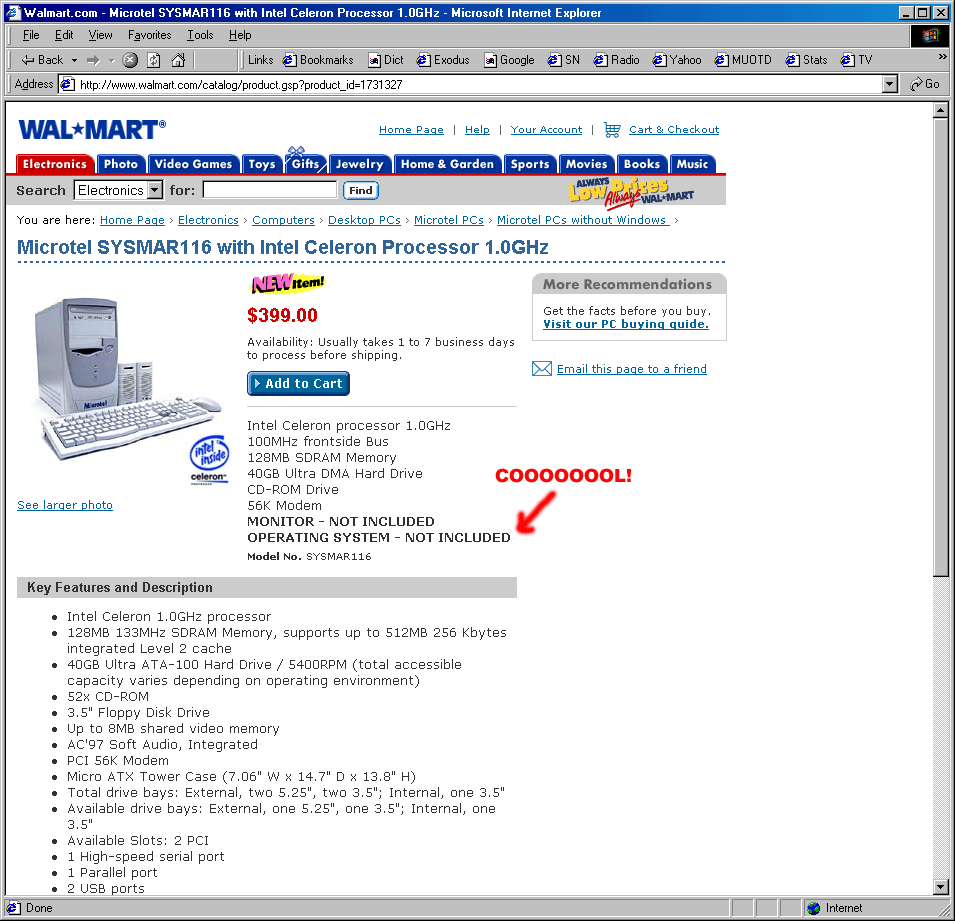
Nick Denton: "I have a new theory: the west coast is the home of weblogs because people in New York have a real city to enjoy, and real newspapers for which to write, and there's no damn time to opine for free." I don't get it. He's blogging from NY, for free, opining. What? MSNBC: "Less than a week after its blockbuster debut on the Nasdaq stock exchange, online payment firm PayPal has been hit with a class-action suit charging it with improperly administering users accounts and poor customer service." Scott Girard: "If you have kids, you probably know about GoGurt." Blogging Dane blog David blogging me blogging Doc blogging Jacob blogging lots of other bloggers. Daniel Berlinger posts a mini-review of Six Degrees. On this day four years ago Jeremie Miller put up an XML parser in a Web page. It's still there. He went on to design Jabber, based on more low-tech XML goodness. Russ Lipton: "Software vendors aren't omniscient." Amen! Rob Fahrni: "Hey Dave, Zeldman's personal size still uses tables for layout! I think he's adopted Dogma 2000 for his personal stuff and uses his bag of tricks for paid gigs." Thanks to CamWorld for the link to this Walmart computer, $399, with no operating system. Screen shot. Morning coffee notes Good morning and welcome to Scripting News. I will be your guide today to many wonderful things on the World Wide Web. First note. Looks like CSS beat out Dogma 2000 in yesterday's survey. Maybe I should phrase it another way. If you had to choose between a plain text weblog that had something to say and one that used all the latest and greatest technology but had nothing to say, which way would you go? Another thing -- I was going to make an offer to Zeldman -- I'll convert Scripting News to CSS if he'd use Radio (or some other inexpensive CMS) to edit his weblog. We waste a lot of time looking up at Microsoft and saying how they fuck us over, but we don't use each others stuff. If Zeldman used ours and hit a deal-stopper bug, do you think we'd fix the bug more quickly than our friends up north? Something to think about. Instead, his strategy increases our reliance on Microsoft. Sorry, that's not where I want to go today (or tomorrow). BTW, Microsoft guys don't like the "stuff us in a locked trunk" metaphor. But get this, we are right now stuffed in their locked trunk, the damned Web browser, although we're mostly in denial on it. Did they ever ask us, the users and developers of the Web, if we wanted them to kill Netscape? (Or to be fair, to help Netscape to an early demise?) Had they run a survey, do you think we would have said "Oh sure go ahead and take control of the Web, we all want to be MS developers, sure." Uhhh, no. I don't think so. And speaking of fairness, why exactly should we be so fair with MS. Do they play fair with us? Ask Jim Allchin to tell you his vision for the Internet. I bet it's not a pretty picture. Does he play fair? Hmmmm.
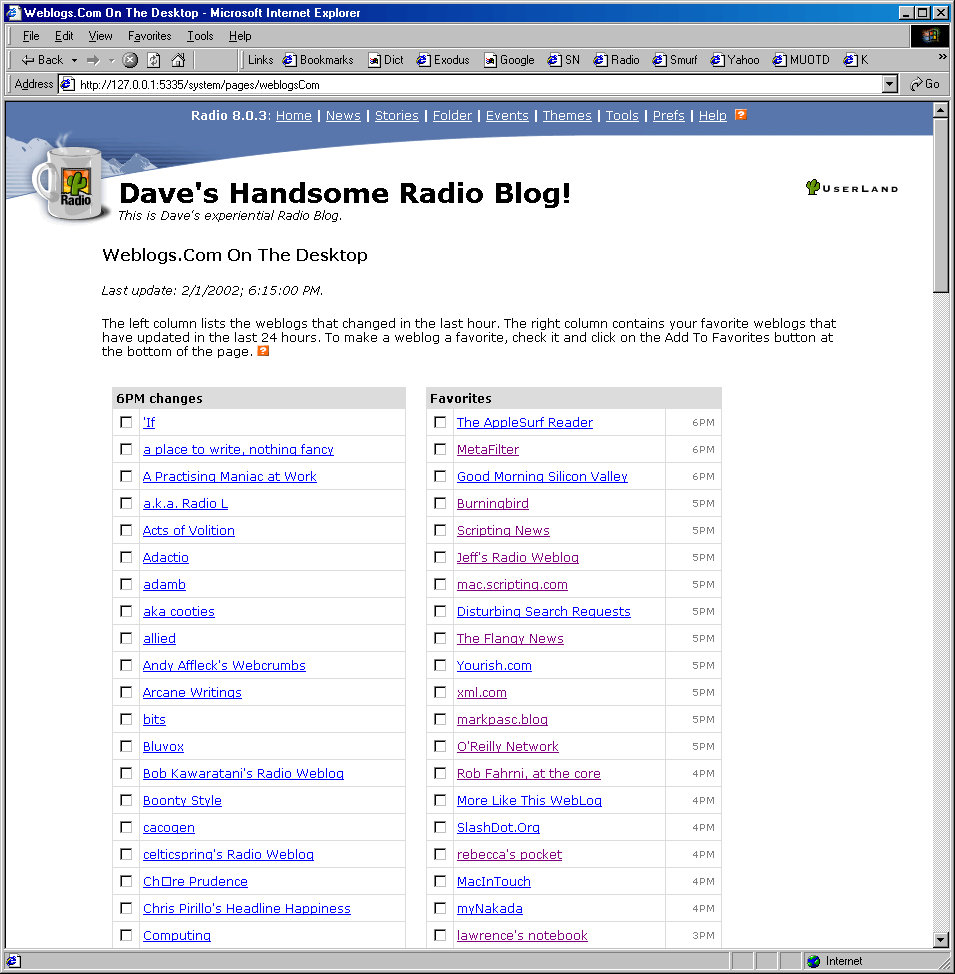
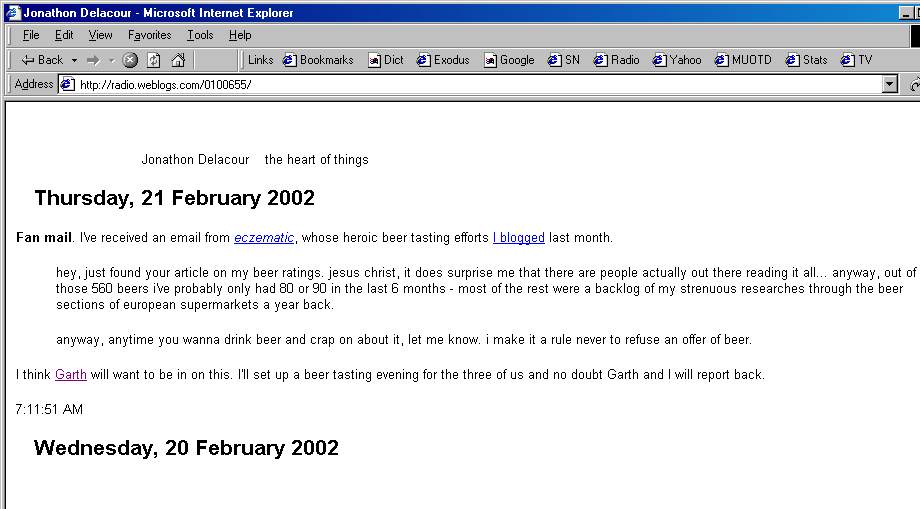
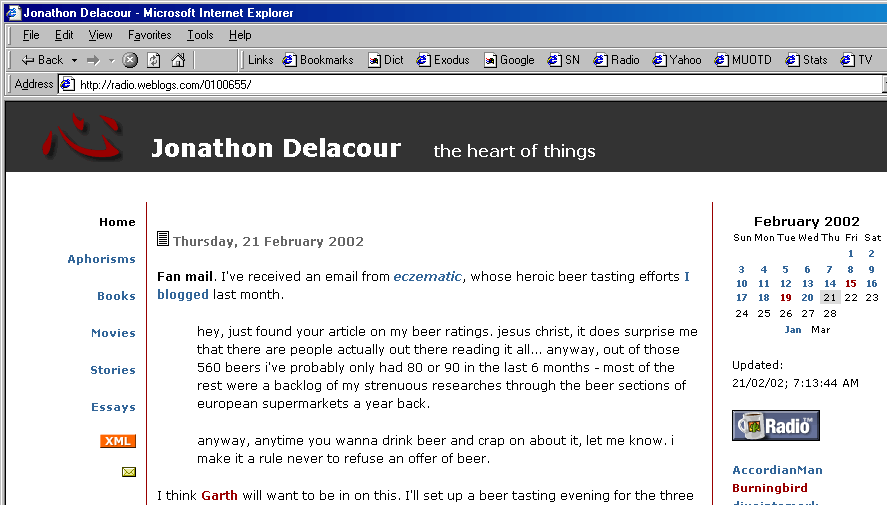
Frank McPherson gave me an idea for a new macro for Radio. If you use the Weblogs.Com interface, we know what your favorite weblogs are, and we know when they updated. So why not have an easy way to include that in your home page template? That's what this macro does. Demo. Call the macro this way: <%radio.macros.viewFavoriteWeblogs ()%>. That's all there is to it. Paul Boutin wonders if Dig-It (get it?) is a hoax. Amazon is auctioning three Segways. Branscum: "PR is awfully helpful to companies trolling for investors, I am told." A downside to CSS I haven't seen mentioned elsewhere. (And it may be a bug in MSIE.) When I visit Jonathon Delacour's site, for a few seconds, this is what I see. The formatting is applied, and then I see this. The delay is long enough that I start reading before the makeup appears. I lose my train of thought, and start reading again. Blue Robot: "Just one LINK element or SCRIPT element inside a document's HEAD element will prevent a flash of unstyled content."
Survey: "If you had to choose between the philosophy of CSS or the philosophy of Dogma 2000, which would you choose?" Patrick Berry: "CSS is even more for the writer than the reader."
At the same time, we're back on track with Google on the XML stuff. Should be pretty interesting. Can't say more at this time. BTW, in case you wanted to know, Doc is the number two Doc on Google. I'm the number two Dave, and try as hard as I can, I no longer own John Doerr. But I never give up! DHRB has comments now, so if you want to flame me there's never been a better time. Jean-Louis Gassee tours the Bay Area, en francais. 7/20/99: "Once a long time ago he asked me in his French way if I was a pimp or a whore. I had trouble answering, but when I turned the question back at him, without hesitation he said he was a pimp."
Web Services will surely die a slow death in the industry trades (it never really had much life there). But there's one light in the doom and gloom -- InfoWorld. Re-read Steve Gillmor's last column and consider what the world must look like through Microsoft-colored glasses.
Another company that is raising interesting questions is Avantgo. I've gotten a few emails with pointers to a new policy of charging information providers to flow content through Avantgo's content management system. To be honest, since I'm not a palmtop user, I'm not sure what Avantgo's system does. We publish a version of Scripting News that's suitable for reading on palmtops. It's not economically feasible for us to pay to have it distributed, so if we are presented with a bill we'll probably decline. But that may be up to our readers. Is there economic value in the content we create? Avantgo seems to be betting that there is. I can't keep up with Russ Lipton, he's writing so much about our software. This morning he has a piece called UserLand Philosophy 102, and of course Russ links to 101 from the top of 102. I think Russ understands our philsophy, if not all the tactics. It would be interesting to write other people's philsophies and see how close you get. One year ago today, Eric Raymond wrote of XML-RPC: "It's deliberately minimalist but nevertheless quite powerful."
Jon discovers an important feature of Internet 3.0. Real-time edits preserved for perpetuity. BTW, for everyone who's afraid to look bad on the Internet, I recommend Dogma 2000, the cure for all ills. "The words in your brain are not written in a correct way." Amen! Meryl Evans: "The CSS test files help you destruct a Web site, whether it be for finding leftover font tags or for seeing how a Web site has been constructed." Fox News has a weblog. Jim Roepcke is grappling with a conceptual issue relating to upstreaming. Paul Andrews: "The land of blogs is really the best and brightest Britney-free zone you can find." Lots of cats. I just did some digging and came across a very interesting number. One of our Frontier servers has taken over 37 million hits. The Radio community server, a relatively new machine, also running Frontier, has taken 11 million. Here's a site that, more or less, conforms to Dogma 2000. It's very nice, colorful, pictures of NY's ChinaTown. Lots of little imperfections, make it that much more genuine. Meanwhile Be has become a lawsuit. Rob Fahrni asks why they don't sue Apple. Good question. Slashdot says "Today Be employs a single person in a tiny office in Mtn View." A dispassionate tutorial on CSS from Apple, nicely done. Mindpixel: "New research by economists at the Universities of Warwick and Oxford in the UK has provided surprising insight into just how much people hate a winner."
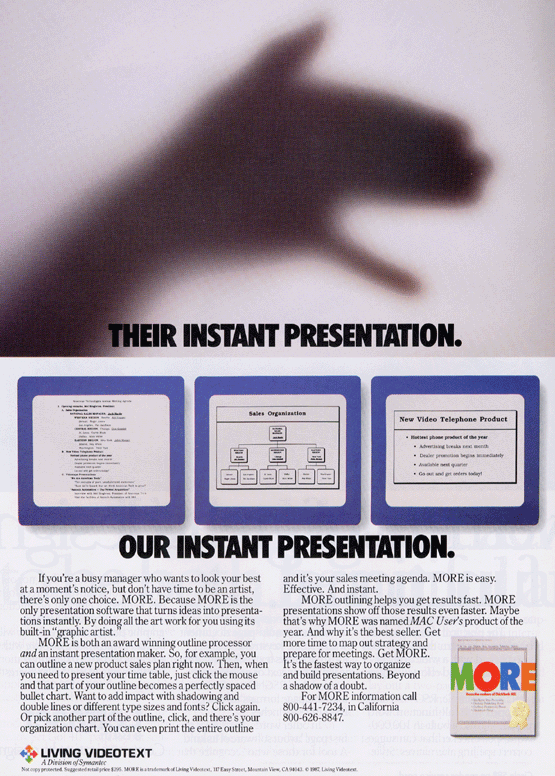
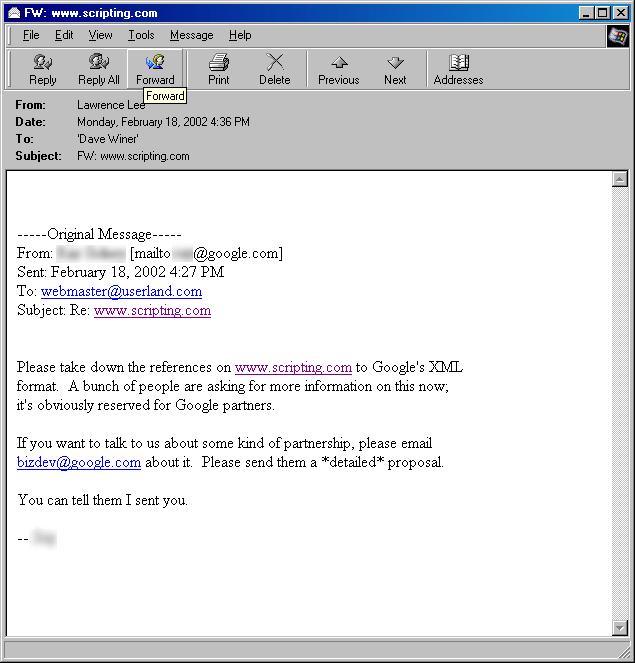
Limited Pie is a weblog on markets, the economy, and trading. Nice pic of Alan Greenspan in dress with pie. Jumpgate Alwin goes CSS. Nice! 12:03PM: SH4 outage cleared. No data loss. Praise Murphy! Greg Hanek dug up this old MORE ad from MacWorld 1987. Nice lookin redesign over at Evhead. Blogging about blogging about blogging about blogging about blogs. This reminds me of the watching them watching us watching them watching us stuff we were doing in 2000. Pet peeve of the day. Someone sends an email saying you have a bad attitude because you never respond to emails. So I respond saying something pithy and original, and it bounces, and then I remember it did that the last time I responded to his complaint, and the time before that too. Andy Sylvester updates his Radio UserLand directory. Farhad Manjoo, the author of yesterday's Wired News piece about weblogs, responds to my comments about the story. NY Times: "The Pentagon is developing plans to provide news items, possibly even false ones, to foreign media organizations as part of a new effort to influence public sentiment and policy makers in both friendly and unfriendly countries, military officials said." Signs of life at Yahoo Yahoo is running a survey for people who use YahooGroups, like me. They must be getting pounded, the response of the survey is very slow. Basic feedback, I don't care about winning $1000. I only care about messages and archives, we never use files, chat, polls, photo galleries, etc. We use their service to tie together communities of developers working on apps and standards, and to support our customers. We chose YahooGroups (when it was eGroups) because their service was so fast and easy to set up. Yes, I would like to get rid of the ads, esp on archive pages, because they interfere with the readability of the pages. But most important I'd like to get more bandwidth. The service used to be very fast. Now it's very slow. I'd pay to get more hardware on their end so they could serve us more quickly. Lawrence works at UserLand I got a few emails from people who believe that I had not completely obscured the identity of the person at Google who sent me the email yesterday. I understand the confusion, but I did not reveal the person's name. Lawrence Lee, who received the email on our webmaster account, forwarded the email to me. Lawrence works at UserLand, not Google. BTW, yesterday I had a talk with my team, showing them the Google email. I said, if we're lucky someday we will grow large enough to employ people like this. We must make sure that when that happens, we remain accessible to people outside the company, so we can continue to grow. SH4 outage We have an outage on one of our servers, 64.75.32.135, also known as Subhonker4 or SH4. It's mostly used for hosting free Manila sites. One of its databases is damaged, an important one. Another set of other problems keep us from being able to access the backup, so we don't know if the backup is good. We've put in a lot of hours trying to get it back up, but it's clear it's going to take a bunch more. As far as we know, the content of the websites is not at risk. The problem is with config.root, which tells Frontier, among other things, how to map domains to websites.
New pref: Only upstream after publish. Designed for people with slower CPUs who want to use Radio. I got a response from Google about my inquiry to develop to their XML interface. I will be sure to send them a *detailed* proposal. After hell freezes over. Evan Williams: "It's hard to believe there are people at Google who don't get the web."
Jim Roepcke did an upstream driver for Conversant. Nice work Jim and thanks for the kind words about the docs. Bryan Bell started a CSS Themes discussion group.
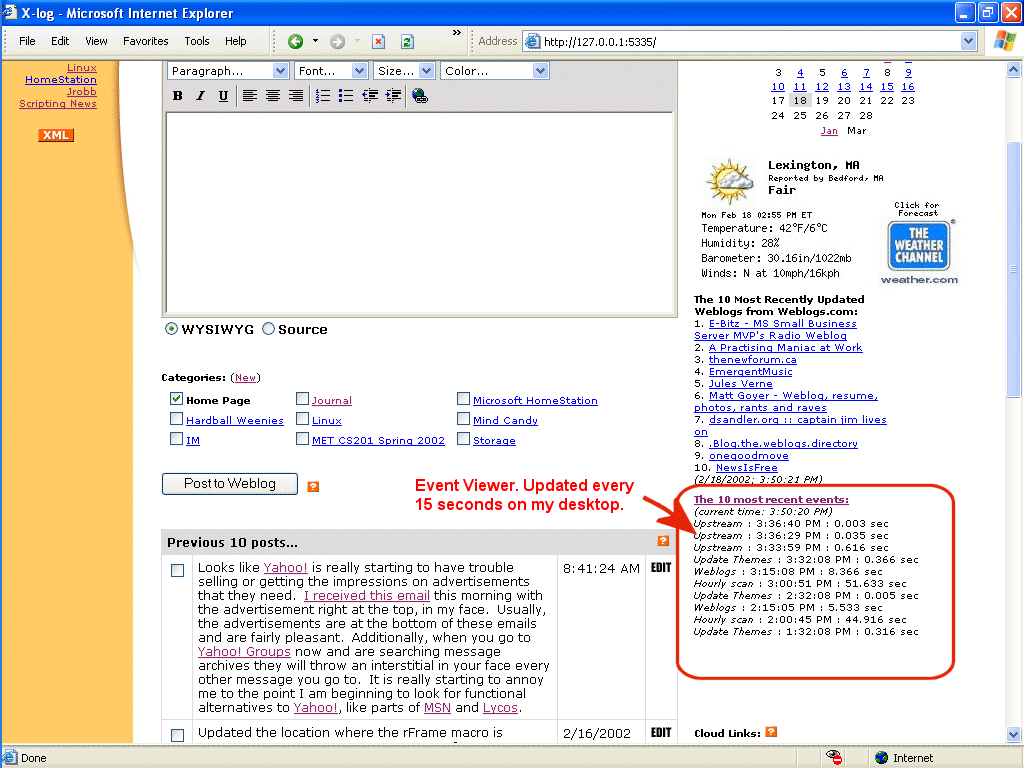
KPIX: "The manager of an Albertson's in Half Moon Bay told Channel 5 that a local man in his late 50s came in Monday morning with his two daughters to validate the ticket." Dann Sheridan has another miracle, a real-time event viewer for Radio 8. (Screen shot.) Adam: "You can run webservices in TextEdit on OS X!" Faisal: "Some have lobbied for CSS use by suggesting it frees the designer from having to fight with the code to get it to work across all browsers. I'm no web designer, but I wonder if they've actually used CSS, since it appears to have all the same problems. It just shifts the compexity around." Doc Searls: "If it's a fact that most blogs suck, it is neither a useful nor an interesting one. Unless you're writing a story about why blogs suck." Amen. Public writing is one of the few areas, maybe the only one, where the pros judge the amateurs. Conflict of interest. Of course they want to trivialize the amateurs. I talked about that with the Wired reporter, although it didn't make it into the piece. Phil Suh and Cameron Barrett operate an excellent content management system mail list. Kelly White archives an email conversation we had about open source and snake oil, among other things. Eric Schonfeld: "What the *&%*$@!! Are Web Services? (And Why You Should Care.)" FWIW, I think Web Services the way Eric talks about them, are not worth caring about. Let the BigCo's slug it out. It's just another stinky industry slugfest. Borrowing a line from today's song, below. What's that I smell? Do I smell home cookin? No, it's only the river, it's only the river. I suppose you'd have to have lived next to the Mississippi River to get that one. Today's song: "Find myself a city to live in." More thoughts for certain people leaving the Bay Area, this time more gentle. First, as has been pointed out elsewhere, Silicon Valley and San Francisco are two very different places. I live in Silicon Valley. Urban folk are often surprised, when they look closely, at how beautiful the environment is here, if you get off the valley floor and venture into the hills. If you live here for a while, it gets into your blood. When I go to NY or London, two incredibly great cities, I miss the physical and spiritual beauty of this place. If I visited SV I would dream about living here. That's point number one. 2. If you want schooling in the art of technology entrepreneurship, there's no better place in the world than Silicon Valley. I came here in 1979, wanting to make great software products. This place is to software what Memphis is to the blues. It's a magnet. When I arrived here, the generation of 1960's entrepreneurs, the gray beards of that day, were here, and you just had to find them (took me a few years) and they're happy to share what they learned, for the sheer joy of intelligent ambitious young minds. If you came here looking for just another city, you'd find it lacking. But if you came here looking to shake up the world with great software, you'd find it vibrant, interesting, challenging, and the only place to be. Wired: Blah, Blah, Blah and Blog. The old quoted-out-of-context thing again. I said all the words he said I said, but I don't agree with the conclusion he put in my mouth. "Real talent" are his words not mine. There are so many great weblogs today. But I still think we're in the pioneer stage. I want to make it still easier, and then make it easier again. Also, without the supporting argument, I come off somewhat lunatic saying that the weblog world covers technology better than Dvorak and the other ink-stained pros. Here's the argument. Suppose there are 50 million PC users (there are probably more). Suppose only one percent of them can write and have something to say about technology. That's 500,000. Suppose only one percent of those are motivated enough to run a weblog. That's 5,000. In other words, the combination of writing talent, motivation and technical expertise are no longer so rare. It's time to make way for a new generation (Dvorak is of my generation) and it will work differently for them.
Russ Lipton, a man with a big heart and big vision, wrote a fantastic Radio 8 installation guide for not technically sophisticated folk. Thanks Russ! News.Com: "A federal judge late Friday told Microsoft it must disclose portions of the Windows source code, including XP and XP Embedded, to nine litigating states and the District of Columbia." NY Times: "Rather than spend time and money to patent the idea, Plantronics posted a description of it on IP.com, a Web site that enables inventors to establish an idea's legal existence — a concept known as prior art in patent law. By putting its design in the public domain, Plantronics sought to prevent competitors from patenting it." NY Times: "Record companies have said that it's the artists who lose with services like Napster. Under the labels' new Internet services, however, the performers still don't get a dime." The Shifted Librarian is one of the best of the new Radio 8 sites. "My name is Jenny, and I'll be your information maven today." Googlewhack, Googlewhack, Googlewhack, Googlewhack.
Salon: Losing the war on patents. Simon Fell has a new Radio tool that keeps you updated on Weblogs.Com without having to go there. Nicholas Riley has a Mac OS X script that adds the Radio menu to his Dock. Wow. Nice. And he uses one of the neatest tricks from 1997 to get you the software. Robb Beal: "Table-less CSS designs are for people with time to experiment, not for busy people shipping product for a diverse user base." Kevin Altis: "What are examples of WYSIWYG products that do CSS right?" As promised, more comments on CSS, posted below. Matt Howie: "You know those pansies whining about fuel economy? Run them over." The Circle is a "scalable decentralized peer to peer application." David Brown: "One of the features in UserTalk that I enjoy the most is the feature that I thought was the most useless when I first read about it." NY Times: "Cars have taken the names of all sorts of places and things, but the Mazda MP3 is probably the first model to be named after a feature of its sound system." Clark Venable: "I installed Radio 8 on my secretary's computer today (complete with serial number). She's so smart that she could see right away what to use it for." Michael Himsolt is posting to Radio using BBEdit on Mac OS 9 via XML-RPC. Steve Hooker is doing a CSS-based Radio site. Four years ago today Chris Heilman posted a fantastic Frontier at a Glance page with links to the community and UserLand and docs, and all kinds of cool stuff. Lots of news and new ideas for a Sunday. Web bugs in XML
One of the biggest feature requests is that we do something similar for the XML feeds that Radio 8 users produce and read. As I was doing the bug review (heh) it hit me squarely in the middle of the forehead. If our XML files had the URL of a web bug you should ping when you've read the file, bing, there you are, we've got the feature everyone wants. What's cool about this is that we don't have to wait for the browser vendors to do anything. It's my code doing the reading, so all we need to do is add a new element to our XML feeds. The politics in the syndication community will probably be the hardest part of the feature. I wanted to write this up before I forget. Comments in Radio sites Another of the big feature requests for Radio are comments. Right next to the permalink of an item, a link to a popup window where readers can share their love and admiration, or answer the question that you're asking, or drag you down a notch or two with a nice juicy flame. Murphy-willing we should have that feature ready to roll tomorrow or Tuesday. You can see it working on Jake's test Radio site. He's a late night worker (I'm early morning) so he won't read your comments until around 4PM Pacific. How did we do it? Manila. Basically any Manila server can host discussions for Radio users. Everything has a place and a purpose. And it's an open design. We'll show people how to plug in any discussion server to form communities of Radio sites. More of that, much more, coming soon. A nice review TopXML: What is XML-RPC?
Signs of a developer community Yesterday Dann Sheridan shipped something very cool for Radio -- a way to do dynamic browser-based dashboards that link into the core of Radio's XML engine. There isn't a lot of software in Dann's release, but it's still a breakthrough. Talking with John Robb on Friday I asked if this wasn't just a gimmick. Before I finished asking the question I realized that it wasn't, any more than the features we put into Radio that make it easy for first-timers to ignore the engine and focus on the interface that Steve Gillmor calls "placid" were gimmicks. At UserLand we call those John Robb Features, things the engineers wouldn't think of because we're too accustomed to crawling around in the complexity of the environment. Dann is a Radio newbie, at a programming level, and he's given us a key John Robb Feature for the future. Yes for some people refreshing the page is too much to expect. A readout that refreshes on its own lowers the barrier one more inch, letting even more people in. And it's a feature an engineer could learn to love too. Imagine a log, displaying on the machine next to you, and to find out what's going on there you just have to look at the machine -- you don't have to find the mouse, find the Refresh icon, click it and wait. Steps saved even for those in the know are still steps saved. Another sign of developers supporting Radio as a platform is the work being done by Seth Dillingham and Brian Andresen at Macrobyte. With Radio at $40, and the economy so tough, they're going to do something bold -- they're going to release Conversant for Radio 8 and Frontier. It's a very powerful environment for doing Web apps. At the same time, they've released as an early beta, a tool that allows Radio and Frontier to communicate securely over HTTPS. What a gift. I understand that we're going to be able to distribute this work, once it's done, as part of the core release of both Radio and Frontier, so Murphy-willing, we'll all be able to communicate securely, shortly. There's a caveat though, this is only the client side of HTTPS, we still have to get it working in our server software. Scott Andrew on CSS He says: "The push for XHTML/CSS gets a lot of resistance from certain people, which leads me to wonder: what's the big deal? Why is it when web developers ask for something as simple as CSS, or a valid XHTML template, we either get harsh ridicule or a patronizing chuckle and pat on the head?" There's a misunderstanding here. I'm not chuckling or patronizing, I'm implementing. We now support CSS. If you go back to my original post, you'll see how I framed the question then, and it's largely still how I frame it, except now I've been said to be at war with CSS, so I'm more careful about stating my opinion. Too bad. Because if you're a soldier in a cause and you want to win, you have to look at the weak spots just as carefully as you do the strengths. I will continue to study CSS, try to find the good stuff, but understand that I have to look at the whole picture, not just what you want me to. Hurdles CSS must overcome 1. Installed base. Millions of people know how to do basic HTML. They don't know CSS. People who know how to layout with tables in all likelihood will continue to do so.
3. All those "non-conforming" sites. At best the Web five years from now will be 50 percent CSS and 50 percent table-based. Browsers will still have to support tables for layout. 4. It's weak. I still want lineto, moveto and drawstring. That would be worth converting my brain to. (Hardly any conversion needed, I already know how to do it from programming in C.) 5. It's incomplete. Look at all the problems people are having doing basic webloggish things in CSS. Is it worth the pain if the result is less functional than that it would replace?
Radio UserLand 8.0.5 is available for download. Dann Sheridan is working on a real-time data displayer for Radio/MSIE users. (Screen shot.) Ken Bereskin is collecting dock collections. Steve Gillmor: "Dave Winer wraps the thrill and agony of Frontier's creativity and complexity behind Radio's placid browser interface." NY Times: "An Internet start-up goes public. It is not profitable, in fact, it has lost hundreds of millions of dollars to date, and faces competition from old-economy stalwarts. Yet on the first day of trading, investors go wild, pushing the company's stock up 60 percent. Sounds like 1999? It happened today." Hello Google A few weeks ago I asked for help at Google to be able to experiment with their XML interface. (Demo.) What a runaround. Google appears to have a core of people who love the Internet. Their PR people have always been helpful and enthusiastic. But try to find someone at Google who can talk developer stuff, and you're in for quite a trip. I post this here as a possible way of cutting through the maze. I'd like to prototype a distributed tool for writers that uses Google in an interesting new way made possible by the distributed writing tool we already have deployed on thousands of desktops. It's a money-making opportunity for sure, if it works, we'd be happy to share the profits. So if you work at Google, please let us play with your XML service and see what happens. Radio-Design mail list As promised, we're ready to open the Radio-Design list, for designers working in Radio, and for vendors who produce tools that are useful to designers, so they can give us advice and we can help them be successful, and vice versa. Radio is not just a platform for geeks, it's also a venue for designers to innovate, teach and explore new techniques in easy content management. That's the charter of this list. Real-Time Enterprise mail list Last week, our friend Dann Sheridan, an enterprise guy from Accenture, and a Radio 8 developer, started a mail list to work on real-time technologies for the Enterprise. I subscribed to this list, it's an interesting topic, I want to learn more. Morning coffee notes Good morning fellow coffee drinkers. Got a big white mug of steamin coffee. It's yummy. (I hate the word yummy, that was an experiment. I survived. I also hate cat pictures, yesterday I ran one. I think the CSS zealots are out to lunch, but yesterday we shipped a CSS theme for Manila. I see a trend.) Anyway things are really weird in Silicon Valley. The Good Earth in Palo Alto, one of the icons of our culture, shut down. That's where I had dinner with Doug Engelbart, and lots of other cool people who call this place home. Up and down University Ave, the main commercial street of Palo Alto and Stanford University, are For Lease signs. Niehaus-Ryan, one of the highest flying PR firms of the Dotcom Boom, shut down last week. I read Nick Denton's essay on what a stinky place this is, and while I share some of his snobbish attitude (I'm from NY) I look forward to the day when the carpetbaggers who came here seeking unearned fortune, go home. They fucked this place bigtime. Even as they leave they fuck us. Poor manners. I can't afford to be so cavalier, because I am invested, with a company that's based here, and I own a house and some land. In 2002 being a small company is a huge struggle. We're still here, but some months are more difficult than others. There's a "collection" mentality among the survivors. Everyone has to collect. No one can pay. My little company never participated in the DotCom mania, so I figured we were immune from the collapse. It's not actually so simple. In an economy that's tubing, it's hard to stay on the surface, in a little boat, and not get sucked into the Big Flush. We are managing, inch by inch, staying afloat, and have a great time with the software and the community. But the business environment, which hasn't been normal here for over a decade, shows no signs of smoothing out anytime soon. Two years ago today News.Com was kvelling about Eazel.
A new CSS-based Manila theme: A Theme Apart.
Peter Wright: ".Net marks the dawn of the third age of computing -- embrace it." Isaac Salpeter: "Who is Peter Wright and what has he done with Andrew Leonard?" Burning Bird checks in from St Louis. More weblogging car travels. Doc's car broke down yesterday in San Jose. "Off the road again," says Doc. While I wasn't watching a new meme seems to have taken hold. Blink. Derivation? I don't know. I guess the b stands for blog? What other kinds of links are there? Heh. Zopista: "Hmm perhaps a few more mentions of Radio and I'll get on Dave Winer's weblog." OK. Brent Simmons: "I’ve often wondered about the kind of mind that can’t like two things, that has always to proclaim one is great and the other evil." David Kurtz: "Just drink the kool-aid, ok?" Try again. To people who love CSS, and think it's the wave of the future, check out the Linux Advocacy Mini-HowTo. Everyone who is promoting a cause can learn from this excellent doc.
Looks like I'm going to do a 45 minute presentation at the O'Reilly Emerging Technology conference. That's cool, should be interesting, I'm going to talk about distributed content management. I was also invited to speak on a panel about web services, chaired by Adam Bosworth. That's cool, Adam is a smart guy. I also suggested they invite Simon Fell, Sam Ruby, and Andrew Layman to participate in the panel. PS to O'Reilly -- how do I get on the radar for the people planning the Open Source Convention? Speaking of Sam, ever the patient evangelist, he has a plan for getting WSDL into Radio 8. I will read this of course. I guess that's the price of success, people want you to do things to help get their favorite technology adopted. This is a new experience for me. I'm accustomed to being on the other side. I appreciate the respect Sam is showing. No sarcasm. Speaking of Simon, he has something new too today. "I started by building a subscriber interface to the weblogs.com data. You register the URL(s) of the weblogs you want to subscribe to, and the port & path of where your callback handler is. Then when the service sees a change in any of the URL's you subscribed to, it'll call you back with a SOAP message saying its updated." Now this is easy to support. I do nothing but say "Keep going Simon, great stuff." Thanks to Jonathon Delacour for listening and feeding back. Cockroaches after nuclear war Henry Jenkins: "Like cockroaches after nuclear war, online diarists rule an Internet strewn with failed dot coms." Jenkins' piece echoes a belief that's getting more hollow every day. He says "It may seem strange to imagine the blogging community as a force that will shape the information environment almost as powerfully as corporate media." It may seem strange to some, but to me it doesn't go far enough. Corporate media is disappearing. It's diseconomic. It fails to give people with minds what they want, differing perspectives and access to information. His quote, adapted to 1981, would go like this. "It may seem strange to imagine the personal computer community as a force that will shape the information environment almost as powerfully as mainframes and minis." They did said stuff like that. Instead, as we know, the PC devastated the mainframe culture's control of information. When the revolution was over, IBM was tottering on bankruptcy (they recovered) and all their competition either transitioned to PCs, or retreated to the workstation market. In all cases, they lost control, and before that happened, to many, it was unthinkable that they could. Call us cockroaches if you want, I'm sure IBM thought Apple, Microsoft and Intel were cute and dirty too, but distributed and decentralized news is rapidly becoming an accomplished fact, as fractional horsepower computers overtook centralized and controlled computers in the 80s. Too much attention was paid to the dotcommers, the PC revolution also had carpetbaggers and charlatans. To pay attention to the excesses would be to miss the trend. Michael Fraase exposes an incorrect story about Comcast that spread like wildfire.
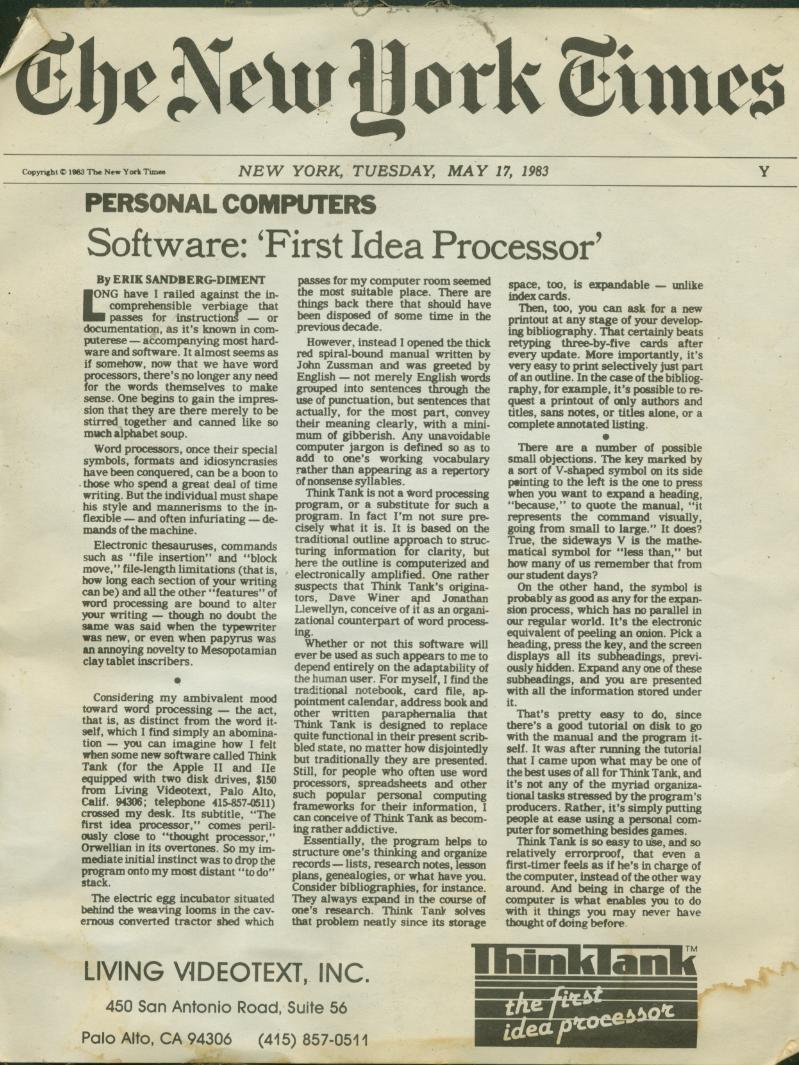
Open your minds for another bomb. David Brown is using Radio as a Python IDE. Yah. Aha. JOHO sets Pirillo straight. "If you criticize me, I will revise my post so that yours looks stupid." Hey I had lunch with Doc today on his way back to Southern California. I promised that by the time he got home I would have the name of the founder of Creative Computing magazine. Within minutes I got several responses. David Singer was first. The correct answer is David Ahl. Thanks. Close call! More data for Doc. There was a book edited by Ahl called The Best of Creative Computing. So, how did we come around to this topic? We were wondering if CC were to start up today, and it were on the Web, what would it look like. How did I get interested in this in the first place? A phone conversation this morning with Jon Udell, about BYTE. What value is there in the name? A lot to a graybeard like me (and Doc and Jon). BYTE and CC were great in their day. Weblogs look like they're going into the same space. What can we learn from them? How can we do it better with the shorter turnarounds, and a less expensive publishing process of the Web. It gets even weirder. David Gewirtz who worked for me at Living Videotext, worked for David Ahl at CC.
Aaron Gillette is connecting Radio and Zope. Russ Lipton: What is a template? Ivan Ristic: "I have created a really cool script that instantly creates an XML-RPC server from any existing PHP class!" This evening I'm reviewing the Weblogs.Com code, line by line, and the error messages are cracking me up. Try this one out, remember this is software talking. "Thanks for the ping. But the name of your weblog looks (to us only, no criticism intended) like a URL. However foolishly, we think of this as an error." Cydney Gillis covers the VS.NET rollout. "The San Francisco event was one of more than 150 that Microsoft will stage around the world in the next 60 days in a $20 million launch, the company's biggest ever for a software development tool."
Notes on yesterday's CSS discussion. Net-net, I don't pray in the same church as many other people do. More power to you, let's try to work together anyway. We will provide a CSS-based theme for Radio and Manila, so our users have choice. We will also start a mail list for designers working in our software, so they can give us advice and we can help them be successful, and vice versa. Cmdr Taco: "Will you marry me?"
The startup script. Coffee, email, Weblogs.Com. It used to be coffee, email, NY Times, WSJ. Times they are a changin.
Paul Andrews: "It's good to see some real journalism coming out of the established press." Bo Brock: "Radio is the first app I installed on my new iMac." Michael Fraase: "If I was thirty years younger I’d say something really stupid like 'you guys rock' or whatever the current appelation of appreciation is. But I’m an old fart and you’ll just have to settle for 'thanks.'” Right on. Glenn reports that Boingo is giving out free Wi-Fi PC cards at Gate B4 at Sea-Tac airport. Mary Wehmeier: "Perfect wasn't good enough to win the gold." News.Com: "Kodak has filed a patent-infringement lawsuit against computer maker Sun Microsystems that focuses on technologies found in Sun's Java programming language." O'Reilly: Top Ten FAQs for Web Services. Kevin Altis: "I made a simple, but crucial addition to the radioclient PythonCard app today." MMOTI 2002 Last year on this day I wrote version 2.0 of How To Make Money on the Internet. "Make the product people want and sell it to them." That's the executive summary. You can read the whole piece or skip to the end. "The combination of user-based information exchange and products that reflect user experience and wants, is where money will be made on the Internet." Rahul Dave asks which of the free services provided by Yahoo and SourceForge could be commercialized. I like that way of thinking. Many of the communities I'm part of need a better version of the mail list software that Yahoo runs, which used to be the best, but now suffers from TMA (Too Much Advertising) and ever-slower response times. Are tables really evil? Thanks to Zeldman for the pointer to a table-less three-column liquid CSS-based site that degrades gracefully (that's a mouthful). Now I've been trying to figure out why this is so important. I wrote XML-RPC for Newbies, to help people understand why it's so important to geekish Web developers. Would a designer please write a Table-less CSS Templates for Newbies, to explain why tables are evil. I don't get it. Or is this just gymnastics, which is cool, but tell us so, please. James Spahr: "We will all be healthier when tables are not used for layout purposes anymore." Why? Owen Briggs: Design Rant. Dave Polaschek: Why avoiding tables is important. Here's Dave P's weblog. I have a scaled-down rendering of Scripting News that I think is more readable than his, and doesn't compromise the reader experience for people who have reasonably modern machines with a graphic Web browser. One of the things that prompted this request was Karl Dubost's surprising rejection of Radio 8, just days after we released the software. Now that the dust has settled, I wanted to understand what was behind his criticism. Then I read Sjoerd's comment yesterday, where he said he publishes his content in XML, that totally validates, has no tables, none of the "bad" stuff. So why don't the CSS advocates use that? Why did Karl ignore that? Or did he, and chose not to consider that in his evaluation. Doesn't it matter that we broke through in other areas? (Of course it does.) Perhaps they don't know we do XML. Hey, when you see a white-on-orange XML button does that make you happy or sad? Finally, those of us who use tables are part of a mass of people who learned to develop websites that way. It's impossible to get us to change. If that's your cause I'm not on board. I made a decision a long time ago to accept HTML as it is, I called it a crock, but what a great crock it is. Important caveat: The way I choose to render SN and the wants of Radio 8 and Manila users are totally separate things. Dave Dombrowski: "CSS won't buy you a great deal today. Certainly not in Radio where it's pretty easy to redo the pages it outputs. But CSS will buy you a ton in the years to come." Austin Burbridge: "I don't want to be a stunt-man, waiting for the next browser to break my work, or wondering whether some visitor took all the trouble to come to my page only to find a mess, because her browser was on a device which didn't suppose that it would take a trick to put a footer at the bottom." John Brooks: "The table hack works for desktop browsers, and probably will continue to for as long as the Web exists." Brent Simmons: "I don’t care how Joe Blow works; I care about how I work." Tony Collen: "So I've sold you on CSS, right?" No. Sylvain Carle: "Table are evil for the same reason CORBA is evil." Feh. Sam Ruby: "Dave is proud of his archives that go back nearly five years. Five years now when somebody wants to access them, they will quickly realize that they were designed to be viewed by desktop machines. Their response will inevitably be, 'how quant'." Actually my archive goes back over seven years. I just looked at the first bit in the archive. "Quaint" would be very kind. Softens the hands while you do the dishes BTW, the RadioServices.app thing that's causing such a stir of buzz, is at its core, made possible by XML-RPC. Ta-dahh. And it's the weird kind of XML-RPC that's becoming so popular. The two processes are on the same machine, but get this, they don't have to be. Now that's flexibility that people can use. And by the way, thanks to Apple for baking XML-RPC support into the OS. That matters too, for acceptance by developers. It gets into every nook and cranny of the culture. Here at UserLand we call that "support from the platform vendor." Nice. Thank you.
Michael Kinsley: "I didn't do what I intended to do, which was to prove that the economy of the Internet made it possible for this kind of journalism to be self-supporting. I am sort of like Moses leading people to the edge of the Promised Land, but not all the way there." Honest. A note of congratulations to Microsoft and best wishes for a successful launch of Visual Studio .NET, tomorrow. We look forward to many years of happy interop. Up in Redmond they're asking if hell froze over too. Nah it's just springtime and love is in the air. Two sure signs. One, the perfume smell is everywhere. Two, the frogs are making a racket. I can hear them right now as I write this, indoors. No doubt there are still a few frosts to come, and probably a couple more big storms, but it's unmistakeable, the California winter is almost over. BTW, people are buzzing about Six Degrees. I look forward to trying it. Now a little-known fact -- it's done with XML-RPC. How about that. A desktop app that uses XML-RPC. Just like Radio. I bet the two programs will even work together. In incredible ways. Bill Bumgarner has been doing some kickass stuff for Radio on Mac OS X. "Now I can post to Radio from any application that has Services. I can take advantage of the spell/grammar checker in Word. Use Project Builder's code formatter. Edit Tables and other HTML markup via WebObjects Builder. Easily post the output of a command in the terminal." Jason Gillman calls this a "Major Breakthrough!" Screen shot for us Mac-deprived people. Ken Bereskin, the blogging Apple exec, gives his seal of approval. Ken, isn't it fantastic that there are such creative developers working to make our products work better together. It doesn't get any better than this! Le Devoir: "Si après avoir expérimenté avec quelque temps avec Blogger, vous vous apercevez que ses fonctions sont limitées pour vos besoins, vous voici prêt alors à faire le saut vers Radio, l'application de blogue la plus puissante actuellement." Yo. Michael Swaine has a Radio weblog. Welcome! Torture. Sorta. Reading Dan Gillmor rant about crashes on Mac OS X and problems with the wireless LAN at Demo cause a pause. It's the usual Gillmor fare, but it's one thing for software to crash because of a bug, that's bad for sure, but it's even worse when they deliberately crash the software. Where is Dan's outrage about the broken archives? Does he sympathize more with his employer or his readers? Could he criticize Knight-Ridder if they deserved it? Andy Sylvester continues to kick butt with the Radio 8 users directory. The spirit of DIY.
Victor Ruiz writes: "On March 2nd, the 'I Quedada Bitacoril Hispana' will be held in Madrid. It's a webloggers meeting. I wish I could be there. I bet Spain is warmer than California. Sjoerd: "Changing the buttons from table cells to divs don't suddenly make them more meaningful."
Wired: "It may be a long time before British Telecom knows whether it lucked out or lost big in the legal sweepstakes. But even if it wins its court battle, experts said the British telephone company has already lost the war."
We're lucky to have Jonathon Delacour using Radio 8. He's unstoppable. Yesterday he spent all day working with others on his templates. According to Delacour, you can definitely do a table-less CSS type weblog with Radio 8. He says he's not a designer or a CSS hacker (I guess he is now).
A couple of things about CamWorld from the critics section. 1. Permalinks. Each item should have a URL of its own. This is basic practice for weblogs in 2002. 2. While the design was beautiful and innovative when it started in 1998, today it's kind of stale and uninteresting. With all due respect, an HTML newbies' first Radio 8 site looks prettier than CamWorld. Once they learn about themes, it's all over. Cam it's time for a redesign at CamWorld to show us your ideas on the state of the art in Web design in 2002. The current design has fallen behind, imho.
DaveNet: Google is decentralizing.
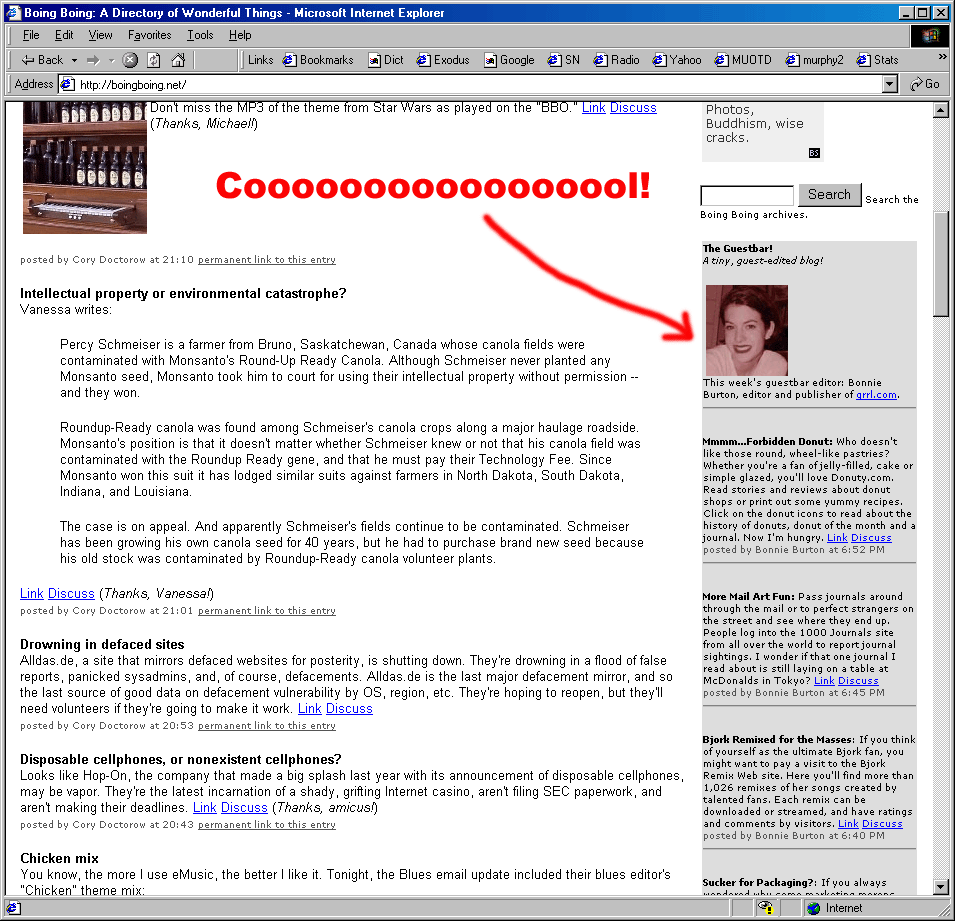
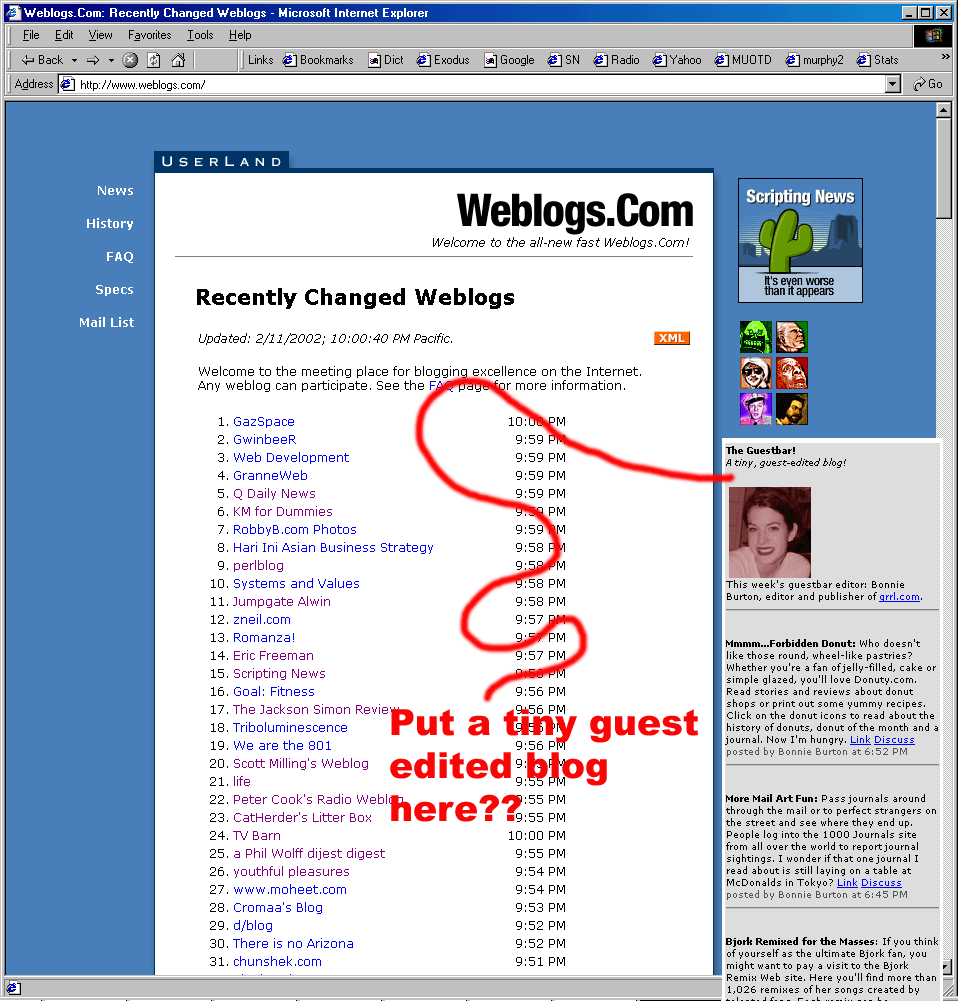
I tried, best I can, to answer Steve's questions. John Robb expands on my answers. Tim Jarrett: Confessions of a referral junkie. Jon Udell: "A Web services architecture, which is currently still the exception, will rapidly become the norm." I just saw a really cool feature on Boing Boing -- they have a thing called The Guest Bar, "a tiny guest-edited blog." Once a long time ago I echoed Tomalak's Realm in the right margin of Scripting News. Now I really like this idea and have just the spot for it. I wonder how they decide who to give the space to? Seth Dillingham notes a double meaning in the name of this site. "I still need a holiday." Me too. Yesterday's RFC is today's feature. Sylvain: "J'ai eu 4 offres pour une license de Radio en échange d'un redesign CSS." An ominous silence at Evhead. Last post was on Wednesday. What's he up to? Lots of people want to work with Radio and Filemaker. Luckily, a lot of work was done to make Frontier work with Filemaker, and that should apply to Radio as well. Dan Gillmor is blogging the Demo conference.
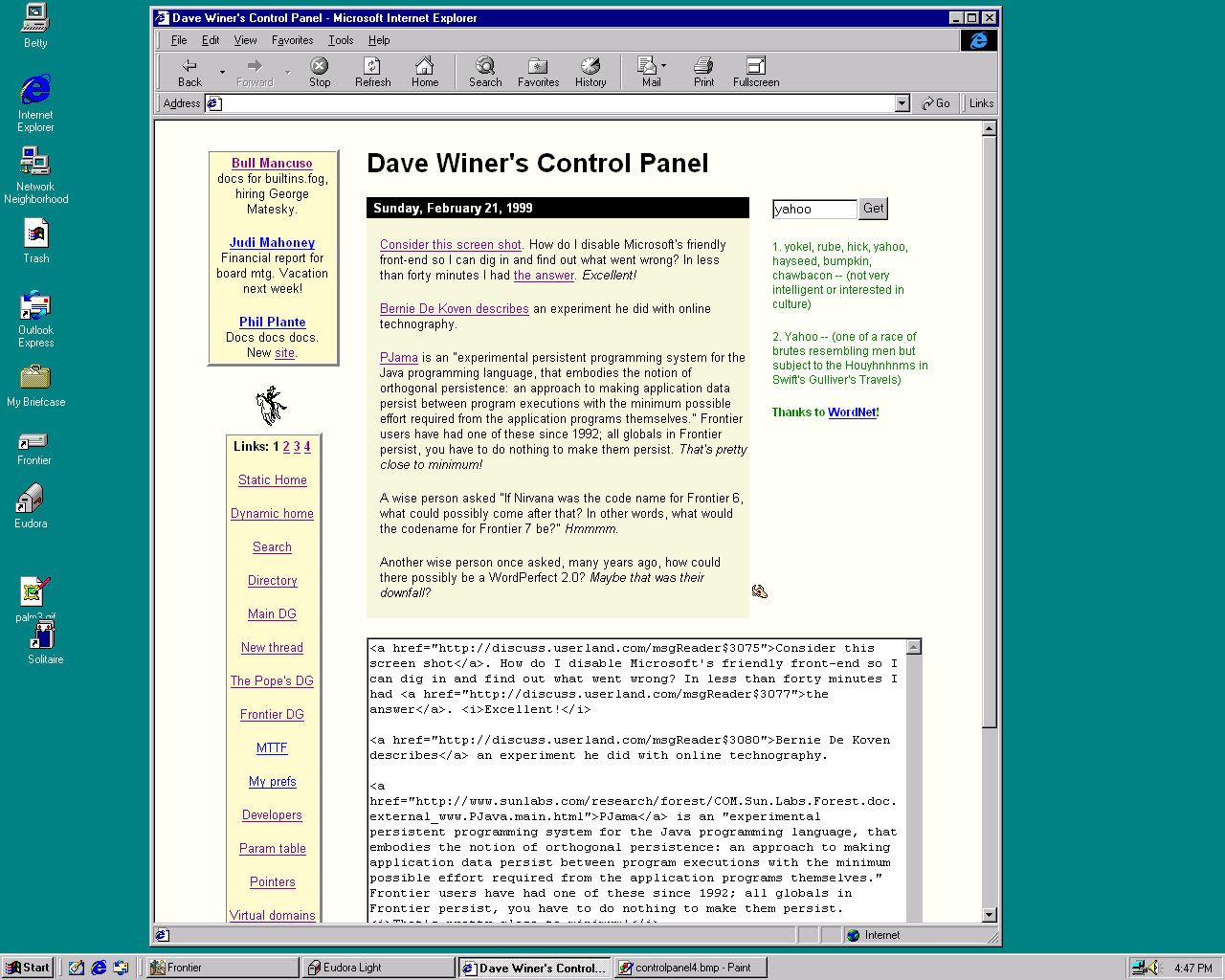
Kevin Altis: "It is difficult to manually read a WSDL description of a SOAP web service and figure out which parts you need for your programming language and SOAP library of choice." Russ Lipton: "So what the heck is it?" Joe Gregorio: "Finally, a table-free layout for my Radio blog!" How Scripting News works First, check out this DaveNet, written on this day in 1999. 2/11/99: "It was a seed-drop, an egg that could beget a chicken, if only there were a rooster to do the deed." I was writing about syndication, our first steps in that direction, in late 1997, and how they were bearing first fruit in the winter of 1999. Now, in 2002, syndicated XML from amateur journalists is common, not mainstream yet, but soon it will be. That's the process of Scripting News. The stuff that appears here, written by me, UserLand, and sites I link to, are new ideas with potential that may not be realized (commercialized) for several years, if ever. But it's interesting in another way, even the ideas that don't bear fruit. The mind of the engineer is interesting. Until the Web came along it was hard to tap into the story. The best engineers are good story tellers and good cooks and they take risks. Also in February 1999, at the same time we were working with syndicated XML, we were also experimenting with browser-based editing of weblogs. Here's a screen shot. In that pic you can see the humble beginnings of Manila, and then Radio. Almost three years ago. Cam, Delacour, Bryan, Netscape 4, Zeldman After Cam's excellent rant yesterday, Jonathon Delacour decided to help out his readers with old eyes (me!) and converted his site template to black-on-white, which is like a breath of fresh air for me. I like Cam's rants because they're pure and moralistic, and because it says something that I like about me. My body chemistry is only mildly tweaked by his Dave-deprecating way of saying things. Fact is I have very little to do with the templates in Radio or Manila. I am a writer and programmer, not an HTML designer. In matters of design I defer to Bryan Bell, who in my opinion is one of the heroes of the content management revolution. I get a beautiful looking site that renders slowly in Netscape 4 (disclaimed) but like Zeldman, I believe it's time to move into the future. I get compliments all the time from strangers who see this site and say how beautiful it is. And the design is over a year old. That should give you an idea of how leading edge Bryan is.
Tim Bray: "Today is the fourth anniversary of XML 1.0." Lawrence wrote a howto for moving content from Blogger and Movable Type into Radio 8. This is still a new art, so if you're not an early adopter, let other people pave the path for you. A few have already made it across. Welcome to Peter Drayton, .NET developer, and Radio 8er. BlogApp for Mac OS X is a Blogger API editor, with spell checker. Bill Bumgarner got it working with Radio. Janne Jalkanen did an XML-RPC interface for his Wiki clone. Glenn says they have better coverage of the Olympics on the Canadian TV network. How do I get that on DirecTV? I have a sad feeling that I can't. Sam Ruby: "Started reading a new book: Programming Jabber. The day is clearly coming when others wish to 'help' me out by offering to host my identity, but you know, there are some things I really want to control myself." Back to hole digging. An RFC for a callback for Radio's firewall. Why yes, I am hungry. NY Times: "To make its case against severe sanctions, Microsoft, shifting its previous strategy, has named both Bill Gates, its cofounder and chairman, and Steven A. Ballmer, the chief executive, as witnesses in a trial on remedies in the antitrust case it lost."
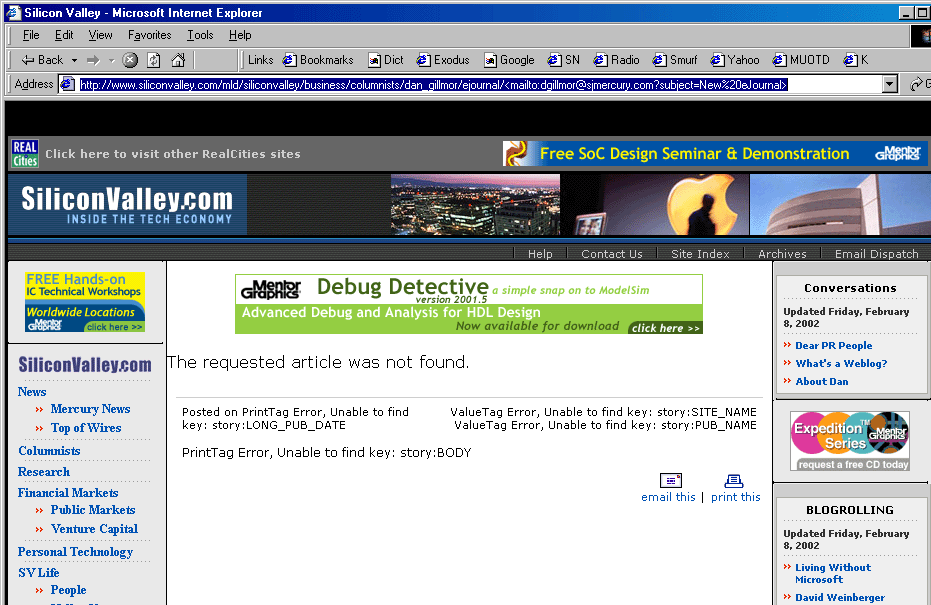
To give you an idea of the damage caused by Knight-Ridder's transition, just do a Google search for Dan Gillmor. Google is very confused too. The first thing they say about Dan is "Cofax Error." Now is that the same guy who wrote the piece about domain names not being important because Google can find you even if you have a whacked out url? Of course I would point to that piece, if I could find it.
Eve Andersson shares what she learned about VCs at Ars Digita. Summary: Murphy's Law applies to financing too. CamWorld: " It took me a couple hours to figure out Dave's templating system in Manila, but I did figure it out." Duncan Smeed: "Doc is from New York!" Me too! Daniel Berlinger: "I discovered a huge scary limitation in OS X TCP/IP support." The Holy P Sometimes I wonder if the P in P2P stands for the Pope?
Fortune: "With so many tech magazines out of business (we're not naming names), these e-newsletters, once solely for tech heads, are becoming mandatory information sources for the mainstream." Ingo Rammer got Radio to talk to .NET. Bing! Simon Fell: "Sam raises some good points on what its going to take to talk to .NET My Services." Peter Drayton: "The MSN Protocol was written up as an IETF draft back in '99." Ken Hagler is working with XMethods to get interop in SOAP. This is important stuff. Thanks for pluggin away at this Ken. Overstated: "The top 25 meme producers are as follows.." Cameron Pope: "XML-RPC lets us decouple our user interface from our data manipulation." A reminder of how beautiful anger can be. Guardian: A tale of one man and his blog. Doc: "What they did to Barry, and to Dan, was blast tens of thousands of links into a fine mist of 404s." Glenn: "San Jose, We Have a Problem." Peter Svensk notes that the delay of Olympic broadcasts on the West Coast is a contention betw NBC and its affiliates. Of course Lawrence found a bunch of links about the NBC controversy. Lawrence is Canadian. He says "the Opening Ceremonies on CBC were also commercial free. And live, coast to coast." Bootstrapping into .NET Now that we have the foundation for Web Services in Radio established, we can call via SOAP or XML-RPC, and we can write services that are callable over the same protocols, and we know that we can make cross-Internet calls, there's one more area to focus on, and it should be relatively easy, but may take a few steps -- that's using SOAP and XML-RPC to communicate with apps running on the same machine. This is going to become important as we bridge into different membership and presence systems. In my last DaveNet I asked a question. "What role should the Instant Messaging vendors play? They already have a big directory of users, we could tie into their networks, but would they like us to do this, or would they even let us?" Well, it appears that Microsoft will let us do this. So let's proceed with an investigation. The core question is -- can we communicate, via SOAP 1.1, with the .NET runtime? We need help with this because we don't have the expertise inside UserLand. That's when I ask the community to help. Help! The presence services are available in .NET. For Radio to tap into those services we have to create a connection, to learn how to call services in .NET from our environment. It's going to be a bootstrap, an inch by inch thing. Explore-ship-vacate In 1998, I asked Mason Hale to write a story for the (then) new superstars of the Frontier community on how to work with me. Mason passed down some of the folklore, but he wasn't in the first class, which started in 1991. Dan Shafer, was there then and is here now. So was Chris Gulker, then at the SF Examiner. In the next group we had a CompuServe forum, a novelty then for a company of our small size. John Baxter, Tom Pettacia, Steve Michel, Peter Dako, Leonard Rosenthol, Mike Cohen, Richard Scorer, Scott Lawton, Steve Zellers, Terry Teague (what a great tester), you can see their names on the Credits page for Frontier 3.0. And many of them are back, using Radio 8. To the members of the new community, don't overlook these people. They have incredible minds, and deep experience with Frontier, and are very generous and kind people, who love to share what they've learned. Now the class of 96 is coming back online, I'm not on the mail list because of all the flames, but when it quiets down I look forward to hearing people's ideas on the next steps in the evolution of our environment and tool set. BTW, Mason is totally right about the explore-ship-vacate cycle. I feel the vacation coming on any week now. Good morning coffee drinkers Stilll catching up, reading the blogs, you know the routine. Lots of email about linkrot. Apparently columnist Dave Barry got lost in the reorg at Knight-Ridder. Mark Pilgrim found him with help from Karl Martino. Karlin Lillington from the Irish Times says a lot of her articles are missing going all the way back to 1995. Ryan Tate who writes for Upside says all the BigPubs and many of the weblogs run by pro journalists play loose with the archives. Many thanks to Andy Sylvester for doing such a great job with the directory of resources for Radio users. We'll try our best to keep those links from rotting!
SCNS for SOAP 1.1: "Earlier this week we released Radio 8.0.4 with support for Simple Cross-Network Scripting. At the time we released a driver for XML-RPC, promising a driver for SOAP 1.1 later in the month. It's ready now." Seth Dillingham reviews SCNS. "SCNS was promised years ago, but since then a number of us had almost given up on it. Some things, though, are worth waiting for."
Charles Cooper: "Unfortunately, the outsized influence wielded by the big software concerns means the voices of independent developers are getting harder and harder to hear." I've got a yearning to go skiing. It's been a couple of years. I wonder if any Rocky Mountain ski resorts have great Internet connectivity? My favorite resort is Vail. I wonder if they have a T1 line. Fernando Pereira says Vail is boring. But I like boring! Thanks to Glenn for the pointer to this fantastic Flash hack. InfoWorld's top technologies for 2001. Web Services is #1. The 2001 Turing Award goes to Ole-Johan Dahl and Kristen Nygaard of Norway "for their role in the invention of object-oriented programming." Andy Sylvester started a directory of Radio 8 resources. A bunch of fixes in upstreaming released on Wednesday. Michael Kinsley: "There are some actual world leaders at Davos, but for most participants it is world leader fantasy camp." Chris Double: "Woohoo! My first webservice works." DIY!
Remember the story about mainframes and how well-intentioned people thought that users couldn't be trusted with their own data. Then came the Apple II. We're back there again. We're going to get bruised for sure, remember when you were a kid and learned how to ride a bicycle. But fear is frozen fun. Inch by inch. DIY DIY DIY. BTW, the philosophy of DIY says that you DI whatever way makes sense to Y.
That's why I made sure to give Bill Gates proper credit in my last piece. It's true that he inspired me to work on scripting user-oriented apps. Then we infected Apple with the idea, so counter to conventional wisdom, sometimes Microsoft does the innovating and Apple sometimes copies them. Heh. How about that for irony?
Mass High Tech: ArsDigita closes, sells assets to Red Hat. On this day last year we got our first non-UserLand SOAP validation. It was Simon Fell's PocketSoap. The beginning of a productive friendship. Googlewhack, Googlewhack, Googlewhack, Googlewhack. SJ Merc and Linkrot
Dan is always railing on how the computer and software industry cares not one bit about users. I think he goes overboard on that. Now it's time for Dan to turn his jets on his own organization for one more time breaking all links into his Web writing. The Merc was one of the pioneers of Web journalism, one of the first sites in the early days. That's the good news. The bad news is that every time they transition their internal system (and they do it often) they break every pointer into the old versions of their content. Even so I will continue to point to Dan, where ever they move him this time or next or whatever. But all those broken links in my archives are a reminder that it's hard to do what we do, and maybe if Dan doesn't dig into his own organization and shed some light on their processes, perhaps in the future, he will be kinder to other software developers. How bad is it? Uhh the feedback form on Dan's site is a broken link. Steve Zellers: "Why did they change the Mercury News format? I had been so happy." Reader comments on the changes in Dan Gillmor's weblog. He characterizes them as not friendly, but these people like you Dan, and they're perplexed. My feedback. I want your blog to be at dangillmor.com, now and forever, and it's OK with me if you link to the Merc, but I come there for you, not RealCities (whatever that is) or SiliconValley.Com (ditto). Remember when Lycos bought Wired News. WTF is Lycos. (Answer: an also-ran search engine, that turned into a meaningless conglomerate of websites owned by CMGI then a Spanish portal.) I would prefer if Wired appeared to own Lycos, makes more sense to me. And in my mind Dan Gillmor is far more important than every other thing in the Knight-Ridder empire. I wish they'd get a clue and let you gain some momentum with an easy to remember URL, simple weblog-style features, and no linkrot so the archives keep working. Dan you say things that belong on the record. When they get lost, we lose our context.
As a way of saying thanks to Radio 8 early adopters, we've increased the per-user allocation on the community server from 10MB to 20MB. That should give everyone some breathing room. And thanks from everyone at UserLand to the incredible Radio 8 community. What an inspiration! Note: This upgrade is for everyone who's using Radio 8. Also, to get your Cloud Status box to reflect the 20MB allocation, update Radio.root. We had to fix a bug in the way the capabilities flow to workstations. Garth Kidd: "If adding a protocol to the new SCNS syntax is as easy as dropping a new verb in user.protocols.." It is. Radio-Dadio: "If this message appears in my blog, then it worked!" Wired: "Imagine if one company held the right to collect a fee each time an Internet user clicked on a website link and jumped to another Web page." Rob Fahrni did a Visio rendering of my Two Views of Scripting in 2005. What's remarkable is that Visio is a Microsoft product, and Rob works for Microsoft. This has always been one of the cool things about MS, a kind of Ballmeresque BOGU, it makes Visio look good, and it makes Microsoft look good (!) because they don't mind criticism, and they won't miss an opportunity to show off their products. Mark Pilgrim brings the philosophy of DIY to Web Services in Python. This is going to catch on as smart hard-working scripters figure out that there's no magic to Web Services, and you don't need a BigCo to hold your hand. Paul Boutin: "It's FlashTrack, the latest in a line of 'scumware' programs unsuspecting surfers are being tricked into installing on their PCs." Patrick Logan comments on Don Box's article which I pointed to yesterday. Don makes a case that's pretty thin. My enviornment checks parameters. If a procedure requires 3 parameters and I pass 4 or 2, that's an error. The program stops execution with an Error Info window and a pointer to the offending line with a stack crawl. Scripting environments have come a long way since their humble beginnings. Don's piece is a perfect demo of the arrogance of C programmers. It's a retro kind of arrogance because scripting is here to stay, unless they repeal Moore's Law. I'm going to have to kick Don's butt (in a friendly way) next time I see him. Disclaimer: I'm a C programmer. McCusker: "Patrick's right and Don's wrong." Look twice at this column on Networld Fusion. Hey it's a weblog, and it's a Radio weblog. Nice. He wants titles on weblog posts. That's on the list of course. Keep em coming! Garth Kidd says he would give a kidney to know who's subscribing to his RSS feed. I don't need a kidney, thankfully (I have a friend who does, no kidding) but last night I wrote the code to accumulate this information. The hard part is the user interface. I'll work a little on that this morning. DHRB: "I heard about a new protocol named XRPC."
This site will be #1 on Daypop very shortly I'm sure. Then again there's always TubCat.
Radio 8.0.4 is an app-only release that adds Simple Cross-Network Scripting, a feature that was designed four years ago, that pushes Radio to the leading-edge in simple client-side scripting of XML-RPC (today) and SOAP (later this month). It has an open driver-based architecture so support for new protocols can be added without kernel changes. Kevin Altis: "Radioclient is a PythonCard application for interacting with Radio 8 via the Blogger API." Cool! Mozilla.Org: XML-RPC in Mozilla. Don Box: The Importance of Being WSDL. "The idea of having machine-readable contracts is obvious to developers who work in strongly typed programming languages such as Java, Delphi, or C++." Miguel de Icaza: Mono and GNOME. "I am not sure what people told Richard Stallman about my plans. Given the confusion surrounding .NET, it is very possible that people were asking 'Miguel wants to depend on Passport' or something just as bad as that."
Key point: "As far as I'm concerned, there's no problem with Microsoft doing what Microsoft does as long as the rest of us act in our own self-interest. The situation I'd like to avoid is a one party system, like the one we have in Web browsers today, and in desktop operating systems." Garth Kidd is putting the radio in Radio. Wow. My mind is exploding. I am happy! Lance Knobel: "When I was at the Forum, I argued that every participant should be given a weblog and encouraged to write up her or his experiences. I'm sure only 5-10% would have taken up the offer, but those 100-200 running perspectives on the event would give a fascinating insight into both the participants and the meeting. The other executives at the Forum didn't see the point, and a number of them, in fact, worked reasonably hard to get Klaus Schwab to prohibit me from writing my Davos Newbies. 'No one's approving what he's writing,' they complained. Klaus, to his credit, told me he'd looked at the site and enjoyed it." Robert Occhialini: "Now everyone has easy access to all the meaningless drivel I wrote back then in addition to the drivel I'm turning out now. I'm sure that's just what the Internet needs." Weblogs.Com is in high-water mode again. Setting a new mark every minute this morning, edging towards 550. Referer logs are so cool. This image from 9/11 is getting a lot of hits today for some reason. The hits are coming from Google's image search page. I can't tell what the query is. Sam Ruby connects Radio with Axis. Bravo! Steve Zellers: "Later on today, I'll share a secret." That was Monday. Steve, what's up? Inquiring minds want to know. Steve has a good track record in mind bombs. I've lost a lot of brain cells due to his innovations.
News.Com: Giants forging Web services consortium. InfoWorld: IBM, Microsoft, BEA partner on Web services.
Sjoerd Visscher is operating an RSS cloud from his desktop. If you go to his site and click on his XML Coffee Mug, and if you're a full peer, his machine will notify your copy of Radio when he's updated. Leading edge stuff. Thanks Sjoerd. Note to Phil Ackley, this is the Holy Shit Terrorists! feature you asked for. If all RSS feeds worked this way your News Aggregator would never have to scan. You'd be notified instantly of breaking news. Steve Pilgrim is having trouble parsing this. That's how all mind bombs work. Your brain refuses to accept it. That's a defensive thing. It's good, it's what keeps you alive. But these are the friendly kind of mind bombs, they only hurt because they're so twisted. The industry response to yesterday's DaveNet, which I didn't link to from Scripting News (too much other stuff going on), was pretty awesome. Lots of rushed meetings being set up. It seems people are surprised that we're doing Web Services. I don't know why, I've been broadcasting it for years. Still happy for all the attention. Radio is a charming product. Never seen anything like it. More Mac OS X tips from Ken Bereskin. Richard Stallman wonders what Miguel de Icaza is up to too. 9/9/00: "The killer app of P2P is.." Garret: "Did you hear about the Buddhist who refused novocaine while having a root canal performed?" Wired: "A Taiwanese website is selling streams of new and classic Hollywood movies for $1." Daniel Berlinger: A Busy Developer's Guide to Manila-RPC. Last night we released a bunch of new stuff for Radio categories. The links on the desktop website home page go right to the editor for the category, there's a link for creating a new category, and here's the really sweet one, you can apply a theme to the HTML rendering of a category. Adam Curry envisions a distributed calendar protocol, built on Web Services, free of Microsoft and Miguel. D.I.Y. Aaron Cope sends a pointer to ReefKnot, a "Perl toolkit for iCalendar/RFC2445 compliant calendaring." I wrote an Ode to Miguel one year ago today. "SOAP celebrates diversity. CLR wants to be the universal scripting environment. CLR and its tools will define what it means to be a Microsoft developer. Sun has the same philosophy. Both want to capture, hold and define developers. The Internet offered us freedom. I'd rather be an Internet developer." On this day in 1999 we released Mail To The Future. Yes Virginia, it has an XML-RPC interface. (Maybe SOAP too, I forget.) John Dvorak: The Blog Phenomenon. Kevin Altis: "wxPython is a cross-platform GUI toolkit for Python." Mozilla 0.9.8 Release Notes. At the bottom of Dan Gillmor's last post from NY is this ominous paragraph: "When I get back to California, I will be learning how to post my weblog in a new format. Our internal software platform is changing, and the format you see here will not be preserved. It may get messy for a few days or even weeks, for which I apologize in advance." I feel sad for Dan! Why do they make him do that. He's a writer. Dan should be using the best tools. Since when is the SJ Merc a software developer? I shudder to think of the linkrot. Last time they did a transition at the Merc, all external links broke. Yow. Are we going to deal with that again? Lawrence found the new version of Dan's weblog.
Mind bomb: DIY Web Services with Radio 8. "Come with me on a little trip, and at the end not only will you know what Web Services are, you will have written a couple, and even better your mind will be exploding with new ideas of what Web Services can do for all of us to build a better Internet.” BTW, I rigged the example so that bloggers who got this working would say hello to me on their blogs. Heh. Simon Fell: "As Dave points out Radio supports both XML-RPC and SOAP, but unfortunately fails to tell you enough to actually make a SOAP call." True. I left a bunch of loose ends. We're working on making it even simpler. Should have more by the end of the week, maybe sooner. Jon Udell: "Dave's premise, and mine too, is that the Web has been in a state of arrested development since shortly after its birth. It was meant, from the start, to be a two-way collaborative writing environment, not a one-way publisher-to-reader environment." Milestone, we got Robert Occhialini's Blogger site converted to Radio. Still more testing to do. Sorry about what I said yesterday about Blogger and XML, with Aaron Cope's help we figured out how it works. Still learning. It's an all-XML solution. Easy. We're going to do a howto probably tomorrow. The Utah Red Cross is a Manila site. "Only 4 more days until opening ceremonies." Phil Ackley: "I forgot. You guys tune in because I'm mildly amusing, not because you give a damn about my politics. Sorry. I'll be funny now." Charles Miller wants to develop web apps in Radio, but can't find the docs. We have to do much better at laying this stuff out. The docs are there, but not well organized. BTW, I would use Google to search whenever possible.
Great stuff this morning on Davos Newbies. Great stuff this evening from David Davies. Daniel Berlinger: "Archipelago is a XML-RPC based editor for Manila web sites." O'Reilly: Miguel on Mono. A hearty Right On to Cory Doctorow for his Sunday rant from a guy who's been accused by some of the best flamers out there of having too much time "on his hands." Doc: "People ask me how I find time to blog." Delacour: "A few years ago I was involved in the Electric Minds adventure, an online community that eventually imploded. Everyone has a theory about why that happened but I believe a community without tangible goals frequently degenerates into a talkfest or flamewar." Wireless Week: Got Your Wireless Blog Yet? Gary Secondino: The Underdogs Have Their Day. Renzo Riga: "The Boston Globe didn't update their page all night. Talk about missed opportunities and not knowing how to capitalize on new media." Megnut can't believe the Patriots won. Steve Pilgrim, quoting Radio: "Macro error: Can't get the address of methodResponse because the table doesn't have an object with that name." I did an e-interview with E-week, it's not a stunning article if you read Scripting News. (Warning before you click on that link. There's an ad on that page with an audio track. Ouch.) Anyway, it's true we're going for simplicity. See today's MB. Superbowl commercials On last night's Superbowl, lots of commercials. That's cool. Some years the commercials are the only thing that's interesting. Not this year of course, the Patriots played with spirit and won. That made it worth watching, even if there were no commercials. One series of commercials are worth noting. I believe they were run by the Partnership for a Drug-Free America. They linked drug use to terrorism. The premise is that terrorist organizations are funded by selling drugs which make their way to the US. So when you buy illegal drugs, you may be funding terrorism. They were careful to say "may" not "are." What's coming next. A link between abortion and terrorism? A link between voting Democratic and terrorism? A link between being black or jewish and terrorism? David Kurtz wrote a fantastic essay about the commercials. John Robb: "We support terrorism more through the purchase of oil than drugs." Funny. One of my old DaveNets is in the first page of a Google search for "superbowl commercials." Integrity A while ago I wrote down two rules about integrity in public writing. It doesn't matter whether you're a pro or amateur. I think these two rules are necessary and sufficient. 1. Disclose all pertinent information about your interests. 2. Never state as fact something you know not to be true. There's a lot of casual use of the term integrity, but to me, this is what it's about. I'm comfortable that my readers know that I'm a software developer and CEO of a company. That I write publicly is my small contribution to what I see as a revolution in business. And if you ever catch me saying something that you believe is untrue, it's only an integrity issue if, when I said it, I knew that it was not true. From time to time I have to restate these rules to help everyone get back on track. The sites I link to in my blogrolling list (to the left) all, imho, have integrity. I think I know who's writing, and believe they would never knowingly mislead. But they're human, they make mistakes, they have lives (and interests), and most important, they have integrity. I added these notes to my What is Scripting News page. Postscript: Integrity is only one of the criteria I use for my blogroll. Mostly it's random, sites I think of this way. "I find that site useful, I'd recommend it to others." I actually have to think of it. It's also a way for me to reciprocate. If a site gave a few good links that I used on SN, I like to pay that back by including them in my list. There are thousands of worthy sites that aren't in my blogroll. Some people want this reassurance. BTW, disclaimer, I'm not a god, or the final arbiter of goodness. One more postscript, to my anonymous detractors. Decloak. Say who you are. You can't possibly speak with any integrity if you don't use your real names, and tell readers something about yourselves.
The Washington Post reviews Radio 8. Scroll down to the bottom of the page. Nice review! Thanks.. Michael Fraase: "That CD you just bought? It might not be a CD at all according to Philips, the Dutch company that specifies just what, exactly, is and is not an audio compact disc." Reads like an intro to a 60 Minutes segment.
Seth Dillingham: "Next thing you know, the Curse of the Bambino will be lifted so that the Red Sox can win a pennant." It'll never happen. Skywave is a great Radio blog, I didn't know until today it was edited by a famous blogman. For 10 points, guess who? This morning I finished the Web Services tutorial. A few friends are testing it. I'll link to it tomorrow, and probably run the first DaveNet since Radio 8 shipped. In the meantime if you poke around you can probably find it. Kevin Malm is blogging the SuperBowl commercials. Now I've seen everything. Wes: "I think evolution is over, because natural selection is over. Virtually everyone stays alive. I'm not complaining." Gregor: "Hello, my name is Inigo Montoya. Prepare to die!" Dan Lyke is implementing the Blogger API for Flutterby. Jake: "Then, 12 bars later, say I start adding extensions and leading-tones. I build the excitement in my own little part of the whole performance, and the audience, while they might not understand what's going on, hears that the tension is building. The other people I'm playing with have three choices again -- the same ones they had before: a) deny it, b) reluctantly go along with it, or c) support and build on the foundation."
Transitions Today we're doing a transition with the Heroes & Villains weblog. It's a great site with a huge community, running in Manila. It started when we were offering open free hosting, and quickly came to top the charts. It's one of the highest flow sites on our servers, with a very large database, it grew to consume much of the resources of the machine it's running on, which in addition to hosting several hundred free Manila sites, also performs mission-critical functions for UserLand. Over a year ago we decided to transition out of the free hosting business, and made that decision public. Sites that consume small amounts of bandwidth and have small DGs are of little concern. But H&V is in a class with only two other sites, MattyG's and Disturbing Search Requests. We've also decided to stop hosting MattyG. We sent an email to Matty, but it bounced. We also posted a note on the site's discussion group, and now of course I'm talking about it here on Scripting News. This is the best we can do. We will continue to host Disturbing Search Requests, for the forseeable future, Murphy-willing; and all other free UserLand-hosted Manila sites. We're considering whether we want to continue hosting Editors Only sites, there are a quite a few, but for the time-being we're not doing anything there. A final note, thanks to Steve Hooker for helping make the H&V transition smooth. It's a pleasure working with him, we look forward to doing more of that in the future. Thanks!
Phil Ackley: "I just realized what Radio needs: A 'Holy Shit! Terrorists!' button." Keith Ballinger, one of Microsoft's SOAP architects, has a weblog too. Welcome! Multi-tasking. "A list of five of my favorite weblogs, every time I update the page you'll see a different list. This is one of the examples in the DIY Web Services tutorial I'm working on." Work continues with Robert Occhialini moving his Blogger content to Radio. It's tricky, Blogger looks like it can create XML output from the contents of the database, but unless we're missing something, it doesn't encode left angle brackets and ampersands, two characters that appear frequently in blog posts. If that's true, there's no way to generate XML. So we're falling back, and just producing a format that can be easily processed by string pattern matching. Yes, it kind of looks like XML, but to be clear, it isn't. Note to Robert, don't worry about the format of the date. Use the date format that Blogger produces. A bunch of tweaks for the Radio Spam-free MailTo feature. A post here was deleted because someone did the thing I praised everyone for not doing. Live and learn. Again and again. Oy. Bangor Daily News: "The diversion is over and it’s time for everyone to get back to work.” Garret: "What kind of trouble can I get into today?" Powazek: "The universe is always listening." Alan Reiter: "I think I just read someone's Weblog about how a large number of bloggers are cat lovers." SJL: "It's one of those special days: 02/02/02." Shane McChesney: "I'm just a geek who likes to watch his car's odometer roll over on the thousands." Adam Curry: "Lang leve het bruidspaar!" Last year on this day our SOAP 1.1 Validator launched. This sparked movement to interop in SOAP-land. Dan Gillmor: "Each of us has been asked to nominate some technology or agent of change. I'm suggesting the combination of sensing with computation, creating machines that will observe and interact with the people and things around them." Dan, that's the wrong answer. It's people, not machines. Oy. Machines make people more powerful. Don't expect machines to become people. What a looney toons notion. Dan, tell them about amateur publishing and weblogs. Lance go have a talk with Dan, he needs a reminder. On this day in 1998, I posted comments on Eric Raymond's Cathedral and Bazaar. It's an interesting read today, given what's happened in the last four years. 6/11/00: "BTW, the term Gustatory Tour is old. My uncle and I, in our younger days, dreamed of hiring servants to cart us around NYC in wheel-barrows, from restaurant to restaurant, our bodies sloshing over the edges, loud belches emitting from our mouths, singing drunken songs of pleasure, and plotting the next stop on The Tour." SOAP interop and the Web Yes Sam, some of what I said yesterday was condescending. On a mail list I would have been flamed to a crisp for saying that. The beauty of the Web as a medium for learning and discourse is that I can keep going, and so can you and everyone else. On the other hand, some of your lectures to me have missed the mark and hurt my feelings, just a little, but what the heck, I'm a big boy and we have bigger fish to fry. We agree that interop is a big deal. Hope you didn't miss the big interop event that happened yesterday! Interop on developer mail lists is nice, a step in the right direction, but where it matters is when users try to get our products to work, and they do. Read Mark's comments, and take them to heart. This is where interop matters. An adventurous developer decides to get two apps working together. He learns a lot, and shares it. Read the last paragraph of his report for an eye-opener. And Sam, watch for a "You're Soaking In It" experience later today, Murphy-willing. Our old DG We had a meeting with a BigPub yesterday, and one last week. At both meetings we comiserated about the impossibility of running a discussion group for people who read our sites. Yesterday I did some repair work to get the archives of our old discussion group back online and just spent an hour or so trawling through the messages. There were some great posts. The vast majority are easy to read, not complaints, not accusations, just sharing an idea or experience, a tip, an observation, asking for help, answering a question, helping someone out, or thanking someone for their help. Our experience mirrors that of the Big's. In any open DG, eventually the few shout down the many. All I wanted to say about this is what a shame. The few even get to rewrite history, they shout so much, point the finger so aggressively -- I totally forgot what a cool place our discussion group was.
Mark Woods connects Radio and .NET over SOAP!! A big breakthrough. Remember this day. A developer got our products to work together. Break out the champagne.
O'Reilly: AppleScript on Mac OS X. Sylvain Carle: "Radio veterans, why not adopt a newbie?"
Don's Amazing Puzzle is now top on Daypop too. What's the lesson? You probably aren't seeing all that's happening. Don't trust your eyes. Don't jump to conclusions. I hope that's why people find the puzzle so fascinating, it tells the truth about perception. Somewhere along the line people started listening to me. I wonder when that happened. I was the last one to figure that out. NY Times: "It's just a bunch of goofy puppets."
Burning Bird: "I will continue to beat you about the head on this issue until you ultimately bow to my superior knowledge on this subject." George Scriban: "Has Apple implemented some way for Apple Events to respond to SOAP or XML-RPC requests?" Robb Beal says no. From the It-Had-To-Happen Dept, the Anti-Bloggies. Victor Echo Zulu: "Do you play Microsoft Solitaire?" Yes. Dan Shafer on migrating from Mac OS 9 to X. Ben Hammersley is blogging from Tehran. Don's Amazing Puzzle is #1 on Blogdex. Go figure. Jon Udell: "Sure enough, I counted 3 Fs." One year ago today: "Centralized servers no longer have a viable business model. That's good, because while our centralized servers huff and puff, the performance monitor on the PCs we use to browse and write for the Web stay flat, and so do the brains of most people using the Web. The users are getting bored, that's why our growth is flat too." Oy. A List Apart falls for the BigCo hype about Web Services. Zeldman oh Zeldman. Don't you love us? We're trying to make it easy for you. Instead you're praying at the altar of Big. "No good deed goes unpunished." Please feel free to ignore the above. Dan Gillmor: "I'm heading into the first session this morning, featuring Colin Powell, Lord Robertson (NATO head), the prime minister of Australia and others." Hit a bump Oy I hit a bump in the DIY Web Services project -- there's a limit on the built-in callScript verb, it can only be used to call script objects, not code objects. I could write a text-to-script parser in UserTalk (yes Virginia, contrary to popular belief it is possible, it's just an Algol-like language), but instead we're going add an enhancement to the kernel to keep everything where it belongs. So the ETA for this little mindbomb is now tomorrow or Sunday. Not a big deal, I wish it had been ready today, but that's life. The silver lining to this is that I get to play with a juicy problem, how to get Blogger archives to flow through Radio 8. Robert Occhialini is asking the question on our discussion group. It's not necessarily as easy it looks. We'll figure it out. A note to C developers Sometimes it seems people disagree with me before they understand what I said. That's human nature. But it doesn't change the fact that I was saying something. Steve Zellers, who I admire and owe so much to, says we should like C because we use it. And we do like C and we do use it. But that doesn't change something important. While C plays an important role in the under-under-pinnings of the Web, the Web is glued together with scripting. Yes, the interpreters, databases, communication stacks are generally written in C. That's cool. But that's not the Web. (Postscript: Browsers are also written in C, and look where that got us.) The Web is a view-source environment. From day one it was built on sharing what we know. If you like what someone else is doing, just get the source and have a look. Yet it is still mostly a respectful environment. The only way to get this is to practice. Put up a website and do your work there. And get ready to learn. It's not enough to put up a website and leave it there, as many C programmers do. Update it every day. Tell more and more about yourself. And then you'll find yourself scripting more, and leaving some old philosophy behind. If you haven't done this yet, you can't know what I'm talking about. Sorry. But the good news is that lots of C programmers (Java too) are starting weblogs. Some of the things you believe today will seem silly in a few months if you stick with it.
When Sam Ruby talks about unwashed masses using IDEs, I know he doesn't get it. But get this, he said it on a weblog, in public, on the record. So he's on the path to enlightenment. We'll watch carefully and nudge and push back when called on to do so, with love.
"It's even worse than it appears."
|
 
|
||||||||||||||||||||||||||||||||||||||||||||||||||||||||||||||||||||||||||||||||||||||||||||||||||||||||||||||||||||||||||||||||||||||||||||||||||||||||||||||||||||||||||||||||||||||
|
© Copyright 1997-2006 Dave Winer. Previous/Next |
|||||||||||||||||||||||||||||||||||||||||||||||||||||||||||||||||||||||||||||||||||||||||||||||||||||||||||||||||||||||||||||||||||||||||||||||||||||||||||||||||||||||||||||||||||||||



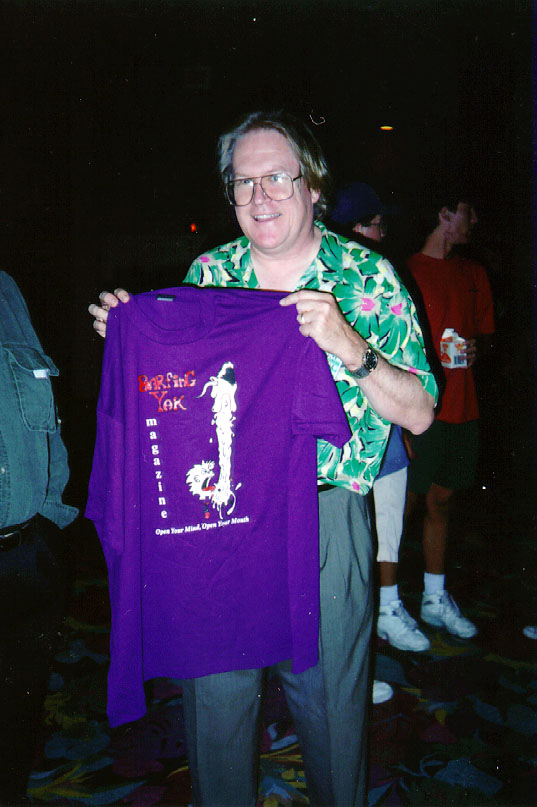

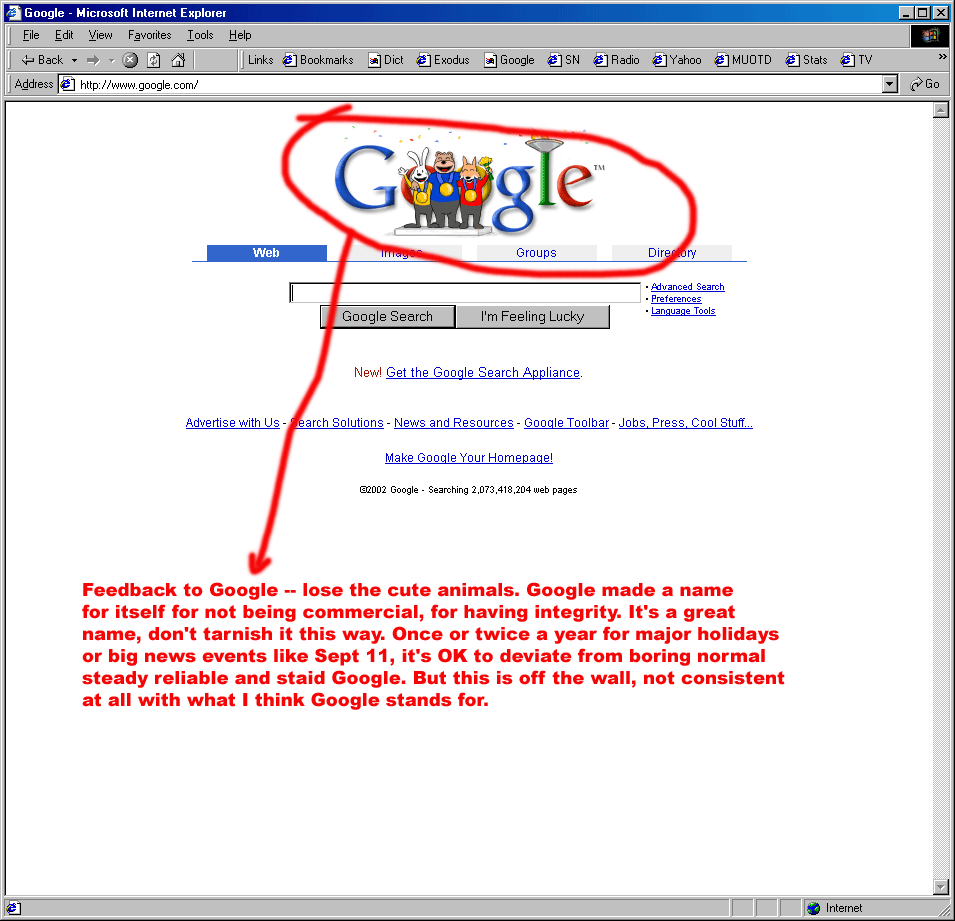












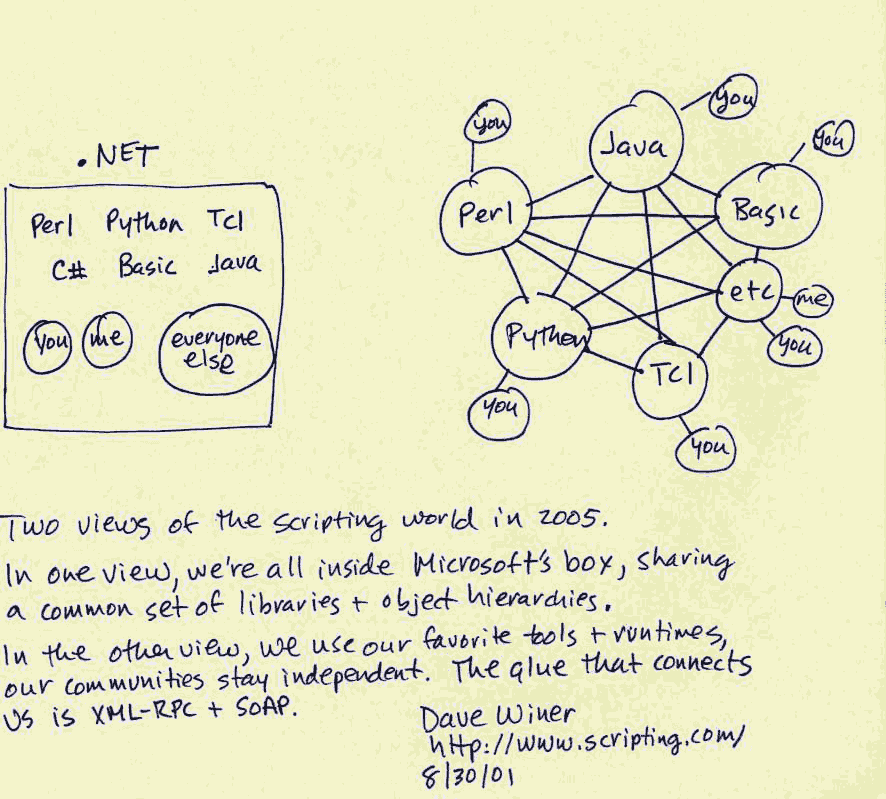
 A preview of what's coming in 8.0.4 re Web Services. On Monday we got the server side really simple, in the DIY tutorial. This highlighted the client side, which was a lot more complicated than I liked. We had a