|
|||||||||||||||||||||||||||||||||||||||||||||||||||||||||||||||||||||||||||||||||||||||||||||||||||||||||||||||||||||||||||||||||||||||||||||||||||||||||||||||||||||||||||||||||||||||||||
Outage update. Our Linux server appears to be infected with a worm. Until we completely back it up to a new server (installed yesterday) the outages will continue. At that point we'll have an extra static server at Exodus. Update at 5:15PM. The backup is complete. At 7PM there will be a planned outage on the static server, as we try to nuke the worm. If it works, everything should be back up by 8PM. If not, we go to plan B, and remap DNS to point to the new server. That will take as long as it takes for the DNS changes to percolate. Survey: "Will the number of weblogs continue to grow organically, or will there be a big spurt of explosive growth?" "Google's Genius?" asks Sam Ruby. "To pick a wire format for which there are dozens of toolkits poised to directly translate the protocol into readily consumable bits." Yes. Finally, a screen shot of PythonCard. It looks like you could do a kickass blogging tool with it. A particularly tricky virus. Who wouldn't want to know about an email to The World Bank that bounced. But wait a minute. I didn't send an email to them. Cute. Mike Chambers points to the Macromedia Developer Resources XML feed. A few weeks ago, as we were getting ready to flow the NY Times content through Radio's news aggegrator, we also released a driver for Macromedia's feed. So if you're running Radio now, you can subscribe to the feed by clicking here. Giles Bateman: "If the judge took away Internet Explorer (the weapon MS used in the crime for which they have been convicted) and barred them from further development for the Internet (appropriate, given the nature of the crime), Microsoft's monopoly power would dissolve on the spot." Amen. Alan Reiter is blogging the Technologic wireless conference in San Francisco.
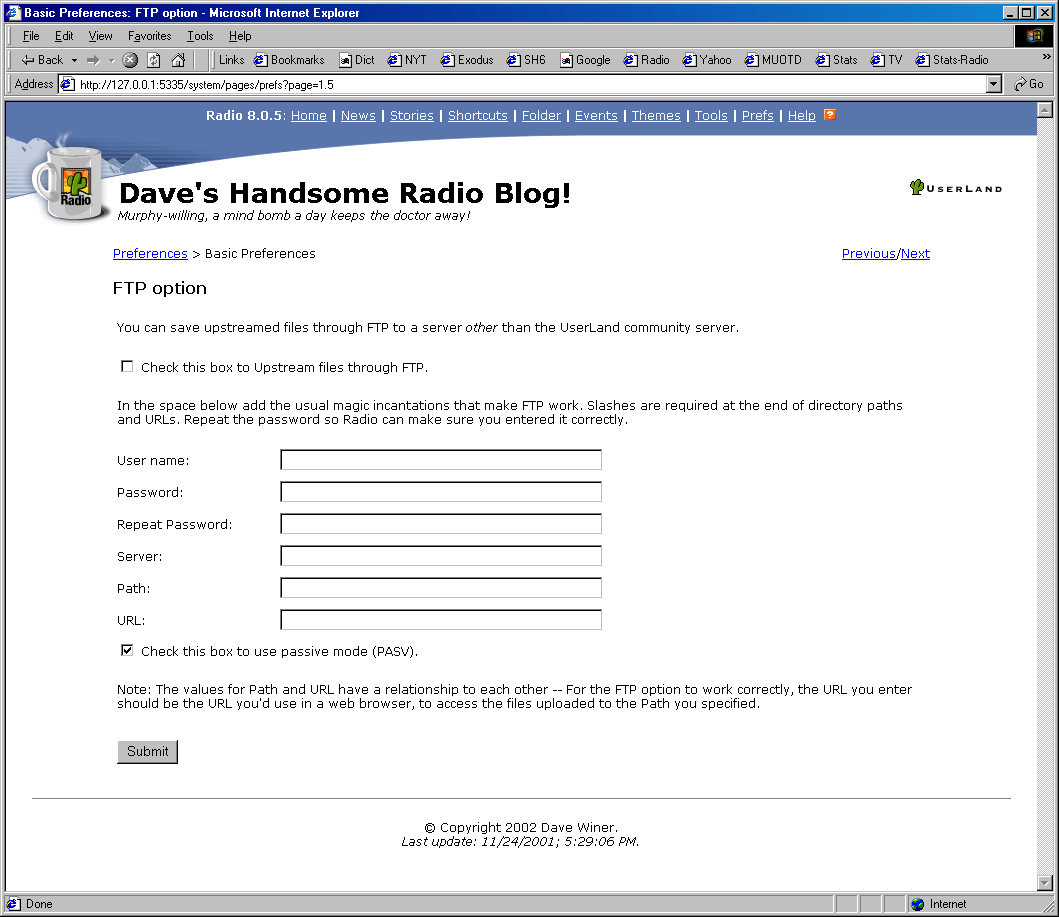
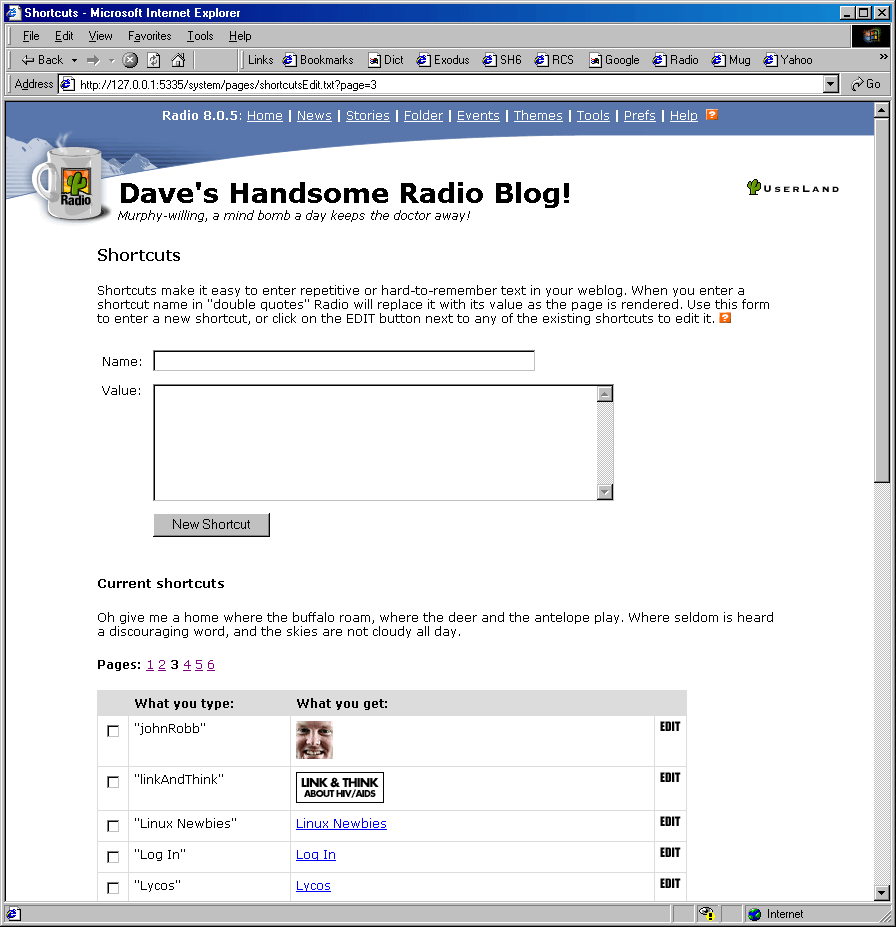
James Hong: "Dave is like the BigCo of weblogs." Heh. Marc Barrot continues his work on activeRenderer. John Robb: "Radio is a fully decentralized system. Even better, it provides you with a complete back-up of your weblog on your desktop and the ability to add to your weblog while disconnected. Given that it is decentralized, you can opt to self-host your weblog at your ISP or on your corporate Intranet in under a minute." I posted this to correct some incorrect information that's floating around. We worked really hard for a couple of years to build a completely decentralized system. It takes a few minutes to post an incorrect analysis of the product, and then that floats around out there, and hurts our business. Play fair. Our product isn't perfect, for sure, but don't ding us for not doing things the product does do. Roland Tanglao: "I don't understand what the big deal is about moving your weblog from Radio to another system to avoid centralization problems." Note the URL on Roland's weblog. On the discussion thread at Burning Bird, the source of the incorrect information, Simon Fell says: "You're not tied to hosting at Userland with Radio." It's so obviously true. Here's a screen shot of the FTP prefs page in Radio. Just click on the checkbox, enter your information, and it upstreams where ever you want. Also a little-known fact, you can serve from the machine you author on. If you're running Radio, try clicking on this link. Navigate through the calendar. It works. For a low traffic site, or a site on an Intranet behind a firewall, you might even want to use it this way. Radio has a lot of power that we don't push, be careful when you say it can't do something, because there's a pretty good chance it can. NY Times: Fun With Your Zip Program. "Using little more than the zipping programs found on most personal computers, [Italian scientists] can easily distinguish between texts written in 10 different languages and almost unfailingly tell which of a large group of texts were written by the same author." Chilling Effects Clearinghouse. "Have you received a letter asking you to remove information from a Web site or to stop engaging in an activity? Are you concerned about liability for information that someone else posted to your online forum?" 250 emails this morning. Only four contained content. The rest were spam and viruses.
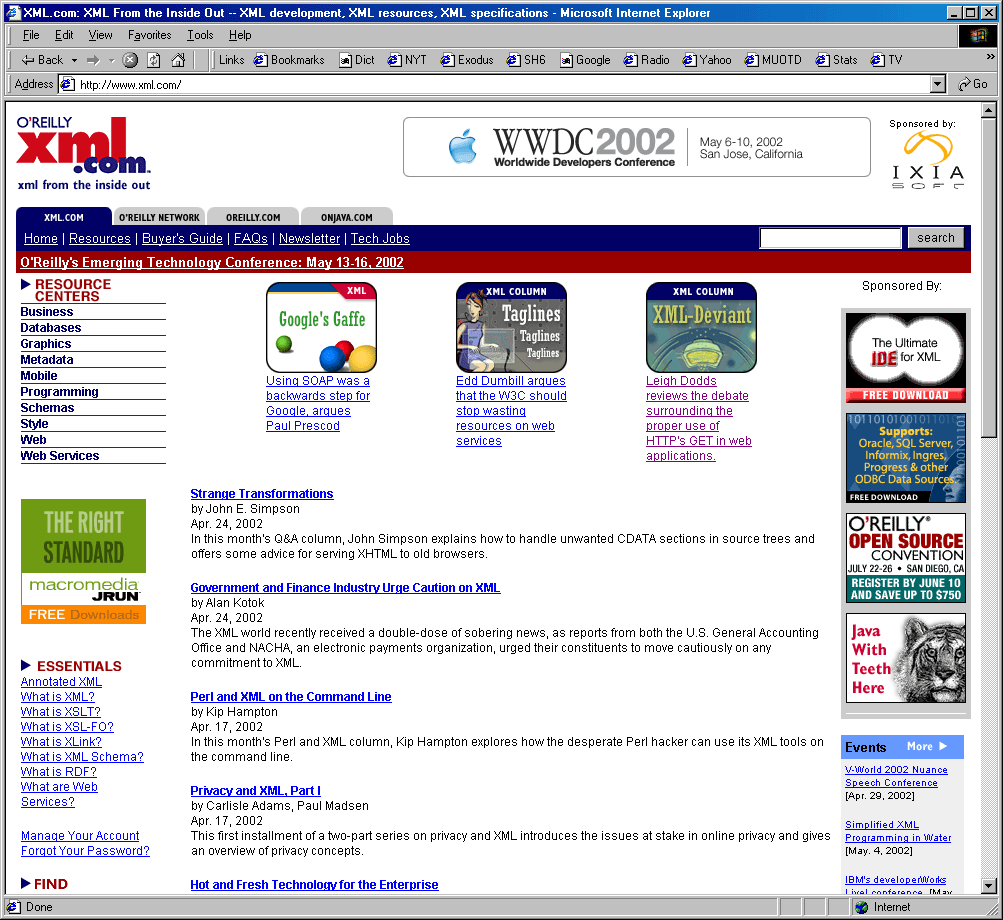
DaveNet: Making friends with Hollywood. Scott Johnson: Marketing Software When You Are a Small Company. James Hong: "It's disappointing that HotOrNot.com didn't get nominated for a Webby Award." Colin Faulkingham: "All I need now is a super groovy Radio client and we are off and running." I hope some enterprising Radio developer writes glue to help get Colin's project flowing. I'd do it myself, but I haven't got the time in the next few days. Let's make this a community barn-raising. He's got a great start. Help all of us out and let's take the next step. Thanks! Phillip Pearson notes that a Google search for Scientology now returns Operation Clambake as the first match. Sjoerd offers another view of REST vs RPC. I have yet another. There's a seed of the debates of the early 90s over AppleScript syntax, which if you go deeper into, you'll see is the REST philosophy, viewed through a different lens, at a different time. Lots of nouns, just a few verbs. I don't want to reignite the flames after all these years, but I should say that I was on the RPC side then too. Who wants a lot of nouns. I like man pages that tell you what the parameters are and what each of the procedures returns. I don't believe in super flexible interfaces, I like enumerated entry points. Check out the verb set for our programming environment. Maybe there are two schools of thought. It's been one of the most interesting days yet. An outage, some personal stuff (sorry I don't do that here) and then I got an email, from a lawyer at the Church of Scientology wanting us to remove their copyrighted material from one of the free sites we host. I looked at the site, and they may have a point. There is some blockquoted material, the author claims that it comes from a Scientology document, or does it? Is it fair use? The passage is fairly long. I am not a lawyer. And unlike Google, we are playing the role of an ISP, although we don't derive any revenue from hosting the site. Further I'm not that interested in Scientology and I have a few other things on my mind. Anyway I sent an email to the author of the site, Bill St Clair, asking if it is copyrighted material from Scientology. I think that's the appropriate first step. Jon Udell: The Google API is a Two-Way Street. "So don't ask only what Google can do for you. Ask also what you can do for Google, and for the Web, by making the most of the metadata you publish." FWIW, they should be running articles like Udell's on XML.Com. I took a screen shot of their home page today for reference in a couple of years. How far from pragmatic. This stuff is deploying now. Developers are excited. None of that comes through at XML.Com. InfoWorld interviews Macromedia's Kevin Lynch on Web Services. Another day of outages on our main static server. Jake is down at Exodus to investigate. Lawrence explains what this outage means for people using Radio who upstream to our community server. Motley Fool: 12 Myths About AOL. News.Com: "While Macromedia executives tout one of the company's biggest product launches ever--Web design tool Dreamweaver MX--company lawyers will be in court for the beginning of a contentious patent suit against Adobe." Adam Curry's mom: "Yikes! I don't even know what RSS feed is. All I know is: I'm up and running - and it's fun. Yes, Adam, you're allowed a smile and an 'I told you so.'" USA Today: "Hundreds of Internet radio stations plan to go silent Wednesday to protest proposed record-label royalty payments they say would endanger their industry." Mike Chambers has a Flash weblog. Zeldman reviews the new Dreamweaver. "You had to jump through hoops to make Dreamweaver 4 support current web standards. Dreamweaver MX Preview Release came out today, offering vastly improved support for CSS, XHTML, and accessibility." Dave Ely: "Web Services was a really bad name." Steve Gillmor reports on Stop Energy among the Bigs. Matt Brown's Dreamweaver Blog. "This is probably the most exciting day in the last 18 months for a lot of people involved with Dreamweaver. I am convinced that this is the best release of Dreamweaver yet without a doubt." Susan Kitchens: "John W Dean made this announcement: He's gonna reveal the identity of Deep Throat on June 17th." NY Times: Why Gates Won't Apologize. "Asked by the states' lawyer whether his company had done anything to address the court's finding that Microsoft illegally commingled the code of its Explorer browser with Windows, Mr. Gates said repeatedly that he had made it easy for computer makers to remove the Explorer icon from the desktop." Last year on this day I was reading Breaking Windows and writing about the Strategy Tax that we all pay, whether we work at Microsoft or not. On this day in 1997, I posted a retraction and apology. When you screw up there's no harm in admitting it. It's raining today. Very nice. The garden just loves it. Lots of planting last week, everybody says "Good timing Dave!" All my new friends, and the old ones too, say how happy they are wth the unusual spring rain. Good deal. Marc Barrot makes progress with his activeRenderer. Keith Ballinger explains his dislike for RPC. Seth Dillingham documents an ancient optimization.
Sheila Lennon at the Providence Journal has a weblog. "'Bottom-up' journalism from the pros." Rogers Cadenhead: "The give-and-take of weblogs lends itself to fast corrections from readers and other webloggers." Sam Ruby: "I'm now convinced that one can architect a system in accordance to the principles of REST and then implement that system using RPC style, HTTP transport, POST binding, SOAP. In fact, I'll go further and state that the GoogleSearch is an instance of this." One less thing to worry about. A Hollywood-friendly application of the Internet: distribution of movie trailers. Note that some news sites have trailers linked to their reviews. This is a perfect application for Radio, we would link to the trailer as an RSS enclosure, also linked to the source, with a title and a short description. Users' machines download the trailers overnight. No click-wait. Higher resolution. I'd like to do a deal with the movie studios similar to the one we have with the NY Times. We'd be happy to help them sell their product. A win-win. Who should I talk to? 1/11/01, Payloads for RSS. "I thought that video on the Internet was a loser for three reasons, that build on each other: 1. When I click on a link to view some video, I have to wait. 2. The wait is longer than the video. (In other words I have to wait two minutes for ten seconds of video.) 3. The quality is horrible."
We had an outage this morning, cleared around 9:30AM. The main Radio Community Server was down, Weblogs.Com was not updating, everything else was running okay. We've been having problems with our static server, trying to fix them, but well, maybe it's not so fixed. Oy. Someday we'll be completely decentralized. I look forward to that day. Dave Polaschek reports from Minnesota that it's snowing again, and his knee went out so he's been watching a lot of movies, and he rates them. That's useful because there are so many boring movies out there. Keith Ballinger: "I hate using SOAP for RPC." Why? What email has become. 2/3 spam. 1/5 viruses. A bunch of ad hominems, sprinkled with a few interesting messages. Morning coffee music For some reason for the last two weeks I've had Bruce Springsteen's Thunder Road rolling around in my head.
"There were ghosts in the eyes of all the boys you sent away. They haunt this dusty beach road in the skeleton frames of burned out Chevrolets. They scream your name at night in the street. Your graduation gown lies in rags at their feet. "I've got this guitar and I've learned how to make it talk. "And in the lonely cool before dawn you hear their engines roaring on, but when you get to the porch they're gone on the wind,. So Mary climb in. It's a town full of losers and I'm pulling out of here to win."
Heads-up: We're doing some maintenance on a static server this evening at 7:30PM Pacific for about 30 minutes. There will be an outage for Radio.Weblogs.Com sites, UserLand mailing lists and Weblogs.Com. You may also notice some broken images on Manila sites hosted by UserLand. Back to scripting. I've heard a lot of people say that SOAP was designed to circumvent firewalls. In fact, that wasn't one of the goals for SOAP. We chose HTTP because it was broadly supported in scripting environments, and we wanted the lowest possible barrier to adoption. It was also done with respect, don't reinvent something that already works. You can pick up the trail, starting in the strategies and goals section of the XML-RPC spec. We knew some would say that firewall circumvention was a motive, we talked about it, we used HTTP because it was a good match for what we wanted to do. Faisal Jawdat: "With the influx of new 'bloggers' over the course of the past few months, I've created a handy key to help newbies understand what they'll be doing." Really nice outline browser by Marc Barrot. "thinkusaalignright"Report on the responses to my Sharon Must Go piece posted yesterday. A few predictable name-calling emails saying (I guess) that the only way to solve the problem is to kill Palestinians. I generally don't respond, because being warlike in an email seems kind of contradictory. If you have such a will to die for your cause, go fight and good luck, but email is a tool for people who wish to reason and think. Imho, you can't do violence in email, yet some people persist in trying. Other more thoughful responses ask me to see it from the point of view of an Israeli, and that's fine, we've done a lot of that for a long time, now try to see it from the point of view of an American. Israel is a distributor of American power. If it weren't for the US, we assume, Israel would not exist. It certainly has no hope of peace without help from the US. If I have doubts about exactly what we would be going to war to protect, I imagine a few other Americans do too. I think we've made a big mistake by letting the Israeli point of view dominate the discourse. We are two separate countries.
The New York Times autoblog is proving quite useful. Whenever it updates, it pings Weblogs.Com, so I don't have to go looking anywhere special to see that there's something new. It just updated a few minutes ago at 10:15AM. Now that's weird, because mid Saturday morning on the west coast seems the least likely time for it to update unless there's some news breaking. During the day last week they would post AP reports on news that's happening in real-time, like Gates' testimony in Washington. Today they posted a deep piece on US strategy re Iraq that's dated tomorrow, so it's for the Sunday paper. We get it on the Web long before it appears in print. It's worth reading. Quite an article. And the autoblog idea is proving itself every day. BTW, it's just incredible that I get to play with new delivery systems for such excellent content. I still can't believe that the Times trusts me with this stuff. Thanks! Howard Greenstein: "Paul McCartney not only looked great, but he sounded amazing. So I decided to take out my Ipaq and capture the concert in 15 second snippets." NY Times: "The United States economy is showing signs of life. So why is the stock market still acting the part of the deadbeat?" Happy Tutor: "Perhaps Userland could solicit Social Venture Funding. In addition to economic survival and growth, the company seeks to create a true free-market of ideas on the web, in which peers work with peers, or as citizens, rather than as passive recipients of broadcast, mass-cult, copyrighted content. Rather than rich branded messages, or monopolies that lock us all in the trunk of brand-think, Userland creates the infrastructure that lets a thousand flowers bloom, a good democratic (actually Maoist) ideal. Userland sustains the info-commons -- what Dave calls 'the two-way web.'" Brian Lenihan: "I smelled like a rotting corpse but nobody said anything. Amazing." Lawrence posted three print-friendly versions of Frontier tutorials from 1999. The first tutorial walks through the website framework, the lizard brain that forms the underpinnings of Manila and Radio; the second covers scripting and the third is an appendix. Something I've wondered about. "Every screen reader except OutSpoken for Macintosh can handle tables quite adequately, so go ahead and use them." Berco Beute wrote his own blogging software using Jini.
Essay: Sharon must go. Salon: "Sen. Fritz Hollings is pushing a bill that supposedly safeguards online privacy -- but actually gives intrusive marketers a green light."
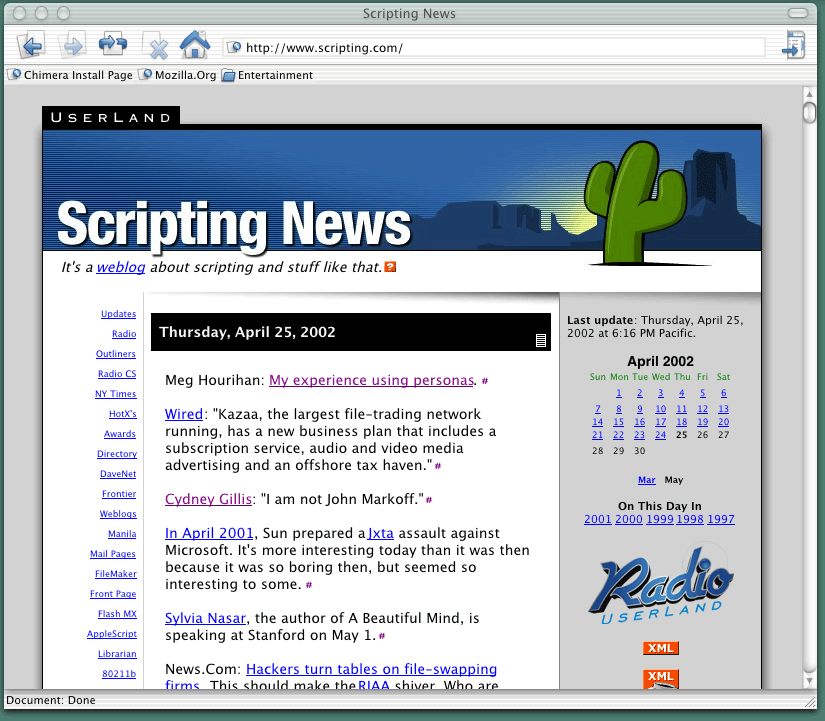
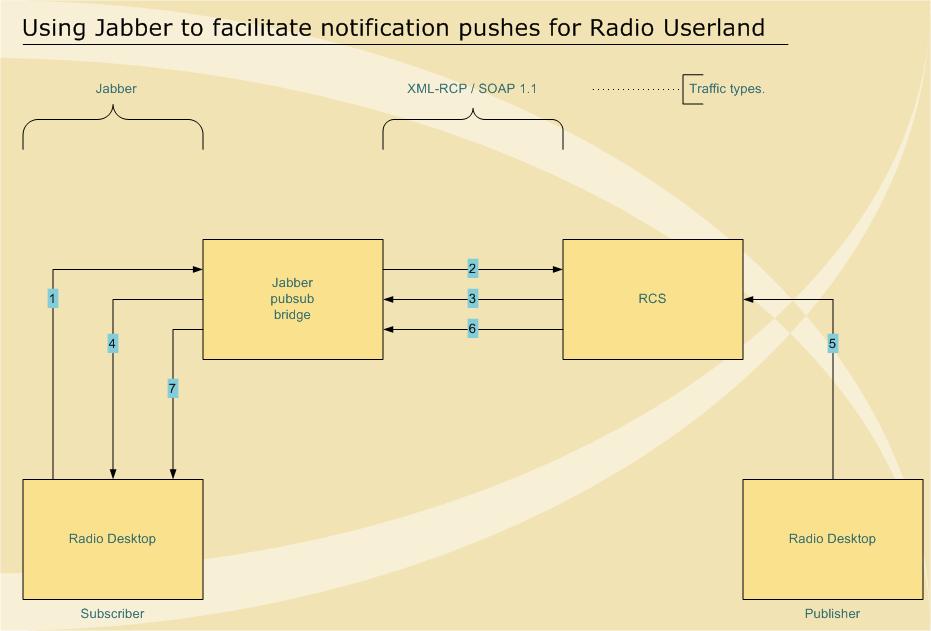
On this day two years ago SOAP 1.1 was announced. LM Orchard blogs Chris Heschong quoting Ken MacLeod, a proponent (?) of REST: "the only thing holding us back is a marshalling standard." Oy. John Burkhardt, who works at Groove, has been tasked with integrating Groove with the rest of the Internet, via SOAP. Matt Pope also works at Groove and has a Radio weblog, which bodes well, I hope, for Steve Gillmor's vision. To the Groove guys, I think RSS 0.92 is a good first step on the path to interop between Radio and Groove. Here's a walkthrough I did earlier this month showing how the pieces in our publish-subscribe system fit together. Tim Bray sent a screen shot of Chimera, a Mac OS X browser that does anti-aliased text. Looks really nice. Time.Com has an article about Mozilla. How many factual errors can you spot in the lead paragraph? Radio updates heads-up A heads-up to Radio users who are interested in the technology of root updates. We're getting ready to deploy a new updates system, one that's based on statically served files, not XML-RPC. It'll be a two-step corner-turn. First we'll release new parts that implement the workstation side of the new updates process, but to turn it on you'll have to manually edit an object database cell. Everyone at UserLand will turn this on, and we'll ask courageous programmer-type Radio users to do this too (if there's a failure, to get back online for updates, you'll probably have to do something programmerish). We'll cross our fingers and hope for the best, and fix any problems that surface. After a few-days of burn-in, we'll send out an update that sets the object database cell for everyone, and the corner-turn will be complete. Why are we doing this? It's another step on the path to full decentralization. The work that our server is doing now will be done on the workstation in the future. The static files will be served on Apache, at first, then if need be, will be moved to a more sophisticated server that's capable of bringing more bandwidth online by just adding more iron. Still diggin!
Meg Hourihan: My experience using personas. Wired: "Kazaa, the largest file-trading network running, has a new business plan that includes a subscription service, audio and video media advertising and an offshore tax haven." Cydney Gillis: "I am not John Markoff." In April 2001, Sun prepared a Jxta assault against Microsoft. It's more interesting today than it was then because it was so boring then, but seemed so interesting to some. Sylvia Nasar, the author of A Beautiful Mind, is speaking at Stanford on May 1. News.Com: Hackers turn tables on file-swapping firms. This should make the RIAA shiver. Who are they going to sue out of business now?
Collin Faulkingham posted a spec for the discussion group web service he's working on. Zoe: "Do for email what Google did for the Web." Dan Shafer explains in greater detail why he thinks PythonCard on the Mac is such a big deal. Scott Johnson: "Its just amazing how quickly a real community can get something done when they think its important." Mark Baker: "I agree completely." Edd Dumbill: "It is past time that the W3C called an end to its involvement in web services. Despite the name, web services have increasingly little to do with the Web as we know it, and those at the forefront of its development seem to have little fondness for the W3C or its technologies." I want to be really clear that I do not endorse Edd's position. His focus is wrong, imho. Look at what the independent developers are doing. That's what matters. Edd is a consistent source of what I call "Stop Energy." The reason all this is coming to a head now is that there is a lot of motion. He and his friends have been able so far to control the news coming out of the XML world. I always believed that would break at some point. Now it has. That's good. The XML.Com philosophy is far too centralized, and relied on BigCo's and the W3C for innovation. I don't think Edd has been around the block enough times to know that it's hopeless to expect that to happen. Innovation comes from independents. My rebuttal, posted last night, applies to Edd's piece too. RFC: What is Stop Energy? Thanks to Groove News for this pointer to a clear statement on competition from a Groove person. A NY Times reporter discovers that, with software, it's often even worse than it appears.
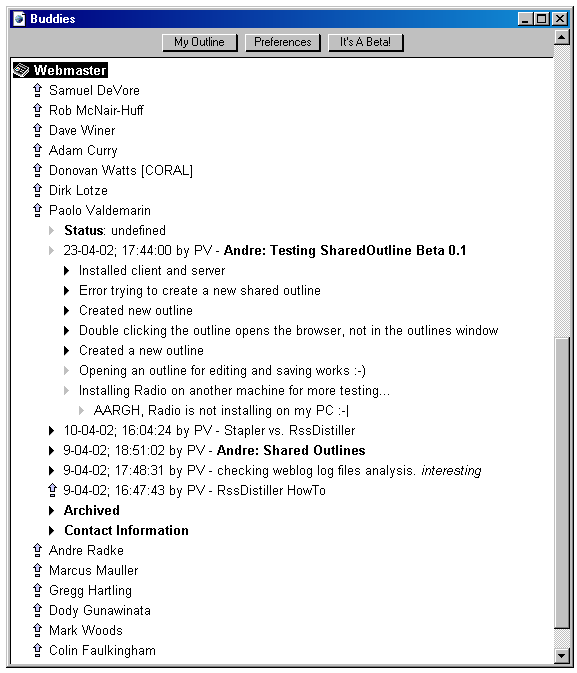
Paul Prescod: Google's Gaffe. "I take the SOAP-ifying of Google as a sign that the web services hype has now reached overdrive." Rebuttal: "SOAP is, as Prescod acknowledges, a juggernaut. It's better, imho, to accept that it's here, above all the objections that have been raised. Every service that comes online is potentially a killer app for the next layer of the Internet, one that's not confined to HTML browsing. I'm sure that somewhere in this space is huge growth of knowledge-sharing made possible by tools that work better for more people. That's where the prize is, in the activation of minds." Vint Cerf: "The Internet is for everyone." Colin Faulkingham: "The DGWS server is a lot like a Group Weblog but structured more like an actual Discussion Group." AP: Microsoft Chairman Bill Gates said Wednesday the company has not tried to figure out how to remove elements of its Windows operating system, because the task would be impossible." Andrew Orlowski: "Remember: this is the plea for clemency from a convicted criminal." Craig Burton: "He lied. He knows that he lied. Nothing new." Dan Gillmor: "I created a quickie weblog for a symposium in Beijing this week and updated it live from the podium as I was speaking. Eyes went wide as people saw themselves show up on the Web." Dan Shafer: "My favorite new app development environment, PythonCard, is about to meet up with my favorite new operating system, Mac OS X." Wealth Bondage: "Perhaps Userland could solicit Social Venture Funding." Kur5hin: "Media giant (and MPAA and RIAA member) Viant conducted an extensively detailed study of filesharing last year. It's an excellent analysis of the current state of various types of filesharing systems as well as an overview of the legal and technical issues surrounding each." I'm glad that Clay Shirky has stopped saying that BigCo's and Web Services are one and the same thing. Now he says that SOAP (what about XML-RPC, Clay) is an essential ingredient of decentralization. For that he gets a half a bing. But he doesn't say what it will do for people. He would have gotten the full bing if he had a weblog. That's the next step in ShirkyLand. (Yes, I'm cheeky and I don't know my place.) CNN: "Google needs to get untentative," says Dave Winer, the CEO of Userland Software and an influential online essayist. "They need to grow, and developers are central to that. They become your sales force. Google has the two magic ingredients that developers love: users and potential." Paolo and his team have a beta of a new Radio tool that does shared outlines. Darrell Smith is the CTO of Morpheus. James Hong: "How did Jake know what I was up to?" Scott Mace: "How many of you reading this have experienced Launch.Com?" Philip Pearson created a PHP implementation of xmlStorageSystem. "This may seem like a completely pointless project, seeing as RCS is already more or less free, and PyCS does everything pretty well already. However, neither of them will run on your $10 hosting account that only allows CGI and PHP. This will." With three implementations, I started a new sub-directory for xmlStorageSystem. LM Orchard: "When subscribed to 100+ RSS feeds, it's like I'm floating in this N-dimensional space where I can overhear voices from hundreds of rooms without being overwhelmed. When something triggers some of my mental filters and watchwords, I click the link and delve deeper." Mike Deem: "The people who run Microsoft could decide to delete all the source code and go home. Microsoft is a private enterprise run for fun and profit. If you take the fun and profit out of it, why bother?" On this day last year: "The time to ask the question about Microsoft truly being open isn't now, when they have everything to gain from openness, but when they achieve dominance in the market. At that point, without government intervention, or self-imposed restraint, you can be sure it's going to close up." Evan Williams: "Some days—usually Mondays—I wish I had someone to tell me what I should be doing. I mean besides thousands of Blogger users." I finally saw A Beautiful Mind yesterday. Very sweet movie. Maybe there's only one good idea in a lifetime. The rest of it is a struggle to see what's real and tune out what's not.
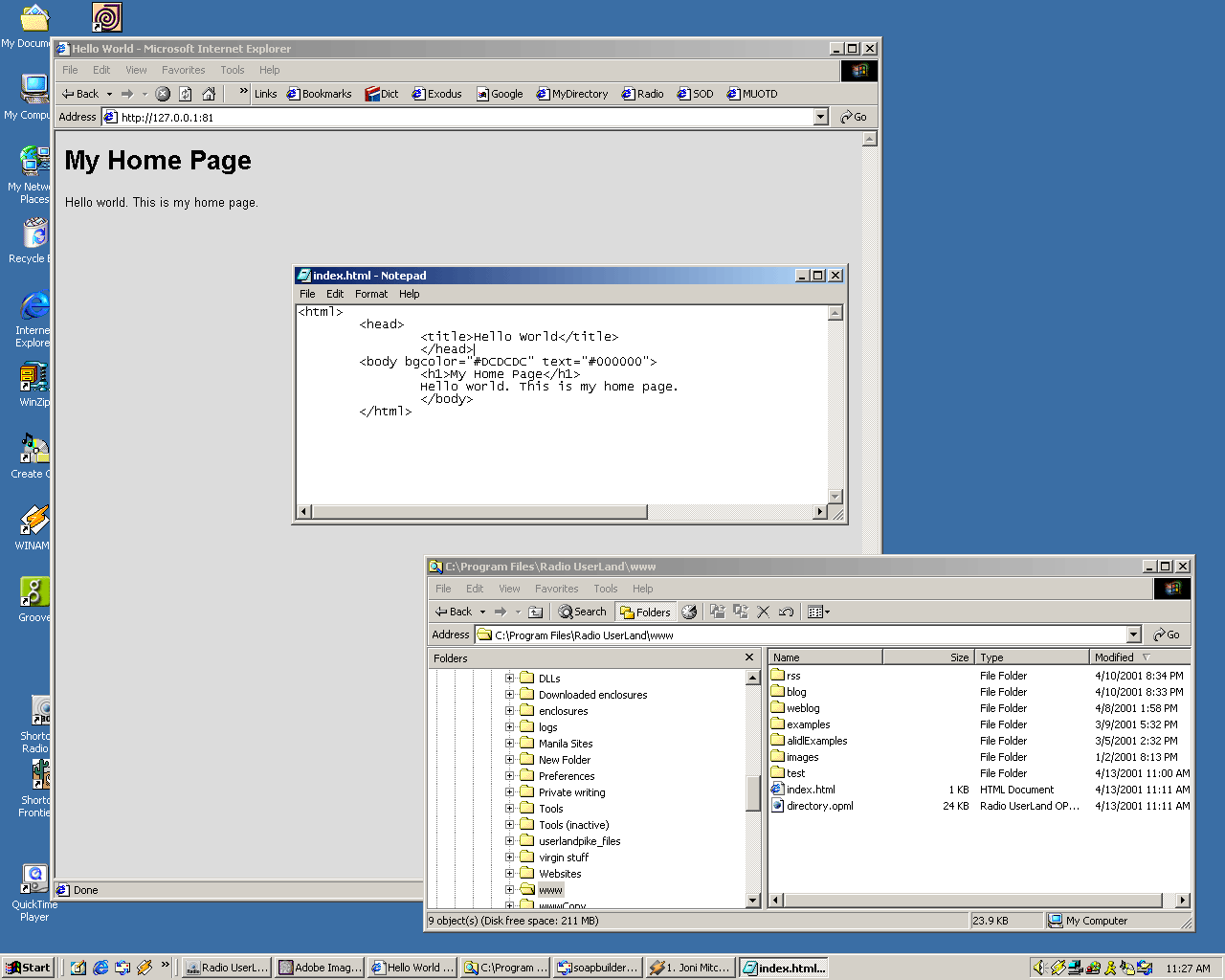
Radio's Outliner: How to write an HTML page in the outliner. News.Com interviews the Brains Behind Kazaa. Jon Udell: "As blogspace evolves all around us, new forms of writing appear." Cydney Gillis: Did Gates lie? AP: "Gates argued that the penalties would keep Microsoft from releasing timely security updates." Jacob Reider is looking for benevolence in business.
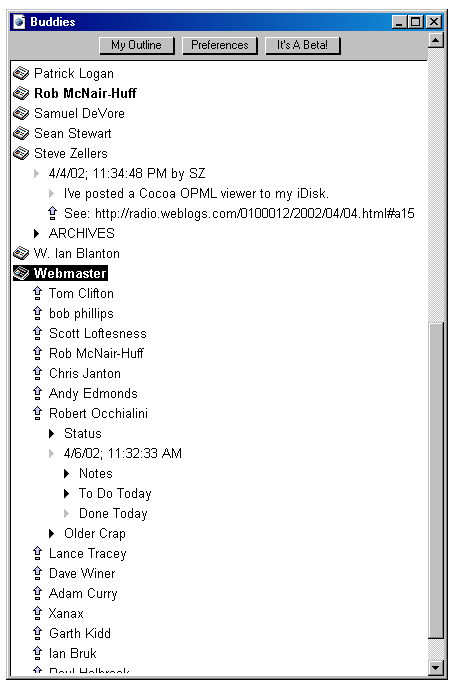
Rob McNair-Huff, editor of MacNet Journal, has a public outline of Mac OS X apps by category that tracks the development of each product. This is beyond what the tech pubs used to do. They'd publish snapshots of markets, that were useful, but didn't change over time. This is very cool.
Scott Johnson: "Write a renderer in PHP." Phillip Pearson: "Why not just render them when they're generated?" Truth is as strange as fiction. Brent Simmons found an outliner in AppleWorks. Apparently it's a pretty good one. Martin Traumwind has a graphic Java browser for Google relationships. 4/2399: "Airport security has stopped hijacking." Ooops. Matt Goyer: "It even works in Opera.. Damn I'm good!" Howard's Zope Notes: "Thanks Guido!" Kevin Stewart: "Microsoft already 'supports' modular versions of Windows with Windows CE and Windows NT Embedded. They allowed a form of Chinese Menu construction of those OSes. Which supports my vote that Gates is misleading the court. Just my $0.02." The battle for the Web continues Good morning. A small flood of mail about yesterday's Microsoft survey. Some comments follow. When I read the account of Gates' testimony yesterday I dashed off an email to people at Microsoft who I consider friends. I'm still willing to help Microsoft, but first we have to deal with the mess. Here are some facts. 1. MS has the dominant Web browser. 2. They got there illegally. They were convicted. 3. We're in the penalty phase now. My belief: The conviction was the correct result. Now they must come up with a penalty that is appropriate, that will prevent Microsoft and future would-be Microsofts from using a monopoly in one technology to gain a monopoly in another. To allow juggernauts like Netscape a little breathing room to learn and make mistakes before they have to deal with a monopoly that acts willfully to cut off their air supply. To make Microsoft a better platform vendor, with more developers, with more new ideas being tried out. To help developers and their investors trust the market, without illegal and unethical interference from Microsoft. On strictly pragmatic terms, if Microsoft isn't lying when it says it wants developers for its new platform, they should welcome the opportunity to get its developer relations back on track. Yesterday's survey says that at least people who read Scripting News, many of whom are developers, don't trust them. You can try to rationalize it any way you want, but a majority said clearly that they believe Gates lied about something that is central to the issues at hand. Arguing with me is pointless. The problem is deep. A major correction now is something that a Microsoft that's thinking long-term should welcome. Microsoft clearly doesn't have any vision for the Web other than owning and controlling and freezing it. As Web developers, it was our air supply that Microsoft cut off. The correct solution is to decouple the Web from Microsoft in a permanent and non-revokable way. It should be done in a way that causes the least possible disruption of service for users, while creating the maximum possibility for competition. For Microsoft to argue fairness is ridiculous. They are not qualified to argue about fairness. 7/12/01: Restoring competition to the browser market.
DaveNet: How to be a revolution. "You can't undermine by trying to dictate the terms, you have to do it by invading at night, slipping in the back door unnoticed. Then when the old folks wake up, it's too damned late." Emergent Music is the "seed of a new, better, music industry." Dan Bricklin comments on the NY Times auto-blog. "This type of news feed, with reverse-chronological headlines, summaries, and links to articles in real-time, is good for catching up. It's different than a normal news page, sorted by what's most important, where the new stuff may be at the bottom. Breaking stories have frequent updates, and they show up as that." Steve Pilgrim: "I've been prowling the weblog world today." Fred von Lohman: "The BPDG standard is not about stopping piracy. It's about Hollywood regaining some measure of control over what you can and can't do with television. It's about cramming the VCR genie back in the bottle, and giving Hollywood the power to bring new technologies to heel before they can deliver new capabilities to consumers." Roland Piquepaille: Political Shocker in France. InfoWorld: Gates testifies in remedy hearing.
Survey: Is Gates Lying? Mike Deem: "When simplifying for mass consumption any issue as complex as this one, one could 'spin' it in any number of ways without abandoning the 'truth.' Gates is spinning this one in the way that is best for Microsoft's bottom line. It is his responsibility to Microsoft's share holders to do this." I responded "Mike, while I'm not a lawyer, I don't think it's legal to spin when you're under oath. I think it's required that you tell the truth." Steve Gillmor: Google, Dave and Ozzie. Great article Steve. This is the InfoWorld I used to love. An inspirational article. I won't give up on Groove yet. If they open it up so that Radio can participate in their network without jumping into the box, we'll be all over it, as we are on the Google API.
I added a sixth disclaimer to the docs for the Google-to-XML-RPC gateway. "UserLand does not keep a copy of the keys that pass through this server. We don't use this information in any way, and will not do so in the future."
Paul Nakada: "Links are the weblog equivalent of venture capital, except, without the strings. We just got funding for this blog today!" Hehe. Here's a second round. Lots of discussion of deep-link philosophy. Here's another analogy. Suppose I told you about this great book. Read it, but read the last chapter first, and if you want you can skip the rest. Would that land me in court? Another one. Suppose I'm writing a scholarly paper. Two years ago another scholar published a copyrighted book on a different but related topic. On page 49 he discusses an experiment he conducted that I want to base part of my argument on. I put a footnote on my citation, telling my readers to look on page 49 of his book. Did I just violate his copyright? BTW, if you're a friendly lawyer (there are some) read today's NY Times article about Bertelsmann and let me know what's up with the antitrust case against the BigCo's of the music industry. It seems they don't want us to look at that. Let's look at that. Howard Kurtz: Who Cares What You Think? Blog, and Find Out. Steve MacLaughlin: Taking the "R" Out of Free. On this day last year: "I write software for guys like Doc."
DaveNet: The Mind of Google. "I started to feel like I was interacting with something with a mind. Of course Google doesn't have one, but it does a fantastic job of tapping into our collective minds." NY Times: "If Bertelsmann buys Napster, it will have two of its divisions on opposite sides of a serious legal divide, with billions of dollars in damages at stake." Ernie the Attorney: "If all I do is point someone to a location on the web, then what have I done that triggers the copyright laws? I haven't made a 'copy' of anything." ResearchBuzz found a semi-documented Google feature, searching by date. Sam Gentile ran a great rant about C programmers trying to understand programming with a runtime. "This is not Windows. This is not COM." True. Hey it would be interesting to see a feature-comparison of runtimes. Microsoft has some features we don't, and vice versa. Hal Plotkin: "Targeting a handful of specific lawmakers for defeat makes a lot more sense than putting a bunch of geeks on planes." Wired: "Joining Hollings as co-sponsors of the CBDTPA are one Republican and four Democrats: Ted Stevens (R-Alaska), Daniel Inouye (D-Hawaii), John Breaux (D-Louisana) and Dianne Feinstein (D-California)." Paul Snively: "Rather than defending our future, they are selling it out from beneath us."
Steve Zellers: "I'm definitely in Dave's camp on this." Paul Snively: "Adam and Dave are talking about two different things that are often used to accomplish the same result." Last year on this day: "The subjects of the press are now doing their own press. Does this strike you, as it does me, as a loop? Why is it necessary? Haven't we been here before? Isn't this what happened with mainframes when personal computers came along? How secure were the mainframe people when faced with a horde of Apple developers with nothing to lose. They were dismissive, for sure, I was there (so was Bricklin) but it didn't matter. The users could do it for themselves. And then that's what happened." Scottish Lass: "With the dawning of the age of the Google Outline Browser all three predictions are now given earthly form and the wise shall heed the goodness unleashed on all mankind by the guardians of the 'G'. Those whose arms sit at right angles to a body that neither sleeps nor eats shall be the bringers of a new age of knowledge sharing and enlightenment." Hehe. 2/15/98: Meet an Outliner. "I had to experience the usefulness of an outliner before I could envision using one, to advantage, myself."
Wired News revisits the issue of deep linking. Tony Bowden did a G.O.B. in Perl.
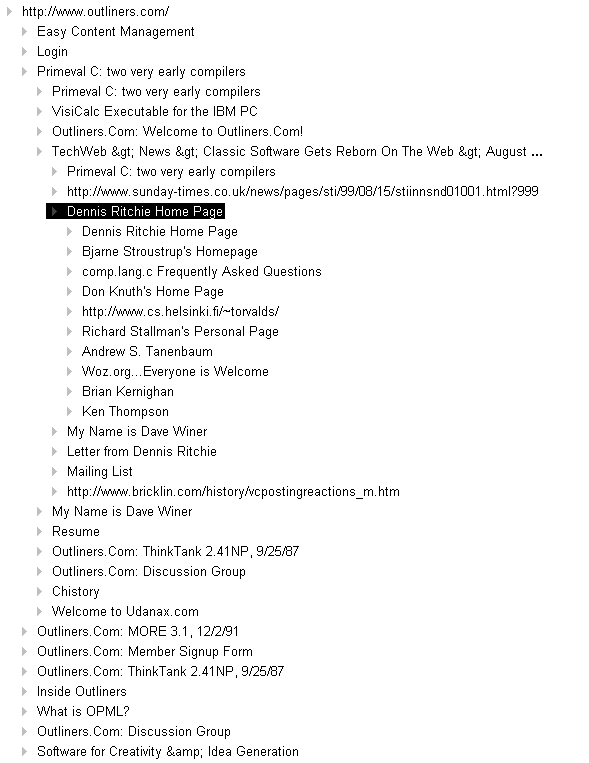
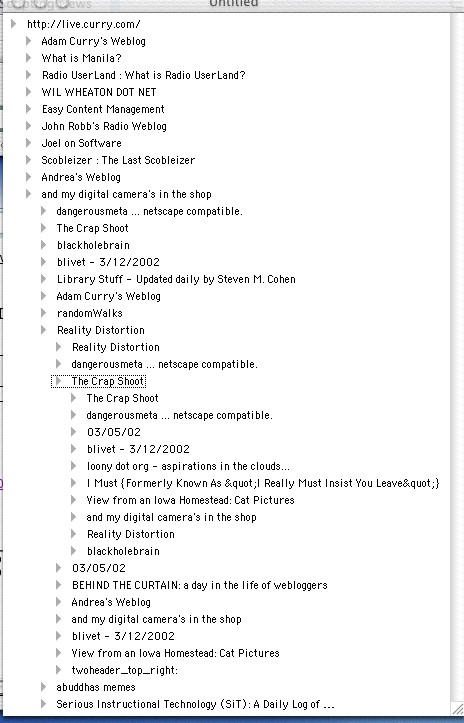
Radio's Outliner: Google Outline Browser. "It's a different way to crawl through The Mind of Google."
BTW, this is very much like something I played around with in MORE in the 80s. We licensed a thesaurus. I wired it into the outliner. Type in a word. Double-click to see its synonyms. Repeat until exploration is done. It was a great way to think up product names. Browsing Google the same way is different. Sjoerd Visscher did a G.O.B. in HTML. He also offers some possible insight into Sam Ruby's light bulb. I added the three G.O.B.s to the apps sub-directory. I came across the word telegraphy in dictionary.com as I was Google Outline Browsing, and found many of the related pages were mine! Somehow it seems to have figured something out about me, or how I am perceived. The Mind of Google. Adam Curry is GOB'ing too! David Watson is combining Google with Swing. David Davies released a new version of his assetManager tool for Radio. Adam Curry released the long-awaited picture of his helicopter flight crew.
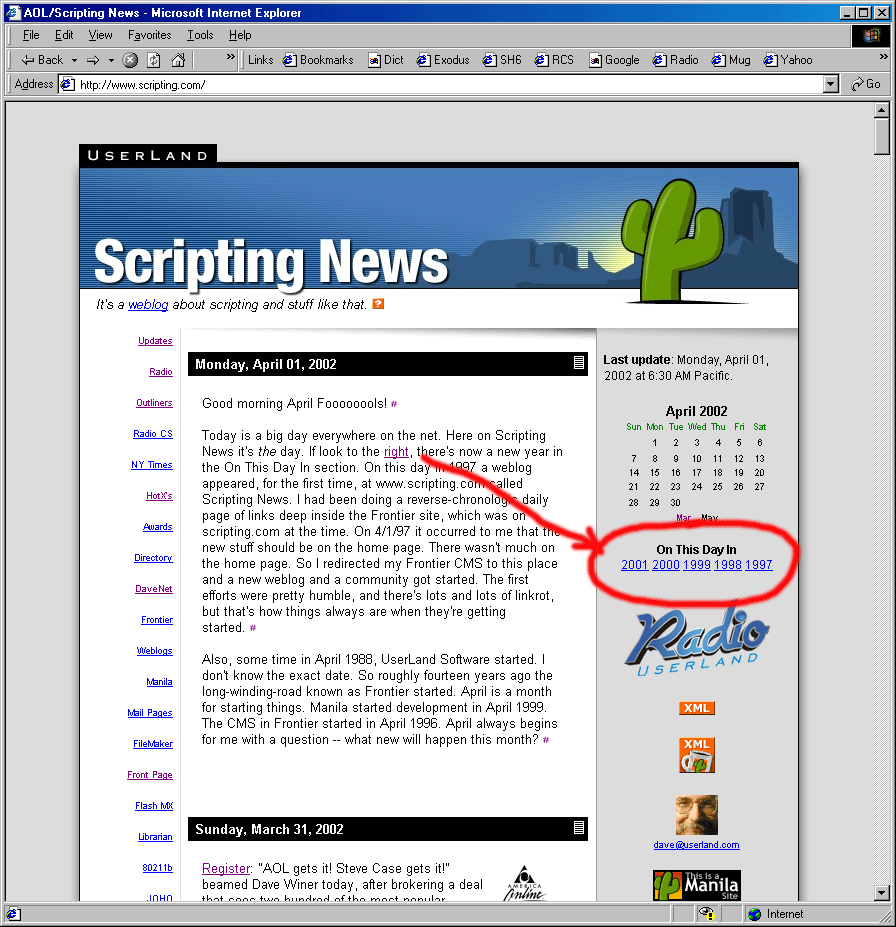
On this day in 1999, Jakob Nielsen advised that we were stuck with old browsers until 2003. Coool. Only eight more months. On this day in 1998, Bob Atkinson, one of the designers of XML-RPC, said that the debate over HTTP-POST was a red herring. Chuck Shotton agreed. "No disrespect to Jeff Allen, but his comments are FUD." The debate continues to surface from time to time on mail lists and weblogs. Kazaa, Morpheus, Brilliant What really happened between Kazaa and Morpheus? Who owns Brilliant? I stopped watching Music-on-the-Internet when Napster was shut down. I'm back in the loop again, reading, asking questions, learning. I am not running the software on my desktop yet. Are you? 3/4/02, News.Com: Morpheus' downfall: Bills weren't paid. 4/8/02, Register: "Since late last year KaZaA downloads have contained 'sleeper' software which let Brilliant Digital Entertainment, a 3D advertising and modelling software start-up to activate Altnet, its own P2P network." 4/18/02, Wired: "Kazaa users, angered by the network's inclusion of secretly embedded spyware, can now connect to the peer-to-peer network using a hacked version of the application called Kazaa Lite." Who do you trust? The Wired article, linked above, may be the worst news yet for the RIAA. Their theory so far has been that they can shut down music sharing by shutting down companies like Napster, MP3.Com, Morpheus and Kazaa; and whatever pops up next. Their technologists seem to be telling them that there is no such thing as decentralized file sharing. But what if there is? And the music industry strategy may have a twist. Consider this possibility, and it's just a possibility. As they say on TV, this story is based on real events, but the story itself is fiction, real people are not portrayed. Let's say a popular music sharing network starts up. Call it Music For The People Networks (MFTPN). It's popular, millions of people download and use the software. MFTPN is low on money (of course) so a group of Hollywood producers, (apparent) renegades, start a new venture to capitalize on the flow of creative material over the Internet. They approach MFTPN, and say "Include our software in the package and we'll give you $3 million, no questions asked." MFTPN reviews the software and sees that it is what it appears to be, and says yes. But there's a back door, because the software can update itself over the Internet. Now behind the scenes, the renegade Hollywood group is actually funded by Disney, AOL and other members of the RIAA. Why would they give so much money to fund a company who develops software that they so despise? Fade to commercial. Tune in next week for the next episode
On a lighter note, from Wes Felter, "Some home-brewed Ethernet addresses I've seen: 0xFE:ED:BA:BE:F0:0D (describing Calista Flockhart?) 0xDE:AD:BE:EF:CA:FE (time for a steak?) 0xDE:AD:CA:FE:BA:BE (must be a Java-hater)." Steve Zellers: "0xC0CAC01A 0xADD511FE" David Johnson: Building an Open Source J2EE Weblogger. Hmmm. Kinda looks familiar. WSJ: "AOL Time Warner Inc., whose online service is struggling to hold on to customers who want high-speed Internet access, is rethinking its cornerstone strategy of promoting such broadband access nationwide. The move calls into doubt one of the main goals of the merger that brought the Internet and media colossus into existence." News.Com: "In yet another test of new services, Google is quietly wading into the expert-advice market, a lackluster business that proved too taxing for some former Net highfliers." Mozilla 1.0 Release Candidate 1. Sean Gallagher: "I just finished doing an immersion in the ebXML specifications for an article I've been working on." Talking with Jon Udell, he tells me that there's a white-on-orange XML icon for the RSS feed of O'Reilly's Safari website. It tells you when a new book appears on the Safari service. Seth Dillingham: "Customers who buy gifts for their vendors? Just six months ago, I would have said that such things don't happen, but Brian is the second customer to do it this year." A perfect demo of the problem with web services in this article in the SF Chronicle. The first eight paragraphs of the piece have to get all the BigCo bullshit out of the way. No mention of XML-RPC of course. Larry Ellison gets ink, but we don't. See why that might create some resentment? No good deed goes unignored. All good ideas get stolen and then tortured to death, by the Bigs. Russ Lipton: How to Add a Google Box to your Weblog. Abe Fettig: "I was thinking about a way to use the Google API that webloggers would find more exciting than the Google Box, and I came up with a little Python script that looks up a site's rank for a given search term on Google." Interesting sequence on Sam Ruby's weblog today. It's true, SOAP doesn't have to be much more complex than XML-RPC. (BTW, the problem is with the ever-changing maze of specs and schema and confusing press statements and weird consortia, not the wire format.) Let's keep it that simple and everyone should be OK with it. I remember how Eric Kidd left the SOAP process last year this time, being sure that it was a moving target. I feel the same way, not sure about Brent and Daniel. If the SOAP that Sam has on his blog today is all anyone has to do, then SOAP should enjoy great success with independent developers. BTW, why doesn't Sam support XML-RPC? Just curious. Maybe Brent, Daniel and Eric could teach him a thing or two? I support SOAP, why doesn't Sam support XML-RPC? Or does he? Paul Boutin: "For Web browsing -- still the biggest time use of home computers after e-mail -- the new iMacs are notably slower than a PC." Rob McNair-Huff says Mac OS X is to blame. Kenytt Avery did the Google outline browser I spec'd yesterday, in Python. Screen shot. Doug Landauer picks up on the legend of the cafe babe. "She later transferred to FirstPerson, the semi-secret Sun subsidiary that developed Oak, that turned into Java." Jon Udell says some things that I find puzzling. "There will be a semantic web," he says. How does he know that? He also says "Radio is not the endgame by any stretch of the imagination." Hmmm. Yesterday was the one week anniversary of the release of the Google API. In that week, we explored many of the nooks and crannies of the power it reveals, but certainly not all of them. That the experiments are so unsatisfying is not for the lack of interest among developers. We'll do it again and again, no matter what the naysayers say, no matter how silly the examples are, this is how you explore a new capability, this is how we get creative, as a community, by turning off the judgment and playing. It's like tennis. Google hits the ball over the net, we hit it back. Now we hope they respond by exposing more functionality. Edd Dumbill's rejection means nothing to users (what is /bin/dev/whatever anyway?) but the Cape Clear experiment he disses is interesting, even if it irritates him. (What about the email addresses they're accumulating, that worries me.) Anyway it's possible that somewhere in the small Google API there's a nugget we haven't yet found, an application that transforms the Internet in some way that's meaningful to someone. And we can hope that Google and other big centralized services see the power of interested developers and try out some more new ideas we can experiment with. Some people think that the vague roadmap that the W3C offers is the true path to wonder and enlightenment. We've been here before, maybe some of you haven't, but the big proclamations very often fail. (Actually, empirically, they always do.) For me, this goes back to the boom of Lotus 1-2-3, and the assumption by many that their follow-on, Symphony, would replace it in short order. It didn't happen. Magic isn't something you can invoke through planning and speeches, conferences and consortia and cover stories in the BigPubs. It only happens when the time is right. Old beliefs die hard. It's better to accept magic when it happens than to try to hold on to your old ideas. Radio is a rocket ship. To say it's not the endgame, well what is? Is the Web? No way. Someday it will look like an Apple II looks today. So to say Radio is not the endgame is a no op. As long as humanity survives there will be another iteration. But when you find something that has some of that magic, go for it, don't be a stick in the mud, and don't pay too much attention to people who are.
I talked with Adam on the phone this morning, and asked how he prepares the music for his weekly radio show. "If the song I'm looking for isn't available through Morpheus, it doesn't get played on the show." Jon Udell blogged a new term today from Sean McGrath that I'm going to be using in the future, probably a lot. "In XML land, not only are the equivalent of 'global variables' created with wild abandon, but their creators often see fit to invoice based on the number they create for you." Creating global variables with wild abandon. Wow. What a picture. It's so true. Sounds like Peter Drayton, Simon Fell and Ingo Rammer are adding all kinds of rest-of-the-world friendly bits to Microsoft's .NET, which would be totally welcome news, of course. Phil Ackley: "Watch for flying dogs." Pedro Ornelas's XML-RPC library for Flash. Oh yeah, we're in trouble now. Read this article if you think there's a chance that the USPTO isn't fucking us. Hard. Warblog peace blog warblog peace blog warblog peace blog warblog peace blog, I'm just a blog blog. Google Answers. Interesting. Russ Jones is watching PayPal. Jeroen Bekkers is blogging Groove. Lieff, Cabraser, Heimann & Bernstein. TIAA Cref. Archer-Daniels-Midland. Sudexo Marriot. The Catherine T and John D Macarthur Foundation. Harry Nillson: "Good bad good bad good bad good bad." Jon Pugh: "Every OSA script ends with 0xFADEDEAD." Andrew Duncan: "0xDEADBEEF was used, IIRC, for null pointers in PowerPlant, Metrowerks' app framework for Mac." Ryan Cox: "The first 4 bytes of every Java class file has the magic value 0xCAFEBABE." Steve Zellers reports that they love the cafe babe at Apple too. Paul Simon: "Where have you gone, Joe DiMaggio?" Note to Scott Andrew. Yes, it exists. But we prefer the XML-RPC approach for all the reasons you state. It's easier to transmit complex structures. Less work for the scripter and it's more conservative of the centralized resource. Looking for a fun Google project using Radio's outliner? I spec'd one this morning, in my Instant Outline, of course. Brent Simmons who used to work at UserLand says something funny on his weblog this morning. "Since I work for myself, I can choose to be impolitic when I want to." Read what he says. Why is it funny? Because what he says is official UserLand policy. BTW, imho, laughter is when the truth connects to your funny bone. The louder and deeper the laugh, the closer to the truth. It's kind of obvious that the BigCo's spread their seed over a very simple format to try to add value to justify their existence. That they accomplished so little by doing it, is evidence of one thing, we don't need them. They had a lock on the communication system before we all learned how to use the Internet. Not no more. Some of my detractors say I have attention deficit disorder, and I'm sure it looks that way to them, but actually sometimes I figure out which way we're going before most other people do. Then, the only thing to do is to wait. An example of this is the SOAP and XML-RPC interface for Manila, which we came out with in 1999, three years ago. Today I read that Google and Microsoft are the only ones with real world apps that support Internet scripting. See what I mean. If you're not there at the right time, it doesn't matter. This doesn't trouble me. We need Google to get everyone looking at this stuff. And in the intervening three years we had time to figure out more stuff and get it implemented too. Today I'm having fun with Eric Norlin, via email, talking about how centralized Web apps were training wheels funded by VCs and the public stock market. We needed to do centralized apps first, they were baby steps on the way to decentralized apps, like Radio. I wrote about this in DaveNet. Here's a pointer to the piece where it all came together, in early 2001. "It costs money to buy servers and keep them running. When you add features you have to add more servers, because it's inevitable that those features consume CPU cycles. But investors aren't buying us free servers any more, so we have to make the ones we have do more work by distributing the work." BTW, if you're looking for a simple SOAP app to play with, I think you'll find this one is almost as much fun as Google's. Wired: "Kazaa users, angered by the network's inclusion of secretly embedded spyware, can now connect to the peer-to-peer network using a hacked version of the application called Kazaa Lite." Too little too late and the train already left the station. Edd Dumbill: "The frenzy over Google's new SOAP API is just plain silly." Daniel Berlinger: "At least they're trying." Amen. Seattle Times: "The federal government might use Microsoft's Passport technology to verify the online identity of America's citizens, federal employees and businesses, according to the White House technology czar." Interested in what's almost certainly the first SOAP site? This was a private site I set up for notes about UserLand's work to coordinate with Microsoft and Developmentor in March 1998. Wait there's more. Here's a page we did for Netscape about Frontier 4.1. Oh the memories. Wow, spring is in the air. I just got an email from O'Reilly asking if I'd like to do an XML-RPC interop workshop at the Open Source Convention. Yes yes yes, totally, absolutely, far fucking out, yes, please, great, how many different ways can I say YES! Go go go. Let's do it. Henry Copeland: "At Google, roughly 170,000 people a month search for The Beatles, while 850,000 a month search for Jesus." Opera for Linux beta 2. Blake Winton: "If you're debugging a PocketPC program, and the debugger loses the connection to the device, you will get back an error code of 0xBADCAB1E." If you live in Baltimore and use Radio, check out the Baltimore Sun's new RSS feed. Bing! Russ Lipton: Managing Your Subscriptions.
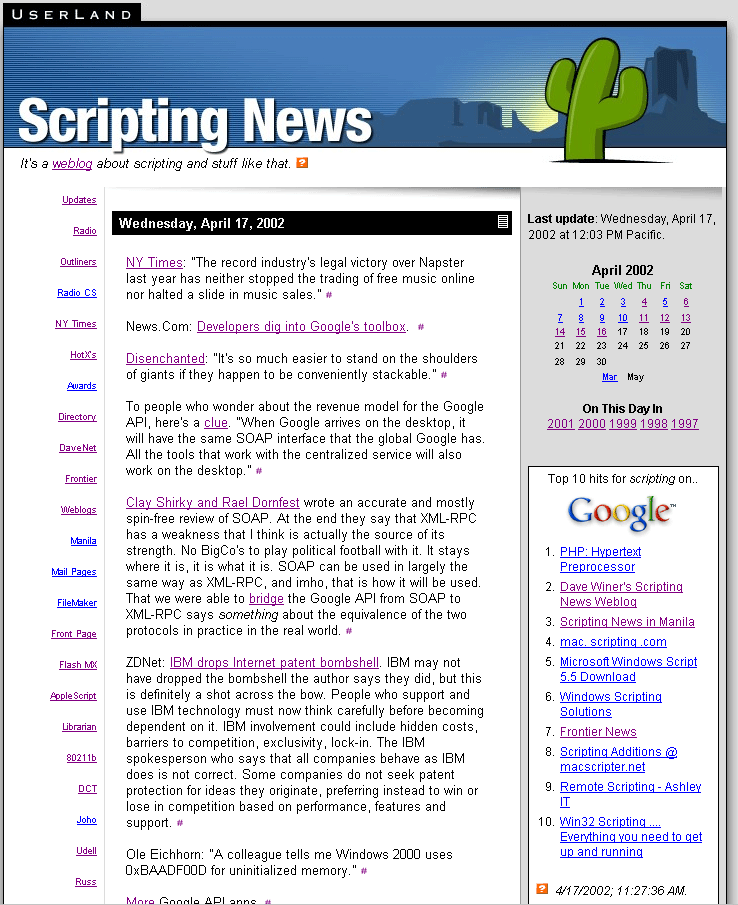
NY Times: "The record industry's legal victory over Napster last year has neither stopped the trading of free music online nor halted a slide in music sales." News.Com: Developers dig into Google's toolbox. I retired the Google Box on this page. Screen shot. Jim Roepcke: "Great, now let's put 'em all out to pasture!" John Robb: "I'm a ex-special ops guy."
Hey O'Reilly really used the title on the OS Con session. Blogging Without The Screen. Nice. To be clear, I'll be asking the questions, for the most part. Old habits die hard, but it's an important distinction. Matt Haughey on 9/11 blogging: "Calls for peace intertwine with calls for arms. Descriptions of real time events as they happened, filled with pain, horror, anger, and sorrow. It doesn't require digging into the edges of the political spectrum to get an accurate picture of blogger's view of the day, it's all out there in the open, and quite easy to find." Kevin Werbach: "Sssshhhhhh. This site is still under construction. There's nobody here but us chickens!" Disenchanted: "It's so much easier to stand on the shoulders of giants if they happen to be conveniently stackable." Jake: "Ole and Lena were excited to get a new cellular phone.." To people who wonder about the revenue model for the Google API, here's a clue. "When Google arrives on the desktop, it will have the same SOAP interface that the global Google has. All the tools that work with the centralized service will also work on the desktop." Clay Shirky and Rael Dornfest wrote an accurate and mostly spin-free review of SOAP. At the end they say that XML-RPC has a weakness that I think is actually the source of its strength. No BigCo's to play political football with it. It stays where it is, it is what it is. SOAP can be used in largely the same way as XML-RPC, and imho, that is how it will be used. That we were able to bridge the Google API from SOAP to XML-RPC says something about the equivalence of the two protocols in practice in the real world. ZDNet: IBM drops Internet patent bombshell. Ole Eichhorn: "A colleague tells me Windows 2000 uses 0xBAADF00D for uninitialized memory." More Google API apps. Interested in Segway? Check out Paul Nakada's Segway weblog. Looks like I'll be speaking at the O'Reilly Open Source Convention this year. Working with Nat Torkington, we finally came up with a title that works. I'll be doing Scripting News in person, which I describe as "Blogging Without The Screen." I've done lots of those kinds of sessions. Here's how it works. I have a mike and I talk for a bit, just like my morning coffee notes. I say things to get people thinking. Then when someone has something to say, I go them and we have a little conversation, until someone else wants to talk, and then I go over to them and do the same thing. It's like a weblog, but face-to-face. No one has to line up at the mike, it's very informal, no time to get nervous, and different points of view get heard. The experts are the people in the audience, not panelists. Maybe this year someone will blog the session. It's a good format, it's fun and informative, and we get a chance to learn from and understand each other. Andy Sylvester: Radio UserLand Study Guide. Jerome Camus explains outliners. Tim Jarrett explains the Semantic Web, with caveats. Homer Simpson: "You want the truth? You want the truth? You can't hannnnndle the truth!" One year ago today: "Speak for yourself Dan, I plan to win a Pulitzer." On the same day Joel Spolsky said: "Sometimes smart thinkers just don't know when to stop, and they create these absurd, all-encompassing, high-level pictures of the universe that are all good and fine, but don't actually mean anything at all." On this day in 1997, Frontier 4.2.3 shipped. It was a long-lived version, the last Mac-only release. Postscript on Conxion Over the last few weeks, the archives for Y2K contained a painful story that I haven't linked to, but it deserves a comment from a two-year perspective. Here's what happened. Our Internet service turned to crap. Our T1 line went down for long periods of time every day. Everyone who used our services knew it was going down. There was no way to hide from that. We investigated the problem, worked with our ISP, and did what we always do -- shared what we learned with our readers. I built an app that measured the outages, computed the amount of downtime, and made the info publicly available. Of course they could only be read when the line was up. Frustration crept in, because humans were involved. For the most part, we all kept our cool. Antonio Salerno, the CEO of Conxion was on the DaveNet list, and had the idea that the T1 line was used to send out an essay or two each week via email. This was the big disconnect. At the time we were hosting thousands of Manila sites at the end of the T1 line. We were working on SOAP with Microsoft. We were releasing new software to our users. We had a diverse development team that connected through the T1 line. When it went down, all that stopped. Salerno warned me to stop writing about the outages. I said no. I asked my readers for help, esp people at the San Jose Mercury-News, because they cover San Jose (of course) and the ISP was located in San Jose. But it hit even closer to home. We were hosting Dan Gillmor's weblog at the time. I felt they should cover it because the issue wasn't about technology as much as it was about honoring the First Amendment. No support ever came from any of the professional press people who read Scripting News. A few weeks ago, out of the blue, an ex-Conxion vice-president sent me an email. He was researching various lawsuits against Conxion, and did a Google search and uncovered the archive of the clash they had with UserLand. He wanted to know if we were suing Conxion for the cost of the outages and for the big human outage when they disconnected us. I said no, we weren't pursuing it. The damage was done, but we had recovered, and moved to Exodus and have had no problems with their service. From two years hindsight, I would have done nothing different. If there are outages that users and readers see, you have to say what's going on. I didn't see any way around it then, and I don't now. There were three business entities involved. UserLand, Conxion and PacBell. We should have worked as a team, to get everyone back online asap. PacBell did the best they could, so did UserLand, and at Conxion, all but one person worked hard and professionally, with empathy, every day we were out, to get everyone back online. We were shut down because one person wanted us to do something that we couldn't do. We survived. But I learned that the speech guaranteed by the Constitution is not a sure thing. If you say something that pisses off one of your vendors, you might get shut down. And other people who say they value free speech may not stand up for you. Onward.
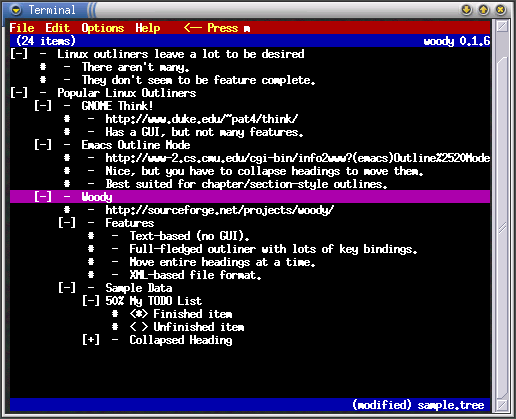
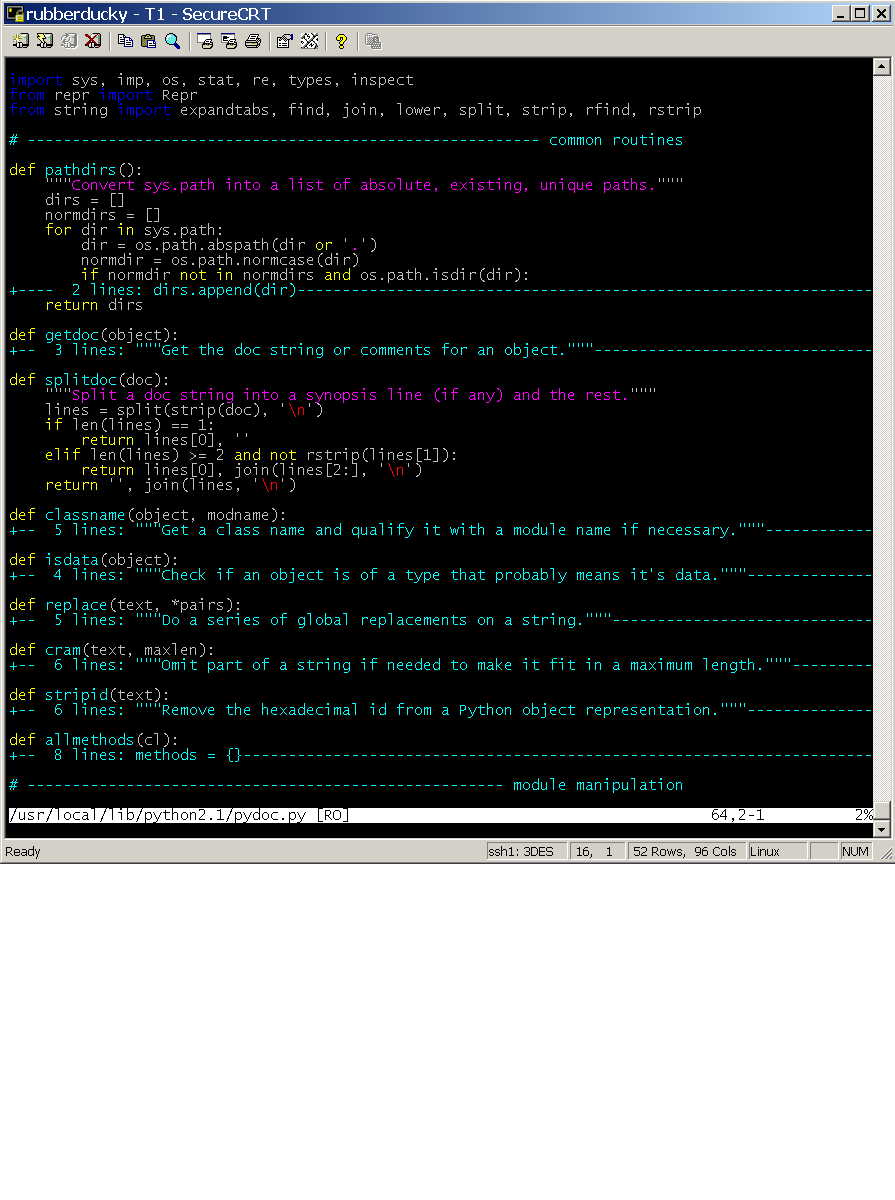
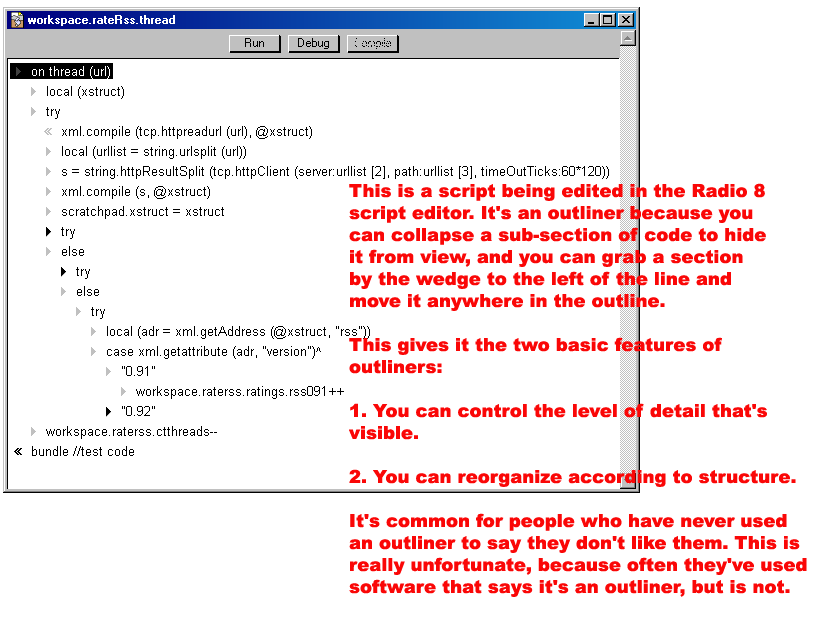
NY Times editorial: "These are critical times for establishing the scope of our freedoms on the Internet." Network World: "Deutsche Bahn AG, the German national railway operator, Wednesday will file suit against Google because the company's search engine provides links to a Web site that offers instructions on how to sabotage railway systems. Lawsuits against Yahoo and AltaVista also are being prepared." Another old-time ink-stainer joins the blogging revolution. Welcome! Russ Lipton: Why RTFM Won't Work. John Robb: "Glad to be of service to a fellow Bostonian." Tim O'Reilly: Preserving classic software products. Today is outliner screen shot day. Here's Java Outline Editor, via Scott Granneman. Oy now when they have a bad year, we're all responsible for it. Could just as easily spin it as "Music sales dip, industry's inability to offer a commercial Internet-based distribution system seen as culprit." A candidate for best named blog of 2002. You have to understand hex to get it. He uses LiveJournal, Movable Type, Wiki and Radio. All in one mind. Blogging Kottke blog Business 2.0. "Break the habit of only reading the sites listed in Instapundit's sidebar." Amen to that. Reminds me that Dvorak eventually did answer the question I asked. He picked blogs at random from the recently updated section on blogger.com. I guess each review of blogging is a reflection of which microcosm the reporter tapped into. It would be interesting to see a reporter write a piece based on the updates at weblogs.com, which is the source of news in the blogging world that I refresh 80 times a day. Last-yard code already in Radio 8. "Most RSS feeds do not contain enclosures, but this mechanism may eventually catch on as a way of distributing movie trailers, educational material, or other large media objects." Eric Kidd sends a screen shot of the Woody outliner running on Linux. Charles Cooper: "Groove Networks CEO Ray Ozzie hates spam just as much as the next guy. But unlike that next guy, he's offering a potential way out for corporate-networking chiefs troubled by unsolicited e-mail." AP: "Supreme Court Strikes Down Ban on Virtual Child Pornography." Seth Dillingham reports that Macrobyte has deployed its first secure site using their TLS product for Frontier and Radio. A big bennie for Google in showing us a bit of how Google works through their API -- smart developers like Paolo Valdemarin are finding new niches of Google greatness. "While all dictionaries have always been lagging behind real-world usage of words, Google is actually registering it in almost real time." Paolo makes a good point. A dictionary is just another kind of aggregator, and all aggregations have trouble keeping up with Google. Tim Berners-Lee speaks at Stanford tonight about the Semantic Web. BTW, I think I finally got the vision. It goes like this. There's data in this blog post. It relates at least three things. 1. Tim Berners-Lee. 2. Stanford. 3. Semantic Web. 1 will be at 2. Link to Semantic Web from the arc between them. Link to www.stanford.edu from 2. With this information properly stored in a relation, you could query it. Now, I gotta figure out why this is different from Google, which probably already does a pretty good job of extracting all that meaning from this post. Postscript: TBL is not speaking at Stanford tonight. Not sure what that says about the Semantic Web. I'm doing a session on Distributed Content Management at the O'Reilly Emerging Tech conf next month. "Bring your ideas to this two-way session, and be prepared to envision the Internet-based publishing network of the future." Bring your blogs too. Hanan Cohen: "Look outside the window. The graphics are amazing." Daniel Berlinger asks why I think the syntactically relevant indentation of Python was a breakthrough. There are a couple of reasons. First, it removes complexity from the language. Semicolons and curly braces are not needed when you let tabs and carriage returns do the work. The two methods of expressing structure are redundant, and if I had to choose I'd pick the one that visually reflected the stucture, which tabs and returns do, and imho semicolons and curly braces don't. The second reason I like it is because it enforces a common indentation format on all code and ends silly arguments on coding teams about which way is right. Since we all eventually have to read and use other people's code, in Python, you're guaranteed that you don't have to spend hours indenting the code so you can work with it, it already is indented in a way you are comfortable with because all Python programmers indent the same way. Of course this doesn't solve the problem fully, it's just a step, a theme, a message to programmers that some stylistic differences aren't worth fighting over. BTW, this is not an exclusive advantage of Python. Frontier, which was started a a couple of years before Python, also takes this approach (and goes further, its IDE is an outliner). We don't argue about indentation in our community. There's only one way to do it. (The right way of course, since I designed it. Heh. Sorry.) Anyway, I try to be kind and generous to Python because the community's philosophy is so close to ours, we like being friends with them, and I hope vice versa. A hearty welcome to Louise Kehoe, columnist at the Financial Times, who just started a weblog. Mazel tov! This page can't be displayed because you need fresh air. In the 80s a bunch of word processors claimed they did outlining, but they didn't. WordPerfect was the classic example. They did outline numbering, but didn't support expand/collapse or reorganize according to structure, the two basic features of outlining. You can't say you are an outliner if you don't do those two things. (Well, you can say it but it isn't true.) I just got an email from Mathieu Longtin, with a screen shot showing an editor named Vim, which he says is an outliner. It is not. It does something called elision, a common half-step towards outlining, and no doubt a useful feature. Here's a screen shot of the script editor in Radio so you can do an A-B comparison. Steve Litt says that Vim is an outliner. Marc Barrot notes that a new version of SOAP::Lite for Perl is available, with the security hole closed. A note to Mark Pilgrim -- outliners are useful tools. Back at the dawn of the PC era there were a handful of people who thought you could do anything in a word processor, even a spreadsheet, and get this, they were right. But (there had to be a but, right?) you don't get recalc in a WP. And in a flat text editor you don't get expand and collapse or the ability to reorganize according to structure. Python is a breakthrough language in that it considers indentation to be syntactically revlevant. Our outliner-based language environment takes it further -- by editing in an outliner, you get the ability to hide detail and move huge branches of code around with a single keystroke. Even if Mark doesn't want to believe, other Python developers may want to take a look at Radio. Thirty-day free trial. You won't be sorry. BTW, so many people miss the utlitity of a format like OPML by missing the tool that's used to edit and browse it. It's like evaluating a car by lifting the hood and looking at the engine. You can learn something by doing that. But you can't evaluate the driving experience that way. To do that you have to dive in and use it. I never would have understood HTML if I didn't use the browser first. Even so, I had trouble understanding HTML without looking again and again, trying to piece together how the format related to the experience. There aren't any shortcuts. I'm not impressed by people with closed minds, all I get from that is that their mind is closed. Open minds are interesting. Another example was the Mac in the 1980s. Lots of people with closed minds said it was just a toy. People who used it knew that it was much more.
Now, I understand why Akamai might want to announce a deal with Microsoft. But they should know that it comes at a cost. Where they could be a platform vendor, and attract developers to help them, they are giving the full developer opportunity to Microsoft. And given the rep that MS has with developers, that's just going to incentivize competition, and waste the value of Akamai's work. Akamai's technology is not so deep. They could use some developers to help broaden their deployment. Patrick Berry: "I think Dave jumped the gun a bit on this one." From the land of incest and irony. Business 2.0, which is owned by AOL, has two pieces that connect the dots. One on the lack of any visible strategy for AOL, and the other on the blogging craze, both rendered practically unreabable by pop up ads, a craze AOL made famous. Performance art! A great line at the close of the piece on AOL. "It needs a hundred digital czars -- the leaders of every business unit -- trying to figure out how to turn the Web into the primary means of distributing content, and combining it with that of other businesses to make entirely new products." Amen to that.
Last year on this day: A weird idea. Two years ago today: Investors wondered if the great bull market was over. Postscript: It was.
MSNBC: Business pros flock to Weblogs. "Javaid’s brief experience has convinced him that far from an exercise in self-indulgence, Weblogs actually can be used to increase worker efficiency." Wow Scott Johnson has been writing some great Radio tutorials. Off to dinner now. I'll read them tomorrow. Daniel Berlinger: "Very coo; though. What a great country."
Here's a step by step tutorial that shows how to create a Manila directory using Radio's outliner. The usual disclaimer applies. If you're happy with Radio as a weblog tool and news aggregator, you may completely ignore the outliner. The key screen shot for the howto. And the directory that's derived from the outline in the screen shot. Happiness is three new Udell columns: Groove 2.0, Zope, and Virtuoso. NY Times: "AOL is wobbling." OnFocus: "The Weblog Bookwatch searches weblogs that pass through the Recently Changed list at weblogs.com looking for links to books at Amazon.com." Eric Soroos: "OpenDoc will be back. It won't be called OpenDoc, and it probably won't run in 4 megs of memory, but it will be there." Richard Rodseth: "We were motivated by substantial fear of OLE, and that Microsoft would control the desktop user experience on the Mac with OLE's sometimes clunky UI." On ZDNet, David Coursey quotes Microsoft's Charles Fitzgerald on Microsoft patents on web services. Ryan Tate sends a pointer to a Slashdot thread "talking about a text editor called Vim being ported to KDE." He says "The coolest part is that the integrated KDE web browser, called Konquerer, takes Vim as a drop-in replacement for use in textareas. This is one important area where Linux is ahead of Microsoft." Groove 2.0 press release. "Groove version 2.0 features significant enhancements and new features to both client and server software, including integration with Microsoft Office applications, new project and meeting management toolsets, and, most significantly for large corporate customers, the introduction of customer-hosted management and system integration capabilities." NY Times: "Recently published patent applications bolster the tantalizing speculation that Mr. Kamen may indeed have something much bigger up his sleeve." Paolo: "Today I moved Radio UserLand folder to my iPod." Eric Olsen reviews how weblogs covered Sept 11. Yesterday's piece on Google, directories and OPML seems to have found at least one curious mind. Some ideas require careful reading, exploration and thinking. The Web with distributed decentralized directories will be cool. BTW, a minor random note. There's a new term today in the world of Google.
SoapWare.Org: Google, directories, OPML. The Covers Project has an XML-RPC interface. Now Google has one too. "It's a way to call the Google API using XML-RPC." Omar Shahine: "I got Simon Fell's Word to Radio Macros working with Mac Word X and Mac OS 10.1." Myelin: "This is a web server, written completely in Python, that implements the xmlStorageSystem protocol used by Radio UserLand, a popular weblog tool." Joe Friend was the program manager for PageMaker back when we worked with Aldus to get scripting support into the product. Scott Loftesness: Notes on Radio Customization. Nothing beats a Coke and pizza. Or. Nothing bizza Coke and pizza. Or. Nothing beats a Coke and peats a. Mel Brooks channeled through Ernie the Attorney: "Tragedy is if I get a paper cut on my finger. Comedy is if you fall in an open sewer and die." Federico Reinfeld: "Thanks for the links to the Venezuelan crisis. As a Venezuelan in the United States, the lack of information was a very painful situation. This is what weblogs are made for. Thanks again! Muchas Gracias por Radio!" One year ago today, I proposed a next step in SOAP interop work. "Here's the benchmark I propose. First, deliver a multi-vendor SOAP-based writing-publishing system that uses no Microsoft software. Then switch out the non-Microsoft components with Microsoft pieces, where they exist, one at a time, and have it still work." Here's what's interesting about that. Even though the leaders of the SOAP interop process, at the time, hadn't tuned into weblogs then, now many of them have. And the plan that we proposed, of course, was the blueprint for what we did. Today you can run a modern Web publishing system using no Microsoft software. I think we need some kind of logo for that. "This weblog is produced using nothing from Microsoft." Easing our dependence on MS is good for everyone, including Microsoft, imho. Adam Curry, who is honored in the current issue of Wired as one of the coolest of bloggers (I agree) was looking for a Groove API, and instead found out that he isn't cool enough. Now that's funny!! Here's proof that InfoWorld has a long way to go to get back to where it was. A few factual errors in this piece, and absolutely no inspiration. Keith Calder: What Weblog Are You? NY Times: Venture Capitalists See Investors Grow Mutinous. It's about time. Let's bring the venture back to venture capital. Take some risks, guys and gals. You can't earn the fat management fees if you don't invest.
Bing bing bing bing bing bing bing. DaveNet: What's next after the Google API? It's time for a new sub-directory for Google apps. Sebastian Delmont and Alfredo Octavio are blogging from Venezuela, where they just had a coup d'etat. Blogaritatville: Price fixing caused CD sales slowdown. Dan Bricklin has a detailed review of the Segway.
Economist: "CollabNet brings together a ragtag assortment of crack programmers who volunteer their services for the prestige and personal satisfaction."
Ursula Lotze's holiday houses in France weblog.
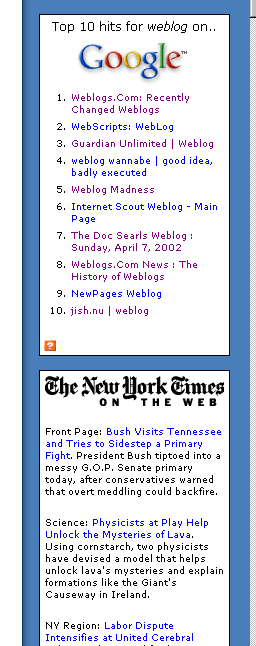
WebWereld: "Google is een initiatief gestart waarmee programmeurs meer dan 2 miljard documenten in de Google-database in hun eigen testomgeving kunnen doorspitten." What if Google had an interface that took a date and returned a list of the top things that happened on that day. Peter Drayton: "Google2RSS is a command-line tool that runs a query using the Google Web API and spits out an RSS 0.91 feed containing the top 10 hits." On this day in 2001, I started work on the core of Radio 8's web server. "Sometimes, to make things simple, you have to go all the way back to the beginning." Paolo: "All borders between your desktop and the rest of the universe are fading, you can borrow the search capabilities of Google's powerful servers from within your favourite application, or you can read news from the New York Times on the same page containing the news from your co-worker telling you what's up today." The Daypop Top 40 now has a white-on-orange XML icon. This means that the top stories of the weblog world can appear alongside the NY Times and news from your co-worker.
Julian Harris: "Oddpost is the first practical online web application with a desktop-quality user experience." Dean Landsman: "I am not Ernie."
DaveNet: What does the Google API mean for regular folks? Survey: Is the Google API useful? Google glue for: PHP, Ruby, C++, Tcl, Movable Type. More here. Slashdot, Metafilter threads for the Google API release. Congrats to Dan Gillmor on winning the EFF Pioneer award. JD Lasica: The Rise of Digital News Networks. Very interesting article. Note that the NY Times is going the other way. Instead of concentrating all their content in a common Web interface, they are distributing it through many. Michael Calore: Getting Paid on the Internet. Brent Simmons has a Macintosh news RSS feed. Novell now has a white-on-orange XML button on its Cool Solutions home page. Kevin Werbach: "Web services, Weblogs and WiFi are the new WWW." In a few months I think Kevin will add outliners and OPML to his list. A mock press release from November 2001. "It just works, not much more to say," he concluded.
A new Manila macro makes it easy to include News Items on any page in your site. ZapThink: "So, what happened to Sun? How did they fall from Java industry leader to Web Services also-ran? And what can they do to get back into the battle?" I was about to add a pointer to a must-read ZDNet article about IBM and Microsoft and how they plan to hijack the Internet with patents on SOAP, WSDL and UDDI, when the funniest thing happened. Praise Murphy!
Dan was probably just being thoughtless From the With-Friends-Like-That-Who-Needs-Enemies Dept, Dan Shafer emits: "If you're not Microsoft or maybe IBM/Sun with Java, development tool makers don't stand a chance against good Open Source projects." I think we're learning is that it's better if open source and commercial developers work together, Dan. But big lies die hard. The myth that open source wipes out all that comes before it except the BigCo's robs the users of any hope of new user-oriented software. Think about whether or not you want to do that. The world never changed the way the hype said it did. Developers need money to live. If you want good software, you're going to pay for it, one way or the other, sooner or later. A lot of developers are out of work now, perhaps some of them would have jobs if it weren't for this foolishness. Imho, a fundamental rule of evangelism. So many people praise the efforts of software developers by trashing their competitors. You don't have to do it. PythonCard can be excellent without its competitors being trash. BTW, I'm sure Revolution, a commercial product that Dan says is a goner, has plenty to offer that the open source PythonCard doesn't, and vice versa. What a priviledge to have two excellent products to choose from, from developers who really care about quality and empowering users. Early morning notes Good morning sports fans! A late night edition of Scripting News focusing on the mind bending mind bombs from the mind of Simon Fell. I don't know what kind of coffee he's been drinking but I want some. First thing I noticed is that Simon has figured out how to get Microsoft Word to post to Radio weblogs. Wow. That's a pretty good writing tool I hear. It's got a spell checker. He did it by wiring up Radio's support for the Blogger API to our SOAP gateway, and then calls it via VBScript and PocketSOAP. We should make it so the Blogger API is automatically connected via SOAP. No reason not to. But wait, there's more. He wired up Microsoft's Visual Studio to the Google API. The insanity continues. In his Samples Gallery he has glue that connects Visual Basic to the Google API. Yup it seems like SOAP is alive and kickin over in SimonFellLand. Bravo! Manila and the Google Box In the rush of excitement over the Google API release yesterday, it wasn't clear how one Manila server could handle multiple users making requests given the 1000 per key per day limit. Then it hit me driving home from dinner. Add an optional parameter to google.macros.box allowing you to specify a key. Then each author could manage his or her own limit. Then the only thing that would be needed is for the sysop of the server to make the macro legal. This is going to require a change to our implementation of the Google API, not something I want to attempt at 1AM. But for Manila users, I think we have the answer. Another engineer joke Two engineering students were walking across campus when one said, "Where did you get such a great bike?" The second engineer replied, "Well, I was walking along yesterday minding my own business when a beautiful woman rode up on this bike. She threw the bike to the ground, took off all her clothes and said, "Take what you want." "The second engineer nodded approvingly, "Good choice; the clothes probably wouldn't have fit."
Google: "With the Google Web APIs service, software developers can query more than 2 billion web documents directly from their own computer programs." Bravo! DaveNet: Google is just the juice. Using the Google API with Radio and Frontier. In progress. Important note: A limit of 10 results per query was added on the Google server at the last minute. Radio and Frontier users please update again to get the fix. Something James Snell and I agree on. "What would really be interesting is if it was a two way thing. You know, I own content on the net. Google maintains a directory of that content. Google let's me notify it when that content changes, a simple ping that says 'Hey, I just updated my web page! Process the changes and update your database please!'" No matter what, we're now past the starting point on the relationship between content and search engines. Just a few hours after the release of the API, Google Boxes, primitive though they are, are already on several dozen weblogs. Even though the scripts are simple, they have been written and they work. I hope the conversation can become two-way. We are listening to Google. Now we'd like to help make the index even better, more responsive, more current. What if, an hour after they shipped a new feature, their index could help you explore what just happened. What I did today on Scripting News could be automated. We could watch in real-time as knowledge enters the world, on a global scale. A new sub-directory on SoapWare.Org for the Google API. Steve Zellers is connecting AppleScript to Google. Matt Webb has a Perl interface for calling Google. He adds "I can't wait to see this integrated with the Instant Outliner." David Watson has a Visual Basic interface. Mark Pilgrim has a Python interface. Aaron Cope has a Perl interface. Rael Dornfest: Google Web API. John Robb has a Google Box on his weblog. Jake has one too. More bings coming. Steve Ogden, Andrew Wooldridge, Dan Mitchell, Marc Barrot, ICANN, Jon Udell. Amy Wohl: "I'm a Google addict." First we had Ernie the Attorney. Now there's I Am Not A Lawyer. What comes after that? Microsoft's Kevin Browne. "The way we’re looking at the Mac is as a great client platform for connecting to .NET."
Jon Udell: "You've got to love the openness of a system that makes it possible, and easy, to do this non-kosher thing." Geeky feature: Description Filter Callbacks. John Markoff says that HailStorm died a quiet death. A Microsoft spokesperson says the Markoff story isn't exactly correct. Frank X Shaw, a vice president at Waggoner-Edstrom says: "There is evolution, but even at the launch of the whole initiative Bob Muglia said that Microsoft would not be the sole provider of HailStorm services. Microsoft will provide some services, but lots of others will provide them as well." John Hiler asks if bloggers are journalists. In my humble opinion, anyone who follows rules 1 and 2 is a journalist. A joke that women who date engineers would get. News.Com: Groove 2.0 due on Monday. Library cats in the United States. Another engineer joke Thanks to Stan Wesolowski for sending this joke. During the French Revolution, many high-profile people were sent to the guillotine for execution. On this day the first up was a doctor. However, when the executioner dropped the blade it fell only halfway and stopped. The executioner declared, "Sacre bleu! By the laws of the new republic, if the execution fails you are spared. Do you have any words before you are set free?" "Oui," replied the doctor, "I declare that I will now dedicate my life to tending to the sick and wounded who have suffered so much in our recent trying times." Next up was a famous philosopher. But again the blade stopped halfway down! "Unbelievable!" cried the executioner. "This has never happened before -- twice in one day! You, too, are spared. Will you also have something to say?" "Oui, oui!" said the philosopher. "I, too, shall dedicate my life to help our suffering countrymen and women. I will try to ease their minds and assist them in becoming vibrant members of our new republic." As he left, an engineer was brought up to the guillotine. "You know, if you greased that pulley..." Postmortem on HailStorm With Markoff's piece today, it seems we can now write the epitaph for HailStorm, and hopefully learn the lesons, and never make these mistakes again. (Hah.) HailStorm didn't work for two reasons: 1. The antitrust conviction. 2. They don't bootstrap. We read the transcripts of the trial, and some of us read David Bank's book. No one with a mind was going to get in bed with Microsoft after reading about their low regard for developers. The Bank book was a expose of the first order, never has "it's even worse than it appears" been more clearly true. Who wants to be the next one to be deprived of air supply? HailStorm was the most megalomaniac attempted power grab ever. Not only did Microsoft want to write the rules for air supply, but they wanted to own the atmosphere. Why would anyone with a mind willingly sign up for that?
There's still cause for hope. Microsoft can still become the statesman of our industry, the evangelist of developers, the enabler of markets. They can have the lion's share of the growth, they just have to give up on the concept of control. It's just an illusion anyway, they don't actually have any control, and as soon as their strategy reflects this, we can all get productive at building the next layer of the Internet, including Microsoft.
DaveNet: New York Times, UserLand and Weblogs. Press release: "We are pleased to offer Weblog creators the ability to post headlines from NYTimes.com with UserLand's software," said Martin Nisenholtz, CEO of New York Times Digital. "Weblogs are an increasingly popular form of self-publishing within a highly influential community, and are therefore an important distribution channel for our high-quality content." Miguel de Icaza: "I have been trying to understand what has happened in Palestine which started the current events." The Stencil Group's white paper on Web Services for corporate strategists. An InfoWorld report about Microsoft's Mark Lucovsky. Eric Rudder: "We bet the company on .Net, but we can't do it alone. We need your support." Amy Wohl: "I published my newsletter on Monday morning, with a story of IBM's stock price reversals. Tuesday when I read my New York Times I realized that I, a tiny part of the giant Internet electronic printing press, had beat the printed version of the New York Times." Internet.Com: "Although blogs have been around for years, the recent blistering pace of their adoption has captured the imagination of Web hobbyists and online news executives alike." Louise Kehoe: "When I first came across weblogs a year ago I was derisive in this column. I saw them as derivative, mostly comprising links to articles written by other people with brief comments. I thought of them as the digital equivalent of scrapbooks containing pictures and articles cut out of magazines and newspapers. My new-found enthusiasm is based in part on finding a few high-quality examples with original thoughts. I am also drawn in by the format and interactive nature of the weblog." Eric Olsen: "You don’t have to know HTML from Esperanto to blog, which is why thousands of people who would be otherwise intimidated by the technical aspects of computing are blogging like MoFo’s." Marc Barrot has info on the Perl/SOAP security issue. Paul Kulchenko, the author of SOAP::Lite, explains how to close the hole. Russ Lipton: How to Create Shortcuts. Emmanuel Décarie: DocServer2man. On April 4, I was looking for the announcement of XML-RPC on 4/4/98. Today I thought to look on archive.org, and it was there. Happy Birthday! to Wes Felter. Paolo: "Stapler and RssDistiller are both fine tools, each with its own unique features and unique bugs." Heh. Coool. My spin. What a priviledge to have two excellent products to choose from, from developers who really care about quality and empowering users. Sean Gallagher has an excellent rant today.
Here's a place I didn't even know existed. Thanks to Jon Udell for pointing to Marc Barrot's excellent developer site. I just read all his archives going back to early March. He's onto something. Oh geez John Robb is leaking again! Bryce reviews the new design of the WSJ. "I was stunned." John Robb had dinner tonight with Adam Green in Boston. I would have loved to have been a fly on the wall for that. So many IQ points at one table. New prefs for Manila discussion groups. "You can optionally display the full text of responses to a specified depth, and choose the order in which responses are listed. You can also choose whether pictures, stories, home pages and news items appear in discussion group listings." New advanced pref for Radio. "Today we released a set of parts that makes the upstreaming of directory.opml optional, and disabled by default. If you run an application that depends on it, you have to turn it on." A heads-up -- we moved the Radio site to a faster server. It may take some time for the DNS change to percolate, in the meantime we've redirected, and the only impact for users who wish to post to the discussion group is that they may need to re-log in. Good news -- the new server is much faster. Two new boxes in the right margin on Weblogs.Com, one connecting to Google, and the other to the NY Times. In the Times box, which first appeared yesterday, we show seven random stories from the last 24 hours. When you refresh, you might catch a story in a section you don't subscribe to or normally read. By our count there are over 300 new Times stories every day. The Google box links to the Top 10 hits for the term "weblog" and the Google logo links to a full search. How did we do it? I can't tell you. Now. Martin Burns: A Quick and Dirty Blog using Zope. To Markpasc, happy to help get people to look at Stapler. Use Perl: "About four months ago there was Phrack article named RPC without borders which describes quite serious security hole in SOAP::Lite module." Postscript: Randy Ray is digging in. "Looking forward to comparing notes with you guys tomorrow." Russ Lipton: What is Content Management? "Userland is doing its utmost to package Frontier's content management features in sugar so the medicine goes down easy."
Another way of looking at it. Manila, which is bundled with Frontier, competes with Movable Type. Radio, at this time, appears to not have any competition (of course it's coming). Blogger, which so far doesn't license its software, is the free site king. Their challenge is to convert free users into paying customers. A what-if about search engines. What if one of the leading search engine companies decided to license their technology in a way that allowed communities to determine their own crawling policies. What led me to this idea? A quote at the end of yesterday's NY Times article about Google, from a competitor. "There was a two-year window when Google was the only company focused on building search. No more." Competition is going to open new vistas. The race is on. The big gaping hole in search? All the content on my desktop, and yours. The goal? Easy five minute install, instant results, integrated with all the knowledge of the www. Why do we need to tweak the crawling policies? If search is going to work on local area networks, page rank means nothing unless people have weblogs. A passive crawler won't give people what they want. But if a popular search engine supported the simple Weblogs.Com ping protocol, they could re-index weblogs when they update, making search much more valuable because the currency of the index goes way up. SoapWare.Org: Weblogs.Com SOAP 1.1 Interface. As search engines become part of the web services world, this very simple interface will become central to distributed content networks cooperating with search engines, without compromising the integrity of the search engine. Masukomi: "Wouldn't it be great if there was an OPML debugger?" Doc's father's last words: "Am I still alive?" The answer, which he never heard, was No. Ouch. Eric Norlin and Doc are getting interested in Web Services. I wonder if they'll find the revolution. Eric Olsen: "As the volume of blogs has ballooned well into six-figures, the need for links from 'star' blogs has become an absolute requirement to be noticed." Patti Smith: "So you want to be a rock and roll star well listen now to what I say. Get yourself an electric guitar and take some time and learn how to play."
Radio 8: "Shortcuts make it easy to enter repetitive or hard-to-remember text in your weblog." I just got an email, I bet Cory got one too -- and it's so exciting, but I can't tell you about it. :-( Thanks to Ernie the Attorney for the link to this ABA article about blogging. Ernie says "Oh, God, run for cover everybody. The lawyers are coming, the lawyers are coming." It gets better (or worse) -- here's a court in West Virginia that has a Radio weblog. Man this is so coooool. Wired: "VersionTracker, a popular software-download website, lists more than two dozen different hacks for the iPod." Michael Sippey offers some fantastic ideas for ways Google can make money. The last one is surely in jest, but the first one hits the bull's eye, except I don't want it in the toolbar, I want a local Web app with Google branding and technology that integrates searching on the Web with searching on my local area network. I don't have $25K for a Google box, and that would be total overkill. I just want Google to index my email and other documents I have lying around on various local systems. It's so weird that it's faster and easier for me to find stuff on the Web than it is for me to find stuff locally. So much harder I usually don't even try. BTW, I like his #2 too -- that's kind of like what we're doing with Jabber. Eric Norlin: "It is not a crime to try to make a buck on the Internet." Radio Poster connects RealBasic with Radio. Eric Freeman at Disney has a Radio weblog, and his own Radio Community Server. Nice. And then Alan Reiter pointed to an article by Freeman entitled The Real Reason WAP is Crap. With a compelling title like that you gotta read it right?? NY Times: Google's Toughest Search. Gordon Meyer: "These notes were written in Tinderbox and exported to Radio for upstreaming and formatting." Matt Deatherage: "It's a big world out there, and I'm part of it." Excellent tagline. It's twisty and fun and humble and smart. All that in just 11 words. We're working on a redesign of the DaveNet site. I wanted a simpler easier to read format. Last week when I saw the design of the Oddpost FAQ page, I said -- that's it -- that's what I want. Easy to read text, large type, nicely spaced. I gave the job to Lawrence. Today the first iteration is up, my comments are here. If you have some ideas on design, post them to a weblog and send me a link. I want to use more CSS, but do it tastefully. The lizard brain Shortcuts. A new feature for Radio, a loop back to 1996. 1996 was a big year of innovation at UserLand. It started with a project with a thousand writers, that proved once and for all that the Web is not a productivity application, it's groupware. Most of the code in my GUI website design tool was running in scriptland, in Frontier, which was then a shelved product after doing battle with Apple, and losing my shirt. Who knows whether it was wise or not, but in April 1996, I went back into Frontier and came up with what eventually would be called the Website Framework, which viewed a website as a hierarchy of content, attributes and scripts, and introduced the concept of rendering, and along with it, macros and the glossary. All these concepts are still here today, and perhaps even more surprising, so is the implementation. The text you're reading now was rendered through the website framework that was developed in 1996. I think of this as the lizard brain of Frontier, Manila and Radio -- these were the first full steps towards web content management at UserLand, and while we only had a glimpse of what was to come, the work was good enough that we still use it today. Our detractors who say, unfairly, that we don't have an appreciation for continuity at UserLand should consider that website framework apps of 1996 still run in 2002, in the same way that today's web browsers can display sites that were built in 1996. Anyway, when we were in the endgame for Radio 8 late last year, we had what I considered an inadequate implementation of Shortcuts, which is a browser-based interface on the glossary part of the lizard brain. I wanted to do something better than what we had, so we pulled the feature, and promised that we would swing back around to it after Radio 8 shipped. And today we're ready to show you how it works. What does lizard brain mean?
If you apply the same evolutionary principles to software, which is totally valid, you can see the layers as they came online. The Frontier 4 glossary was hardly the most primitive part of the system, for that you'd have to go deep into the kernel, and the low-level database functions, the script engine and the outliner, which were the first bits I programmed in 1988. So perhaps more analogously, the glossary of 1996 was really the bird brain of Radio 8. But you get the idea. Matt Kineiko says I should look for reptile brain and sure enough, there are lots of hits for that. Thanks! Salon: A unified theory of software evolution.
XML in South Carolina Jenny the Librarian spotted a white-on-orange XML icon in an unusual place. The Latest Headlines page at the Spartanburg Herald-Journal, in South Carolina, now advertises its RSS 0.91 feed and aims it straight at bloggers. Screen shot. How did it come to be? Andy Rhinehart, who's an editor there, reads Scripting News. The Spartanburg Herald-Journal is owned by the NY Times. Song Today's song: "She'll be coming round the mountain when she comes. She'll be coming round the mountain she'll be coming round the mountain she'll be coming round the mountain when she comes."
Monday's new CMS feature for Radio is just about ready for primetime. Lawrence has it working. He says "The usual disclaimers apply. I am not a lawyer, my mother loves me, and I take a shower at least once a week whether or not I need one." OK, I admit it. I told him to say that. Note: CMS stands for Content Management System. I've been writing my own disclaimer text. It goes like this. Why yes I am cheeky. And I don't know my place. DJ is cheeky too. He has a new weblog editor running on port 5335 in Peerkat. DJ is one of the new cast of characters. He comes from JabberLand. He uses Linux on the desktop. He's working on getting his world to work with ours. So what's so cheeky about that? Nothing, it's cool. It's nice to watch a smart developer digging in. Andy Edmonds is bringing OPML to Mozilla. Masukomi: How to clone software. NY Times: "Microsoft has always had a crisis-driven mentality," said Mr. Howard, the security expert. "You have my word: we will lead the industry in delivering secure software." I read Flash Blog every time it updates and click on the links because I don't develop in Flash, but seeing movement in another community gives me ideas about the ones that I am part of. And I want to learn about Flash, and reading a weblog helps the process. Paolo Valdemarin: "I'm a big Radio fan, so I agree with most of the thumbs up comments, this is why I read with most interest the thumbs down comments." Rogers Cadenhead: "I wish I didn't like Radio Userland so there'd be at least one critic willing to go on the record." John Robb: "There is a blazing debate between Michael and Rahul going on in the comments section of my last post." Bill Appleton: "Here is the first posting for DreamFactory News." Patty Waldmeier: "The ninth circuit US court of appeals is being lobbied to reconsider a dangerous if little noticed decision handed down in February. The case involves the quintessential web practice of linking. Critics say it could turn almost every web link into an act of copyright infringement, threatening the unique value of the web as a tool of knowledge by preventing people from finding their way around it." My first stop this morning is the Daypop Top 40. Google's SOAP interface is #1. Oddpost is at #10 and rising. I thought it would shoot to the top immediately. Perhaps the Mac skew of the weblog world is at work here. (When Apple announces something they dominate the top 10.) Dvorak's essay about weblogs is 32. I sent him an email asking which weblogs he had looked at as the basis for his column. He asked why I want to know. "Just curious," I said. One year ago today: A Busy Developer's Guide to Living. "When in doubt don't take it personally." Paul Snively: "Help, help! I'm in this bloody great nutshell!" Two years ago today I met Cameron Barrett and Jeremie Miller at a face-to-face at Netscape in Mountain View. I got a neat pencil case from Cam, and started a long collaboration with the Jabber community (which is now bearing fruit).
Google is working on a SOAP-based API. We've already verified that Frontier and Radio work with it. I'm not sure how much more I can say about this at this time. Slashdot thread on Google's SOAP API. Sam Ruby has some comments. Check out this HTML rendering of my instant outline. Sweet! Glenn Fleishman: Sock Puppets and Sociopaths. The CNET staff dreams of a perfect email client. "Lena Lena what happened here!" asked Ole, on coming home from work. "Oh Ole, we were robbed!" "cried Lena. "Did he get anything?" asked Ole. "Yes, but I thought it was you Ole!"
Masukomi sees a connection between instant outlines and conferences. Josh Lucas: "You are up by 3 runs. The opposing team has the bases loaded and now Barry Bonds comes to the plate. Do you pitch to him or walk him even though it scores a run for the other team?" A tip for people using the instant outliner. You probably don't know about this OPML file. It's a reverse-chronologic list of outlines in the order they last updated. It's exactly analogous to weblogs.com, but for the outline-based web. It's a mind bomb in itself. Subscribe to it for an instant pleasurable experience, if you like ahas or bings. Here's a sneak preview of a new Manila feature we're cookin up. Yes, you'll be able to do Slashdot-style discussion groups with Manila. Jake's been having fun with it. Hehe. Following the tradition of showing screen shots of work in progress, here's a snap of the user interface of the new shortcuts stuff I'm doing for Radio. And a new tradition, you can follow the work on my outline. We move quickly and we do it openly. It's a zig to the patent-based software industry's zag. As we invent, the "lab notebook" is open. Other developers can see what we do and how we do it.
Morning Coffee Notes Good morning. Coffee. Loose-ends. Reading outlines and weblogs. Etc.
Garth Kidd discovered the feature that makes the instant outline so much more than just an instant outline. There's a mind bomb tucked neatly in there. If you link to another outline it expands in place. It's as a web page links to another page, but you kept your context. All my work with outliners, since 1978, has been about getting to this place. It's a big idea. I call it the world outline, and it's as ambitious an idea as the world wide web.
As reasonable people, I really don't think we're so far apart. I have no idea what Markoff sees when he reads the blogs. I don't even know which ones he reads (I assume he reads this one). If he read Slashdot he could be forgiven for believing that it's a cesspool of controlling idiotic mindless crap. There's a certain kind of abusive personality that shows up in droves when you say "Anyone can comment." One more morning coffee note. Don't miss in the CNET reviews, there are very many people who want us to succeed. The reviews are uniformly well-written, intelligent, even if they're not totally balanced (a negative comment here and there adds to credibility). What I get from reading those reviews is a simple message. "Let's Go UserLand!" -- it's kind of like the way I say "Let's Go Mets!" It's like punk rock or Napster, or Mayor Koch. Our religion is DIY and Murphy's Law and Moore's Law. There's no time like now. Let's go. OK, just one more note. I wondered what the NY Times would look like if it were a weblog. So I quickly put together a little app that scrolls the NY Times headlines through a web page based on the XML feeds we're getting, showing the last 24 hours of stories from the Times in reverse-chronologic order. Guess what, they are releasing stories throughout the day. You couldn't easily tell before because the NY Times home page is like the front page of a daily newspaper. At our dinner in January I pitched Martin on doing this for users. I want to do a bit more finish-up work on this little app before showing it to you. It's very simple. A page you can check every hour to see what's new from the Times. It's so good that it might even be serious competition for this weblog, and all the others.
CNET reviews Radio 8. Nice review. We need a spell checker. They like Blogger better, but gave it the same score, 8 out of 10. But the best part are the user comments. You guys really like us. Wow. Thanks!
BTW, to the people who say UserLand never helps its users, I gotta say this. They must not know Lawrence. Raise your hand if he has helped you get past some kind of problem. He does such excellent work, he's so steady and smart, and helps so many people, and it's as if he didn't exist to some. And then there's Russ Lipton. OK he doesn't work at UserLand. But he works as if he were part of the team. He just posted something on the Radio DG while I was writing this. Check it out. A user with vision. The software biz is tough, and we need help like we get from Russ to make it. Fact. It's so funny, earlier I forwarded a pointer to the post Russ was responding to saying "It's a good thing I'm working on shortcuts!" What Michael was saying: "I don't want to type in links." Uh huh that's right, you don't. Soon you won't have to. Just in time engineering. Bing? OK, and then there's Jeremy Bowers. Check out his outline to see what he's doing for all of us. The Jabber-Radio bootstrap is progressing nicely tonight. Teamwork. I am happy to punch holes in the framework so Jeremy can bolt his stuff on. His cowpath may turn into a freeway for content through from all kinds of networks. But first Jabber. Why? Because when we asked if they'd work with us, they said yes. Sometimes it is just that simple. We need helpful support people with encyclopedic memories. We need visionaries who roll up their sleeves and fill in where needed. And we need friendly persistent geeks who like working with each other. Esther Dyson on the connection between blogging and face to face conferences. A new candidate for best-named blog of 2002.
Paydirt isn't in the database at dictionary.com, but pay dirt is. Further exploration. This is a search where Teoma's refinement capability helps. On Google, the top answers for paydirt don't tell me what paydirt is. On Teoma I can see right off the bat, with no clicks, that I'm in the right ballpark. Steve Zellers is doing OPML in Apple's Cocoa environment. Steve knows outliners, he used to work on MORE at Symantec. He's also proudly displaying the XML-RPC Man on his weblog. Arf arf! Charles Cook: "XML-RPC.NET is a class library for implementing XML-RPC Services and clients in the .NET environment." I find this weblog intriguing. Centerbeam is a famous company, started by Sheldon Laube, from Novell and US Web. I wonder who the blog is for?
DaveNet: Four Years of XML-RPC. Mohsen Al-Ghosein: "Thank you for keeping the dream alive Dave." He's one of the designers of XML-RPC. If you like structs and arrays, thank Mohsen, not me. Thanks! News.Com: Microsoft preps content locks for devices. Dori Smith: "Who do I have to kill?" You know spring is here when the wisteria blooms. A really smart idea. A software company, Stone Design, starts a weblog to inform their users, and attract new ones. Oddpost. How do they do that? Wow!
JD Lasica: "The coming mobile revolution will require newsrooms to undergo a sea change in strategic thinking." Tony Bowden comes from the world of Wiki, he spotted my invitation to work on OPML connections, yesterday. Let's get our software worlds to connect. Structures of written Web-accessible information is the common denominator. OPML is the connector. On this day four years ago, without any fanfare, XML-RPC was unveiled on Scripting News. All the links are 404's, proving that even then, and at all times inbetween, Murphy ruled our world, and it's even worse than it appears. Still diggin!
Another cherished belief that this explodes -- weblogs are useful. The secret to the success of both SOAP and XML-RPC is the weblog. Mail lists stop when someone posts a flame or a challenge from left field. Weblogs keep on truckin. For example, James Snell of IBM sneers at Sun for not joining the interop process. This makes me cringe. IBM didn't join the process (nor did the people he applauds) until long after it started. But the work can continue. It's just one blog. He can say whatever he wants, believe whatever he wants, and the work continues. Norah Vincent: "Web logs are infuriating because they are thoughtful alternatives to the self-important New York Times, Los Angeles Times, Washington Post and their toady satellites, much of whose reporting has become hardly less biased than the bloggers'. Bloggers at least have the honesty to admit their biases up front." John Robb compares instant outlining and weblogs to email and instant messaging. Russ Lipton explains what scripting is.
AP: "Rick Belluzzo, Microsoft Corp's president and chief operating officer, unexpectedly resigned Wednesday after a little more than a year in the position. The company said it has no plans to replace him." News.Com: "[Yahoo] said Wednesday that it plans to shut down its online invites site." Palestinian weblog: Electronic Intifada. Hanan Cohen, in Israel: "Death does not justify death - this is the moral foundation for solving the conflict between the Jews and the Palestinians." David Kurtz: "When California was faced with an energy crisis last year, Vice President Dick Cheney asserted that 'conservation may be a sign of personal virtue, but it is not a sufficient basis for a sound, comprehensive energy policy.' And so what did Californians do to stave off rolling blackouts and rising energy costs? They conserved." True. Phone talk with a reporter yesterday, not an interview. He raised a concern that makes me pause for thought. He cited the Wen Ho Lee case, where the NY Times ran a story that turned out to be false. So the pro's are concerned, rightfully, about the damage they can do by shooting from the hip.
Paolo presents: RemoteEdit. Use GoLive, Dreamweaver or Front Page to edit Radio templates. Very cool stuff! Frontier/Radio developers, have a look at Macrobyte's new Transport Layer Security module and let me know what you think. "The purpose of the protocol is to provide encryption and certification at the transport layer (in this case, TCP), so that data can flow through a secure channel without requiring significant changes to the client and server applications." Josh Lucas says they've fixed the problems with the Advogato XML-RPC interface. I wrote several scripts in Radio to test the connection, and it works as advertised. Nice simple docs, clear, easy to follow. Advogato diaries are simple weblogs. Here's the diary I set up for my tests. Hey I'm a master. Thanks. Nice work. A new weblog API to add to the mix. Philippe Rekacewicz: "Water in the occupied territories has been under military control since 1967." Bob Crosley: "If Al Qaeda members were walking into US resturants, shopping malls, bus stations, etc. with bombs strapped to their chests in a concerted effort to kill as many Americans as possible, what would be our reaction as a nation?" Rogers Cadenhead: "I wrote a Java servlet to serve instant outlines in a web browser using Internet Explorer 6's built-in XML rendering engine and an OPML XSLT transformation written by Joshua Allen." Tony Collen: "I am transforming OPML to HTML realtime inside Cocoon."
Brigitte Eaton is improving the Google-rank for her Santa Cruz Real Estate site. From my instant outline Bill Seitz had different expectations about what an Instant Outliner would be. My personal opinion -- the reason he hasn't seen the type of system he describes is that it isn't implementable. Or put another way, you have do what we're doing before you figure out how to do what he wants. We start with the Instant Messaging model, which many people understand. You get a structured surface to write on. You get to choose how you want to do it. I think that narrating your work is the way to go. But also answering questions or asking them of people you subscribe to is good too. The key is to find ways to flow the stuff entered there into a knowledge base. I have quite a few ideas about that. ;-> But for now I use copy/paste. Pave over the cow paths. That's how you bootstrap. Watch me copy/paste this into Scripting News. It works. BTW, to anyone using a Wiki, I'd highly recommend adding code that understands and generates OPML. What if you were in Israel? Thomas Friedman: "Either leaders of good will get together and acknowledge that Israel can't stay in the territories but can't just pick up and leave, without a U.S.-NATO force helping Palestinians oversee their state, or Osama wins — and the war of civilizations will be coming to a theater near you." Michael Bernstein: "Sentiment here has definitely shifted in the past eight years or so, with the general perception being that the Palestinians interpreted the 1993 Oslo accords as weakness on Israel's part, since before the accords suicide bombings were an extremely rare occurence. Very few people here are willing to make that mistake again, and it's clear that the system that spoon-feeds unreasoning hatred to the Palestinians at every level of society, from grade-school textbooks to the evening news, is going to have to be gutted and eradicated, much as had to be done to post WWII Germany." Bernstein's comment, from Israel, shifted my thinking. After Sept 11, in the US we know what it feels like to be on the front line of the war in the Middle East. It came to North America last year. Now the news is all from the Middle East, but it can swing to any part of the globe in an instant. A song to get the day started Take me out to the ball game, take me out to the crowd. Buy me some peanuts and cracker jacks, I don't care if I never get back! So it's root root root for the home team -- if they don't win it's a shame. Cause it's 1. 2. Three strikes you're out at the old ball game.
Instant Outlining revealed Jon Udell's piece on Instant Outlining is available on O'Reilly. "It's been clear to me for a long while that the only thing that might displace email would be some kind of persistent IM. That's exactly what instant outlining is. If it catches on, and it's buzz-worthy enough to do that, we'll have a framework within which to innovate in ways that email never allowed." Instant Outlining in Radio 8 is still a beta and will be for a while. If you're an adventurous soul with high tolerance for user interface glitches and new ideas, please give it a try. Everything Jon said is true, and what Tim said is true too. It's not for everyone. But it is for workgroups who want to get to the next level after email. I wrote a brief intro to Jon's piece for DaveNet readers.
Adam Curry's back-of-envelope review of Instant Outlining. "Currently I'm in Dubai, dialed into the net at about 21k/sec, a far cry from the DSL speeds I'm used to. 'Checking mail' results in 20 minutes of downloading penis enlargers. The same amount of time allowed me to catch up with 9 projects and people scattered around the globe in my Instant Outlines." New feature. We now have a Weblogs.Com page for instant outliner users, also available in OPML and RSS. It gets real trippy when you subscribe to the OPML feed in the Instant Outliner. It works. Heh. This is a stock feature of Radio Community Server, there's no new code on the server. Yehi. Today's news Good morning sunshine, the earth says hello! Why Masukomi kicks ass. She describes exactly the kind of software company I want to be part of. Luckily, I am. Charles Eicher is streaming QuickTime from his Radio desktop. Coool-oh. Cydney Gillis: "The industry got a belly laugh yesterday at Microsoft's expense." BusinessWeek's special report on 802.11b. DJ Adams did a block diagram that illustrates the relationship between our publish-subscribe network and the connection to Instant Messaging that I am looking for. Bing! Rob Fahrni visioizes DJ's diagram. Clarence Westberg is looking for info on connecting Radio and .NET.
Seethru Music has a concise list of Napster alternatives. Bull Mancuso: "I went to have my heart to heart with McNealy, he was in his office and the guy wasn't even scared." Teoma on Google, and Google on Teoma. Next. Teoma on Teoma, and Google on Google. Just for a moment in time, this search is interesting. Alex Beam Alex Beam in the Boston Globe writes another blog-basher. I don't think he understands that weblogs can be used to tie communities together. We do criticize each other's ideas, and thanks for making that easier. There's a lot of pressure to only say positive things, but we have to get past that. As far as readership, this weblog has a lot more than 35 readers, and it might even have more readers than Beam's column, but sites with just a few readers can be very valuable to those people, and that's important. Be careful about criticizing a medium based on just a few practitioners, one could reach an incorrect conclusion.
Backend: Publish-subscribe walkthrough. DJ Adams responds to my walkthrough viewed from Jabber. New search engine to play with, Teoma. Looks pretty good! Jon Udell: Java, XML and Web services. Raph Levien is doing his PhD research on why I'm on crack. Apparently this is not an April Fools joke. I'm not sure what the Adminimizer app is but if you blog in MSIE check it out and tell me if you like it.
BTW, I felt this was a good idea even when the Web was in flux. I met with Macromedia people shortly after they acquired Flash from Charlie Jackson's company, and encouraged them to, in addition to being a browser plug-in, to also be a browser. Yes, I love the Web, and think that HTML browsers are great, but we have to try multiple paths out, or else we stop learning, and even worse, we drive into cul de sacs where the only way out is through Microsoft. Well, we're there now, fully, so let's try out lots of new ideas, let's see if there are some new tricks we can teach the Internet. News.Com: "A Web site sponsored by Microsoft and Unisys as a way to steer big companies away from the Unix operating system is itself powered by Unix software." Ooops. Daniel Berlinger: "Frontier's birthday is in some sense my programming birthday." Jon Udell: "The future of literate storytelling has never looked brighter to me. I can't say the same for the future of the glossy publishing industry, though." Steve Zellers has an eloquent solution to the MP3 dilemma. After all the lawsuits and power grabs are over I'm sure this is the system we will use. Scott Rosenberg: "Somehow, Times writer Lisa Guernsey equates some slowing of the Web's ability to mint instant pop-culture memes with a 'lack of compelling content' -- as though the presence on the Web of every major newspaper, magazine, radio and TV show; every major government agency, most legislative bodies and court systems; nearly every significant retailer and manufacturer; and every think tank, research center and institution of higher learning were insufficiently 'compelling content' compared to the supposed dearth of inane diversions crippling the Web today." All software developers too. Andre Durand writes an excellent article about the future of Jabber. I have a slightly different spin. The clients for Jabber will come from desktop apps, like Radio, that integrate Jabber functionality behind a UI. The user will barely be aware the Jabber is the technology that's linking Radio's so that outlines from your buddies update instantly. I had a phone talk this weekend with DJ Adams to talk about how our publish-subscribe system works. We want to use a Jabber server as a proxy for users behind firewalls and NATs. Jabber won't carry the payload, that's in OPML served statically by Apache, but it will percolate pings around the network. I think it's time to write a cheat-sheet that explains how it works. It's really simple, but it's also really twisty. BTW, when I say "Apache" above, you can substitute any static server. It's a short-hand. To me Apache is a lightweight highly optimized app that can blast bits out port 80 without much care and feeding. Wired: "Farrell Eaves' camera was a perfectly ordinary Nikon CoolPix 990 until he accidentally knocked it into a pond last summer. Now it's a magic camera." Good morning April Foooooools! Welcome to the AOL family Steve. You've got blogs! Google hasn't been bought by AOL, yet. We've got pigeons! InstaPundit is proudly flying the AOL banner. Random Slashdot post: "God I hate April 1st. What is the point of all this nonsense? I gues it could be funny, but after about age 5 it sort of stopped being funny for me. Perhaps I should go re-discover my lost childhood or something." Also announced today, Metafilter and Kuro5hin are merging. Everyone is selling out today. Cooool. I wonder who Microsoft will buy? Sun? Apple? IBM? Pyra?
Five Years of Scripting News
Fourteen Years of Frontier
|
 
|
||||||||||||||||||||||||||||||||||||||||||||||||||||||||||||||||||||||||||||||||||||||||||||||||||||||||||||||||||||||||||||||||||||||||||||||||||||||||||||||||||||||||||||||||||||||||||
|
© Copyright 1997-2006 Dave Winer. Previous/Next |
|||||||||||||||||||||||||||||||||||||||||||||||||||||||||||||||||||||||||||||||||||||||||||||||||||||||||||||||||||||||||||||||||||||||||||||||||||||||||||||||||||||||||||||||||||||||||||





















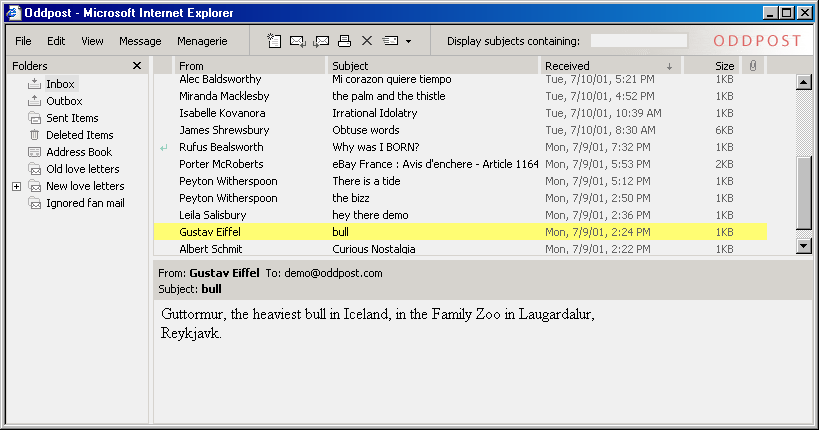



 Today is a big day everywhere on the net. Here on Scripting News it's the day. If you look to the
  Also, some time in April 1988, UserLand Software started. I don't know the exact date. So roughly fourteen years ago the long-winding-road known as