|
||||||||||||||||||||||||||||||||||||||||||||||||||||||||||||||||||||||||||||||||||||||||||||||||||||||||||||||||||||||||||||||||||||||||||||||||||||||||||||||||||||||||||||||||||||||||
Another day of notate fumare.. Congrats to Brazil on their World Cup victory! In baseball, you might think it's impossible to steal home plate, but it actually happened yesterday in a game between the NY Yankees and NY Mets.
Simon Fell's BlogToaster looks like fun. 1/1/02: What is DRM?
Last year on this day, a survey asked: "Do you think Microsoft adds features to their operating system in order to eliminate competition?" 89 percent said Yes. (All the more terrifying when you realize that MS considers older versions of their own OS to be competition.) Dean Landsman: "I quit smoking on April 15, 1978 at 5:20PM." My iPod just played Dr Hook's Cover of the Rolling Stone for me. What a rocked out mindfreeing blow that'll get ya when you get yer picture on the cover of the Rolling Stone. Then another Doctor, with Rickie Lee Jones Making Whoopee. "Lotta shoes, lot of rice, the groom is nervous, he answers twice, it's really killing that he's so willing to making whoopee." On a sad note, Daniel Case, a Bay Area investment banker, and brother of AOL's Steve Case, died of brain cancer at 44.
Dylan Tweney: Broken Trust. "The problem is that Palladium requires users to place a huge amount of trust in Microsoft. You don't get to decide what runs on your computer -- Microsoft does. You can't even open files unless you've been authorized by Microsoft, or by a third party. And that puts a huge amount of power into the hands of these corporations." 802.11b News: Warchalking Hits Government. Update on iPod. All the songs are loaded. Listening to tunes now. Starting with Donald Fagen's I.G.Y. "Perfect weather for a streamlined world. There'll be spandex jackets, one for everyone." Now you're fully informed on the events of the day. Morning no smoking notes At 9:30AM it was two weeks since I had a cigarette. Cory Doctorow and others send a tip that you can move files from Windows to Mac by turning on FTP on the Mac. Or use the built-in SMB support. Thanks to Julian Melville, Mike Cohen, Aaron Pressman and Christopher Fullford for the pointers. (It worked the second time, I have my music folder from my W2K machine mounted on my Mac OS X desktop.) Then I plugged in the iPod, and a few seconds later its icon showed up on the desktop. What's next? Suppose I should read the docs. OK, 8:30AM update. I'm copying all my music from the Windows machine to the Mac. Should take about an hour. I moved one song across and am listening to it now on my iPod. Nice. A candidate for best-named-blog for 2002. I like the automatic updating feature of Mac OS X. The Mac machine I inherited was running a really old version of the OS. I've installed two levels of updates so far, and doing a third level right now. It's almost as easy as updating Radio or Frontier. I still wish the iPod just used 802.11b or 10-Base-T to connect. A new way of thinking about that. In the early 80s CP/M software was the kind of juggernaut that HTTP was a few years ago. This led to very strange things, like a CP/M card for the Apple II that allowed it to run WordStar, dBASE, SuperCalc etc. You could argue that Apple II software was better or faster, but the weight of a such a large mass of users made the CP/M card very very popular. Apple has a way of blazing the trail for others. The product that cleans up in this space will work very nicely with Dell, IBM, HP, and Sony computers running MS operating systems.
Mac OS X running OK, with Jake's help, I got my Mac OS X Cube running. It wasn't too hard. I like some of the neat UI things they've done. Like when you enter the wrong password, the dialog shakes its head. No need to beep at me. I like the special effects when you launch an app. I like that I can run the terminal window. Nice. Next we have to figure out how to copy my MP3s from my Windows machine to the Mac OS X machine. Morning health notes Feeeeeling much better today. They say there are some up days and some down days -- in both of the concurrent body things I'm doing -- withdrawing from nicotine addiction, and healing from heart surgery. Having both go on at the same time probably isn't all that uncommon. Today is a pure upnote because both are giving me positive feedback today. People often miss that there's a positive side to quitting smoking (beyond the usual things) that happens almost immediately. You're not supressing your senses when you're not smoking. So the full sensory effect of the world hits you like a big blast. That's good and bad. Today it's good. Rate of recovery. It can be deceptive. Family and friends and me are deceived. I look normal, I have good energy when seated. I dress normally, can take care of myself like anyone else (feed myself, go to the bathroom, etc). But when I try to do anything that requires strength or stamina, I get a rude reminder that I still have quite a way to go before I'm back. I can't walk for more than five minutes, I get out of breath and need a rest. I can't drive a car. I can't go shopping. I'm exceptionally irritable (no smoking) and scared (eeeks it was my heart). Anyway, as one might expect, when I get grounded -- accept what is real, then I feel good. It's nice, even wonderful, to be able to walk for five minutes on a gorgeous California summer morning. Not much more to say about that. It could have been impossible. Glad it worked out. Community iPod Gift
Mark Staben says that the Sony laptops support Firewire, so it's lucky -- that's what my laptop is. So after trying to get my Mac cube to boot (it didn't) I'll think I'll go that route. I'm going to try using Media Four's software for Windows. Just took a look at the Vaio. There's no obvious way to connect a Firewire device. I'm sure Firewire is nice and fast, but as I've said before this product should be OS independent, and use HTTP and be done with it. Mark adds: "You will also need (if you don't already have one) a 6 to 4 pin Firewire cable - the Macs use 6 pin and i.link (Sony's Firewire) uses 4 pin. The one that came with the iPod is a 6pin-6pin (will work with your Cube if you could boot it)." Erik Wrenholt: Apple, Please Open up the iPod API. Where we'll pick up Another BTW, the little technical excursion this morning was grrrreat for my state of mind. Perhaps next I'll pop the stack and get the weblog outliner tool ready for a private beta. Before the break, I had it working for Blogger, Movable Type and Radio. I wonder if any Manila developers would like to volunteer to do a MetaWeblog API implementation for Manila? That would make this new tool work better.
Good morning sports fans! Warchalking. Cooool. Lots of new developments on Tim Knip's Groovey weblog. Bret Fausett is blogging the ICANN meeting in Bucharest. 2/14/97: "Bucha is short for Bucharest, the capital city of Romania." Hey -- did they say who Deep Throat was on June 17??? Sheila Lennon has the scoop. John Dean says it was Pat Buchannan, with a big asterisk. On this day in 1997, the US Supreme Court affirmed free speech on the Web by overturning the Communication Decency Act. White House: "Many files associated with the previous administration have been removed from this server." David Weinberger: "So, please, Dave, be patient with yourself. We want you around for a long time. Oh, and fuck the tobacco industry." Chuck Shotton: Doctors vs Geeks. Twelve days of no smoking. Munching on baby carrots. The vivid dreams seem to be behind me. Drinking lots of water, taking vitamins. The most important thing is getting into a routine, a new one, without smoking. That's just beginning to happen now.
Search Engine Watch takes another look at Teoma vs Google. Kimbro Staken: "Oracle 9i is now by every definition that I know of, a native XML database." Jon Udell: "Microsoft's Jeff Raikes beat the drum this morning for the tablet PC." Sean Gallagher: "White male juries are hanging juries." Glenn Fleishman: Monoliths and Their Causes. Fabien Petitcolas: MP3 steganographic tool. Joshua Whalen: "One of the hardest and most nasty things that happened to me the first time I tried to quit was my lungs filling up with phlegm, and my sinuses getting all congested." Yup, happening here. The emails continue to be fantastic. So many smart people leading me to other smart people. It's so funny just a couple of weeks ago we were talking about the value of tech blogs. It turns out a couple of cardiologists are regular readers. The father of one of my readers is a smoking cessation researcher at Stanford. Joshua Whalen has great practical advice for real people quitting cigarettes. Are they tech people? Yes of course they all are. Led me to an interesting place. In some areas we have deep respect for the techies. I saw that at the hospital. It's deserved resepect. What these people do is rocket science, beyone the comprehension of people who don't have deep and specialized training, and talent and perseverence. When the time comes we put our lives in their hands. While in the hospital, contemplating the piece I will certainly write at some point, reluctantly I came to the conclusion that the lead of the story would have to be this: They saved my life. So are techies worth it? Hey, if they can save your life, yes, certainly. So this leads me to the next question -- does my software ever save anyone's life? Is there enough value in it so that I could earn the kind of money the doctors earn (they have to be making hundreds of thousands of dollars a year). I'm pretty sure that to be a top software developer requires as much training, perseverence, rocket science -- as being a top surgeon; but our society doesn't value us equally. When medical legislation comes up in Washington, for example, it's not uncommon for doctors to testify -- but when legislation or court decisions affecting technology comes up, no developers are asked to explain the technology. You get CEOs of tech companies, but that's a far cry from a practicing software developer. Sidebar: There's no doubt that weblog software and news aggregators can save lives. A combination of our stuff and Google's, deployed behind a decent firewall at the FBI or CIA, could solve many of their terrorism information sharing problems. Further, I have no doubt that weblogs used more deliberately in health care would be good, and of course health care saves people's lives. And perhaps this series of notes on smoking cessation will help a couple of other people to quit before getting a deadly illness. So while it may seem grandiose to think of software as life-saving, it isn't really a huge stretch. I came to the conclusion that at some point our civilization will either value excellence in information technology, or will suffer a big setback. We're building so many systems on the little ones and zeroes, but yet our universities turn out crappy developers with no ladder to climb, few real heroes to look up to, few bonafide life saving techie role models.
Talked with Doc this morning. He says that Internet radio is still under seige by the US government, that the thaw last month with the Librarian of Congress was just temporary. Via Ernie the Attornery and Kur5hin, comes this amazing story about the Oscar Meyer Wienermobile as a potent tool of global terrorism. "Packed in the back of the Wienermobile, which will travel throughout the East for a year, were boxes of Wienermobile whistles, Wienermobile Hot Wheels, Wienermobile-shaped Beanie Babies and a karaoke machine featuring the Oscar Mayer wiener and bologna jingles." John Patrick, a retired IBM exec, has a Radio weblog. I read it every time he updates. Brig Eaton integrated her weblog portal with the Weblogs.Com XML feed. Perfect combination of technologies. Andy Barker has an RSS aggregator for ASP. Lots more great email about smoking cessation coming in. Thanks, I'm reading every one carefully, even though I can't respond to them all.
Sorry about the lack of updates to my RSS feed. I've been using my laptop to post stuff to Scripting News and it doesn't have the new code yet, trying to stay out of the office which reeks of smoke. Had to come in here to do a Mail Page. Learning so much good stuff. Joshua Whalen: "Over the last 10, 20 or however many years you smoked, Nicotine accumulated in your body's fatty tissues. Whenever you come under stress or eat badly, (or worry) your body burns some fatty tissue, and some of the stored Nicotine is released into your bloodstream, and in this way, it is kind of like having a dozen nicotine patches trickling the stuff into you. Definitely do not use the patch if you are already cold turkey. It will only maker this worse. Instead, you want to clean out your fatty tissue." Andy Edmonds: "The A Day in the Life study is a large scale sample of internet behavior. Data collected will be released under an open data license. The first study will commence in mid July." Semant-O-Matic may be just the thing. Its author, Maciej Ceglowski, calls it a Blog semantic search engine. Jacob Reider, a physician, writes about smoking cessation. Dave Sifry is happy that Movable Type makes it easy to add a Google-It macro to his blog with a little programming. It's pretty easy in Radio too. This weblog needs a restart. Got any news related to scripting, weblogs, XML, new uses for the Internet, etc, and I will do my best to deliver the hits. Drinking coffee now. Not smoking. 9 days. Fascinating emails. One guy wrote that he quit for 190 days and then restarted, first with a single cigarette, then a pack, and then cartons. For me, nine days into it, I feel like I'm dancing with a 7-foot cigarette who is always saying -- Just Smoke Me. The dreams have been super-vivid and frightening. My sense of smell is also that way. Everything in my indoor environment smells of cigarettes. Outdoors is much nicer. Thanks for the 802.11b. About doctors and cigarettes. Just guessing that most doctors never smoked, or if they did they didn't do it for very long, so don't really understand, at a personal level, how hard this drug is to say goodbye to. It just doesn't want to let up. The doctors say "You have to just quit." But what are the best strategies. Should you use the patch if you've already got a week of cold turkey under your belt. Interested in what other people think. Kelly White sent a link to Douglas Adams' death as reported on Scripting News last year. I wondered too, what happened to Adams. Had he been to the doctor? What condition was his heart in? Did he have pains. He died on an exercise bike. OK, here's the deal. I did not have a heart attack, but it was close. I had bypass surgery, which I am now recovering from. It was my fault -- I had classic warning signs that I ignored. No family history of heart disease. Most important -- I wanted to keep smoking. The numbers are good if I quit smoking. If I don't the numbers are totally awful.
Good morning and welcome to another in a continuing series of web logs called Scripting News. It's not quite a soap opera, but it's close. Paolo sends a pointer to a site with Get Well Soon greetings from people who read this weblogs. Nice job everyone. Thanks for all the good vibes that keep coming in. It's nice to be so appreciated. Smoking You gotta know it's tempting to just tell the story, but there's a problem, I don't remember most of it. I was heavily sedated much of the time and am rapidly forgetting the rest of it. Here's something I'm not forgetting. I am now an ex-smoker. I want to say that in public. Of course I still really want to smoke. I figured something out in the hospital. I'm the kind of person who likes to solve problems by smoking. How do I know this? Because every time my mind encounters a problem it says "OK, I'll just have a cigarette then." I bet a lot of other cigarette smokers deal with problems the same way. Now that I don't smoke, I still have the idea that smoking will help me deal with problems. It's funny, one part of my brain has figured out that this is wrong (in fact smoking causes more problems than it solves) but a deeper part of my brain still believes it. This leads to some funny arguments inside my brain. But so far so good. I got to go through the worst of the withdrawal in a hospital where there was no possibility of smoking, and now the craving seems manageable. No doubt other people have smoking stories to tell. I was one of the lucky ones, I survived to tell my story. So far so good. Recovery It's likely I will fully recover from this, but it's going to take some time and I will have a different kind of lifestyle, so who know knows what's coming. Here's a quote: 5/7/97: "People move, life is more like a wild dance than a ceremony. You just can't tell what's coming next."
Greetings sports fans. First I want to thank everyone who sent their good wishes. This was probably the toughest week I've ever had. I came through it stronger, but changed. Not sure how much I want to write about it, but I did want to acknowledge, as soon as I possibly could, that it meant a lot to have so much support. Just got home a few minutes ago. One step at a time. Wired reports on a deep linking controversy at NPR. Cory Doctorow says the NPR ombudsman is either a liar or a fool. The Register says a decision is coming soon on the British Telecom patent on hypertext linking. Gary Reback: "The chief suit responded. 'OK,' he said, 'maybe you don't infringe these seven patents. But we have 10,000 U.S. patents. Do you really want us to go back to Armonk and find seven patents you do infringe? Or do you want to make this easy and just pay us $20 million?"
Vint Cerf on the origin of the term RFC. Last year on this day, a follow-up to Microsoft-free Fridays. "Another idea! All-Microsoft-Mondays. Every word on every site points to Microsoft.Com. Give our readers a preview of what the Web will be like in a couple of years." Steve Gillmor: Memo to Bill Gates. It's going to be a light day here on Scripting News. Lots of non-Internet stuff going on.
DaveNet: XML and academia; Newspapers and weblogs. Megnut wrote the blogging piece we've been waiting for. "As with free speech itself, what we say isn't as important as the system that enables us to say it." Yes. Dane Carlson notes that "blog" is being added to the Oxford English Dictionary. Milestone: My Weblog Outliner posts to Movable Type. More info on the weblog outliner. In this post I explain how attributes work, and wish we had broad support for a permalink attribute. I'd like to be able to ask a weblog system (Blogger, Movable Type, or Radio) to convert a post ID into an HTTP url, so I don't have to bother the user. It's a complicated mapping for a human mind, not too hard for weblog software. I was able to add the feature to Radio in about five minutes, it's probably a pretty easy addition for everyone. Postscript: Just emailed with Ben Trott. The next version of Movable Type will return a permaLink element of the struct in metaWeblog.getPost. Just to prove how weird the Internet is, I turned on all three tools at the same time, and it worked. My new soul brother Glenn Reynolds blogs John Hiler noticing that the unsigned music and unpublished books he's finding via weblogs are pretty good. Yeah. I wrote about this in my Monoculture piece last month. "Perhaps monoculture has run its course. Maybe what's happening now, but it's hard to see, is that each of us is taking more responsibility for getting our own information, for creating our own entertainment, and not giving that power to the centralized entertainment and information industries." Daniel Berlinger is geauxing to catch some jazz tonight in Nanuet, NY. Must read Eric Raymond's Sex Tips for Geeks. Mark Pilgrim sent an email on Tuesday saying that he now has his own wiener boys, and he "gets it." I said I support what he's doing, his narratives of real-world case studies for accessibility are just what I wanted, to help me understand what the issues are, and what solutions exist. Some people are making fun of Mark, and that's cool too, because so far the parodies have been well done. I know it can be hard to look in such a harsh mirror. So I also support what he's doing because it's valuable to me and I don't worry about what may appear to be preaching. I've gotten to know Mark as a smart person with strong opinions who doesn't cut corners. That's harder to do that it might appear. David Carter-Tod's weblog is getting really interesting in the last few days. I read it every time it updates. David is a longtime member of the Frontier community, an educator who has deep knowledge of instructional technology. Mac OS X people who can do Radio scripting -- want an interesting project that people would really appreciate (not for me, I still use Windows) -- wire BBEdit into Manila through XML-RPC. Talk with Paolo. I bet he would like to sell such a widget. Vince Outlaw is blogging the Playboy Jazz Festival, with pics. BTW, a personal note. I've lost eight pounds in the last three weeks. Getting in shape. Happy about it. Paul Ceruzzi: "I just got a Dell laptop running Windows XP and it won't run Thinktank." When Doc took off on his trip to Munich he said "auf wiederbloggen." Today he's reporting live from the JabberConf, talking with and about all our friends. This time it's the Americans who are jetlagged. Doc Searls: There is no demand for messages.
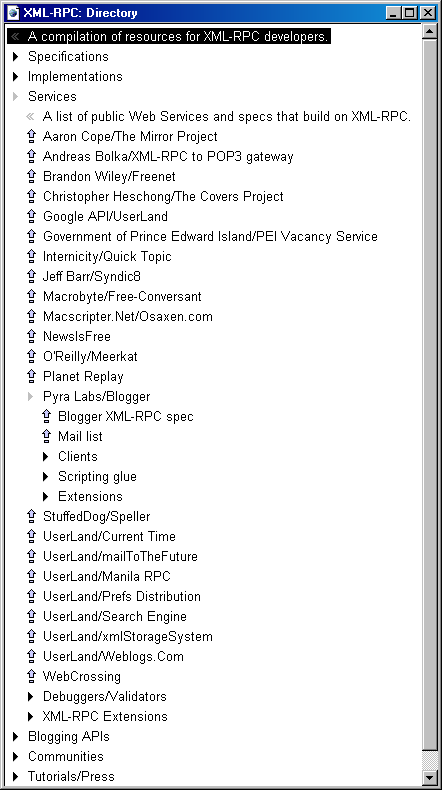
Russ Lipton's RadioDocs, on-line, ready for UserLand. Milestone: My Weblog Outliner posts to Blogger. Mickey Kaus and Glenn Reynolds (mostly) endorse my plan for newspapers embracing weblogs. Kaus wonders why businesses should pay to associate with newspaper websites. Fair point. I really wanted to say that businesses that have nothing to say (advertising) that interests anyone should perhaps find another business. This is just a paraphrase of part of Doc's philosophy that says that there is no demand for messages, which is why advertising is such a 20th Century concept. BTW, this is the third time around this loop. The first was just after the Davos Y2K meeting, in response to questions about how pubs can make money on the Internet. The second rendition came after the dotcom bust. Note to Kaus, UserLand, a software business, communicates through Scripting News, a weblog. (I'm the CEO.) Where are the permalinks on Kaus's weblog? This evening we released glue scripts for the MetaWeblog API for Frontier and Radio. Is it just me, or do other people think that XML feeds like RSS can help make information more accessible to people with disabilities? What about outliners? Today, an application for Radio's outliner that will be new for many. We've brought a feature from Manila into Radio Community Server, making it possible for people to create Yahoo-like directories that appear in their Radio weblogs. These directories can include other directories. They're built on an open format, OPML; which can be created in any compatible outliner, including Radio's outliner. Viewed another way, directories are hiearchic blogrolls. When you start getting hundreds of links in your blogroll, and start categorizing them, it's time to look for something richer, and that's where directories come in. Several real-world examples of OPML directories. Rick Klau has a directory of law weblogs. Yes! Screen shot of the XML-RPC directory edited in my outliner. It's interesting that they're discussing directories on Blogroots. The first thing I thought of when I saw their list of weblog management tools was "I want that as a directory." About the politics of directories. DMOZ scores points for "open" in comparison to Yahoo, but it is not decentralized. There's still a single owner of each category, and if that person wants to exclude something they can. This, emphatically, is not weblike. The directory I'm envisioning is one that's as open and chaotic as the Web itself. No one owns a category anymore than there is a single place to go for information on a single topic on the Web. We thrive on triangulation, multiple ways to view each subject. Earlier this month I wrote a piece about directories and Google. Perhaps it makes more sense in light of the technology we released today. Now it gets more interesting. I asked Mark Pilgrim to create a list of weblog neighborhood implementations so I could include it in one of our directories to show that you don't have to use our outliner to participate in the decentralized directory of directories. Here's the demo. I included Mark's directory in mine. Then he sent two more lists and I included those too. Note that Mark's lists could have been hierarchies, nested as many levels deep as makes sense. Mark can edit his directories, and within one hour his changes will be reflected in mine. Suggested links go to Mark, not me -- because the directory environment knows that he's the author of his branches, not me. That's why OPML has information about the author. Paolo explains how Radio can be viewed as decentralized Intranet portal software. InfoWorld's readers choice awards form. It's surprising that no weblog software or news aggregators are on the list. Next year, imho, they will dominate. Remember, InfoWorld hired Jon Udell. And it wasn't just for his good looks. Jon Udell: "I'm sure it's true, though no-one can come out and say so, that the FBI are among Google's most intense users. I hope a private network of weblogs will be the next step." Brian Buck is fighting bone cancer, on his weblog. "My first reaction was that of taking on a war." Brian is on the Credits page for Frontier 4. Bravo to Ed Cone for pushing back against one of the great listmakers of our time, Eric Raymond, who did more to divide the software world than just about anyone. An essay about academia and XML.
A news aggregator is "software that periodically reads a set of news sources, in one of several XML-based formats, finds the new bits, and displays them in reverse-chronological order on a single page." Paolo: "It's important to consider that 'set of news sources' could also mean reports generated by your accounting software, status of your servers, posts in a discussion group, orders from your e-commerce site, updates from your co-workers workflow management software.." Thanks Paolo, that's absolutely true. Fortune: "Katz spends all his time making money from patents rather than selling an actual product or a service." Charles Miller asks a key question. Suppose you work for a company and keep a public weblog. Are you required in some way to blow the whistle, in public, on your employer? Imho, absolutely not. It could easily get you fired, and it isn't fair to your employer, unless they employ you as a journalist. Now, this does not mean you are not a journalist. Just disclose that you are an employee of the company that employs you. Then readers will know to look elsewhere for information about that company. Reasonable people will understand that you will not disclose information that could hurt the company. I was interviewed today by a Japanese wire service. They asked if weblogs spelled the end of newspapers. I said they didn't have to, if the professional news organizations adopted the technology. He asked how. It's worth posting. First, I would offer a copy of Radio UserLand to every person on the editorial staff (okay, I'm biased) and say "Start a weblog now if you want." Then I'd make the same offer to the readers. Then I'd watch to see what happens. I'd say to the staff "Read the new weblogs, and for those of you who have your own, point to the articles you find interesting or useful." Let this run for a few months. My bet is that the community starts generating good news reports, on things like school boards, and city council meetings, the stuff that the organizations no longer cover. (Or medical care, or city workers who dump paint in the sewers.) Just what people see and what they think. Democrat weblogs that beget Republican weblogs. Elevate one of the staff weblogs to the main site (by then its flow would probably be almost as big as the rest of the publication). Go back to all the editorial people who haven't started weblogs, and invite them again. Wait a few more months. Here's the New Economy bad news (sorry) -- cut the people who aren't participating in the new network. My bet is that the community gets energized by the new participatory journalism and the former reporters, who now are editors, talent scouts and teachers, are also energized, doing what they wanted to do when they got into journalism. Now ask the community what they're willing to pay to keep the system working and growing. I know I'm naive and unrealistic, but this is how I think it will work. Another source of revenue. Charge local businesses to place their weblogs on your network. This is advertising turned around. No more interstitials and ads that interfere. If people aren't interested in your business, maybe it's time to find a new business. News drives interest. Minds, not eyeballs. Real issues not puffery. New products that meet people's needs and wants. No limits on where we go. Tom Degremont is using Radio to write his captain's log for the 4 months of sailing he plans to do this summer. Edward Champion: "The relationship between hard money and journalism is closer than you think." Deborah Branscum: "So various blogs may be buzzing about the [NY Times weblog piece] but I expect the rest of the world yawned and moved on." Jim Armstrong met Ted Nelson and Doug Engelbart last night.
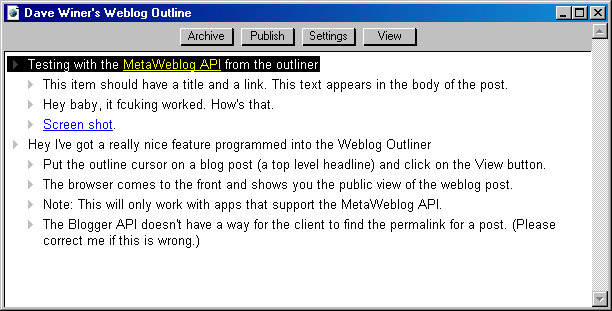
Two years ago today: "I am the god of my garden." Also on that day: "If you support developers who don't patent, one of the best things you can do is give them credit for their inventions, and do this carefully and completely. Almost all creative people want recognition for the risks they take. When they are generous with their ideas and don't patent them, extra recognition is a good idea. This is something positive everyone can do to encourage generosity from developers." Mark Frauenfelder: "This is the first and probably the last time I'll ever be on a national TV commercial." Jon Udell: "The idea of disposable spaces is something Groovers take for granted, but it's a bit unusual from a web perspective." Several things on my todo list today. 1. Write a What is a News Aggregator? tutorial, to explain the "other half" of the Radio feature set. Done. 2. Announce and roll out Russ Lipton's new gentle guide to Radio UserLand. It's end user docs. Yeah. Finally. 3. Something else. ActiveState: "Do you know someone who's really made a difference to open language programming?" SubAverage: "Greg cannot get laid. This is not a popular culture cliche or a philosophical statement; he really cannot find a girl who will have sex with him." Noteworthy: I got a friendly email from Ken Layne. He said a lot of other things in his interview that weren't quoted. Every BigPub piece seems to have its scapegoat. In this case there were two, Ken and Cameron Barrett. I'm sure Cam said other things that were less fear-inspired, and more gracious than what he was quoted as saying. And Ken clearly wants more technology, and says he doesn't want to steal anyone's thunder. I asked him to post his comments so I can point to them. Glad to get that outage behind us. Today, in 2002 at least, it seems that the weblog world is self-healing. Nice. BTW, I use an outliner to edit Scripting News. Screen shot. Soon, you will be able to too, even if you edit a Blogger, Blogger Pro, or Movable Type site. (Of course it works with Manila and Radio UserLand.) Note to other blogging tool vendors, please, if possible, support the MetaWeblog API. The editing tools can do more for users if you do. To Evan, I think this would be a great Blogger Pro upgrade.
DaveNet: What I'm learning about journalism. A couple of months ago, Peter Day from the BBC came to my house for an interview. It's part of a four-part series on Silicon Valley, airing this month. Update to the Radio implementation of the MetaWeblog API. The struct returned from metaWeblog.getPost now includes a string called permaLink. I can imagine Sam Ruby nodding his head in approval. SaferSex and Web-Pages-That-Suck are nearly tied for first place today on the Radio Top-100. John Robb: "Hey. Stock options." Deborah Branscum: "Call me crazy, but I really like these California girls." Tom Matrullo: "When quality, independent thinking, and honest speech are so unthinkable as to seem silly in an organization, it doesn't take a visit from Dr Freud to figure out where the real problems might lie." Ed Cone reviews Radio: "I would recommend Radio to both the power blogger and the hobbyist. And I would recommend it to business users looking for ways to reach their customers, partners, etc. I would also recommend that UserLand continue to make the product simpler and more intuitive, and the help files easier to use for the mass-market audience." Hats off to the Blogroots people. Look at how they break down weblog management tools. You can see that Radio is doing something new. Thanks for noticing. And Manila and Movable Type are comparable. We see it the same way. Michael Wolff: "The music industry is becoming, in size and profit margins and stature, the book business." BBC: "John Ashcroft says a plot to attack the country using a radioactive 'dirty bomb' has been prevented." Sean Gallagher: "What does an editor-in-chief do if he or she knows his magazine is two ads short of making its nut, and the suits are sharpening their axes?" Rogers Cadenhead: "How likely are you to have sex during next month's July 4th weekend?" When people say Scripting News takes too long to load, I send them a pointer to the lightweight version. It's totally OK to read that one. NY Times: "Etherlinx has taken the 802.11b standard and used it to build a system that can transmit Internet data up to 20 miles at high speeds -- enough to blanket entire urban regions and make cable or DSL connections obsolete." The First Movement is a Flash-based weblog browser. Nice. It displays RSS feeds. It'd be interesting to see what my new RSS feed looks like in this browser. Mark Pilgrim: "Jackie can not read Braille at all." A new XML-RPC client/server for PHP from Keith Devens. Press release: GoUpstate launches new Weblog. "In real life, the TechGoddess is Jenny Levine.." This is so interesting. Jenny's Shifted Librarian is one of our favorite weblogs, and GoUpstate is doing some very interesting stuff in their community with Radio. Andy Rhinehart is our contact there. If things go as I think they will, the state of South Carolina may be the most weblog-wired state in the union in a few months. Keep on truckin. Jenny will be a great pied piper. BTW, here's a good question. Why is South Carolina one of the most important states in the union? It's the only state that can throw Ernest Hollings out of office when he comes up for re-election. I believe in the corporate death penalty, and I also believe in the political death penalty, for representatives who try to steal what's not theirs for greedy idiots in Hollywood. Rick Castello: "When you read a blog, you are seeing the world and they events described through that person's point of view." Saltire: "Today's way of doing business is not sustainable." Work continues connecting Groove to Radio. Radio is all about publishing. The root of that word is "public." By design, Radio makes it easy to make things public. On the other hand, Groove wants to keep everything private. The connection between the two products should reflect their respective nature. Publishing should be an overt act in Groove, something you do deliberately. "I want to publish this," says the Groove user. He must have permission to do that, whatever that means in GrooveLand. John Burkhardt, who works at Groove, says "This is something that freaked me out too." Jon Udell has much more today on the Groove-Radio connection. Thinking about the NY Times piece. I said a lot more than what I was quoted as saying, as I'm sure Kottke, Cam, Ken Layne, and Glenn did. I would really like to read what they said. Transcripts would be nice for people who want to know more. The Web has that ability, even if print doesn't. And while the story was "nice" -- it was another clubby piece about weblogs-- not really very serious. Basically this seems to be the nugget of news. Kottke got irritated about something that was irritating. Is that major news? Hmmm. Now, another question that we all should have asked the reporter. Where's your weblog? Thanks to Meg for the pointer to the Gallagher's weblog. Hehe. I love this medium. BTW, an intellectual, not clubby, treatment that followed on their lead paragraph would go like this. Weblogs are different from Usenet. The old techies had good cause to be irritated by the newbies, because they made a mess of a world that used to work. But weblogs are different. A lot of new weblogs doesn't make it harder to read your favorites. This technology is different. That's the answer to the question raised by their lead paragraph. The answer is not in the Times piece, as far as I can see. Here was the lead: "It is one of the enduring cycles of the Internet: the techies build a utopia and then complain when noisy crowds crash their party." Doc has some great comments on the Times piece. I laughed five times reading it. Another note. Ken Layne's comment really stings. "There's nothing novel about the tech bloggers, beyond the fact that a few of them made simple tools for updating Web sites." It's very hard work to make things simple, especially when lots of people want to do it. And there's more to personal publishing on the Web than reverse-chronologic posting. Further, the tech blogs are not limited to discussion of technology itself; we're people -- just like you. When Sept 11 happened, we were all affected. And if we work together, with respect, you may find that technology is even more relevant now that tens of thousands of people are writing publicly on the Web. To be honest, until this piece was written I had never even heard of Ken Layne. That's how big the world is. I'll start reading his site now, and see if there's anything interesting there, and I'll let you know what I think. On this day last year, I wrote about the death penalty in the US and my Uncle Sam who was murdered. See Ken, this is how it works. We're people too. I don't like being dismissed or trivialized by professional journalists, and I equally don't like it when another blogger does it. Thanks for listening.
NY Times: A Rift Among Bloggers. It's a nice article. Everyone likes each other. Coool. BTW, they also said we're journalists. Thank you, glad that argument is over. John Robb: How To Manage Companies in the New Economy. 802.11b: "Other uses of the 2.4 gigahertz band that's the home of Wi-Fi may result in such widespread interference that Wi-Fi networks won't be possible indoors or outdoors in many urban areas." Scoble is on fire today. Way to go Robert! Itopia, in Belgium, has a service I am quite interested in. It's not perfect. I want MP3, not WAV. And I want the recorded conversations to go directly to a website. But it's very close to what I've been looking for. Thanks to Adam, who I've been talking with about this stuff, and thanks to Glenn Reynolds for lighting a fire under my butt. I've also been emailing with him; he's getting ready to do an audioblog for InstaPundit. This is something I not only want, but I want to do it too. Higher bandwidth. Also when people hear me talk, they get a whole different idea when reading Scripting News. Maybe in a few months there will be lots of audioblogs. To listen to these audioblogs, we're going to want the all-digital 802.11b walkman I described in May. Does anyone want to make one? $500, and if it works I'll tell all my friends to get one. Writing Frontier/Radio glue today for the MetaWeblog API. Poynter.Org: "When Jay Harris resigned March 19 as publisher of the San Jose Mercury News, the paper quoted him as saying that he feared corporate budget demands could result in 'significant and lasting harm' to the newspaper and the community it serves." Jon Udell reports from the Groove/weblog frontier. Urldir: Blog Tool Feature Comparison Table. I've been emailing with Sheila Lennon at the Providence Journal over the last few days. Yesterday it took her a long time to get back. Here's why. Wow. Two years ago I wrote about about the Exploding Dog. Two years later, he's still practicing his magic on the Web for all to see. Yay! Warbloggers, the BigPub, SOAP, etc. Glenn Reynolds amplifies on What is a Warblogger. Glad I asked. Apparently it's not what some people think it is. I parse war the same way. On Sept 11, I ran a survey asking if people thought we were at war. Over the next weeks I flip-flopped several times on whether we should be at war. Truth be told, today, I think our leaders make a lot of noise about being at war, but here in the US, it doesn't feel like a war. Later today or tonight the BigPub piece should go live. It'll be interesting to see if they run the quotes from the initial interviews, or if they pick up the open discussion that followed between InstaPundit and Scripting News. Key point, at the time of my interview, I was not a reader of InstaPundit, and said so. Some ideas were presented to me as those of the warbloggers, and they were very crude. I said so. I assumed those ideas were attributed to Reynolds. Mistake. Mea culpa. I fucked up. Then I had the idea that I should talk to him, and find out more about him. We had a phone talk, and then I started reading his site. The impression I had was wrong. At least now I got to say that before the piece runs. I have no idea what I said there, for all I know I'm not even in the piece. Something like this happened when the NY Times did a profile of me last spring. It turned into a condemnation of Microsoft for screwing with SOAP. Although their quotes were accurate, they only quoted the yin, and left out the yang. Is that good reporting? No way. While the story was in process, peace broke out. The story was written as if it didn't happen. Now, viewed a year later, judging from Don Box's ridiculous bluster about what SOAP is (Box now works at MS), the Times may have been right. But the story didn't leave much room for doubt. And MS can try to screw with SOAP, and in the end, I don't think it's going to matter. They've become much less important over time, even in the last year. The story captured none of the doubt, or any of the balance that I have to have, in order to work with such a big company. Dumb-it-down or deliberate manipulation? Impossible to know. I learned from that experience, not enough though, I may have repeated the same mistake in this last bit, where I gave the reporter enough soundbite to hang me, if they omit the balance. I tried to have an intelligent discussion about this with the Times reporter last year after the piece ran. I asked this question. Suppose a reporter goes to a baseball game, and due to some fluke, his presence alters the outcome of the game, and Team A wins. If the reporter hadn't been there, Team B would have won. Assume there's no question about this. So which outcome should the reporter report? Which team won? Of course there's no question. So why should it be any different for tech coverage? The presence of a Times reporter may have altered the outcome of the SOAP interop work. We don't know for sure. But the outcome was different from what he reported. As a result we have some meaningful interop and it doesn't revolve around MS. Look at the Google API experience. Bing. In this case the BigPub process got me to read InstaPundit. That's a fact. I'm no longer clueless about Glenn, or warbloggers. And I gotta thank them for that. We have a philosophy in weblog-land, it's an intuitive thing, as I wrote yesterday, it's probably very similar to the impulse that drives people to seek a career in journalism. There is no difference betw what he does and what I do. We are different people, of course, so the result is different, but underlying that, at a deeper level, it's the same thing. If anyone tells you otherwise, they don't get it. Will the blog bubble burst? Glenn says: "Sure. But it'll be like most Internet bubbles: the real bubble is in attention. Napster got a lot of attention a couple of years ago. That bubble has 'burst,' but there's actually more filetrading going on now than there was then. It's just not on the cover of news magazines. Similarly, someone will soon announce that blogs are 'over,' but weblogging will continue at a higher rate than it's going on now. It will just have become part of normal life. We don't hear much about the 'electric light revolution' anymore, but that doesn't mean we've all returned to candles."
NY Times: The Boom Was Real But So Were Its Mirages. NY Times: "In the casino stock market of 1999 and 2000, Lenk recognized only two categories of players: greed hogs and builders. Bad people and good people. By their actions, they declared themselves. His black-and-white view allowed for no fence straddling." Simon Fell, The .NET Guy and Sam Gentile all speak highly of a new blogger named Drew. Triangulation. Gotta love it. Welcome to the neighborhood Drew. Glenn Fleishman: The Night the Lights Went out in WiFi. Ben Hammersley: "With some work, I think it may be possible to even re-unify the RSS standard, and still preserve the valuable bits that RDF gives us." Today's work notes on My Weblog Outline tool. I'm using the tool to log my work. David McOwen: "During my case there was no news coverage within the State of Georgia because as I was told by friends that the Governor specifically told people to 'hush up' on the subject." BBC: "The next time you install software on your computer at work, you could be facing criminal charges. This is what happened to computer technician David McOwen, when he installed a program on the PCs at DeKalb Technical College in Atlanta, Georgia, US, without first asking permission." I asked Glenn Reynolds where the term warblogger came from. He said: "I don't know where it started. I was blogging before there was a war, but I think it refers to blogging about war, rather than a general love of war. Steven Chapman has a good post on this." Scott Loftesness: "Links to both New York Times and Washington Post stories are designed specifically not to rot and to be permanently in place. Just checked an old Boston Globe link (owned by the NY Times) -- they apparently rot their links using the archive revenue generating strategy of Knight Ridder." NY Times: "My experience with students' computers tells me that the vast majority of them have at least a few spyware applications on their computers, and they're usually shocked when I point them out," he said. "College students, of course, aren't particularly choosy about the software they install." Jonathon Delacour: "Macromedia's Site of the Day -- the Canadian Broadcasting Corporation's World Cup Game Tracker -- is the first well-designed, useful Flash site I've encountered." Dan Gillmor's comments Dan Gillmor: "I have taken on my company in public, on a matter that went to the core of journalistic principles." Received, and I'll think about his comments. To assume that the discussion is over would be parallel to assuming that once Microsoft responded superficially and dismissively to a Gillmor challenge that he would never write about Microsoft again. It doesn't work that way. Next. It's quite possible that other people said that Dan doesn't take on Knight Ridder advertisers, but I surely did not say that. I asked where the line was. The word "journalist" is treated casually by people who practice it, and Dan does it here, talking about the core of his journalistic principles. What, exactly are those principles? Software developers have to routinely endure integrity challenges at the hand of people, like Gillmor, who wear the J-badge; but they take offense if we ask crucial questions that help us understand who they are and what kinds of constraints they accept. It's even worse for bloggers. Only now, after much pushback, are the pros getting the idea that we take what we do seriously. I think bloggers are doing more to bring integrity back to journalism than the pros are. Emphatically, that's what my piece was about. We're helping them, but most of what we get back is dismissive. Dan says "Life is too short, and I have work to do." If a pro asked the questions I did, would Dan be so dismissive? Doubtful. It's worth noting that after Gillmor's comments, we are no more enlightened as to the cause of the outage, nor do we have an idea if the outage will clear at any time in the future. I did not say he should beat up Knight Ridder. I don't even know what happened. For all I know they deserve sympathy. I don't have the facts. It's possible that Dan does. If he doesn't he certainly knows who to ask. I am also disappointed that he chose to characterize my comments as scathing attacks and broadsides. I wonder how he would respond if one of his targets characterized his comments that way. Further, there's been some really ugly mud slung at me on a weblog run by a Knight Ridder employee. It's perhaps predictable, but unfair. It seems they, like some of the companies they cover, have to get clear on what they do, get a philosophy, and learn how to communicate with the world around them. It's not cool to recklessly challenge the integrity of people who challenge you. Net net, the reign of the pros as gatekeepers is ending. Dan is the most visible and open of the pros. For that he deserves our admiration. To his credit, most pros, challenged in this manner, would probably ignore it, or worse, plot revenge. I'm doing the best I can to ask a much broader question, and I haven't managed to connect on that basis. When the employers of professional reporters try to grab something that's not theirs, can we trust the pros to dig in and tell us what's going on. Dan has responded to a much smaller set of questions, and responded defensively and dismissively. I would have preferred if he had embraced the larger questions, and worked with us to not only get the answers, but to help figure out where we go from here. Morning coffee notes Based on emails I'd say that many professional journalists, maybe even most, got into journalism for the same reason people start weblogs. Hoping to make a difference. To have an intellectual life. To be where the action is. Idealism. For many, becoming a reporter was a very positive thing -- but being a reporter meant understanding that the publisher must make money. Compromise. Conflicts. In the heart of such a reporter, the Web was a rallying point, it was a return to their beginning, it called up their inner true believer. But the Web created a conundrum. Try as hard as you can, it's very hard to make a buck selling the written word. Try to skirt the issue. It's in your face. As a software developer turned public writer, it's hard not to be sympathetic, even though many of the same people wrote us off, either because we were Mac developers when that was presumed to be a lost cause; or a Mac-Windows developer when Java was presumed to rule the world; or a commercial developer during the open source mania. To have been ignored in our struggle, brings up bitterness -- these people didn't help us when our basic business model was (unfairly) undermined. Regardless, I am sympathetic. I want the pros to stay in business, and keep publishing to the Web, creating a trail of knowledge, so we can learn from our mistakes, and point to them, so perhaps we don't have to make them again. On the Poynter discussion board, one of the Knight Ridder people asks that we be gentle with their new content management system. Oh does that ring a bell. Of course I understand that. I make software for a living. A new software product is a fragile thing. If not properly cared for, it dies. When something new comes along, truly new, it should be cared for, not undermined. It's no surprise to me that a hard-working engineer wants his or her product to become something. That's natural, sensible, and right. Back in the early 90s, before the Web became the thing, the talk of the industry was a concept called convergence. The media industry and the tech industry would become one and the same. Today that's been realized, and what a mess it is. Now they know what it feels like to be on our side of the fence, and we're getting a taste what it's like from their point of view. The hope is that this increases understanding. Perhaps we can find new ways to work together, don't just believe and repeat the hype, think, evaluate, take a different course this time. Remember the Golden Rule and practice it. There's a new frankness and humility on all sides. Let's make the most of that. Is Glenn a warblogger? OK, I admit it -- I'm clueless. What exactly is a warblogger? I've been reading Glenn's site every time it updates for the last few days. I don't see a warrior. I see a mediator. He links to differing points of view. He cuts through the rage and says "That's not anti-Semitism, Jason. It's just opposition to Israel's policies." Is Glenn a warblogger? If so -- where's the war?
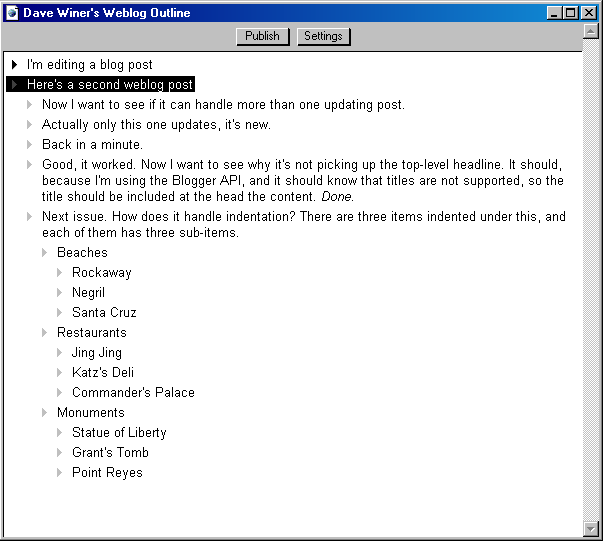
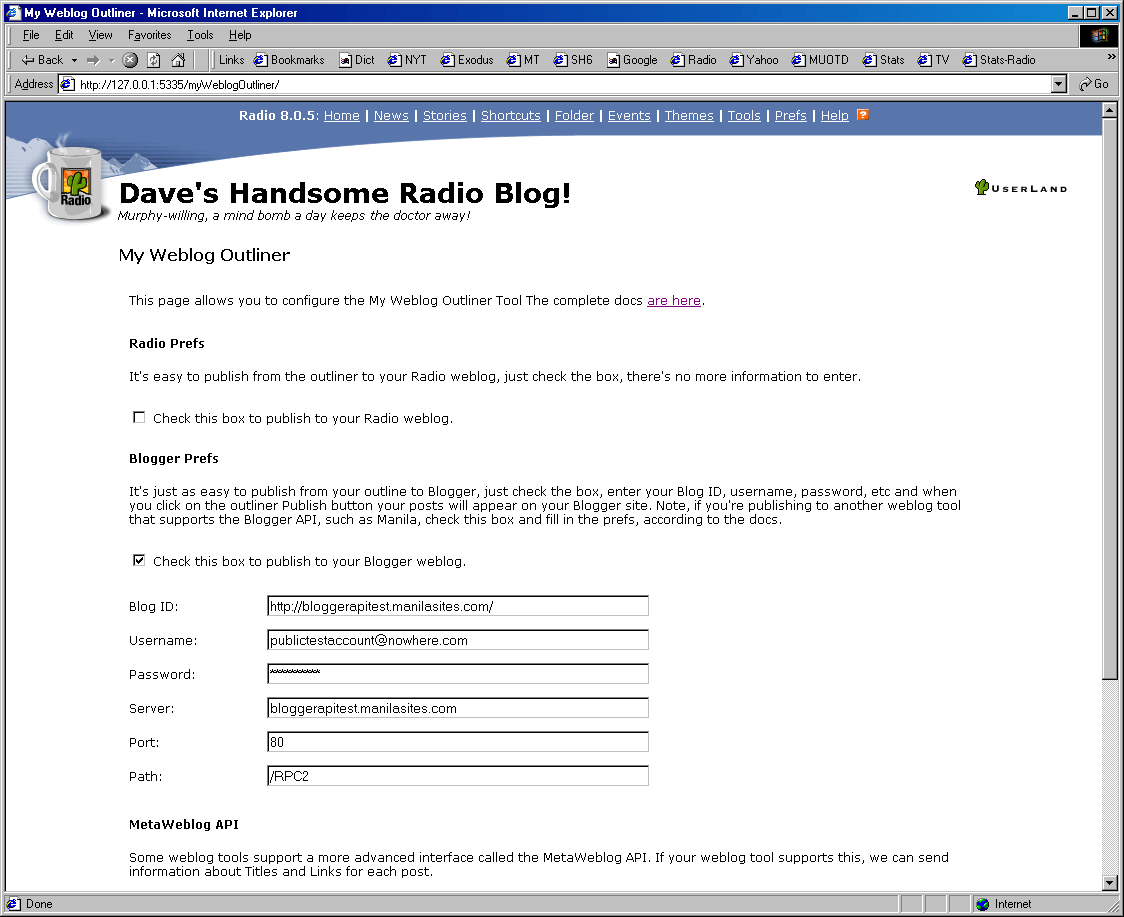
SaferSex.Org is a (high flow) Radio site. Adam Wendt is rendering RSS as a browser-based outline. Now, a theory on the disconnect over the Knight Ridder archive and even a plausible explanation why Dan Gillmor might have chosen not to go into it on his weblog or in his column. First a disclaimer, this theory hadn't occurred to me until I thought about various posts from K-R people on the Poynter.Org discussion thread. The posts said it was a business decision, not a technical one. I missed a fork -- I assumed this meant they wanted to keep the costs down, as did the other non-K-R people who posted. We wondered how much could it cost to maintain the old addresses. That's how I've approached it since the February outage, but I now think this is not the reason K-R didn't preserve the archive. Here's the theory. They charge for reading the old articles. Look at this page. "Searching is always free. There is a fee of $2.95 to view the full text of any article." If you don't pay the money, you can't read the article. Now, why might Gillmor have chosen not to write about it? To understand that, let's step outside the world of journalism for a moment. Imagine I have an ice cream truck (it's hot here today, humor me). It's a really good truck, a great refrigeration unit, a recently overhauled engine, the bells work, and I've got a route where the kids come out every afternoon to get their cool treat. So along comes someone and says "I'll give you a bunch of money for the truck. I'll even send you to Jordan and Israel, and China and Switzerland. I'll tell everyone you're very smart and pay you a bunch of money. And I'm going to use the ice cream truck to compete with Federal Express." You say OK, because the money is good, and you enjoy travel and all the other perks, but secretly you think the buyer is a fool, because it's a good ice cream truck, but he's going to lose his investment if he tries to use it to deliver envelopes all over the world overnight. He's a fool, but he's the customer, so you don't get to say that. Anyway, that's my current thinking. I thought I should share it. Now, if any of this is true, it's still a good question whether Dan made the right call. As a reader, it was horribly confusing. I had to devote much of my attention in the last couple of days reading tea leaves to piece this theory together, and it is still just a theory. A reporter is not an ice cream vendor, the calling is higher. I said to JD in an email today that all employees are not equal. A doctor is probably someone's employee these days, but would you want to be treated by a doctor who withheld critical information to please his employer? (No doubt they do it, btw.) Judges are employees too. So the struggle is definitional. How high a calling is journalism? How much information are readers entitled to, even if they're reading for free? In 2002, when the Web is part of the journalism enviroment, are we entitled to read what a columnist said in the past so we can use that to judge what he's saying now? Is it reasonable to pay $2.95 for that? Sounds like good fodder for a Dan Gillmor column, imho. Ryan Tate: "It seemed perhaps reasonable for journalists not to write about their employers when the employers were single, family-owned newspapers. But this moral compromise becomes increasingly untenable in a world of mammoth media companies and huge newspaper chains. If CNN and Fortune are not able to mount public attacks against AOL, they have no credibility. And if a journalist is shy about taking on small sacred cows, why should we think they will go after the big ones?" Sacred cow: "One that is immune from criticism, often unreasonably so." Progress on the Weblog Outliner. I have it working with Blogger, modulo an outage on blogger.com. As a fallback, I'm testing with a Manila site that emulates the Blogger API (note, they all do). Here's my latest post, and a screen shot of it being edited in the outliner, and a screen shot of the prefs page. Press release: "Knight Ridder Digital, a leader a local information on the Web, announced today that Sharon M. Mandell has been appointed to the newly created position of Chief Technology Officer, effective June 24." Welcome! Colin Faulkingham hits paydirt. Do a view source on this slide show. It's all in one file. He just added an XSLT style sheet to my OPML file, nothing more. Fantastic, synergistic, low-tech, leading-edge. Jamie Warner has a server-side app that converts an OPML document into a single-document presentation using style sheets. Sean Gallagher: "Eisner doesn't respect news as anything more than infotainment, and in the long term, he'll probably turn ABC News into some version of the Howard Beale Show." Brent Simmons: "I learned when I was a teenager not to be a perfectionist." Dori Smith: "There are only 10 types of people in the world: those who understand binary, and those who don't." Jon Udell: Onramps, offramps, Groove, and blogs. Salon: "The Federal Communications Commission is quietly handing over control of the broadband Internet to a handful of massive corporations." One year ago today: "The cool thing about the Web are the clean lines of separation." Two years ago today, I released UserLand's RSS 0.91 spec, with comments on Scripting News. I intended it to be a baseline for collaboration among content developers and CMS developers and people working on aggregators.
FDR: "So, first of all, let me assert my firm belief that the only thing we have to fear is fear itself — nameless, unreasoning, unjustified terror which paralyzes needed efforts to convert retreat into advance." Comments on yesterday's piece Yesterday's DaveNet piece is rising on Blogdex and Daypop. The first comments I read said that I should have disclosed that Dan Gillmor used our Manila software to edit his weblog, and is now using something else. It's true, but there are related things I could have disclosed, for example that we didn't charge Knight-Ridder for the service we provided, even though they ran ads on his site, and if Dan had wanted to take Manila or UserLand to task for technical issues, he could have kept his site, and his job. We did quite a bit of free development for Dan and the Merc, our compensation was learning, and having a great example of a pro using our technology to publish on the Web. No regrets about doing it, and when it came time for Dan to try something else, no regrets about that either. People who focus on the Gillmor part of the story are missing the big picture that I laid out in the second section. Had I not said who Mr X was, I probably would be getting shit about that. That's the way it goes. In the end I felt it would be disrespectful of my readers not to put names on the symbols. But the problem is much bigger. If you expect profesional reporters to investigate their employers, you will be disappointed, because they don't do it. The Gillmor/Knight-Ridder story was just an example. While the media industry is working in Washington to dismantle the Internet, we can't depend on the pros, who work for them, to investigate. Let that sink in. Maybe it's not news to you, but it should be discussed. Is anyone watching them? Hmmmm.
Eric Norlin: "The journos seemed -- well -- shocked that Dave would rail like this.." Scoble: "I think Dan really got screwed by business and technology decisions at Knight Ridder. Whoever is their CTO should be shot, in my estimation. We witnessed a horrid desecration of a good brand." The comments section on Steve Outing's post developed quite a bit. More comments from Knight-Ridder people, but still no one is saying how the outage happened, or if it's going to get cured. A post from a system manager at the Washington Post about their policy about archives. It was interesting to see that the K-R people did not understand that the NY Times track record on averting linkrot is about as good as it gets (perfect, in my estimation, but I haven't exhaustively tested it). Murphy's Law dictates that linkrot is inevitable. There could be valid reasons for the archive disappearing. But if it was just carelessness, and if the archive can be restored, then exposing the issue would be good for K-R. Further, it would probably be good for the systems people at K-R to hear from real users of their product. One more loop-close. Paul Andrews, who I respect and admire (he's one of the pros who leveled with me about the relationship between publishers and reporters), made a totally bonehead comment about Macromedia's weblogs in an article that appeared in the Seattle Times. "Macromedia's bloggers want to have it both ways. They don't want to be seen as shills. At the same time, they are loath to bite the hand that feeds them. As one Macromedia manager told me, he would never criticize the company or tout a competitor's products on his blog, 'or I'd probably be fired.'" Fact is, the Macromedia bloggers have been criticizing their company, they acknowledge bugs, and work to fix them. Andrews' and Gillmor's profession could learn a lot from software developers. We've been through the ringer, and the survivors know that you can't sweep problems under the rug. As we learn to practice their craft, and they learn to practice ours, there's going to be a bunch of new points of view, and mistakes made. Get used to it, there's more coming. That you read this on a software developer's weblog should tell you something. We no longer trust the pros to tell the story. They haven't deserved that trust for a very long time. In the meantime, the faceoff between the media industry and the computer industry continues unabated and unreported. This is the business scandal of our generation, and professional reporters appear to be complicit.
DaveNet: Is it marketing or journalism? Follow-up to today's piece. Steve Zellers: "The problem I have with SOAP and web services right now is that too much is being shoehorned into what should be a fairly trivial spec. We should be done by now, but we never will be because the cost to implement the spec will be too great." Rob Fahrni: "Read Scripting News, or the cactus gets it!"
Lawrence Lee sent a pointer to a Washington Post article about Bush's remark, dated yesterday. Steve Outing comments on today's piece, and links to a response from Knight-Ridder's Rajiv Pant. Major kudos to Craig Newmark, who is suing Hollywood! Glenn Fleishman is a co-litigant. Bill Kearney: "What would happen if simple RSS started supporting namespaces?" Sean Gallagher: "I often find myself feeling like I just walked in on someone in the bathroom or bedroom at an awkward moment, getting way more information than I expected or needed." Triangulation in action. Over the last few hours I've seen three or four comments from Mac OS X users saying that Silk is a good thing. Now I thought I should pass that along. Jeroen Bekkers: "I'm sure better onramps from Radio to Groove from will appear soon." Wired: "One of the country's most respected training grounds for professional reporters has become the first school to offer a class on the 21st century symbol of do-it-yourself journalism." Dan Bricklin: "If Disney or Yahoo! had all you wanted, why would you need Google?" About today's DaveNet Today's mail page includes comments from Dan Bricklin, Dave Carlick, Peter Rutten, Jacob Levy. BTW, in case it's not clear, I spent months writing today's DaveNet. I wrote the initial draft almost two weeks ago. I spent a lot of time considering it. I've known Mr X for many years, and am concerned that our friendship may end with this piece. There's another possible outcome. His employer may read the story and re-think the kind of journalism they want to do, and tell Mr X he made a mistake. We need journalists we can trust. Esp when a mistake is so obvious, and so easily corrected, there should never be any doubt about reporting it. API had an outage. Mr X writes about other companies' flaws, some far less significant than this one. There is a fundamental problem at API, much deeper than the technical issue. The correct approach is to first acknowledge the problem, then fix it, and not prevent critics from talking about it. Daniel Berlinger tunes into this line: "Some of them wrote articles that were critical of the major players, without regard to the business interests of their employers. I saw them do it, and get away with it." He was struck by the "get away with it" part. In a lot of conversations with pros they seem to assume that readers know that they can't take shots at their publishers or advertisers. None of it ever gets documented. But there are some publishing companies, in our midst, that play this game with abandon. Their stuff is pure marketing literature, paid for by sponsors, but usually not directly, presumably so they can deny that there's a connection. There's a new generation of professional reporters, in their 20s and 30s now, who say directly, but not for attribution, that if they get paid for a piece it's got to pass through the publisher before it gets out. Some of them are now taking up blogging, as a creative outlet, I hope. In other words, the people may be good, but the system is corrupt."
A tiny change in Radio's aggregator makes referer logs more interesting. Please read this if you provide an RSS source for Radio users, and you watch your referer logs. Updated.
Glenn comments on my post. Coool. Check this out, it gets better. My coverage of Sept 11 was nominated for the BlogBook, which as I understand it, is a total warblog thing. (Postscript: I've been corrected, it is not a warblogger thing.) Jim Winstead finds neighborhoods by aggregating favorites. My updates-by-hour page is filling out. It represents seven days of updates to Scripting News, broken down by hour. Today I released code for Radio that tracks updates the same way. This information stays on your desktop, but may be used to compute the ttl element for an upcoming version of RSS.
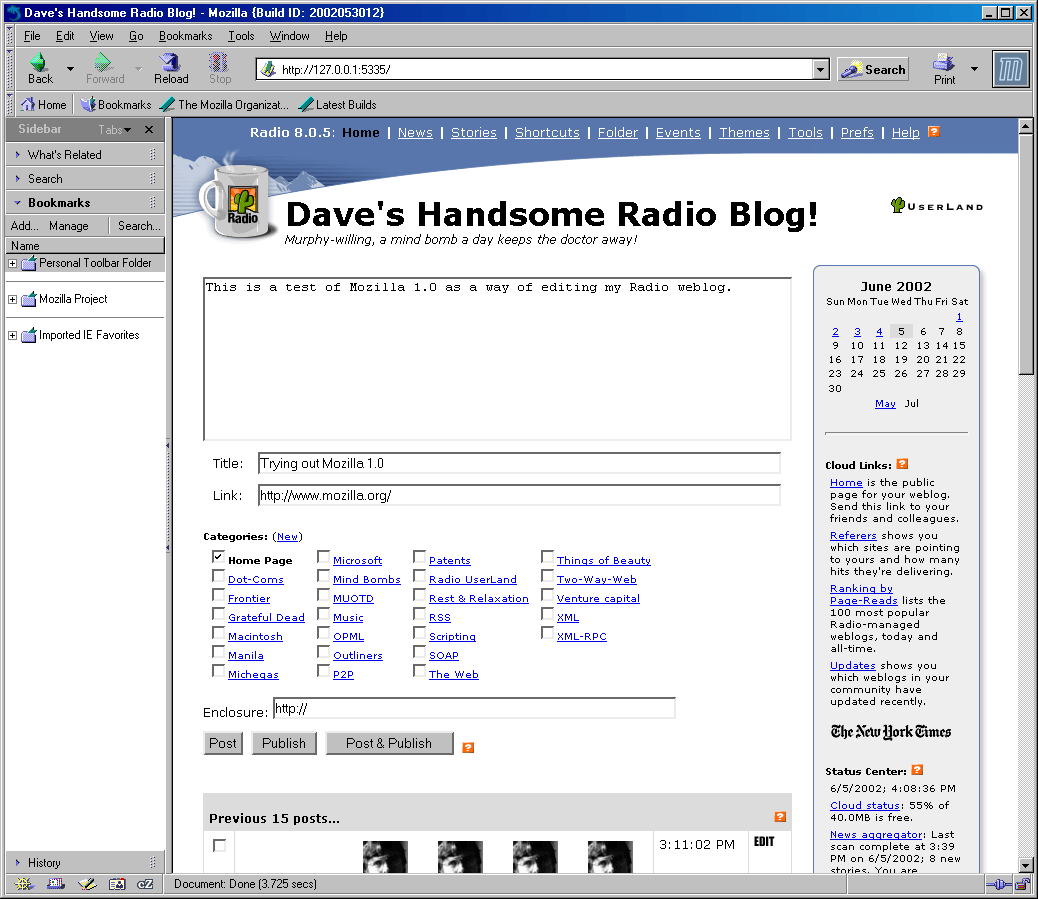
Jeff Schmidt: "When hobbyists encounter one another at a social gathering, before long you will find them talking eagerly about the content of their subject of common interest, showing an excitement, enthusiasm, wonder and curiosity that is reminiscent of beginning professional students. This rarely happens when professionals talk casually with their colleagues." Slashdot: Mozilla 1.0 released. Screen shot. Do a view source on this page on Colin Faulkingham's site. He's got a RadioPoint slide show in a single file. He asks how to get RadioPoint to output one of these. You don't need RadioPoint for that. Just read the OPML source and do the same thing. Great work Colin. Sean Gallagher: "The advertising market for reaching mid-level IT guys is toast." Register: Gopher Holes in IE. Ed Cone: "Doc Searls says his blog ain't for sale. Me, I would blog for bucks tomorrow." Oh yeah. Here's a wizzy text editor in Flash. Bing. Thanks to Jon Udell for the link. (For Radio/Mac and Manila/Mac users, this could be the way we get a wizzy editor in MSIE/Mac.) I love writing tutorials. Last year on this day I wrote a dandy. NY Times: "Hollywood studios seeking to impose electronic controls on digital television broadcasts suffered a setback yesterday as a coalition of technology and consumer electronics companies supporting their efforts crumbled in a cross-industry power struggle." News.Com interviews Apple CEO Steve Jobs. Register: "In its quest for vengeance, the paper and its FBI anti-hacking Pinkerton squad have commanded members of the press to cough up confidential information regarding the Lamo case, conveniently forgetting that real journalists need to keep their notes and correspondence private in order to do their jobs properly." BBC: "The United States served up one of the World Cup's great upsets, as they out-fought Group D favourites Portugal to record a superb victory in Suwon." Warblogs vs the Techblogs? I was interviewed by a BigPub reporter yesterday asking if it was true that the warbloggers had obsoleted the tech blogs. A weird question, because I wasn't even aware that there was a concept of "tech blog." I'm quite confused about why people think the warblogs are so great. Lots of bluster, not much useful info. Kind of like FoxNews (which I don't have the patience for either). Anyway it's good that there are more weblogs, war-based or otherwise. But I'm much more interested in librarians, lawyers, and developers getting into it. While we do bash egos from time to time in TechBlogLand, we're getting a lot more work done these days, using weblogs as the venue for sharing stuff. I like to tell the reporters that SOAP and XML-RPC, RSS and OPML could never have happened without weblogs. I asked the reporter if they could ask Glenn Reynolds to tell them when Hollywood is screwing computer users, or if they ever come up with a solution to the Microsoft antitrust case. And by the way, whose software do you think they use and do they even know how to use it? Andrew Sullivan just discovered permalinks a few days ago. Heh. Believe me there's more work to do, and it's going to be programmers and information mavens that lead the way. BTW, I have something of an advantage, in that my blog predates the media rage that centered on the Pyra crowd, so I've been through this before. Someday Glenn Reynolds will be shocked to find out that he's not the darling of the bigpubs anymore, then someone else will be blustering how they made him obsolete. It won't be any more true then than it is now. This is meta-news. Boring. One of the good things that has come from this is a renewed spirit of cooperation. Now that there are blogs with more flow than Scripting News, I think people feel less threatened by me. For some reason there's more working together going on. For whatever reason, I'm grateful for that.
Mark Kraft: LiveJournal to support RSS and discovery. Davezilla: These are the Daves of our Lives. "Everyone knows a Dave or three. Daves are always dependable, competent, rather silly and the jack-of-all trades in most offices. Dave is always the guy who can fix the copier, jumpstart your engine or make that noisy dog calm down." Marc Barrot: "Look Dave No UserTalk!" Scott Johnson posted his two chapters on Radio for the O'Reilly weblog book, for review.
Lisa Spangenberg: "I want this." Excellent. Bob Hiler: "For two years during the Internet Bubble, I worked as a Wall Street analyst in Frank Quattrone's CSFB Technology Group covering Internet stocks." Cory Doctorow blogs Howard Rheingold's keynote at the Reboot conference, in Copenhagen. I was there last year. Paolo has a new RadioPoint template. Demo. Download. I rebuilt my neighborhood, now there are tons more sources, as people add the headLinks macro to their home page templates, thereby sharing who they're subscribed to, giving my harvester more places to visit. Chuck Shotton: "The Great Leesburg Paint Scandal has reached epic proportions." DJ Adams is exploring neighborhoods using Blogdex. Thanks to Jon Udell for passing along a pointer from Jeremy Allaire to a Flash visualization of their XML-based developer feed. It's tantalizing, but.. To really work, I want to stay in Flash for the whole experience. And my aging eyes have a lot of trouble with the small type, made worse by the low contrast betw the text and background colors. Basically the whole thing is not accessible, for me, to use a term popularized by the W3C. Reuters: "Movie studios and consumer-electronics companies are close to reaching an agreement that would protect digital-television broadcasts from being copied and traded Napster-style over the Internet, negotiators said on Monday." On NewsHour last night, a segment on the demise Napster, which filed for bankruptcy yesterday. One person was interviewed, PJ McNealy, a Gartner analyst. The whole thing was about piracy. It seems the RIAA public relations campaign worked. Never mind that people can use these networks to dig up music that is not in distribution, and that at least some users would be happy to pay a reasonable price for the ability to program their own music, if only there were a way to pay for it. BBC: "A new dictionary is being compiled which will put tens of thousands of Scots words dating back as far as 800 years on the Internet." That's a good idea. When I think of Scotsmen, I think of two people, one a blogger, and the other a Simpson's character. Popular culture. Jon Udell: The Google API is a Two-Way Street. This article came out in late April, but I missed it. Good stuff.
Mark Pilgrim uses Google to find your neighborhood. Here's mine, cached on Mark's server. How it works. "Use the Google API to find which sites are related to scripting.com. Scrape each of those 'related' sites looking for lists of links to other sites. Combine all the link lists into one big list and subtotal by site."
Mind-bomb: Weblog Neighborhood Tool. Neighborhoods of Jon Udell, Jake Savin, Dave Winer, John Robb, Steven Kroeker, Joseph Ruvel, Scott Greiff, Jeff Cheney, Sam Ruby, Marc Barrot, Lawrence Lee, Jenny Levine. Howard Greenstein: "You want to put a Best-Buy and Sheryl Crow 10 Minute piece on my Tivo, fine, as long as I can delete it. Once you start taking up space I paid for, it's war." MacWorld: Turn your LPs or Cassettes into CDs. Press release: MSNBC Launches Weblogs. Pros-with-blogs. The MSNBC weblogs. Eric Alterman, Chris Matthews, Michael Moran, Alan Boyle, Jan Herman. No calendars or permalinks, so they can't really network. The URLs redirect to pages on the MSNBC site, which makes it difficult to point to them or to have them participate in weblogs.com (we had the same problem with Fortune's weblog, btw). Are those page numbers permanent or will they change? I wonder how they write these weblogs. Is that really Chris Matthews writing? How many levels of editing does it go through. Curious about the process. Do posts flow through email to an editorial person, or do they have a browser-based editing tool for the authors. Looks like they use a home-brewed CMS. I often forget that the MS in MSNBC stands for Microsoft. The press release was issued from Redmond. I guess weblogs are in the air there too. Ed Bilodeau confirms that the MSNBC weblogs do not have archives. They won't get many pointers from other weblogs. Real-time weblogs: "Professional journalists are learning about and adopting the new technology." Paul Boutin: "The open-source programmers and testers behind Mozilla are happy." Paul, Matt and Meg: Publishing Online with Weblogs. Keith Devens did an RSS Auto-Discovery script in PHP. Aaron Cope did one for Perl.
Masukomi writes to say that Zoe is going open source. On this day two years ago I learned that one of my heroes had died. I still think about him all the time. Just the other day, in the dumps, I listened to one of his talks, and was reminded that it's all happening now, there is no past, there is no future. Now is very scary. But fear is frozen fun, as some wise person once said. New links for Radio Radio: Links for Blogroll, RSS and Subscriptions. Good morning. We just released three new parts for Radio to enable the new radio.macros.headLinks macro that adds links to the head of each HTML page for RSS feeds, blogrolls and subscriptions. This is the completion of the content-side of the support for the new futuristic crawlers, harvesters and directories that we dreamed about over the weekend. There is a corner-turn in there, a change in the format for the RSS link. Oy. Anyway, glad that's over. These things are often a lot more work than they appear to be at first.
DaveNet: The Googlish way to do Directories. One of tomorrow's innovations. More links for Radio weblogs. It's going to point to the blogroll OPML, if it's present; and to mySubscriptions.opml, and a change in the format for the link to the RSS feed. We won't release the code until tomorrow, to provide a very brief comment period. My Radio weblog already has the three types of links in its head. View source to see what they look like. I had a great phone talk with Mark Pilgrim, who is continuing to kick butt with his harvester. Now he's got it connecting up with Google. The changes above are to make more powerful harvesters possible, like the one Mark is doing. This an experiment. I want to see how blogrolls and directories interact. Send me the URL of your blogroll outline and I'll add it to the list. Hey I found a gem in Jake's blogroll. He has a section for sites with blogrolls. Oh the humanity.
Anita Roddick: "Google's policy of not allowing political advocacy ads is misguided, impossible to administer with any kind of fairness, and a scary step toward restricting the free marketplace of ideas." A Boston Globe op-ed piece masquerading as news. Total hyperbole. Innovation, emphatically, is not enabled by patents. It is enabled by creativity. Patents turn creative work into a legal exercise. If you turn creativity over to lawyers then only lawyers will be able to create. Yuck. Internet.Com: "Security software maker Network Associates, Friday received a patent for storing metadata on a server." Two years ago today: "Ideas are in the air, who created it first? It's usually impossible to tell." Jack Valenti, in 1982: "We are facing a very new and a very troubling assault on our fiscal security, on our very economic life and we are facing it from a thing called the video cassette recorder and its necessary companion called the blank tape. And it is like a great tidal wave just off the shore. This video cassette recorder and the blank tape threaten profoundly the life-sustaining protection, I guess you would call it, on which copyright owners depend, on which film people depend, on which television people depend and it is called copyright." Paolo explains that IdeaTools is an OPML-based CMS. Nice! Adam Wendt explains how aggregators can leave a visible trail. Hmmm. Mark Pilgrim writes a script that discovers that he should be reading Scripting News. Mark is a great guy. We've been having fun with this RSS Auto-Discovery project. The only reason I did it is because he was so excited about it. What the heck. That's why I do software, so my mind can play with the minds of smart people. I'm also a sucker for forward motion. Sure you make mistakes when you move. That's life. If you try to make no mistakes you end up at the finish line having done nothing with your time on the planet. BTW, our next project is to unbundle the directory displaying code in Manila, and get it into Radio Community Server, so that Yahoo-like directories can spring up everywhere. Blogrolls are the first step in a bootstrap. What happens when you want more? Mark's blogroll harvester is a first step too. I hate to say this because Mark says he doesn't like OPML, but it's going to come in handy, now that the blogrolls can have white-on-orange XML buttons that link to their OPML source. Hey, just for fun I added a link element to Scripting News that points to my blogroll. Do a view source. What do you think? Is that fun or what? New Manila macro -- generates an XML Coffee Mug. Now any Radio user can subscribe to a Manila site's RSS feed. Three years ago: "The browser belongs in the operating system. The positive solution is to arrive at a set of cross-platform APIs that allow non-Microsoft HTML renderers to plug in, in place of the Microsoft renderer. We need built-in system-level HTML rendering on Mac OS too."
Announce: Aggregator supports RSS Auto-Discovery. NY Times: "While many Indians and Pakistanis say there will be no nuclear war, they often paradoxically acknowledge the possibility in the next breath." Lars Pind is developing blogging software for OpenACS. BBC: Bush says US will strike first. "The president said he would not leave the safety of the United States and of the planet to the mercy of a few 'unbalanced dictators' who are suspected of working to develop weapons of mass destruction." Tim Knip: "Now I can publish the contents of several Groove tools using the RU-community server + XML-RPC." Paul Sniveley: "I can understand being frustrated with Xanadu. I can understand being frustrated with Nelson." 9/24/99: "Do we still listen to music created ten years ago? We do. Should we look into software ideas that were explored and then abandoned ten years ago? Of course."
For me, flow comes like this. Conceive a complex software system, write the underlying code, plot out how I'm going to get people to actually use it, feed that back into the design, iterate, roll it out, and have people actually use it. Bravo to Brent Sleeper for noting that apps make a difference, and web services that are not app-driven are meaningless. I of course appreciate that he cites UserLand, but it would be just as fair to cite Blogger. Mark Pilgrim continues to lead the parade on the element, which he's calling RSS Auto-Discovery, which seems like an appropriate handle. Glad we can get a cross-blogging-tool effort going. That's more of a new thing than many people might realize, and far more important, imho, than any single feature. This is a tough time to be in business, and we have ambitious goals. It's nice to get some help. Thanks. There are two sides to this. First, get the link elements into the heads of lots of blogs. It's easy for Radio users, and automatic for (most) Manila users. So that means at least a few hundred sites have discoverable RSS right now. The other side is the aggregator. There aren't that many aggregators, probably the largest installed base of aggregators is Radio. The other day I said they don't leave that much of a trail, but then I realized they do. Look at this page, it lists the top 100 most-subscribed-to feeds in the Radio community. The numbers are getting pretty big. And then here's another list. It tells you in real-time the number of people who are getting news from which sources, today, and since we started tracking this stuff on 3/3/02. When this mania launched, Matt Griffith said: "Now I just need an aggregator that supports it." This comment loomed over my ego. That has to be Radio, I thought to myself. So I got busy and figured out how to do it. I'm going to release the two new parts when I am confident that nothing breaks. Done. The next cross-weblog-tool community project should be the Creative Commons XML data that says what rights the author grants. I've not heard anything since the project launched. What's the status? Steve Gillmor: "It's the new Hatfields and McCoys -- the entrenched monopolists vs the disruptive technologists."
|
 
|
|||||||||||||||||||||||||||||||||||||||||||||||||||||||||||||||||||||||||||||||||||||||||||||||||||||||||||||||||||||||||||||||||||||||||||||||||||||||||||||||||||||||||||||||||||||||
|
© Copyright 1997-2006 Dave Winer. Previous/Next |
||||||||||||||||||||||||||||||||||||||||||||||||||||||||||||||||||||||||||||||||||||||||||||||||||||||||||||||||||||||||||||||||||||||||||||||||||||||||||||||||||||||||||||||||||||||||