|
|||||||||||||||||||||||||||||||||||||||||||||||||||||||||||||||||||||||||||||||||||||||||||||||||||||||||||||||||||||||||||||||||||||||||||||||||||||||||||||||||||||||||||||||||||||||||||||
Chuck Shotton: "I've written up a set of proposed extensions to the RSS 0.94 draft to resolve some ambiguities about content types and encoding formats." Garth needs some help from someone who knows the internals of Jabber. To Joel, here's why Groove can't bet exclusively on being a platform. "Most proposed platforms don't make it. It's just a fact. It's not my fault. It's not yours." Don Park writes about corruption in Korea. Doc: "It's a start, but it's got that delegated, glands-off look. It's you know: a site." NY Times: "At AOL, Mr Colburn and Mr Gilburne made an oddly complementary pair, several people who worked with them said. Mr Gilburne is a broad, strategic thinker with a quiet, professorial demeanor. He is prone to stroking his beard, alluding to Shakespeare and making Delphic comments about the technological future. Mr Colburn, on the other hand, is as volatile as Mr Gilburne is sedate. People who worked with them said Mr Colburn paced conference rooms with bleary eyes and a five o'clock shadow. He was known for wearing Armani suits over black T-shirts depicting cartoon characters. And Mr Colburn was also as intensely focused on details as his mentor was on the big picture." John Patrick found some free bandwidth in Ocean City, NJ. There's a new meme going round. Tell me who you are in five words or less. Easy easy. First the long version. I am a man. That means I dig holes. And then fill them in. Then dig some more. So I can do it in two words. Still diggin. Peterme has no credit. Interesting story. Read the comments, they're interesting too. Last year on this day I wrote about taboo-busting and aging. Two years ago today I explained why the misnamed RSS 1.0 was a setback for RSS. No one cared. Sad. Sam Ruby posted a table showing the evolution of various formats called RSS. I sent him a bunch of corrections and they were incorporated. Five years ago today, a princess died in a car crash. Breathwork and open source. You might think one has nothing to do with the other. But someone on a mail list devoted to breathwork, that I subscribe to, has constructed an amazing argument, fantastic in its boldness, with elements of truth, but quite misleading. Not caring Showing that you care is something you're not supposed to do. Better to stay aloof, uninvolved, like a TV character. "I don't really care," I say, when nothing could be further from the truth. This is the American way. (Or at least the California way.) But, at some point you have to take a stand. Maybe it's in the last days or hours of life, struggling against cancer, heart disease or diabetes, or whatever's gonna getcha. Maybe at that point it's okay to care, to take a stand, to fight. But I suspect not. Even then people say "What's he getting so riled up for?" The answer of course is fairly obvious. It's called living, and it's worth getting agitated over, in theory.
As promised, here's the first draft of the RSS 0.94 spec. It's a consolidation of all the specs I've written over the last two years. A few new features, listed on the (new) change notes page. Please read the roadmap to see what comes after 0.94. I'm not looking for much feedback until next week, but of course if you like it, no need to wait to say that. NY Times: "Many blogs, Iranian or otherwise, are boring accounts of people's daily lives, or gibberish-like streams of consciousness. But in Iran, bolstered by the anonymity their computer screens provide, female bloggers are catching attention for their daring and articulate mix of politics, dirty jokes and acid comment." News.Com: Out with AOL, in with Jabber. O'Reilly: "With the release of Mozilla 1.0, the world now has a browser that supports SOAP natively."
Halley also wrote the famous Internet essay that begins with this stunning sentence. "When my dad wakes up today, the first thing he will notice is that he is dead." Megnut: "You see, I never liked tomatoes." Same here. No strike in 2002. "With only hours to go before the first scheduled game on the day baseball players set as a strike deadline, management and union negotiators reached agreement on a four-year contract." Doc Searls reviews Apple's new Jaguar version of Mac OS X, from a user's point of view. Eric Albert: "Scott Rosenberg gets the story wrong regarding Apple's use of the DMCA.." According to News.Com, Apple Computer said it "plans by next month to release to the open-source community the technology it calls Rendezvous, which allows networked devices to automatically find each other."
Audioblogging collaboration betw Adam and Garth? Lots of interesting posts on Doc's DG. It's really spooky watching the archive for 2001 over the last couple of weeks. I can see the events in my world that preceded 9-11, the stuff that would get thrown in the air and pushed aside as we struggled to understand. Note that last year I said that Red Hat was overvalued at $600 million. Have to eat the words. Today its market capitalization is over $840 million. As Gomer Pyle used to say: "Surprise surprise surprise." On this day in 1997 I published a trial business plan for the now-defunct Power Computing, the leading Mac clone vendor of the day. Heads-up. I'm doing my first post-surgery technical project, a merging of the RSS 0.91 spec with the 0.92 addenda, and documenting the new features in 0.94 and including a roadmap for evolution, all in one Web doc with a liberal copyright. Should have a draft ready later today. An example of an 0.94 feed.
I have my instant outliner going again. Radio users can subscribe using the OPML coffee mug on DHRB. The new thing is that notification happens via instant messaging, not polling. And there's something really new in there. A remote procedure invocation protocol. They are not remote procedure calls because they don't return values and are asynchronous. But you can pass parameters, complex ones, using the encoding of XML-RPC. It's the loop-close on the work we did in Keystone with the Jabber folk last August. Works with AIM too. We're bootstrapping on the Radio-Dev mail list. Early in June I wrote a piece about journalism, exposing a vexing problem, and I said something that I believe, that would surely hurt a friend of mine, Dan Gillmor. Dan called me last week, just to say hello, and to express his best wishes for my recovery, which is going well, even if it's way too slow for my liking. Dan's a good guy. I am an extremist, in much the same way Ray Ozzie is becoming one (and Jon Udell is not). I started blogging because the professional journalists carry such huge conflicts, and often don't disclose them. They have to do it to keep their jobs. Human beings in difficult spots. But as a product developer, I couldn't get news about my products out through them. It got so bad that in 1993 I retired from software. I got back in because quite by accident I discovered that I could create my own waves without help from the pros. Now as a result I am a total hardass when it comes to undisclosed conflicts. Sometimes I lose friends because of this. Comes with the territory. I'm glad Dan is still my friend. I love the guy. I feel his pain, he feels mine. Right on. I still get my nose rubbed in the bullshit of the pros every damned day. People who don't tell their readers, and possibly don't even tell their editors, that they're making money on the side in areas they cover. I am totally sick of it. Sweet new design over at Evhead.
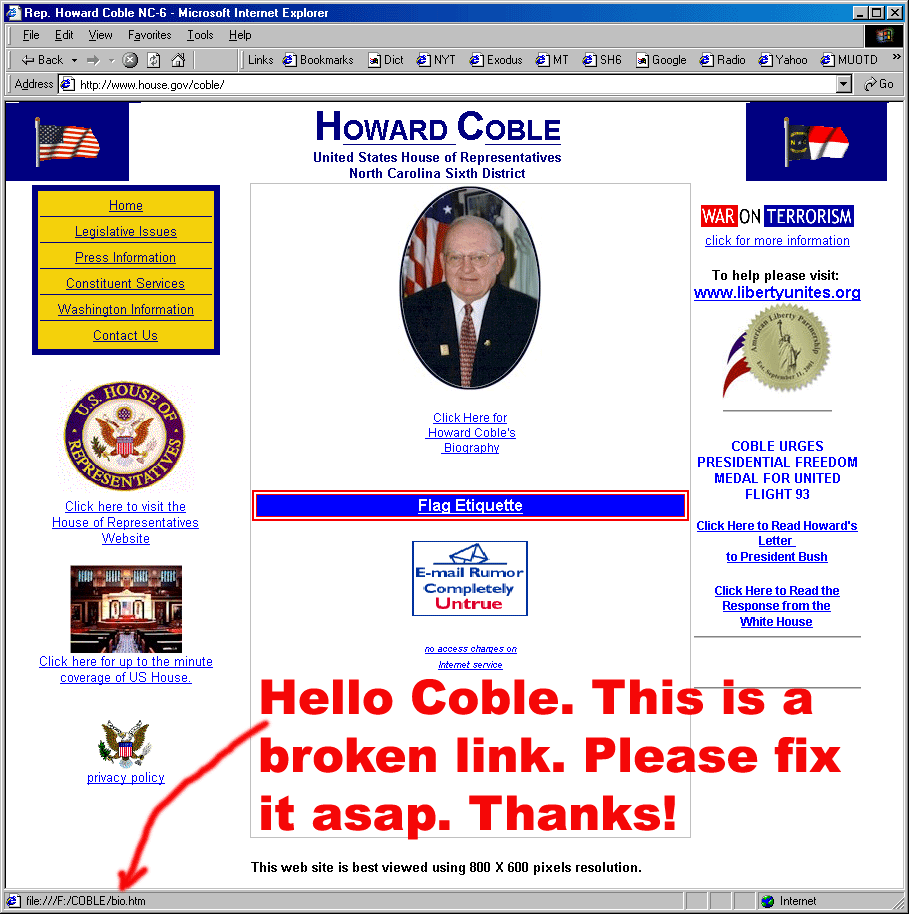
A brief response to Larry Lessig's story about releasing the source code of MORE. Sheila Lennon: "In order to foster the creation of a culture, copyright procedures were established that included sending copies of your work to Washington, thereby establishing authorship and date." Brad Pettit: "As for Lawrence Lessig's romanticized notions of MORE ('many who share my affection for this clean bit of code'), and for those who think the MORE source should be placed in public domain, be forewarned." Ken Hagler works at Symantec. He's raised the question reviving MORE internally. Interesting comments. Sandy Wilbourn responds to Lessig. Sandy is a former VP at Rational Software, and a personal friend since college. As noted here on Sunday, the link to Chairman Coble's bio is still broken. Scott Rosenberg: "Apple found the DMCA to be a pliable tool, easily adaptable for its own ends that have nothing to do with protecting intellectual property." Sean Gallagher: "Well, I'm sure that both Notes and Publishing, if they could be rendered as corporeal beings, would quote Python as well: 'I'm not dead yet.'" The users of a product called Blender are buying it for 100,000 Euros. That's an interesting idea. Good luck to Brian D Buck who's on a new round of chemo. Jon Udell: "I don't know exactly when it happened, but at some point I became an extreme anti-extremist." Have you ever been to this intersection?
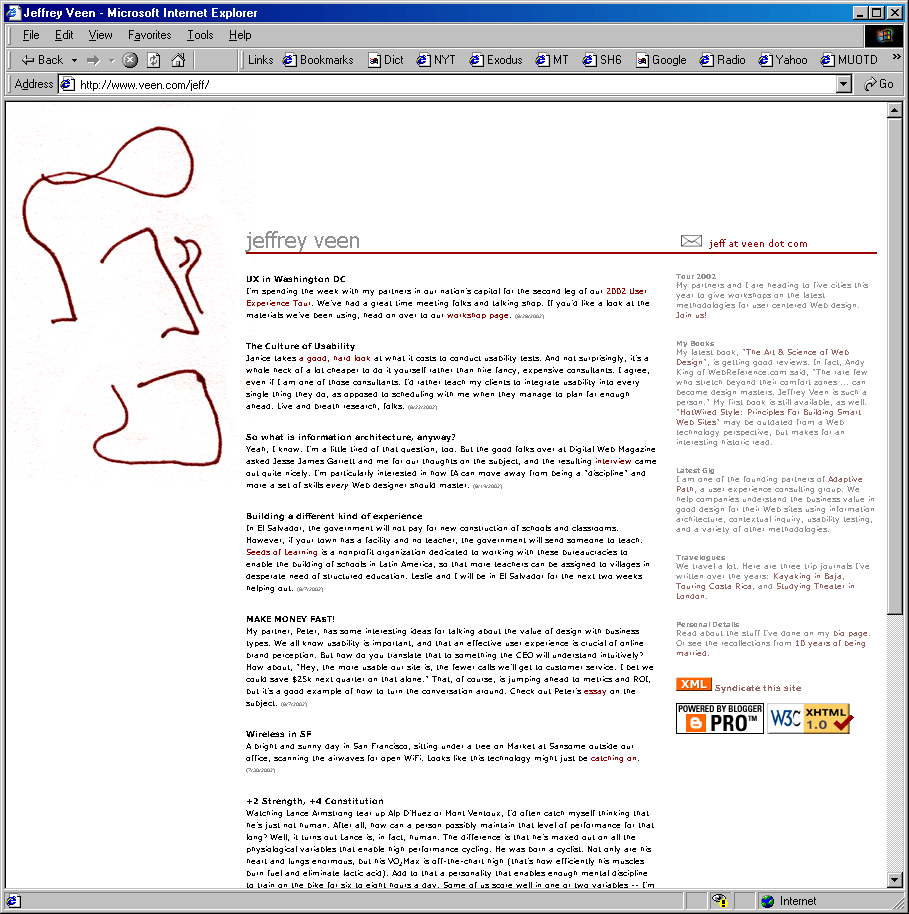
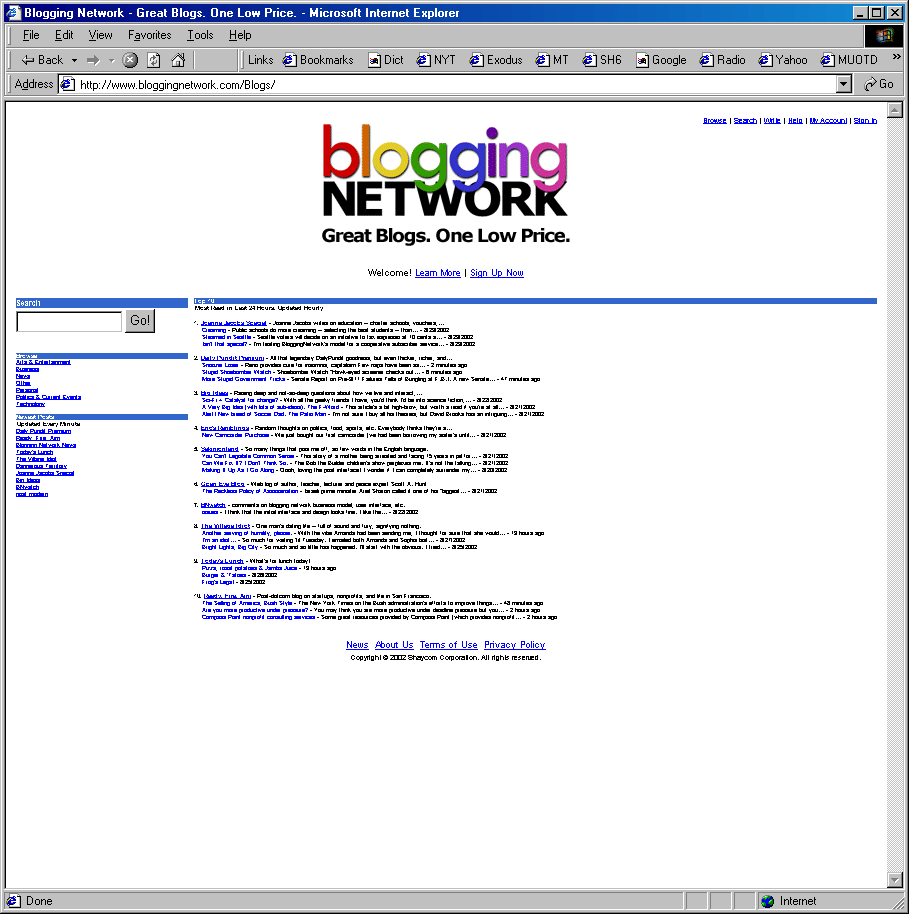
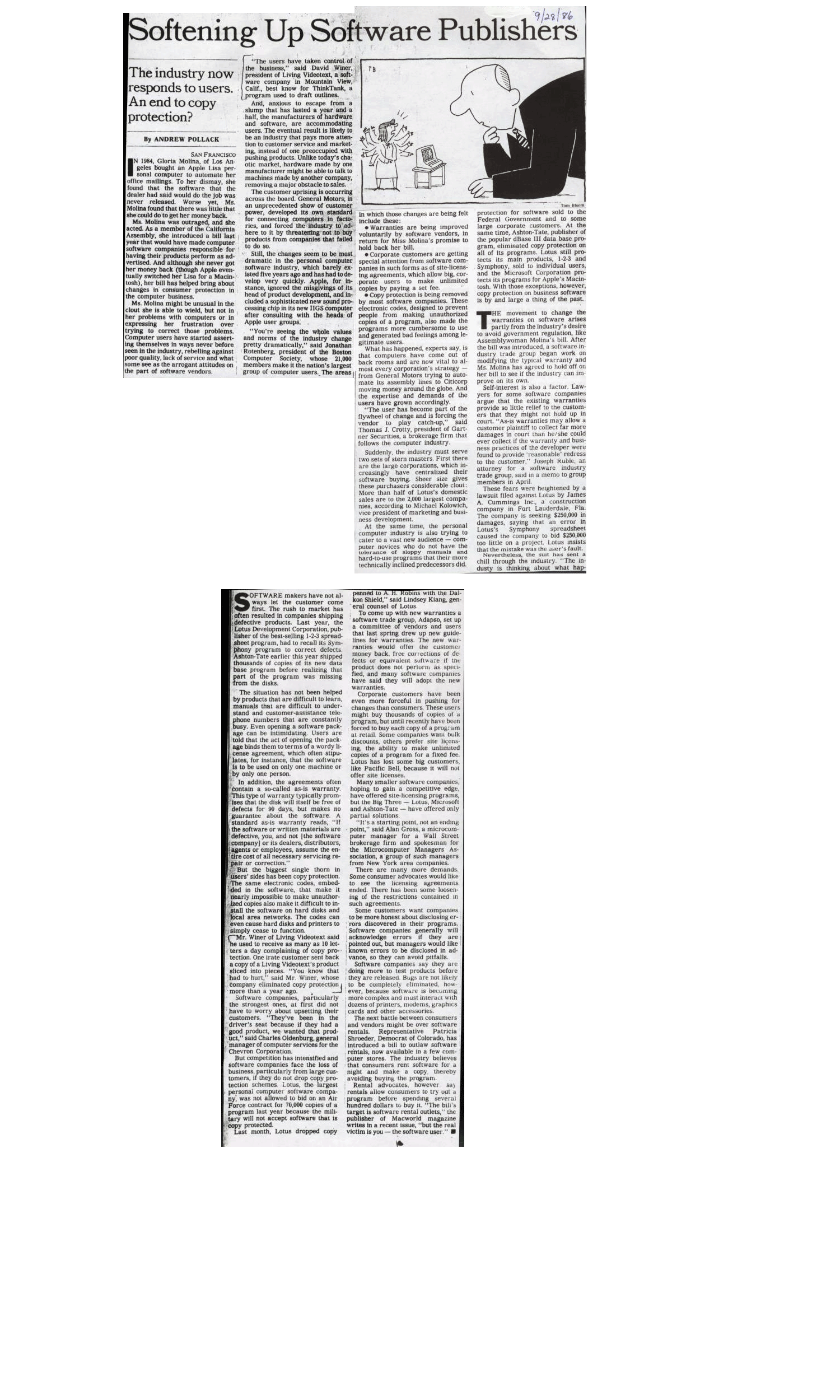
New feature for Radio 8 users. Monthly archives. Just in time for the end of the month. Here's the August archive page for DHRB. Lots of coool pics. Yeah. There's another feature in the pipe, should be released later today. Instant outlining notification over instant messaging. Very rational, right? Still a glitch or two remain. Larry Lessig thinks the world would be a better place if the source of MORE was in the public domain. News.Com: "Apple Computer has invoked the Digital Millennium Copyright Act to prevent its customers from burning DVDs on external drives." Another site that I can't read. Screen shot. Luckily it has an XML feed so I can subscribe to it. NY Times: "The iMac, a graceful piece of art whose astonishingly thin screen floats in air on a gleaming chrome elbow, sells well enough. But whenever a Windows PC maker tries something similar, buyers stay away in droves." Christian Crumlish is looking for pointers to philosophy-oriented weblogs. Ray Ozzie: "Publishing is dead." Don Park: "Publishing is not dead." Rahul Dave: "I am fed up with all the spats and counterspats about licensing, copyright, open-source, free-software, and other yadda yadda yadda. So let me propose a new monicker for software, an inclusive monicker, Loving Software, the software which loves both its users and developers." Tara Sue: "Junebug and I are celebrating for the next five minutes. We' ve claimed our first campaign contributions from Paypal." Thanks to Patrick Breitenbach for helping expedite the Paypal connection. Thanks to Glenn Reynolds for helping to spread the word. Halley Suitt: "I took the plunge and wow.." Yesterday I asked why RSS 1.0 is called RSS. A bunch of interesting responses, some of which I collected onto a single page. Several different points of view represented. Esp read Seth Cousins story, it's a bit of a rambler, he's a techie but a RSS newbie. As the day goes by I may add more points of view. It's good, we're making progress I think, and no flames. Thanks. For crying out loud David, it's super simple. If I build a house I can live in it as long as I want. If I want to rent out rooms I can do that too, as long as I want. Chris Chapman reports that the RIAA website was hacked overnight. He has a screen shot. As a computer professional, I can never condone this sort of thing. It's not okay to deface other people's sites, no matter what the cause. Now, that said, of all the sites on the Web, the one I care the least about being hacked is the RIAA site because they are asking for the the legal right to do that to our computers. Remember the Golden Rule, do unto others as you would have them do unto you. News.Com: RIAA site comes under second attack. Another impossible-to-read website. Screen shot.
Sarah Deutsch, chief counsel for Verizon: "We oppose the Berman bill. It's very troubling in that it essentially permits one particular segment of the US industry to engage in vigilantism on the Internet." Steve Gillmor: "Notes is dead." Don Park has a weblog. Don and I worked together in the late 80s. I don't remember how we met, but I asked if he could hack IPC into the pre-System 7 Mac OS, and he said yes, and did it. I put an API on top of it, wrote some docs and sample apps, and thus was born UserLand IAC Toolkit, an ancient forerunner to Apple Events, XML-RPC and SOAP. Today's song: "The mystery man came over and he said 'I'm outta sight.' He said for a nominal service charge I could reach nirvana tonight. If I was ready, willing and able to pay him his regular fee, he would drop all the rest of his pressing affairs and devote his attention to me." CamWorld: "I leave for Krasnoyarsk, Siberia in Russia in one week." Wow. News.Com: "More than 100,000 copies of Apple Computer's OS X 10.2 operating system were sold worldwide during its first weekend, the company said." Apple's Ken Bereskin is pitching new Jaguar features one at a time on his weblog. John Robb: "Yesterday, I had the distinct pleasure of meeting Rajesh Jain, the CEO of India's Emergic." Tara Sue gets a mention in USA Today. Screen shot. David Reed discusses Howard Coble's editorial in rebuttal to Ed Cone. He sees contradictions and double-talk. It's interesting, because of his chairmanship of the key House subcommittee overseeing the Internet, Coble is not only accountable to the voters of North Carolina, the citizens of the United States have a special interest in his opinions and thought process. Reed says something that's been much on my mind, something I'd love to hear Coble comment on. "Copyright holders can sue under the existing laws. Why create new rights of poorly restrained vigilantism?"
I wonder if someone can answer a simple question, without being insulting. Here's the question. Why is RSS 1.0 called RSS? Please state your opinion, if you have one. (BTW, if you don't understand that question, that's okay. Instead, send me an email saying what RSS is.) Lance Knobel discusses a Guardian interview with Britain's chief rabbi, Jonathan Sacks. This caught my eye because there are a couple of people with the same name floating around the US computer industry. One is a co-author of Lotus 1-2-3, and the other was an editor of InfoWorld who went on to be a top exec at AOL, retired, and is probably worth a couple of billion dollars. I guess it's a common name for talented Jewish people! ;-> Another early Lotus person, Bob Ramsdell, has disappeared from the face of the earth. He's a Googlewhack. He had a bad heart then, he was looking for a transplant in the mid-80s. I hate to jinx it, he's probably alive and kicking butt somewhere, just out of sight of the Web. I ran into one of his friends a couple of years ago and asked what had become of Bob, and she didn't know. I sorta guessed that Raines Cohen would know the answer. Bob died in February 2000. I'm sorry I didn't think to ask sooner. He lasted a long time for a guy who was so sick. Raines writes from Burning Man. "I remember Bob well from the Micro Finance Systems/Lotus days, I was a junior high school summer intern down in the basement in Central Square, working in 1980 on Apple II development of Executive Briefing System, little known as Lotus's first product. I also remember meeting your brother there and doing netadmin work, installing a Microsoft CP/M card in an Apple II in order to support characters needed for the programming language for 1-2-3)." That's funny. I didn't know my brother made the pilgrimage. Thanks to Google all this stuff will be recorded, and Bob Ramsdell, Raines, Lotus and my brother will be forever connected. Cool. One more thing. Raines says Bob's son Blake is following in his father's footsteps. And, of course, he has a weblog.
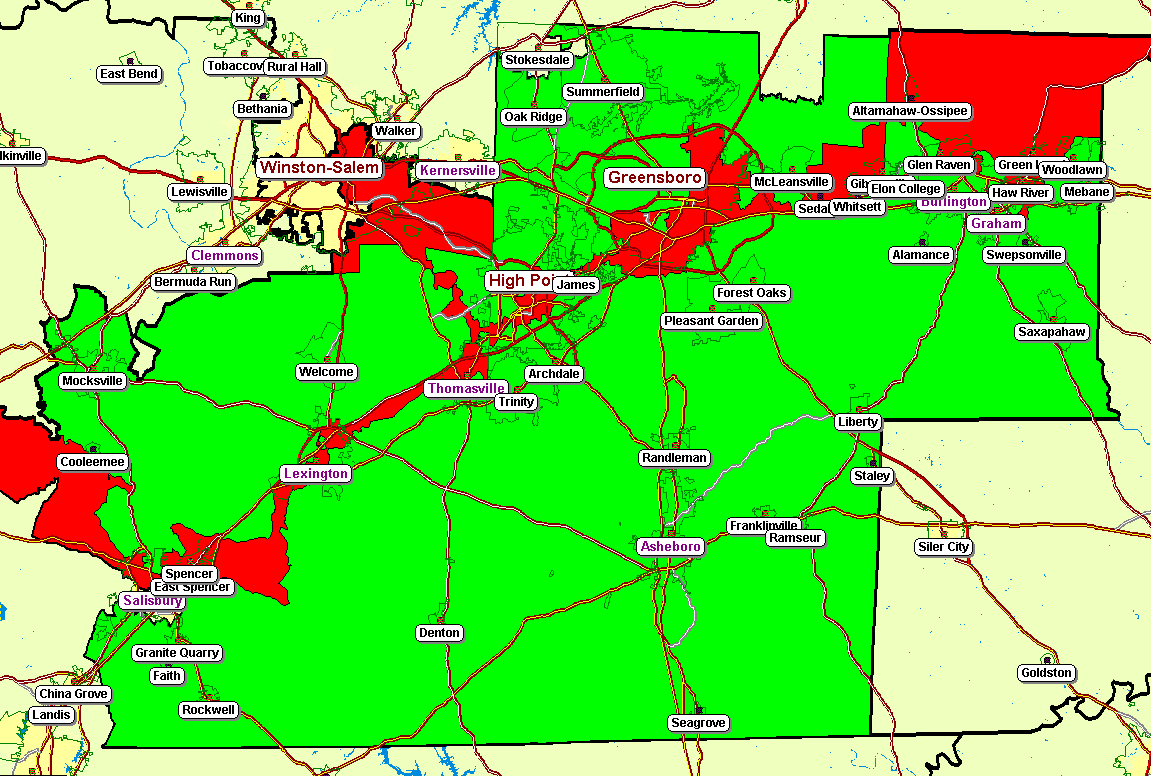
Welcome to Tara Sue's new weblog. It's a Manila site, so we can work on the templates while she's posting. It also has membership, you can join the site, and get bulletins, and participate in the discussion group. Of course since it's a website, it's still a work in progress, but it's a lot more functional than the original site. Howard Coble: Digital piracy bill is sound "Many intellectual property companies are already using some of these defensive measures now and believe it is legal under current law." A list of law-related weblogs. Today's song: "Only in America can a kid without a cent get a break and maybe grow up to be President." Some have asked who's paying for Tara's site. I wrote a page that explains. George Girton sends a map of North Carolina's Sixth District. He says "Here is a small map of what Tara's district looked like last time around (106th Congress), we are now on the 107th, so it could be different. Hers is shown in green, the 12th NC district is shown in red." Here's a site with maps and statistics for the 107th Congress districts in North Carolina. Thomas Madsen-Mygdal: "The next Danish prime minister will have a weblog." Evhead: "$2.50 G&T's. It's like you're making money." News.Com reports that Intel "released desktop Pentium 4 chips running at 2.8GHz, 2.66GHz, 2.6GHz and 2.5GHz, and those chips will be incorporated into new PCs from Dell Computer, IBM and others. Gateway, for example, is using the 2.8GHz and 2.6GHz processors in its new Profile 4 line of computers with a built-in flat-panel monitor, which debuted Monday." Danny O'Brien: "I have an always-on broadband connection, so I can check my mail from anywhere by logging in to my home computer from any net connection. And I do not need spare storage on someone else's server as I have enough spare disk space at home, thanks very much." Scot Hacker is choosing a weblog package for students. I think Manila would do it for him. There already are a few Manila installations at his school, I think. How a link from Instapundit turned into love and marriage. Karsten Januszewski from Microsoft floats a trial balloon for using UDDI to locate RSS files. People who think Washington is passing big laws that screw up the Internet should read Ernie the Attorney's legislative agenda for DC. It's funny but when you're finished rolling on the floor, give it some thought. The courts and a little civil disobedience can fix a lot of bad laws.
NY Times: "These days, Internet users complain of a proliferation of Web sites that offer a peek up Anna Kournikova's skirt or that hawk pills to increase the size of their sex organs. The Internet was supposed to make people's brains bigger."
A fantastic weblog covering the World Summit on Sustainable Development, in Johannesburg, South Africa. Thanks to Shelley Powers for the link. Note: I had an idea how to get the two forks of RSS to merge, but then I did a bit more investigation and found it was a dead end. I was surprised that the top-level element in the RDF branch is not Aaron Swartz wrote a template for a letter to a congressperson that outlines an enlightened view of the mischief that Congress has been up to on behalf of the entertainment industry. I got a funky Russian greeting card with a monkey and even funkier music. If only I knew what it said! (Postscript: I've gotten numerous translations now. It's spam. Shucks. I was hoping I had a Russian friend who thought I spoke Russian.) To Michael Rogers who asks how frequently a person writing a weblog should update (I hate calling these people bloggers, as Rogers does, that's a trademark). My answer is As frequently as something happens and you have the time or inclination to write it up. Rogers then says something provocative: "The kind of article that a writer produces after a week of thought is fundamentally different than one produced after a few hours." True. But you can keep lots of ideas in your head, and think about them for hours, days, weeks, months, years or decades; and even repeat them and expand on them, and (rarely) change your mind about something. Even great writers like Hemingway repeated themes. People who blog do this even more. It helps fill the space. Every event is an opportunity to "prove" ones' pet theories. I do this a lot. It's okay because everyone else does it too. John Robb trawled the Web to find incumbents who were more likely to lose their jobs in the next election, and received big bucks from Hollywood, and supported one of the initiatives to hack the Internet for their contributors in California. If you live in the districts of one of these Reps, you have extrordinary power in November to change policy in the US for the better. Your vote, and your neighbors' votes, really mean something this time. BTW, it's interesting to see that the Internet issues don't appear on the candidates' websites at this time. Ed Cone, in today's News & Record, continues the discussion of the digital vigilante bill sponsored by his district's Rep, Howard Coble. It's remarkable, don't miss what's going on. A fairly random district in America's industrial South is becoming a hotbed for one of the most interesting faceoffs in politics, economics and the Internet. Dan Gillmor: "It's doubtful that Tara Grubb worries Hollywood's movie moguls or the people who run the record industry." Standing on the toes Sir Isaac Newton said "If I have seen further it is by standing on the shoulders of Giants." A beautiful idea, something like "Only steal from the best." BTW, it might have been sarcastic, it turns out, but it's still a nice sentiment and a good philosophy for explorers, leaders and scientists like Newton. Brian Reid, said "In computer science, we stand on each other's feet." That's still true, to this day, and very unfortunate when it happens. Blaze a new trail, start something different, take what we know and discover something completely new. But be careful when you do that. "No good deed goes unpunished."
Glenn Fleishman reviews the new Mac OS X. Destined to take the place of the mud shark in your mythology. I spent most of today working on a new Tara Sue website, one that will be easier for her to work on, and easier for us to help her with. As I was putting together the initial blogroll, I decided to link to Howard Coble, her opponent. I wondered how Tara would feel about it. I just walked her through the new site, and when I explained this part she literally shreiked with delight. In other words, there's an impedance match on values. Of course we point to our competitor. An informed reader would want to know about Coble. His site is part of the big picture. Gotta link to it. Makes sense, right? Ed Cone: "After my first column ran, Coble's chief of staff, Ed McDonald, told me on the phone, 'Now we are going to rip your face off.'" Coble responded to Cone's column in the print edition of the News & Record, but not on the Web. Please, please, all this stuff must be on the Web. All. Must. Got a couple of emails overnight from Tara Sue. She was up till 4AM working on her Web stuff. Right on. Evreyone is setting expectations really low for Tara, but not me. I think she can win. I think the voters are smart and will be able to figure this one out. I love that Coble's chief says he's going to rip Ed Cone's face off. Ed is a powerful dude. That's strong motivation. It also helps undermine the reputation Coble has for being such a nice guy. Look who he's running against. If I were him, I'd apologize right away and send Ed a case of whatever beer they drink in North Carolina. His Good Old Boy reputation could be at stake. Let's also see if Coble reads Scripting News. Ray Ozzie had a lawyer at Groove, Jeff Seul, draft a weblog policy for employees. Meanwhile, back at home, Tara Sue has been Slashdotted.
Political Web: "An analysis of Web sites promoting candidates for House, Senate or Governor in the 2002 election shows that relatively few have tapped the potential of the Internet to stimulate political action on or through their sites." Ernie the Attorney links to two articles, one passionately in favor of reform in the music business, and one passionately supportive of music industry hacking of users' computers. Ernie says he agrees with both. I find that amazing, but we live in amazing times. Weinberger's third point was particularly stirring, to me: "The very thing the most conservative among us have dreamt of, have died for since the founding of this country, is now within our grasp: free markets, free speech, worldwide. And we're blowing it because some dinosaur companies insist on maintaining their grip on every last dollar before their industry dies. 500 million of us can see how close it is, how the world economy would blossom, how the human spirit would get dizzy with possibility, and we're arguing about how we can best prevent it?" Jon Hanna wrote a tutorial on RDF. Cute title. In Business 2.0, Dylan Tweney says a weblog is a "quick-and-dirty, easy-to-use knowledge management system."
Megnut: "For those of us that are self-employed, and for those that are unemployed, health insurance continues to be a big expense, and an even bigger pain in the neck." Amen. Charles Cooper: "Lessig would limit software copyrights to 10 years. After that, the code would wind up in the public domain. I can't think of a better prescription for formalizing the existing constellation of power that favors the Microsofts and Oracles over the small and independent developers." BBC: "Millions of people using Microsoft's Office and Internet Explorer programs are at risk from security holes that could allow malicious hackers to change files on their computers." News.Com: Apple to unleash Jaguar OS upgrade. David Fletcher: New Utah Weblogs. Is today the third birthday of Blogger? According to my archive, it is. Congrats! Meg confirms that today is Blogger's birthday. Through the magic of archives, next year we won't have to wonder. News.Com: Hyperlink patent case fails to click. Ed Cone: "Comebody could end a political career pretty damn fast by letting out some 2 AM brainfart onto the Web." I don't agree with this prediction. My guess is that when politics and governance move to this medium, it will be a lot more resilient than TV. Remember, in this medium, each voter can have his or her own TV station. It's gratifying to read about the role weblogs are playing in news from the Middle East, through Lance Knobel's weblog. In 2000 and 2001, Lance and I wanted to offer weblogs to people attending the World Economic Forum annual meeting in Davos. The management of Davos didn't think it was worthwhile. That was one of those times when we absolutely knew we were right, and that one day we'd get a big I Told You So (assuming anyone remembered the proposal). Eventually the world will be run with weblogs, much the way it's run with telephones today. My belief is that when you find a technology of this stature, you deploy as quickly as possible, without worrying. It could be that weblog technology would avert the next international crisis, or deal with its aftermath, more effectively. (Actually there's no "could" to it, to me it's a certainty.) Here we go. Wired News lifts Tara Sue, and gets Coble's staff to hedge on the Hollywood hacking bill. She's the first candidate with a weblog. Yeah. Soon all races will be run on weblogs. All of them. By the way the Plotkin quotes really sting. How did Tara Sue's weblog get going. Wasn't that the technology industry? Sanjiva, an IBM SOAP developer, comes from and lives in Sri Lanka. He posted a photo essay of a recent trip he took, with monkeys and elephants. Lawyer jokes Happy Friday, one and all. Thinking about Lessig's Hemingway story. Also wondering why Lessig's book isn't on the Web, so we can read his code. So many mealy-mouthed advocates for this guy. That's kind of a clue. They believe in Free Software. All of them paid $21 to read Lessig. Let me know when you get that to parse. (Would they pay the money if they could read it for free on the Web?) Anyway, I don't trust people who tell me that Hemingway reveals all his source code when nothing could be further from the truth. A writer of prose reveals the final copy and nothing more. He doesn't reveal the life experiences that taught him the lessons that the book teaches. He doesn't tell you which ideas he stole from other books he read. He omits all the blind alleys and dead ends, the characters and plot ideas that didn't make the cut. The novelist omits the text of all previous books, and that's interesting because many if not all authors write the same book over and over, refinining it, narrowing the focus, taking stuff out, amplifying and discussing. Some of my favorite authors work that way. Bottom-line, despite what Lessig says, there's no full disclosure in art. Yesterday John Robb said something profound about The Commons. It's almost empty. Not many want to put anything in. Or we want to be selective about it. You can read Scripting News and DaveNet for free. You can even use Radio and Frontier for free, for a short period of time while you evaluate the software. But this world, with doctors, hospitals, grocery stores, cars, gas, insurance, medicine, lawyers, etc, requires money. The trick is to have art in your life and make some of it pay. And that in itself is an art. My core objection to the doctors of You-Give-Me-Your-Source is that there's an art to what you give. Ask anyone who actually knows my work, not people who put me in the same league as $30 billion companies. I give you a lot of my code, but not all of it. Apple does the same with theirs, but they flip it around. No one knows which approach is "right." It's arrogant to think you can dictate the terms of gifts, esp when you aren't yourself immersed in the art. That's what I don't like about Lessig and his followers. They don't do, they just talk. It would be as if I told Bowie or Elvis Costello or Sting how they had to make music for me. Well fuck that shit. I want the music that comes from their creative process. If they want to give me the source, so be it. If they don't that's okay too. Lawyers. Plug in every lawyer joke here. If you think I haven't been generous enough, check it out. It's like the visitors to an art gallery thinking they're seeing all the art in the world. For once I'd like to see the artists get to blow away the critics. Perhaps that's what the Internet makes possible.
Washington Post: "The most downloaded album in Internet history -- the recently released 'The Eminem Show' -- is also the best-selling album of the year, which suggests that at least some fans were spurred to buy the disc even though they already had it stashed on their hard drives." Wired: "[Verizon] refused to comply with the order, arguing the entertainment industry is presuming the guilt of its users without any due process." BBspot is a "satirical news and comedy source and meant to be funny. If you are easily offended, gullible or don't have a sense of humor we suggest you go elsewhere." Mac Net Journal: "Chuck Goolsbee from Digital Forest, the ISP that hosts Mac Net Journal and my other business site for White Rabbit Publishing, posted an interesting note yesterday to the TidBITS Talk mailing list about the MPAA going after his business to shut down an individual user who is sharing Simpsons material through Gnutella while connected to Digital Forest." Tomorrow is Day 70 of No Smoking Dave. Ten weeks. A non-smoking story at the Bowie concert last week. As I'm walking out I see people lighting up everywhere. Smell of smoke all around. It smells good. I really want one. In my mind I outline the steps it would take to be smoking and the amount of time it would take. I would ask someone if they could spare a cigarette. If they said no I'd offer them $1. Oh hell, just offer $1 to begin with. Whoo, where would I get a match. I'd ask for a light. Take a drag. Estimated time, 15 seconds to one minute to first nicotine rush. My heart started beating faster. I felt scared like you feel on a NY subway platform as a train is entering the station and you're standing on the platform and in the instant before it passes you think how you could end your life by leaning forward. I never actually jump, and that night I didn't smoke, and it's good that inside I equate smoking with death so deeply that it invokes my subway nightmare. Do I have it beat? No way. I am still an addict, I expect I will be for life. But I'm an addict in recovery, who is not taking the drug. Even better, I am becoming a constant evangelist for a nicotine-free lifestyle for nicotine addicts, illustrating the old adage that you teach what you most need to learn. Ed Cone: "What is success for a neophyte Libertarian against a GOP heavyweight -- 20%? Would 30% be shocking? The last Libertarian got 9% to Coble's 91%. The successes of Grubb's campaign, and its implications for the Weblog nation, will most likely be incremental, not monumental. But in the real world, that's impressive enough." Doc: "Give every journalist in the whole AOL/Time Warner organization a blog." SJ Merc interviews Janis Ian. "She credits Napster and its progeny with sparking renewed interest in her music, at a time when she can't be heard on contemporary-hit-obsessed radio stations. And she says her decision to offer free music downloads had done the opposite of what the industry predicts it would do: It caused a 300 percent spike in merchandise sales." Glen Daniels is "lucky enough to share a house with the two best cats on the planet." Amy Wohl: "Copyright remains an inappropriate mechanism for protecting software because the right model would let IP owners do what Dave Winer does with his software -- let people develop on top of it or even create another version of it and do that legally -- while still protecting his right to collect revenue from the use of the software itself, should he choose to do so." John Robb: "That a puny $20 billion industry is on a path to potentially cause $100 billion in damage to the US economy based on less than $1 billion in suspected damages defies reason." Joshua Allen rambles his way to an important idea. "The whole point of loosely-coupled architectures is that you don't need to have access to source code to get the network effect." Exactly right. Think about XML-RPC. I can deploy applications that cross all kinds of technical, philosophical, and economic boundaries, without installing other people's software, and certainly not requiring me to see their source code. Yuck. Who wants to read someone else's source? Have you ever tried to read Perl code? Dawn to Doc: "You are the sexiest and sweetest tech blogger ever." That's the truth. More thoughts on Lessig More thoughts on Lessig's proposal for software copyright reform. First I don't have a good pointer to a Web page explaining his proposal, so I'm having to do this from memory. I'm not going to buy his book because I don't want to give him any money because I find what he wants so unsupportable. If you've read his book, and if I've got his proposal wrong, please send me a correction. Thanks. Here's the deal. Lessig would limit copyright to ten years, and force developers to put source code in escrow. After the copyright expires the source code goes into the public domain. Now of course we don't have to do that now. If the customers placed a sufficiently high value on having access to source code, or if they felt our copyrights lasted too long, of course we would have to do what they want us to, or retire from the market. So the proponents of this plan are trying to legislate what they haven't been able to gain in the market. It's a weak position for that reason. Second, it comes at a pretty bad time in the software business, which has been reeling from the idea that what we produce should all be free. Right now, in mid-2002, we're getting back on track, there's a general consensus developing that if we want to have a technology industry, users are going to have to pay. Given enough time that will lead to profitable products, and investment. But right now we're weak. There's no investment in software, hasn't really been any investment in a decade (the investors were buying marketing people, ads on TV, lots of stuff that produced no new software). Why attack such a weak industry, and one that is probably very vital to the health of our economy? After giving it a bunch of thought, I think Lessig is going after the BigCo's, probably Microsoft. But he would also sacrifice the independent companies. If we have to publish our source code the users won't pay for it. Ten years isn't enough time to create a new market. So you wouldn't get any commercial innovation in this system. The BigCo's don't innovate. Further, I don't buy the idea that Lessig's plan is granting me anything that I'm not entitled to, at no charge, by the US Constitution and the First Amendment. But of course I'm as much of a legal neophyte as Lessig is a software neophyte. One final thought, to those who think there are two camps here, the good guys (Lessig, open source advocates, small creative developers) and the bad guys (Eisner, Redstone, Spielberg, Feinstein, Berman, Coble, Rosen, Valenti) -- think again. I have a lot of interests in common with the people you think are bad. I believe in financial compensation for creative people. Where I diverge from the entertainment industry is that they don't pay the artists. That's their basic weakness. (Also as a user of their product, I don't like that they're so anti-user, so unwilling to give me what I want, or even listen to their users.) I am a capitalist and proud of it. And I also believe in the freedoms guaranteed by the Constitution. Perhaps Lessig and his friends are well intentioned, I don't know what the thought process is, and I don't care. They've got a gun to the head of my art and business. We can't talk as long as they have that position. Withdraw, and then let's get to know each other and see what we have in common.
Glenn Reynolds: "The ideal candidate is one who is (1) in Hollywood's pocket; and (2) vulnerable, with a realistic challenger. Any suggestions?" Sean Gallagher: "Both copyrights and patents, post-DMCA, are chilling to free speech and infringe on users' well-defined rights of the past. They've paved the road for anti-time and form shifting for personal use, the locking of users into consuming media in a certain way (and with hardware from a certain vendor), and preventing users from becoming anything more than consumers if possible." Eric Soroos: "How can you tell when a network executive is lying? His lips move." Werbach: "During the Internet boom, the technologists were ascendant, so Hollywood had to play along, though its online efforts largely failed. Now, thanks to the economic crash, consolidation of the media industry, and the long-awaited rise of broadband, these strange bedfellows are finding themselves thrown together. It's not a pretty sight."
The Green Papers website gives you a quick readout, by state, of who's up for re-election, and who's running against them, by state. The whole US House is up, and one third of the Senate. Unfortunately neither of California's Senators, both Democrats, are up for re-election this year. Branford Marsalis starts a new record label. "We guarantee that we will give artists the freedom to make great music." John Patrick: "Stopping for a bite to eat in a small New England town, was I ever surprised to find a Wi-Fi connection available at 1.2 megabits per second. Where was this bandwidth coming from? No idea. Who was paying for this bandwidth? Same answer."
Note to Tara Sue and others running for elective office, Don Strickland may be a good Web campaign manager for you. "I love Larry's notion: identify 2 luddite members of Congress -- one Republican and one Democrat. Organize and defeat them in November. Did I mention I need income." News.Com: "The president of media giant News Corp warns that the Internet has become a 'moral-free zone,' with the medium's future threatened by pornography, spam and rampant piracy." Paolo is leading a project to share bookmarks. WorldTechTribune: NSA deputy director says “never again” to open source. On this day three years ago, I got my outliner connected to the discussion group software that would form the core of Manila later in 1999. I still write that way. When I get back to programming, my first job is to finish the weblog outliner, so people using Blogger, Radio, Manila or Movable Type will be able to edit their weblog posts in the outliner. Sometimes it takes a long time to realize a dream. The email thread with Lessig, mediated by David P Reed, continues. He says he supports copyright for software, and asked for a citation that indicates otherwise. I sent him the Hemingway quote from his Future of Ideas book. It feels like a waste of time on both sides. Ultimately he may get his laws passed but they won't be respected by people who create code. It's his career to waste if he wants to. BTW, here's the bookmark for where we got to yesterday. Chuck Shotton enumerates the whole argument in gory detail. Lawyers please read this before passing new laws. I've been arguing this endlessly with Lessig. He thinks my source reveals all. I'd like to introduce him to some programmers I've worked with who say "comments are for sissies." In user interface oriented software the UI reveals all. Perhaps source matters for infrastructure, but probably not as much as some people (who don't write software) think. Megnut: "I got up a bit earlier today than usual and noticed the sun wasn't yet shining into the living room." Joe Gregorio writes to say that his weblog is more readable now, and indeed it is. Patrick Breitenbach says the culprit was a W3C-supplied "core" stylesheet called "Swiss" that specifies the font size as 1em. The stylesheet is described on this W3C page, which unfortunately also uses the Swiss stylesheet and therefore is difficult to read. Adam Curry: "Good morning from a rainy Belgium." Yesterday I did several back and forths via email with Larry Lessig, we got to an interesting place. Late last night he posted a lengthy piece on his weblog. It's a bit snooty, but what the heck, we're big boys. It's good to see the professor use the medium. By the end of the piece we're in agreement. The most powerful tool we have is the vote. And while he's a newbie to weblogs, it's the most powerful way to route around the media monopoly owned by our common opponents. It's also the key to self-governance, don't overlook the power of representatives who take responsibility for communicating every day with the people who elect them. How could Lessig get this idea until he himself stopped delegating his weblog. I'm glad to see the professor roll up his sleeves and participate. For him, that's the first, and perhaps the biggest step. Now w'e're getting the real Lessig. Excellent. John Robb: "I was the person that offered a weblog to Larry late last year, before we launched Radio." Why do we copyright software? We seem to assume that software is like a book or a movie or musical creation. In some ways software is like those things. But in other ways it's like a car. You might copyright the owner's manual for a car, but it would be ludicrous to copyright the car itself. It's a piece of machinery. For at least a couple of decades we've been copyrighting software, and now I realize that I don't understand why we do. Talking with Doc Searls last night, who is a master of analogy, we kind of agreed that perhaps there is no suitable analogy for software, that software is a unique thing unto itself. There's no doubt, with me at least, that creative developers need to own what they create. I don't believe in communism for my creative work (maybe yours, heh). So when I sell you the right to use my software, what am I selling you, what rights do you have, and what rights do I retain? Be careful, if you strip me of all my rights, I'll go make pottery. It has to be enticing to the creative person. Note: Thanks to Ernie the Attorney for helping me see this in his post yesterday. TQ White on UserLand copyrights I don't have a suitable web place to comment but wanted to add a thought to your process. It's not clear to me where copyrights actually fit into your business. You expose almost all of your code. You encourage people to duplicate your developments (a brilliant thing to do, I think). You allow people to use variations of your software for free under many circumstances. When you charge for Frontier, it's a subscription fee that compensates you for the development work you do each year, not the code you did last year. (Heck, I didn't have the money to continue my Frontier subscription last year but bought a Radio the day it came out. I don't have time while making my new company to mess with it but I wanted to support the process. No copyright necessary on my street.) I don't see how Userland makes use of software copyrights at all or how you would be harmed if they went away.
News.Com: "The US Department of Justice is prepared to begin prosecuting peer-to-peer pirates, a top government official said on Tuesday." Really interesting discussion at Tara Sue's weblog. Mark Pilgrim: "I want to buy Busted Stuff, the new CD from Dave Matthews Band, but I find myself hesitating because I don’t know if it’s copy-protected." News.Com: "File-swapping company StreamCast Networks released a long-awaited new version of its Morpheus software Tuesday, in a bid to recapture its once-unrivaled online popularity." Ed Cone: "She is the first candidate for US Congress to have a Weblog, and that alone is noteworthy." I've had the same dream that John Robb describes. (I also smoke every damned night in my dreams. Always sneaking a puff or two, and explaining myself, sheepishly.) Joe Gregorio's weblog is impossible for me to read. Ernie the Attorney is trying to figure out what we're talking about. "I'm just a lawyer who handles mostly commercial disputes, but to me the current patent law and copyright law system is clearly out of whack." Glenn Reynolds of InstaPundit fame is also a law school professor, and has written a paper on patent and copyright. I haven't read it yet, but I will. Thanks.
Tara Sue Grubb has her own weblog now. Progress. I think Don Box is cutting us a new one (not uncommon) but Simon Fell and Sam Ruby conspire (apparently) to return the favor. Catch all the chuckles on Sam's blog. (You have to be at least a partial XML geek to get it.) InfoWorld: "ICANN weighed in with its choice on who should run the .org domain name registry Monday, tapping the Internet Society in Reston, Virginia." This is so beautiful and symmetric. An ISP is banning the RIAA from its network. Now, let's all of us think of ways we can erase the RIAA from our lives. This could get interesting. Ray Ozzie: "Over the past week, I've been inundated with email from Notes customers and partners who are clearly feeling some pain, in search of answers, and wondering if Groove can play a role." Wow, I gotta admit to being impressed with the surprise that Evan had cooking up. A deal with a major media company in South America of all places. Blogger Brasil. I like the sound of that. Hey what's the Portuguese word for Ooops? I tried to create a new site, and got this error page. Still diggin? Aha, this wasn't news. It was reported on June 17, which happens to be the day I had my surgery. No wonder I missed it. Damn. I should have told the surgeons to wake me up if something important was announced. Happy 70th birthday to my mom. And many happy returns. Happy wedding day to Andre and Andrea. And many spicy noodles!
Here's an exclusive. On the phone with Scoble. "How come you don't update?" I ask. "Too much sex," says Scoble. There you have it.
Check this out. Another political weblog, in Canada. To Lessig, who says we're doing nothing, up yours. We will rock the western political system. In five years every member of the US House will have a weblog and will be communicating directly with the electorate. Two more election cycles. The house will rock as the economy will. Don't worry about JC Watts' story. He's a quitter. So what if the old guys don't listen. Throw em out. You'll see. And we'll throw you out too, Professor Lessig. Ian Rowan writes: "You can force websites to respect your text size settings in Internet Explorer with this bit of mumbo-jumbo: Tools, Options, General, Accessibility, and check "Ignore font sizes specified on web pages." Screen shot. Here's our first picture of Tara Sue Grubb, who's running against Howard Coble for the US House of Representativies in North Carolina. Jesus Garcia for Bakersfield School Board. Reuters: "Stocks piled on gains in the afternoon." Rafe Needleman: "Venture firms still have billions of dollars invested in technology startups, and there are a lot of people worrying about that money." Lloyd Trufelman and Laura Goldberg write about public relations and weblogs. Rahul Dave on the hoopla over open source and the State of California. There's a Slashdot editorial that Rahul points to and comments on. Triangulation. Both Jakob Nielsen and Jeffrey Zeldman ask Microsoft to let users control text size in MSIE/Win. Add my vote too. There are a few sites that I can't read because of text size issues. Some of them don't respond when I manually change the size. Further, MSIE resets the default font size when I choose it manually for one window, making me reluctant to ever set the font size through the menu. Instead I just don't read the sites that set the font size so small that my eyes can't parse the text. While MS is making changes, please also add a user pref that turns off the "open in new window" feature that Zeldman uses on his weblog. It's one of the most irritating things a website can do. Glenn Reynolds: "Can I get a show on MSNBC?" Making money with weblogs A Morning Coffee Notes scrambled ramble that explains how weblogs and money relate. It's so frustrating watching people struggle with the How Do Weblogs Make Money question. At some point they're going to figure it out, and then tell everyone that they cracked the nut. That's how it always goes. Someone will get credit for it, and in this case credit will be worth money. For what it's worth, I've written it up several times. Here's how it goes. There will come a day when there has been enough experimentation, and a CEO of a company that's not in software will have a weblog that makes a big difference in competition in a market that's not Internet-related. It could be the CEO of Ford Motor Company. Last week Steven Levy asked if I meant that Ken Lay would have a weblog. No, Ken Lay will not have one. But the next generation CEO will. His replacement will. Why? Because shareholders will demand it. Because there will be a competitive advantage to direct communication without middlemen. No there will not be ghost writers for CEOs, the ghost writer will be the CEO. Two-way idea-flow. And if the CEOs of existing companies turn out to be too stodgy and uptight to take the risk, new companies will take their place, staffed by users, who contract with manufacturers to ship products they know there's demand for (they're the demand). I'll go dig up a good citation in some essay I wrote years ago. I can't believe people still think that advertising and commissions on catalog sales have anything to do with this medium. That's so ink-stained and so wrong. Postscript -- I found a citation. Please tatoo this on your forehead. Post it on a post-it on your monitor. When ever you wonder how they will make money with weblogs, remember that Uncle Dave gave you the answer, for free, 1.5 years ago. 2/13/01: "Listening to users is actually not that easy. It's easier to be a user and make products for other users. And that my friends, the combination of user-based information exchange and products that reflect user experience and wants, is where money will be made on the Internet." Why does it have to be outside of software? So people can see it. If it's about software, apparently they can't. Think about the site you're reading right now. Hundreds of thousands of dollars flow indirectly through this site every year, and that's been going on for five years. Is that a sustainable business model? Of course it is. It's a friggin business. It's a different kind of business, because the CEO uses words like friggin, and talks about his surgery and quitting smoking, and what movies he likes. Doc Searls tries to get everyone to love each other, bless his ass, but he gets something the Lessigs never get. To understand the Net, Lessig has to take a ride on the Cluetrain, which roughly translates to -- Get the steel rod out of your asshole and start writing a weblog. Some wise person sent me an email last night saying that Lessig doesn't get that the Web is two-way. What a remarkable insight. (No sarcasm.) That is what has been bothering me with all the Lessigisms. He buys into the authority of the laws. How old is Lessig? Has he ever seen civil disobedience first-hand? Have faith, when the users are clamped down on, they'll move. In the meantime, keep mining the memes and don't worry be happy. Anyway I'm rambling. The sooner the clampdown happens, and the less potent the source, the better. Bills like Berman-Coble are good, as long as the courts declare them unconstitutional. They can wake people up and get them moving.
Burningbird: "Why can't everyone just agree with me. Life would be so much simpler." Two years ago today: "If you chose to be creative, you also chose to be vulnerable." Jake Savin: "Here's hoping that my reliance on older hardware isn't about to bite me in the ass." "How do people make money with weblogs," asks the happy blogger who wonders out loud. "How do people make money with telephones and word processors," asks some random wise-ass.
It's not often that I agree with Josh Allen, hard-ass gunslinger for Microsoft, but today is one of those days. I had an hour phone talk with Tara Grubb. She sounds great. Next step, get a website going. She's going to send me some of her writing, and a picture. She's quite a contrast to Coble. A young mom, 26 years old. Daughter of a Vietnam vet. All her brothers were in the military. She's been broke and homeless. 13,000 people in her district have lost their jobs recently. Very ambitious, but seems quite sincere in wanting to reform politics. Her only issue is the Internet. She says she got lucky with the Berman-Coble Bill. She's from High Point. Map. The big industry is furniture. President Bush visited in July. Tara Sue makes a guest appearance in a comment thread on Ed Cone's weblog. "I plan to cause the greatest political upset in all of political history," she says. I asked if the News & Record was the most influential local news source, and she said the Rhino Times was also quite influential. What a weird name for a newpaper. Driving instructions from the center of San Francisco to the center of High Point. Morning coffee notes For those who are new to Scripting News, Morning Coffee Notes are notes I take, in the morning, while drinking coffee. That's straightforward enough. There are often thoughts on my mind before I fully wake up. Sometimes I like to share them. Okay, today's first MCN. Tomorrow is John Robb's 40th birthday. The festivities are starting up. And by an amazing coincidence, the day after John's 40th is my mother's 70th birthday. She didn't think she'd make it this far, but we all knew better. I've been watching more Joan Crawford movies, none as good as the ones I saw earlier, but they gave me an idea what culture was like when my mom was a baby, in the 30s. John was a baby in the 60s, now that's something I know something about. He's too young to remember when JFK was killed, but he probably does remember the first moon landing and Watergate. Ray Ozzie reviews digital cameras. He says it's off-topic, but I don't agree, for several reasons. First, since I'm interested in Ray Ozzie, the more data I get to fill in the blanks, the more accurate the picture I develop of who's doing the talking. We're all human, and that's how human brains work. It's not enough to get data, we want to know where it comes from. Now it's also possible that a few months from now, someone who doesn't know anything about Ray or care about him will be looking for info on one of the products he talks about. They'll go to Google and do a search, and Ray's review will show up. They'll observe that the review has typos and mis-spellings, and therefore conclude that it's authentic, it comes from a real person, not a shill. They'll make a purchasing decision based on a handful of essays like Ray's. At one time we thought perhaps that special sites were needed for these kinds of reviews, but Google handles the job really well. I got an email from Tara Grubb, the Libertarian candidate for Congress running against Howard Coble. We're going to talk later today on how to get an issues-oriented website up for her campaign against Howard Coble. First we have to find out if we can support Ms Grubb, and then I'm going to try to talk with Coble (maybe I have to go to North Carolina for that), and maybe we'll do a balls-out project to elect Ms Grubb as the first Representatitve that the Internet helped elect (to balance the help that Coble and others get from Hollywood). If we could change just one seat in Congress people would stand up and take notice. I don't know enough about North Carolina politics to have any clue if that's possible. But I do know a few bloggers who live in North Carolina, and I plan to ask them what they think. Doc steps in betweeen Larry Lessig and myself. Thanks Doc. He gets it. We are doing stuff. I have tried several times to talk with Lessig about real ways we could work together, to help each other, but he keeps giving these speeches to relatively powerless people blaming them for not doing anything. I wonder what he thinks they're going to do. When I've ask Larry to work with me, I get a blank stare and no action. Anyway, there is cause for hope. Thanks Doc for expressing it so well.
One year ago today, in a MCN-type ramble, I was exploring the blues, and hypothesizing why getting a car wash can cure them.
Beta: Instant Messaging in Frontier/Radio. Jeremy Bowers on HTML in Instant Messages. Jabber and AIM work differently. Markpasc recommends using string.htmlToEmail to dehtmlize text before IMing it. Lawrence: "Hello World! I'm posting via IM!" John: "Create services on your desktop that can be offered to anyone that has a supported IM client or a tcp-im enabled version of Radio -- even if you are behind a firewall." Ernie the Attorney takes a look at Rep Coble. "Is this a guy who understands the highly intricate world of technology that he seeks to regulate? Or is he a guy that sees only a world of screen doors and mosquitos?" John VanDyk reached a conclusion on his quest for compatibility betw Frontier and PHP on Mac OS X. Bowie: "I personally don't think the copyright will exist in the next 10 years. We'll lose all authorship whatsoever." Lessig asks "What have we done about it?" in re technology patents. Here's what we can do and are doing. Develop new ideas and don't patent them. That's the most any developer can do. How about a conservancy for developers who don't take patents. Get people intellectual credit for their creations to balance the proprietary credit they are not demanding. Lessig is so damned irritating. He says "We've not done anything yet." Arrrrgh. Incorrect. He's not done anything yet. Perhaps his friends haven't done anything yet. Does Dr Lessig understand technology any better than Rep Coble? NY Times: "Testing out a tactic to combat online piracy, a group of record companies asked a judge yesterday to order four major Internet service providers to block Americans from viewing a China-based Web site that offers thousands of copyrighted songs free of charge." Listen4Ever: "No web site is configured at this address."
Heads-up, some time in the next few hours (Murphy-willing) we're going to release tcp.im, which allows Radio and Frontier to be an instant messaging client or server (either can be either). It was a collaboration between Eric Soroos, Jeremy Bowers and myself; with Jake Savin doing the close. There may be some bugs and more docs to write over the next few days. Should be final on Monday. Allows us to reactivate instant outlining, and do weblog posts over IM. The first two transports supported are Jabber and AIM. There's a driver framework that makes it easy to support more. Obvious next choices are Microsoft and Groove. Looking forward to seeing what developers do with it. Ed Cone introduces Tara Grubb. "She is the Libertarian Party candidate running against Howard Coble."
Where were you when The King died? Adam Curry: "Gnutella was fun to watch over the past few days. Enter search term Elvis a couple of times throughout the day. All kinds of wonderful and often rare material was being shared worldwide!" Jim Zellmer got a letter from his congresswoman about computers, music and copy protection. John VanDyk is trying to connect Frontier and PHP on Mac OS X using Edd Dumbill's XML-RPC toolkit. That's quite a mouthful. Somewhere, in there, there's a problem. Help John, he's a good guy. John Robb, next week's birthday boy (he turns 40) belatedly celebrates the first birthday of his weblog. Karlin Lillington has a beautiful new weblog. She's a professional reporter at the Irish Times. I've worked with Karlin many times, and am totally looking forward to what she does on her weblog. MacInTouch readers discuss HyperCard. Steve Smith writes: "Just a note of clarification. Howard Coble is opposed this year -- he has a Libertarian opponent. The Libertarian may have zilch chance of winning, but if people in the district who care about this issue could be persuaded to turn out for him -- and to let Coble know why they're doing so, it could put a scare into the politicians who back these outrageous bills."
A note of appreciation to the people at O'Reilly. Ed Cone: "If Coble's office is going to stonewall.."
The history of David Weinberger's face. Wes Felter: "Jaguar is one fast cat." Sheila Lennon remembers the beginning of Woodstock, 33 years ago today. The SEC lists the statements from CEOs and CFOs. Internet News: "New York-based ActiveBuddy has won a crucial patent covering instant messaging bot-making technology, but hobbyists and amateur developers aren't buying the company's claim that it invented the technology." Radio Free Blogistan compares Radio UserLand and Movable Type. No mention of Radio's news aggregator. That's how multi-author weblogs work. Also no mention of shortcuts. The CMS in Radio is the same CMS as in Manila. You don't have to buy a license for Manila to run a Manila site, you can purchase Manila hosting at Weblogger.Com, and other places. And while I suppose UI is a matter of taste, we worked very hard to get all of Radio's functionality to flow through the Radio menu, where Movable Type spreads less functionality across several screens. In Radio, all the functionality is arrayed for you in one place at the top of every page. It means less hunting, and quicker navigation. One more thing, while macros are a relatively recent innovation in MT-Land, they're built in to Radio. Radio is the result of constant development in weblog software since 1996. The depth is there for you to use. Dan Hartung asks if you blog using your real name. Thanks to Sam Ruby for introducing Sanjiva Weerawarana to the world of weblogs. Sanjiva was one of the first IBM guys to work on SOAP. I met him at the W3C annual meeting in Amsterdam in May 2000. Welcome! Ray Ozzie: "Things began to spiral out of control. In a good way!"
Woz is lookin good. We talked about the Internet music clampdown. We hadn't talked about music since Y2K, the heyday of Napster. He said something smart. If the govt wanted to stop spam, they could. He's probably right. Government of the people, by the people and for the people, has perished from the earth. Now the govt is for Hillary Rosen and Jack Valenti. Taxation without representation. A note of appreciation
It's now over seven weeks since I've returned, I'm still mending, my energy is much better (walking a consistent 40 minutes a day), the pain is receding, and today I got a very sweet get well card in the mail, again, from O'Reilly, signed by a dozen people, including Tim and Dale, each with a personal message, all of them very beautiful and generous. My scanner is broken or I'd scan the card for you all to see. So I want to thank the folks at O'Reilly for their big open and generous hearts. Last year they had a loss of one of their own, Frank Willison, due to heart disease. On the day it happened, the Web stopped to notice. This is a place where real people work, and express themselves, where they live, and love, and sometimes get sick, and eventually, die. Tim said something very poignant in memory of Willison, "Of all of us at O'Reilly, Frank is the one we'd most have imagined growing old and grandfatherly, dispensing to successive generations the wisdom, humor and caring that he shared with all of us." It's very clear that Willison was much-loved at O'Reilly, and that their lives were enriched by knowing him, and that his loss was a great one for them. Well, my doctors say I'm going to be okay, if I clean up my act, which I'm doing. I've quit smoking, I'm exercising every day, and I'm not in any hurry to get back into super-stress mode, developing on the Internet. I hope to be around for another twenty, thirty maybe even forty years, making trouble, digging holes, filling them in, and having fun with y'all. Thanks to the gang at O'Reilly for being such good friends. Dave Winer
AP: "Investors staged a late-day rally, sending the Dow industrials up more than 260 points."
Ray Ozzie: The myth of cybersecurity. A joke from Mitch Wagner's cousin Beth.
I have a small favor to ask. Weblogs.Com is very close to an all-time high this morning, with 981 blogs in the list as of 10:37AM Pacific. The high water mark is 990. It's been flirting with 1000 for the last few weeks. If you have a weblog that's part of the weblogs.com network, please update it now, so we can cross 1000, and I can get on with other things? "The high-water mark is 1005 weblogs, on 8/14/2002; 11:06:25 AM."
The Eatonweb Edit Your Weblog Listing Drive. NY Times: "Top executives at nearly half the companies required to do so have certified their financial statements ahead of today's deadline. But many companies remained confused last night about their responsibilities and potential penalties." Jake Savin: "Why doesn't Macromedia come up with a really kick ass cross-platform browser-based WYSIWYG editor plugin? It needs to be really fast, do spell checking, send data via HTTP POST, and ideally be extensible using locally running native code." Rick Klau goes to an expand-collapse outline template for his weblog. Joey deVilla: "During TV appearance, do not put accordion down close to hot stage lights." News.Com: RIAA goes for broke, moves to put online music users in jail. Also on News.Com: The users tell the RIAA to shove it where the sun don't shine. "Digital distribution of music through services such as Morpheus and Kazaa will continue to thrive with use peaking in 2005, according to a report released Wednesday."
ThinRSS is a "Java Web Start enabled RSS browser." Last year on this day, I ran an excerpt from David Bank's excellent book, Breaking Windows. "In this excerpt Bank tells the story of Microsoft's decision to comply with a judge's order to open up Windows to other browsers by breaking Windows, an act of self-defacement that illustrates how far Microsoft will go before bending to authority." The Bank book is, imho, required reading for anyone who wants an informed opinion about the software industry. The publicity tour was interrupted by 9-11, so not many people have read this landmark book. Four years ago: "I like to pour spaghetti on my father's head, and tell him that as long as I'm paying the bills in this house (I am!), he's going to do it my way. Sometimes I even lock my virtual father in the bathroom for 48 hours so he gets a chance to think about it." Today is the two-month anniversary of No Smoking Dave.
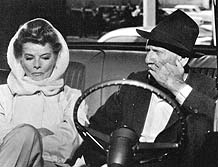
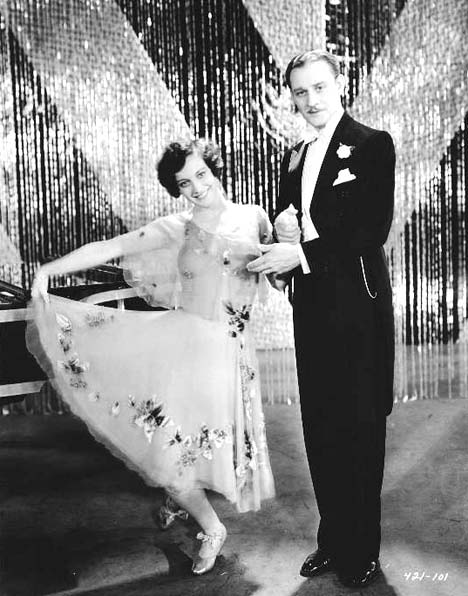
NetworkWorld: "Are Weblogs a legitimate business tool, or merely the Internet's latest vehicle for personal indulgence?" Bret Fausett, a lawyer who blogs, discloses an investment in an area he covers. Well done. Andrew Orlowski: "In the movie Memento, the Guy Pierce character suffers from a condition in which his short-term memory only lasts around two minutes. InfoWorld has taken the precaution of assuming that all of its readers suffer from an extreme version of this affliction: where the short term memory lasts only four or five words. That's why we need to keep being reminded what a 'server' is … twenty three times an article." Illogicz: "A Rich Text/HTML editor for Flash MX, that fully utilizes the new TextField and TextFormat objects." Jake Savin is puzzled by the Flash editor, linked above. He wants to know where the Submit button is. Good question. If we want wizzy editing in Netscape and on the Mac for Radio and Manila, we have to get this info to Jake. The history of Michael Jackson's face. John Robb turns 40 in six days. As part of his review, he lists his near-death experiences. As far as we know John hasn't had any facial surgery. John would you care to comment on that? Here's the DaveNet piece I wrote for my 40th birthday, a little over seven years ago. Paolo: "Can you imagine Jeff Bezos thanking each Amazon's customer on his weblog? Well, I'm not Jeff Bezos, this is not Amazon and, most of all, I have a weblog!" John Robb: "That you can run it on your desktop is a hoot." You heard it here first, RageBoy is a now officially a BabeMagnet™. Two years ago: "For Gates, the issue was Netscape, a tiny village camped out in tents painted to look like a fortress in a gorgeous grove in the middle of the jungle. In comes Gates with flamethrowers and tanks. Air cover and spies. After the battle the grove is no longer gorgeous. It's useful, but not so inspiring." Sting: "Takes more than combat gear to make a man, takes more than license for a gun. Confront your enemies, avoid them when you can. A gentleman will walk but never run." On any given day: "Perhaps the old 'eight 8-ounces glasses of water a day' understanding is incorrect. In fact, you can even drink too much water." Eric Kidd on the proposed California Open Source bill: "I write free software for a living, and I would be adamantly opposed to any such legislation. This is bad strategy (it would only alienate potential users), bad policy (there aren't open source products in many important markets), bad politics (it makes the sponsors look like self-serving fools without even a chance of victory), and bad business (running to the government when you can't compete in the market is tacky)." Three movies Recently I've seen three movies that made a difference to me. I wasn't sure how to write about either of the first two, until I saw the third and was able to string a thread between them. Here are the three movies, in the order that I saw them: 1. Guess Who's Coming To Dinner? (1967); 2. Mildred Pierce (1945); and 3. Witness Protection (1999). All three movies were interesting, even captivating. Katherine Hepburn and Joan Crawford won the best actress Oscars for 1 and 2 respectively. Great acting by the whole cast of both 1 and 2, and 3 was good too. All three highly recommended.
This theme came into focus when I saw Witness Protection last night on HBO (the others were on TCM). I tuned it in because I was curious how witness protection programs work, and boy did I get an education. Surprisingly it's a well made movie, with believable characters, including the fabulous Forest Whitaker, who starred in The Crying Game. Go see it. I'm only going to talk about a couple of scenes. First scene. The wife is beating her husband. Kicking. Hitting. He's in a fetal position. He's really hurt. Bleeding. For the rest of the movie his face is cut and bruised. A few scenes later. Water coming out the door of the bathroom. The wife bashes in the door. Finds the husband sitting upright in the tub. Razor in his hand and vacant stare. She kisses him passionately, petting, saying how much she loves him. Very bizarre. I try to imagine a gender reversal. I don't know what to think. Morning coffee notes I have the cup here, sippin away, taking some meta-notes, or notes about the notes. Three movies tracing feminism from the mid-forties, to the mid-sixties to the early 21st century. The Web and movie reviews. We have to do better. But it's already pretty good. What is the origin of the word "trust" in the context of "anti-trust" or "trust-busters." What does it have to do with the word trust, as in "trustworthy computing." (Martin Schwimmer explains.) Had dinner last night with Dan Ruby. He went to the Microsoft meeting a couple of weeks ago, where they gave themselves a report card on web services. I went to the meeting two years ago. We compared notes. Interesting. It's a cute trick. I wish I had thought of it when I was in high school. I'm going to outline the demo they should have done two years ago, and the one that we're all waiting for, so we can get out of the depression we're in and sell more hardware and software, and get excited again about where computers are and are going. Because Microsoft is a monopoly in web browsers and productivity software, they're going to benefit enormously from the growth that comes from it. But first we have to get their carcass out of the way. (Archie Bunker called it a keister, good word.) We have a venue for the demo, Sept 11, in SF at Seybold. We've invited MS to participate, but haven't heard back from them. It's possible that Steve Zellers from Apple can do the demo. I'll outline it. Postscript: The movie notes took longer than I thought. The other notes will have to wait for later, or another day.
Jon Udell just sent me a really sweet message. He said "Such interesting times. Glad you're still here with us to see them!" Amen to that. I think it was ordained to be. Then John Robb sent me a message saying we had closed another big deal. Okey dokey. And I'm going to dinner tonight with an old friend, and on Tuesday with an even older friend and on Weds I'm going to see Bowie with Woz and the Scoble Boys. Life is good. I'm glad I'm still here too. Ed Cone: "I spoke today with Ed McDonald, chief of staff for Howard Coble." Ed also asks people to send emails to Rep Coble, but requests that the emails not be personal or accusational. He says that Coble won't respond well if the emails are abusive, and I trust Ed, and agree. If you're looking for ideas, start in the Sears & Kmart section of yesterday's DaveNet. Megnut: Blogging for Dollars. Interesting piece. I don't think she nails it though. I want to see weblogs from CEOs and Members of Parliament, people who are responsible, who aren't mouthpieces. I know they can't write, but in the future they will. A hired blogger inside a company is always going to be subject to pressures. It's kind of like hiring an ad agency to write your weblog. Hmm. I'm a Cluetrain guy, I want the head honcho to talk to me, and everyone else. If they do it as a sideline, as the Macromedia bloggers do, a labor of love, somehow I trust that more than if maintaining a weblog is their job. Now, that said, of course there will be professional bloggers, just like there are professional everythings. To me that would be like saying there will be professional word processor users. Hard to argue with. Comments. Mark Paschal: Stapler 2.2.1. Davezilla meets Godzilla. Zeldman: "Attorneys. Can’t shoot ’em, can’t beat ’em with a tire iron and dump the bodies in an abandoned cornfield." Nick Denton: "Oh no, the corporate wordmanglers have got hold of blogging." On BlogRoots, a place to comment on or ask questions about Traction Software's $249 blogging tool. BusinessWeek: "When Macromedia puchased Allaire, the Web software outfit gambled that two negatives would make a plus. Well, 17 months later, they haven't " Ed Cone: "When I got in I found a message on the machine from Rep. Howard Coble." Bing! Hey hey hey, Paolo is opening his store. Here's the intro. Maybe I'll do a couple of tools, just for a little Tuesday lunch money, and to help bootstrap Paolo's store. Mary Lu: "I'm in love!" Ray Ozzie on why weblogs are good for discourse. Yes. Flames don't attract. New ideas do. Weblogs can have a high signal-to-noise ratio. Powerful statements are possible in this medium, where powerlessness rules in discussion fora. In this medium everyone can have the last word. Jon Udell: "Ray Ozzie's sudden and dramatic appearance in blogspace has got a lot of people thinking about a lot of things." Groove is moving fast. They now have a list of Groove bloggers, and include a short blogroll of others, including this site. Thank you. Dan Gillmor: Steve's and Ray's New Blogs. Bob: "Reminds me of the BBS days when everyone helped everyone." News.Com: "Open-source software advocates will unfurl a legislative proposal next week to prohibit the state of California from buying software from Microsoft or any other company that doesn't open its source code and licensing policies." Capsule summary of my opinion on the above. They're out of their minds. Open source needs commercial developers to finish the job they start. Open source is very good for infrastructure, very bad for sweating the user interface details. People have to be paid real hard cold cash to work for users at that level. No one volunteers for that kind of work, and rightly so, because it's pretty thankless stuff, and explains why most open source stuff is so unusable. It's real work to get stuff usable. Lots of looping, trial and error. NY Times: "Pet food stores weren't the killer app for the Web, but peer-reviewed scholarly journals might be." Rogers Cadenhead: "The lead of Markoff's article is incorrect. Sun has been offering Linux-based server appliances such as the Qube since it bought Cobalt in September 2000." Thanks to genehack for the link to The Time Travel Fund. Well worth a read, if not a deposit. Give them $10 now, and in 500 years, they pay to transport you to the future from your deathbed. Think about it.
DaveNet: North Carolina Matters.
Everyone wants to know: Who is Pyra's New Partner? NY Times: "If America's rocket scientists can't keep their data under wraps, who can?" Recreational reading took me from BB, to RB to HC. Cory Doctorow, Glenn Fleishman and Matt Neuburg are speaking at the O'Reilly Mac OS X Conference, Sept 30 thru Oct 3, Santa Clara, CA. Where were you 25 years ago? (I was a grad student in Madison, Wisconsin.) 8/28/96: "I wonder if the bees are philosophical about their condition in the last minutes of life." They're back. Doc Searls: "In the long run the best refuge from Hillary Rosen and Jack Valenti isn't with Steve Jobs and his beautiful machines (much as we may love them). It's the guys in the hills making free tanks out of spare parts." Kevin Werbach found an open WiFi network in the Denver airport. "Here I am, blogging away," he says. Today's NY Times reports that sometimes, when a celebrity praises a drug on TV, they're being paid by the drug company and don't disclose that. Lauren Bacall, Kathleen Turner, Montel Williams and Larry King are mentioned in the piece. Salon: "Under the guise of 'public service,' pharmaceutical companies are quietly paying stars to solicit new customers on TV talk shows with tales of personal suffering and blessed relief." Phil Ackley: "I'd be willing to pay at least 4 cents a click for every single, Jewish, Alaskan woman in her late twenties to early thirties.." Leslie Harpold: "Tell me something about yourself?" Krzysztof Kowalczyk. An excellent new weblog that tends to update at night.
What a thrill to have a developer with Ray's experience on the weblog net. We could schmooze like this once every few years at conferences, but sheez, I don't go to conferences very much these days, certainly not the same ones Ray goes to. BTW, (imho) if Ray decided he wanted Linux-On-The-Desktop to matter, in a few years, it would. I think Doc throws in the towel too soon. Linux on the desktop didn't make it because it was conceived as a frontal assault, offering nothing that Windows didn't already do (much) better. There will be opportunities to fork from Windows, as Microsoft gets more in bed with other BigCo's in other industries. Want a refuge from Hillary and Valenti? Or maybe you just want a break from legacy-ware? Can't use Windows. Maybe you don't trust Apple, yet. BTW, here's a doc from 1997 where I told our users that the Windows version of Frontier wouldn't try to dig into the desktop the way the Mac version did.
Christian Crumlish warns that there is a political leader of a powerful country developing weapons of mass destruction and threatening to use them. Hint: it's not Saddam Hussein. Jon Udell writes a "deployment descriptor" for Radio at InfoWorld. From Car Talk. A doctor goes to a bar every Sunday to get a special drink, an oak-flavored daiquiri. One time the bartender prepares the drink with hickory because he's out of oak flavor. The doctor, on tasting the drink says "There's something wrong with the drink." The bartender admits it. "Okay, I admit that it's a hickory daiquiri.." Arrrrgh.
1986 NY Times article about copy protection. You could have said, a few years later, that copy protection had failed, but that would have been wrong. Now they call it Digital Rights Management. Same thing. Steve Gillmor: "Spam will go away -- with the death of e-mail." Latest Udell column. Put people first for a change. Can't go wrong with that.
1/28/98: "I've read a bunch of reviews of the movie, and no one seems to get this. Hunt is a great actor! She played the role usually reserved for the male lead in a love story. And Nicholson was stunning as an extremely opinionated man who we learn to love." Two years ago: My Friend's Heart Attack. Whew! Heard on NPR yesterday: "Don't confuse god with the flag, they have nothing to do with each other." That's not an exact quote. Somehow the US flag became a religious symbol and the symbol of a country. This is a bug. It's not about god. Also, great interviews with Divine and John Waters. Philosophy of Web services Had a very interesting meeting yesterday, for some reason I'm not allowed to say who it was. So I'll characterize the person instead of naming him. He is an advocate of a particular scripting language, on that's got a loyal following, but it's not one of the huge languages, like Perl or Java; but it's not small either. We were talking about the Seybold keynote on web services. I've got my cast pretty well set, but I was interested in having this person demo some kind of SOAP or XML-RPC app with his scripting language. No matter how we approached it, he was always trying to sell his scripting language, which of course is okay, but later this struck me as totally at odds with the philosophy of web services. I was reminded that when I was in manifesto mode for this stuff, that's exactly what I was saying. And when I meet users that's what they value the most, no lock-in, ease of movement and migration of code. The only ones who don't see it this way are the big companies and their followers who snicker about choice issues, and assume everyone wants to use the environment they use or will want to once they are assimilated. Emphatically, these people are not using the Web, and they might as well use their own language's native mechanism for cross-network communication, they gain nothing by using a protocol that's supported in lots of languages and environments. Yes, I am naive, and I choose to be that way. I understand that sometimes people pretend to support choice, when they really just want to confuse people, or keep them arguing about small details while they take over the world, but I hold them to a higher standard. Let's dispense, once and for all, of these monsters. If you can't handle competition, get out of the kitchen. You know what I mean.
Evan Williams: How We're Spending Our Time At Pyra. Jake Savin: "Blogrolling.Com now supports OPML." Bing! Philip Pearson: "Nothing says 'this is not a waste of my time' like being the top link in Doc Searls's blogroll!" Rolling on the floor, laughing. Fast Company only begins to sketch the Washington-Hollywood power grab. It's true Silicon Valley isn't doing anything to stop it. Our reps in Washington also represent the SouthLand. But I part company with the author of the article on two counts. 1. No matter what the discredited venture capital industry does or doesn't do, the laws they're passing won't stand up to a First Amendment test, and 2. Bad laws are not obeyed by the people. "Think different," as one Silicon Valley company requests. John Robb: "The RIAA, following its sue everybody strategy, is ready to go after the Librarian of Congress." Sam Gentile: "How do we get people to collaborate?" Bryan Bell: "I am now a disciple of Mark." Last night's movie, Sadie McKee, starring Joan Crawford, was fan-tas-tic. I never thought I'd develop a taste for movies that were filmed in the 1930s. I wish they'd make movies like this now. The songs were great too, including the theme -- All I Do Is Dream Of You. "Morning, noon and nighttime, too; all I do the whole day through, is dream of you." Yes, that's what being in love is like. You must remember this.. Weekly smoking update: 56 days since my last puff. Joe Eszterhas: "Some movie stars are more likely to play a part if they can smoke -- because they are so addicted to smoking that they have difficulty stopping even during the shooting of a scene." What about TrackBack? While I was in the hospital in June, the Movable Type folks implemented a feature called TrackBack. I'm not exactly sure all that it can do, but here's at least part of the story. (I'm posting this so I can get corrected if I don't understand the feature. It occurs to me that this post could use the feature, heh.) Anyone, anywhere can send a message to any Movable Type server to associate a URL with a weblog post. That URL will be shown in the list of TrackBack links for the post. Further, based on an email from Matt Mower, for some reason that I don't understand, this can only work with Movable Type servers. I doubt this, because from all outward appearances it is using HTTP, which could be emulated by any program capable of doing HTTP. Matt thinks this feature should be implemented with XML-RPC. I'm not sure it'll take off no matter what it's implemented in. Here's the problem. By design it seems to assume that everyone plays fair. But eventually we all attract a relatively small number of people who would mark up every post with trash talk, if given the chance to. It's a predictable process. That's why I don't have a discussion group here (I used to), or a comments feature. It's why MSNBC is moving to weblogs over discussion software. It's basically why weblogs have a future for thoughtful discourse where mail-list-like collaboration tools are dead-ends. When I think about evolving weblogs, I try to avoid features that turn them into discussion groups. Follow-up: A page of non-Movable Type implementations of TrackBack. Hit-Or-Miss implemented it. BlogRoots has a page called BlogPopuli that's based on TrackBack. They have a tutorial that's only for people who run Movable Type, and have a ping form. Do a view source on the ping form to see how to do it programmatically. Not sure if all TrackBack-capable sites support this form (probably not). Thanks to Anil Dash and Megnut for the pointers and info. Rahul Dave: "Tracking can be simpler, and per choice, less noisy than trackback." Evan: "Wouldn't it be neat if I could somehow automatically link this post to Dave's post?" Dave: "What's so great about automatic?"
Sjoerd: "Today I tried a different approach for XHTML 2.0. I created an XSL stylesheet that converts XHTML 2.0 to XHTML 1.0. Mozilla and IE6 can apply the tranformation themselves. Other browsers can use the w3c xslt service." Had a great phone talk with Adam in Amsterdam. Good to touch base with Europe. It gets so loopy here in the US. News.Com: "Linuxcare, a company that failed spectacularly at selling services for the Linux operating system, is back with a new strategy: selling software." There are now 4543 weblogs in Phillip Pearson's latest weblog ecosystem. Tim O'Reilly: "I met with Microsoft Group VP Jim Allchin, and was amused to see an iMac driving the wall-screen display in the conference room where we met." Jesus Christ has a weblog, but it looks like he could use some help. Jon Udell: "I've been meaning to try ActiveWords, so when its inventor and evangelizer Buzz Bruggeman wrote to me about it recently, I took the plunge." Reuters: "Stocks climbed for a third day on Thursday." Survey: After three straight days of impressive gains in the stock market, do you think it has hit bottom now? Dylan Tweney: "Some recently proposed legislation could open up computer networks to vigilante-style justice."
News.Com: "Dijkstra and his wife also enjoyed exploring US state and national parks in their Volkswagen camper van, called the Touring Machine." Mark Pilgrim is accumulating notes on XHTML 2.0. "Keep in mind that this is all just markupbation at this point." Happy birthday to InstaPundit. One year old today. Mazel tov and many happy returns. Scott Rosenberg, blogger par excellence, expresses disbelief that the emperor of WorldCom had no clothes. News.Com reports that Trellix is adding weblog-authoring features to their eponymous browser-based web authoring program. Dan Bricklin explains, BlogRoots has a thread for discussion, Evan Williams comments. Evan continues: "Man, the heat! I'm getting loopy." Hey it's nice to see Ray Ozzie updating his weblog.
Amy Wohl: "So far, Sun has never been a smart and persistent seller of software. Scott has, in fact, been their own worst enemy, telling me on many occasions that software exists for the purpose of selling hardware. Maybe he's now changed his mind. That would be a good first step." Via Radio Free Blogistan via David Watson via David Copeland, a reporter in Texas has been told to shut down his personal weblog by his employer, the Houston Chronicle. Wait, threre's more. The top item on Romenesko names the reporter: Steve Olafson, and links to a Houston Press article that says that he was fired for running the weblog. Rob Fahrni: "Microsoft has always been known as a combative workplace. It's one of the things that bothered me about the buyout of Visio almost three years ago." Nowadays when a mosquito bites, you gotta wonder, "Did I just get a deadly virus??" A list of things that annoy Bob Frankston. Confirmed, I'm doing a concert with Woz next Weds. Eric Kidd: "SpamAssassin is a highly accurate open source spam filter." The Age: "American movie, recording and software executives could be prohibited from entering Australia or extradited to face criminal charges if a copyright protection bill before the US Congress passes into law." Question: Did you think on Sept 18 that we'd make it to Aug 7 without any more huge terrorism hits on US soil? US citizens can send a message to Congress about the Berman Bill via the Electronic Frontier Foundation. Real-time writing People like to give me a hard time for writing in real time on Scripting News. I can do this because I use a different kind of tool to write. Someday this tool will be more popular and lots of people will do what I do, and it will drive certain people (you know who you are) out of their minds. See, sometimes when writing in this mode, something that's not politically correct, or inadvertently not politically correct, sneaks out. Shit happens. Before I can correct it, some blogger somewhere has launched a holy jihad and is experiencing the rush of body chemistry that comes from it. And then I spot the bit of vulnerability (sometimes it's just a spelling or grammatical mistake or an awkward wording) and make the change and save it, and oops, the flamer has nothing to flame about. There's a bit of a fallacy in their ire, because they don't have to give back the endorphins, but maybe they're hoping for a double-dip. I have many new assholes cut in this manner. Yet I still persist in real-time writing, when the spirit strikes me, as it does today. Warbloggers and linearity The human mind is a wonderful thing. It's capable of doing math, writing poetry and love letters, and can save your life when called on. It's great to have a mind, but sometimes it lies to you. The mind can't handle not knowing something. It strings assumptions across voids of knowledge. You can see Nick Denton do this a couple of days ago, when he assumed that a comment I made on SN was about Muslims becoming perpetrators of the next holocaust. It could happen, but I think it's more likely we're headed there in the US. That our country would consider attacking Iraq for the reason Denton outlines, to induce humiliation in the Muslim world, and that intelligent people like Reynolds think this is a good idea, makes me worry more about our country than any other. We're so poorly defended here, before we attack so mindlessly, give some thought to how many Americans would die at home for this kind of bluster overseas. Like so many armchair strategists, Denton and Reynolds want to fight the last war we won (WW II) but it ain't going to work that way. Anyway, I think this is why we don't get too much support from our allies in Europe. They're scared of the US, rightfully, and so am I. Anyway, I still admire Glenn and Nick, for having the guts to expose their thinking in public on the Internet for me and others to trash. That's the beautiful thing about the First Amendment, and one of the primary reasons I love this country so much. We have the freedom to express ourselves, guaranteed by the Constitution, and that guaratees that we will hear ideas that sound wrong, that we disagree with, that stimulate writing and hopefully thinking (maybe not in that order). As long as that's all that happens, it makes us safer. I've seen people say that Denton's comments are dangerous. So far, only to my belief system, and that's a danger I welcome with open arms. But we have to watch for the messengers of "It can't happen here," because a lot of the first steps down the road to erasing our freedoms start there. That's the truly dangerous stuff. I missed my hot tub I'm a nicotine addict. My name is Dave. I am also a hot tub addict. When I can't use my hot tub I get grouchy. It's how I warm up, it's how I relax. I think every house should have one. To me, it's as essential a device as a kitchen sink. Anyway, I haven't been allowed to use my hot tub since mid-June because of the surgery. The doctors wanted me to give the wound a chance to heal. Well, that changed, and yesterday I was able to use it, with somewhat surprising results. It made my body feel sore this morning. I suspect the soreness comes from storing tension in muscles around the wound. I had tightness in the lower back, shoulders and neck, and even arms, and the upper part of the legs. That's how the body compensates for a wound in the center of the chest. But because I wasn't soaking, I couldn't feel the full pain. So I feel it this morning. Lots of pain everywhere but the wound, which feels more healed this morning than it ever has. Probably after a few weeks of this, it'll all work a lot better. I'm optimistic. I am deeply programmed
Wandering through the streets of NY, last night, in a half-nightmare (I had forgotten to book my return flight and was trying to find a phone that I could access the Internet through), I lit a cigarette from a full pack. I took one puff, and then remembered -- sheez I'm not a smoker, and I threw it down and rubbed it out. I was bummed. It was a bad dream all around. Later I remembered, hey it was just a dream, it was all happening in the subconscious, no lungs were harmed, and even better, I remembered even in an unconscious and unhappy state, that it's not okay to smoke.
Ray Ozzie: "If you can get people to work in the open, it can be quite valuable to others." Reuters: "Stocks racked up hefty gains on Tuesday." BlogTree now has a bulletin-board. John Robb: "This next release of Frontier is going to be huuuge and provide us with a framework that will let us go the distance with our customers." NY Times: Time-Warner names new AOL chief. Kevin Werbach remembers Chick Hearn. Doc reviews last night's Alicia Keys concert in Santa Barbara. Sheila Lennon: "I deliberately did not request press credentials for Newport, and I paid my own way on my own time. I'd blog it as I saw it. I didn't have to go, didn't have to stay, didn't have to file." Two years ago yesterday I went to a concert with Steve Wozniak. It was fun. Sting and KD Lang.
Have you checked out BlogTree? It's now got 1792 registered weblogs. It's a really cool idea, it's totally taking off. A telling comment from Glenn Reynolds last night, and now I have a clue what a warblogger is. I may try to write a new definition. It'll probably involve the words blow and hard, and examples from playgrounds. Dangerous stuff. Watch out for the humiliation, that's where holocausts come from. Sometimes when we bluster and attack aimlessly, we cement relationships between forces that wish us harm. Glenn and Nick respond. My brief response. In addition to being a technologist and living on the west coast of the US, I am also the first-generation American son of Holocaust survivors, born and raised in NY. Does Nick have any insight into my thinking? Clearly not. Reuters: "Stocks sagged on Monday, yanking the Nasdaq Composite Index to fresh 5-year lows." Paul Andrews: Microsoft to give PCs a little Google. Tom Negrino: "Apple's going to sell a lot more iPods in the next quarter." The EatonWeb Weblog Portal got an overhaul. Very nice. Isn't it obvious that Microsoft should use some of their cash to reinvigorate ISVs? Imho, that would be a buy signal for MSFT, an acknowledgement that they play a different role in the software industry of 2002 than they did in 1992. It would also help NASDAQ get over the dotcom debacle. Technology needs a mega-roadmap, in other words a roadmap for future roadmaps. Clearly nothing MS is doing now, or will do in the future, can stick, because there are no credible ISVs to adopt their schemes, to triangulate on their vision. Yes, things like Hailstorm and Palladium are necessary and inevitable, but they can't come from MS. But that's all that's left. Catch-22. Gotta dig out of this Bill and Steve. A Marshall Plan for the software industry bootstrapped in part by the $38 billion hoard. BlogStreet looks interesting. Thanks to Marc Barrot for the reminder to bug the Omni folks to add OPML support to their popular Mac outlining program. Scott Rosenberg: "New York Times columnist Maureen Dowd has her fans, but I am not one of them." Same here. Scott's characterization of her columns totally rings a bell. Honestly there isn't a single current Times columnist that comes close to Russell Baker.
Register: "An addition to Microsoft's End User Licensing Agreement has alarmed Register readers." Jeremy Bowers: "Will you deed your computer over to Microsoft?" Martin Schwimmer: "I'm sorry there have been no blog items since Thursday but I was involved in something very important. Musa al-Mustapha of Nigeria emailed me.." Werblog: "With the end of the roaring '90s, lots of people are finally allowing themselves those vacations they postponed."
Ed Cone's column in the News-Record is up. "Coble is known and respected for his decency and down-home ways. His refusal on principle to participate in the Congressional pension program says a lot about the man who has represented this area since 1984. It would be too simple to label him 'Hollywood Howard' and assume he's in the pocket of the entertainment industry." It's hard to explain to non-computer-users how irresponsible the Berman-Coble bill is. I think any analogy is likely to miss the mark. But enough people know about computer viruses, I think, to allow for a direct explanation, which might go something like this. "Computer viruses are dangerous, they can delete files, disclose private or sensitive data, and can even be used for terrorism on a global scale. Even if the entertainment industry feels that it can write a 'safe' virus (they haven't promised they will, btw), software always has bugs, and a bug in a virus could be devastating, not just to people who use music on the Internet, but for all people who depend on computers for their livelihood, or for medical care or education. Computer technology is used for many important things that have nothing to do with listening to music or watching movies. We can't let the entertainment industry dictate how our computers are used, or take control of our computers, or destroy their utility. We paid for our computers, not them." Okay, I know the wording is awkard, but there are a lot of ideas that aren't getting through in the articles about the Hollywood hacking bill. Janis Ian posts a follow-up to her article about the music industry and the Internet. I read Bruce Sterling's contrarian rant about open source, much of which I agree with. However, there's one bit of pushback that really needs to get out there. There's a lot more to commercial software than Microsoft. To the extent that people frame the conversation as Microsoft or open source, they cripple the non-monopolist commercial vendors. Apple, for example is neither Microsoft or open source. Nor is IBM, Macromedia, Adobe, Oracle, Sun, AOL. And weblogs, like the one you're reading now, are generally managed with software that neither comes from Microsoft or open source developers. Now you may think either MS or OS will crush us, but stop and think, do you really want that to happen? Would you prefer that independent developers be able to make a living writing software? I know, Eric Raymond told you that there were other ways to make money developing software. Unfortunately, those techniques don't work for end-user software, the easy to use stuff, for individual people. The only thing that works there is developers charging users for the product. We can afford to give you a lot of source, but not all of it. Sheila Lennon reviews yesterday's Bob Dylan concert. Rogers Cadenhead: "Peter Merholz's weblog, peterme, has added an RSS feed. It's great to see one of the first-ever bloggers supporting RSS." John Robb has notes on TiVO-of-the-Future. I've been spending a bunch of time thinking about it too, esp as it relates to Turner Classic Movies. I've been watching stuff from the 20s, 30s and 40s. Not much on the Web about the stars of the 20s and 30s. But thanks to TCM I can see what they looked like. It's like viewing an alien culture. Who are these people? I have no idea. Kevin Werbach says John's vision should include material generated by amateurs. Of course. Doug Baron has a funny joke about Texans and Muslims. (It's not politically correct, in about 18 ways.)
BlogTree.Com is "the blog genealogy site. You can register your blogs and record which blogs inspired their creation. You can also search for existing blogs and view which blogs they in turn inspired." Great idea! A BlogRoots discussion thread about BlogTree. It was written by the author of the nonplussed weblog, appears to have been designed on July 1, went live on July 21. Rogers: Publishing a Category to a Private Location. Paul Boutin explains how to record vinyl on a Mac. I need the same kind of cheat sheet for cassettes on Windows. News.Com: "For a mainstream Web site such as MSNBC, blogs offer a stepped-up level of editorial control over the often raucous ramblings from readers in online discussion boards. The site closed the popular boards last December because of the high cost of monitoring discussions that often turned into obscene flame wars." Four years ago today: "Endless paraniod flamefests can be fascinating." Thanks to Jrobb for the pointer to lukwam.com, who has his TiVO wired up to the Web. I want this (without too much hacking). Just think of the collaborative filtering possibilities. Also I have to admit that I'd like to save copies of films like the Hollywood Revue of 1929 on my desktop hard drive. And while you're at it, hmmm, I guess I'd like to share it with other people. What am I going to do, Napster spoiled me. I'm reading mostly good things about SpamAssassin. As you might imagine, with my email address in plain view on this site, I get a lot of spam. I could be a good test case for spam-reduction software. Don't Link to Us! "links to sites that attempt to impose substantial restrictions on other sites that link to them." The connection between private and public spaces is hot again. Jon Udell is discussing it on his weblog, answering a question from Groove's Ray Ozzie, posted on his weblog. Al Hawkins answers my question from yesterday in a different way, from a user's perspective, not a developer's. Agmweb.ca "allows you to search 7 online book stores for books and prices" via XML-RPC and RSS.
BTW, the closing song of the Revue was the first recording of Singin in the Rain. The camera goes from star to star, all dressed in rain coats and rain hats. They're all very unique and beautiful. We watched the closing sequence a half dozen times. The film was heavily promoted, apparently, as one of the first talking pictures. The actors were the most famous actors from the silent era, singin for the first time. Their facial expressions were something to behold. Another BTW, Meg sent me a very sweet story about her friend quitting smoking. I can totally visualize it! Sheila Lennon is going to the Newport Folk Festival to see Bob Dylan. I am totally jealous!
Ed Cone: How to Fight the Corporate Hacking Bill. Nick Denton: "Weblogs are a testament to capitalism, and the importance of clear property rights." Amen. Sean Nolan: Amazon RSS. "Wouldn't it be nice to have an RSS feed for all weblog-related books at Amazon, so that when new books became available you'd know about them? Thanks to the magic of web pipelines, it's become a pretty trivial thing to put together." Excellent! NY Times: "Much weaker than expected job growth in July and some disappointing earnings reports sent stocks sharply lower today." New Bryan Bell themes for Radio.
Bryan Hoch, the man behind the MetsOnline site, shut down by Major League Baseball, now has a column at FoxSports. Kevin Werbach: "Starbucks lost the chance to sell me an over-priced doppio, while I got my email al fresco." Perhaps HP has some honor after all. What is tangent.cx?
Phil Hewitt, who is working on connecting Visual Basic to Blogger says: "The Blogger API server seems to be down at the moment, therefore I can't test it." Phil, you can use our test server to verify that your code works. It's been pretty reliable. And you can download a 30-day free trial of Radio, and test it on your own machine. Sjoerd offers a theory why Dave Rand is the #1 Dave on Google. Recovery update Yesterday I did a vigorous 1.5 hour walk, up hills and down. The iPod came with me. Talked with a guy who had bypass surgery in 1981. He and a friend visit bypass patients in local hospitals. He called, after my walk (how did he know) and we talked for a long time. He said there was a 47-year-old woman at the hospital right now, for her second bypass in 2.5 years. He said that a couple of years after his surgery, the artery blockages were coming back (how depressing), but so far he hasn't needed more surgery. The difference? Smoking. The woman hadn't quit, he had. I guess the purpose of his call was to check up on my life as a non-smoker. Heh. It's okay, so far. Today is my 49th consecutive day with no nicotine. BTW, there's some controversy about whether nicotine is okay or not. My GP says go ahead and use the patches if the urge gets too bad. So far I've not done this, because I don't want to have to withdraw at a physical level again. I asked if nicotine isn't bad for the heart, and (get this) she said it isn't. But I think it must be. It constricts the arteries. When you have blockages in the arteries, the last thing you want to do is constrict them. Another reason I'm not using the patches. Alwin Hawkins: "If you don't need nicotine, then don't take nicotine." They love Apple, but why? Is it me or is it weird that so many open source purists, people who swear by it, argue it to death, and would die for it, seem to like Apple, which isn't open source? Maybe I'm missing something. Or maybe it makes sense, if you need to charge for the software (so you can pay the engineers, for example), to hold on to the source. Hmmm. Sorry. BTW, imho, "open source" is a vestige of dotcom mania. Sure, you can do anything with free money, but that's over, for good (fingers crossed) so let's get real, okay? Thanks. One more thing, open source zealots, like all zealots, checked their minds at the door when they joined the party. They're anti-intellectual, can't handle disagreement, are about anything but freedom.
A correspondent writes: "The answer to the question is 'Unix.'" Yes that's right. Much of the misplaced open source zealotry is really love of Unix. No problem with that. I grew up with Unix myself. Totally. You can see that in the design of Frontier and my outliners. I've written about that many times. That's how I learned to write code, by studying the source code of the original Bell Labs Unix. Now we're getting somewhere.
You gotta hand it to Amazon's Jeff Bezos who had the guts to appear in public dressed as Austin Powers. MacCentral, 4/27/00: Gates dresses as Austin Powers. Radio Free Blogistan: "The indefatigable dws has launched a dynamic Radio FAQ channel. To participate, he says, start a RadioQuestions channel on your blog and tell him about it." Also from Xian: "Jerry would have turned 60 today." Phillip Pearson did another run of his ecosystem crawler, this time using changes.xml from weblogs.com, and is sampling 1452 weblogs now, and lookin for more. On this day in 1999, I created a "news site" on GrokSoup. My site is gone, but GrokSoup is still there.
Imho the Salon blogs have been a total success. Perhaps a little-known fact, it's fairly easy to set up a community of Radio users, like Salon's. The key piece of software, released in the spring of this year, is called Radio Community Server. We decided to license it for $0 to encourage formation of communities, like Salon's; and private ones, behind organizational firewalls. The community software does require Frontier or Radio, so it's not totally free. A new release of Frontier ($899) is in the pipe that has RCS baked in, along with Manila and other goodies. (I'm not working on this release, still on sabbatical.) It seems we're just about at the tipping point for lawyer-bloggers. I'm getting a sense that if we have a legal question that's appropriate to ask in public, it's likely one of the lawyers will answer it, at weblog-speed, which is fast. They also write well. Here's an example. "The Bronx is where I spent a great deal of the formative years in my professional life; it is a place apart in a lot of ways, a little banana republic in New York City." He tells a good story. I feel a kinship with the kind of lawyer who writes in public. Marc Barrot: "The latest addition to activeRenderer is activeRoll, a macro for publishing a blogroll as an active outline, complete with expand/collapse wedges." NY Times: GE is Latest to Reconfigure Stock Options. Ernie the Attorney: "I'm more of a techblogger than a warblogger." Creative Commons shows its preliminary metadata spec. A hearty welcome back to Burning Bird. Happy birthday to Jeremiah Rogers! Last year on this day, I wrote an ode to the PC, in honor of its 20th birthday. "IBM needed the cloners as much as they needed IBM, they were the source of comfort for the customers, they provided the assurance that IBM couldn't try to lock the rest of us in the trunk and throw away the key." Four years ago: "If an idea has a twinkle in it, it's mine! If it can reach our hearts, I go for it. Just like Ringling and Barnum. It's a circus out there. Same on my home page." From Vikas Kamat, in India: "Yesterday, in her blog, my mother silently busted an age-old, dark myth of India that had denied the women the use of a sacred Hindu hymn." He adds: "There's been a lot of activity among bloggers from India. We are trying to build a weblogs.com-like portal just for the Indian blogs." This morning I have a very strange song running through my brain. It's from Woody Allen's Radio Days, a commercial for a product called Re-Lax. It's sung by Mia Farrow. It goes like this. "Get regular with Reeee-Lax. It's easy and safe. The Re-Lax Way." She sings it over and over. I can't get enough! Roger Ebert: "What actually happens isn't nearly as important as how we remember it." Last night's West Wing rerun was phenomenal. I had seen it before, but the second time it was even better. I cried and laughed so many times. Loosened everything up, made me feel realllly good. The closing scene was something else, the background music which comes up to a crescendo is Brothers in Arms by Dire Straits. I'm going to have to look up the lyrics to see how the words fit with what's happening on stage. Yes, it's racism, but we survived Glenn Reynolds asks a poignant question. "What would things be like for Palestinians now, if Israelis or Americans thought like Arabs? They wouldn't be like anything at all, of course. There wouldn't be any Palestinians." Bada-boom. Of course it's just as true that there would be no Palestinians if we thought like Nazi Germans or Klan members in Glenn's home state of Tennessee. Faisal: "I'll take 'generalizations verging on racist wanking' for $100, Alex." Glenn summarizes the discussion with Faisal. For what it's worth, I interpreted his original post as "Those Palestinians don't get it, we're trying to make peace with them."
|
 
|
||||||||||||||||||||||||||||||||||||||||||||||||||||||||||||||||||||||||||||||||||||||||||||||||||||||||||||||||||||||||||||||||||||||||||||||||||||||||||||||||||||||||||||||||||||||||||||
|
© Copyright 1997-2006 Dave Winer. Previous/Next |
|||||||||||||||||||||||||||||||||||||||||||||||||||||||||||||||||||||||||||||||||||||||||||||||||||||||||||||||||||||||||||||||||||||||||||||||||||||||||||||||||||||||||||||||||||||||||||||















 Favorite