|
|
 | Saturday, May 31, 2003 |
Scoble: "Our products are too freaking hard to use." 
8/26/99: "Bill Gates, Steve Ballmer, check this out. You have less to fear from Sun, Netscape or AOL. Your worst enemy is in the corridors of Redmond. Go set up one of your own boxes. Do it all yourself. Your eyes will open."
Responses to comments on the weblog article.
Hanan Cohen reports that Google-Israel has been broken since May 5.
I was interviewed yesterday by a researcher at Harvard's Kennedy School of Government for a case study on the role weblogs played in the downfall of Trent Lott. The study should be out in a month or so, and will be made public. They charge for the studies, I'm going to ask them to make this one available on the Web, since it's about the Web.
Dan Gillmor: "...Wall Street Journal's All Things Digital conference made reporters promise that all sessions were off the record unless the speakers specifically agreed to put the comments on the record. Regular conference attendees were under no such restraint, and as a result we have coverage from the audience, not the journalists."
Aaron Cope makes a valuable point, but does it in a harsh way. His point is well-taken. A weblog clearly does not have to order the posts strictly chronologically. If I believed that, then Scripting News would not be a weblog.
Wes Felter: "I looked at the WASTE design document and as I suspected the protocol is a piece of junk."
blogjsim is an instant messaging plug-in for blojsom.
Ernie the Attorney: "Maybe Jobs is right to factor mortality into his marketing strategy."
News.Com: "When we sense that a person is making an effort to copy the way that we speak, we tend to like that person more, they believed."
Jason Shellen has a wireless photo blog.
Don Park: "CSS heavy web pages on display at CSS Zen Garden look great."
Morning coffee notes 
An old tradition is new again!
Greetings from New York City. Easy drive from Cambridge. Left at 4AM. Found a great oldies station from Hartford, CT. The first song they played was It Don't Come Easy by Ringo Starr. "Gotta pay your dues if you want to sing the blues." The cool thing about the song is that George Harrison, Eric Clapton and Stephen Stills are performing too. That's what I liked the most about Ringo, he needed a little help from his friends, and he appreciated it too.
Another cool thing about driving to NY is when you get close enough to see big green Interstate highway signs that say New York City. For some reason I giggle when I see one. I'm used to seeing San Francisco, even Los Angeles and Reno on these signs. But a freeway sign for New York City? Skyscrapers and everything.
Okay both the WinerLog guys were at OSCOM, and they both behaved fairly badly. The stalking is starting to happen in meatspace now, and that's not fun. Pretty soon I'm going to bring the cops into it. Beware wiener boys, you're getting too close. You both have reps to lose. Nuf said, hopefully.
I think I've got the key for speaking with a Boston accent. Deprecate the R's. So Hartford becomes Hatfod. That's all there is to it, except when you really want to get it you should let just a hint of an R back. Also, reading the highway signs I kept seeing Oxford, which I wanted to write as a hex number: oXF08D. Okay, the 8 doesn't really work. But any word that begins with OX is a candidate for easy hexing.
We're getting close to June 14, when, last year, to people who read this site I just disappeared. "Lots of non-Internet stuff going on," I said then. To me it was the day I quit smoking, and also the day I checked into the hospital (when I wrote that post I didn't know for sure I'd have to go into the hospital, but I wasn't surprised when I did). Shortly after my reappearance, Seth Dillingham said something really nice and very memorable. And for sure, on May 31, 2002 I had chest pain, and was in denial on how sick I really was. Let me share that lesson with you. If you have a pain inside your chest where your heart is, go to see a doctor now, don't think you can exercise your way out of the corner. It doesn't work that way.
| | Friday, May 30, 2003 |
Essay: What makes a weblog a weblog? In progress.
News.Com: "A day after developers at America Online's Nullsoft unit quietly released file-sharing software, AOL pulled the link to the product from the subsidiary's Web site."
Here's the source: waste.zip. Gnu General Public License.
Ed Cone links to a story from Mark Tosczak, a NY Times stringer, on getting credit for his work. "The real problem with the Times policy on stringers is that it's counter to what a newspaper is supposed to be all about: the truth."
Tony Byrne of CMS Watch stopped by to say hello. He says that there are successful 40-person software companies. In my talk yesterday I said this was a species of software developer with a lot of power, a beast of the 80s, extinct this century.
9AM: I'm listening to Jon Udell's keynote at OSCOM. The net connection works (obviously). Of course he's talking about things I love. Apparently he went over his allotted time, I wanted to ask him to comment on the opportunities for open source projects to integrate with commercial software. Jon is in a unique position to talk about that.
How I wrote WMAWAW
I did something different with this piece, I didn't publish it for a few months. I started writing it as soon as I got to Cambridge in March. We did about ten Thursday night sessions. I polished my skills as a user, and watched other people learn weblogs, saw what they got, and didn't. I asked other people for ideas of what made weblogs different from professional pubs and Wikis. I thought, and I wrote, and deleted, and wrote some more. In other words, I did something rather unlike a weblog to try to get to the core of what one is. So if you ever doubt that I believe in other forms of writing, put that to rest. There are occasions when you want to spend a fair amount of time reflecting and editing. Some writing that isn't like a fresco, writ in quick-dry plaster.
| | Thursday, May 29, 2003 |
MSNBC: Microsoft, AOL settle browser suit. MS pays AOL $750 million. Web developers get $0. Web users get a buggy browser. Looks like AOL is switching back to MSIE. Rob Enderle is quoted in article, says AOL is divesting Netscape. Huh? Article written by Jon Bonne, the guy I debated.
Other reports: AP, News.Com.
 Donna got the soundbite at my OSCOM keynote today. There's something for everyone, whether you like Bill Gates or Richard Stallman, or neither. Before that I told the story of how XML-RPC came to be, and how Eric Raymond liked it so much. Then I hazarded a guess that if Eric had dinner with Bob Atkinson, one of the co-designers of XML-RPC, that they'd agree on a lot, and probably enjoy each others' company, even though Bob is a senior guy at (you guessed it) Microsoft. Had I chosen a song for the keynote it would have been Give Peace a Chance. And in honor of Bob Hope's 100th birthday we could have played Thanks for the Memories. Donna got the soundbite at my OSCOM keynote today. There's something for everyone, whether you like Bill Gates or Richard Stallman, or neither. Before that I told the story of how XML-RPC came to be, and how Eric Raymond liked it so much. Then I hazarded a guess that if Eric had dinner with Bob Atkinson, one of the co-designers of XML-RPC, that they'd agree on a lot, and probably enjoy each others' company, even though Bob is a senior guy at (you guessed it) Microsoft. Had I chosen a song for the keynote it would have been Give Peace a Chance. And in honor of Bob Hope's 100th birthday we could have played Thanks for the Memories.
Caleb Crain: Tea in Iraq.
News.Com: "SCO Group Chief Executive Darl McBride said a published report that his company may take legal action against Linux founder Linus Torvalds was overstated."
Nullsoft: "WASTE is a software product and protocol that enables secure distributed communication for small (on the order of 10-50 nodes) trusted groups of users."
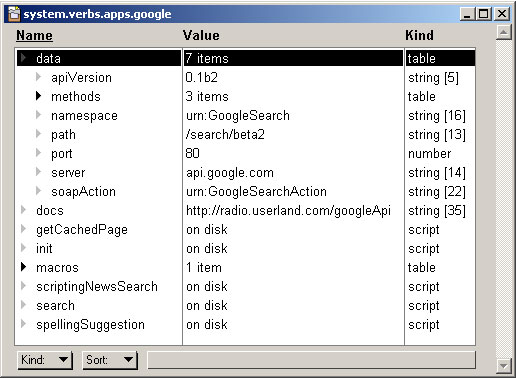
Good news. Brent Simmons is editing Rogers Cadenhead's book about Radio. He tripped over system.verbs.apps.google, which is new since he worked on the code. It is kind of funny, in the old days apps were things that ran on your computer. They still are, but after SOAP and XML-RPC they could just as easily be running on a server farm. The Google verbs are damned useful, I used them to construct my weblog search engine, which I use several times every day.
Alan MacCormack: The True Costs of Software.
It's Thursday and we will be having our usual Thursday evening weblog writers session.
Mark Leighton Fisher: "I am agnostic about Open Source vs Closed Source."
 Daily Princetonian: "This past semester, the nationwide debate over file-sharing and online music theft hit the University in a personal way as the Recording Industry Association of America, a trade group representing the interests of the major record labels, sued sophomore Daniel Peng for what could have been billions of dollars." Daily Princetonian: "This past semester, the nationwide debate over file-sharing and online music theft hit the University in a personal way as the Recording Industry Association of America, a trade group representing the interests of the major record labels, sued sophomore Daniel Peng for what could have been billions of dollars."
BBC: "Apple is clamping down on piracy by imposing restrictions on the way that music downloaded from its iTunes service can be shared."
Not much response yet to my piece about weblogs, RSS and blogging APIs. This is an area where users can have great influence, now. Later, probably not. I've tried to explain the issues in non-technical terms, yet of course as soon as words like APIs and XML appear a lot of ordinary people tune out. But this is where the politics of the software world is played. And later, when it's AOL vs Microsoft in the blogging wars, you can be sure that users will have absolutely no say in the outcome.
Survey: Will blogs wipe out professional journalists?
That's a re-run of a survey we did one year ago today. The results then were quite interesting, and I wanted to see if, one year later, anything had changed.
Register: "Whirling Dervishes Software, the company founded by Windows API expert Henk Devos, claims to have broken Microsoft's monopoly on applications that reside in Windows Explorer."
I've given Tim Bray his share of grief, but in this piece about the state of CSS, he nails it. I esp like the bit about rocket science. Right on.
4/17/03: This is simple, and it does what I want.
NY Times: "Some of Mr. Bragg's colleagues on the national staff had exchanged phone calls and e-mail messages, angered by comments from Mr. Bragg suggesting that it was routine for Times correspondents to rely on freelance contributors to do the bulk of the reporting on some articles."
| | Wednesday, May 28, 2003 |
Thoughts on blogging formats and protocols in May 2003. As OSCOM starts, the issues of interop betw content management tools is very hot in the open source world thanks to work by Paul Everitt and Gregor Rothfuss. By making my position public about the equivalent issues in the weblog world, I will be joining with them in requesting that we put aside our differences (I'm not sure there are any) and establish a set of principles on how we build from here.
David Weinberger tells an interesting story about domain names and people's names. How do you find a childhood friend on the Web? he wonders. I had an related experience yesterday. May 27 is the birthday of a childhood friend of mine, Mitchell Stern. There's no good reason for me to remember his birthday, but I do. So yesterday I looked him up on Google. The first hit took me to a guy about the right age, living in about the right place, but on further inspection I noted that (gullp) he died. It's his obituary. Since there's no year on it, it's impossible to know if it's the Mitchell Stern I knew as a kid. Not much more too say other than it really spooked me.
Karlin has a date and location for an Irish bloggers get-together in Dublin.
Scoble is starting to understand his new relationship with the rest of the world. "You anti-Microsoft'ers will love this.." 
Three years ago today, twenty-two pictures from Venezia, fourteen pictures from Firenze.
Four years ago: "Salon (justifiably) brags that they've matured to the point where they could send a reporter to Yugoslavia. But the web was already there. People on the ground all over the world. Some of them are great writers and have passion for the truth and aren't serving the same masters that the bigtimes at WSJ, NYT and CNN. And most of them don't have websites, yet, largely because it is too complicated and expensive to have one. When this bubble bursts we'll get a new burst of diversity in thought and vision on the web."
A must-read by Joshua Allen about CXO's and leaf-nodes on the weblog tree.
| | Tuesday, May 27, 2003 |
DaveNet: Who will pay, part 2.
A new Manila theme from Bryan Bell.
Cory Doctorow reports on an Apple update that makes it so that iTunes can only stream to people on the same subnet.
News.Com: Apple limits iTunes file sharing.
Tim, we solved that problem, in March last year. Why not use the system we put in place. All you gotta do is ask. Or use Google. The first hit points to the rankings page. Click on any of the links to see who's subscribing. And get this -- this isn't just for Radio users, we created an open system that anyone can ping. Do they? I don't know. Ask them.
Jon Udell called it The RSS stock exchange.
NY Times: "Steve Case, mastermind of America Online's record-breaking acquisition of Time Warner, has begun to talk favorably of undoing the deal by spinning off AOL, according to two senior executives from the company who have spoken with him."
Jack Nicholson: "You want the truth? You can't handle the truth."
Chris Sells: "Imagine a company run as a strict meritocracy that's one of the most important and profitable in it's industry."
Zen Garden: "A demonstration of what can be accomplished visually through CSS–based design."
News.Com: File swapping shifts up a gear.
Preparing for OSCOM
On Thursday I'm giving a keynote at the Open Source Content Management conference, or OSCOM.
When: Thursday May 29, at 9:15AM.
Where: Ames Courtroom in Austin Hall at Harvard Law.
Bookmark list for OSCOM keynote. In progress.
| | Monday, May 26, 2003 |
A correction to Saturday's DaveNet. "In the 60s and 70s at Stanford University, professors worked with students to find ideas worth implementing. Financiers invested, and gave back to the university so the next generation of technology entrepreneurs could be educated, nutured and launched." It wasn't clear that financiers invested in the companies started by the students, not in the work done at the universities. The bug was caught by Marvin Minsky of MIT. (!)
I rented a house today in Newton. It's a 1920's house on a quiet street, close to restaurants and movies. Beautiful New England garden. It's about a 20-minute drive to the office, not as convenient as living in Cambridge, but very sweet.
Over at Paolo's we're working on a definition of mensch. Using my wingy-dingy new search engine, I found a great reference, a mini-article entitled Oh Lieberman, which should have been entitled Oy Lieberman.
There's something sweet about an old-timey Manila site. Thanks to Doc Searls for the link. He met up with the proprietor of that site at a place in NYC called Alt.Coffee on Avenue A in Manhattan. I made a note of that because it looks like I'll be in NY next weekend, with the usual disclaimers, Murphy-willing, ianal but I work with some, etc etc.
William Safire: "The future formation of American public opinion has fallen into the lap of an ambitious 36-year-old lawyer whose name you have never heard."
Sam Ruby: "What took time was trying to find something that would work in IE. And failing that, finding something that wouldn't look like crap in IE."
Paolo: "We went from overpriced, millions of dollars, useless software to underpriced, almost free, useful software."
Karlin: "How about a blog get-together somewhere in Dublin in the coming weeks?"
Oliver Wrede: Weblogs and Discourse.
Steve Gillmor is back. No one told me. Happy.
Who will pay, part 2
There's been a bit of discussion about my last DaveNet piece, mostly users talking about what they're willing to pay, as if they have all the power. They don't.
The power of the software developer not to develop is largely silent, so people don't consider it. Sure the original author may toil at a money-losing labor-of-love long past the point where it has been proven not to be viable, but what about the people he or she is not hiring, the manual writers, testers, more programmers, a sales person, a marketing person perhaps, to work on ease of use and to keep the website current. How about a couple of tech support people (so they can take a vacation once in a while, it's a tough job). It goes without saying, I hope, that these people don't work for free. So if you don't want to pay, you can't have any of it.
(Microsoft of course has enough money to give the Web browser away, but that's not free -- the cost is we all become MS developers and users, whether or not we wanted to; and they don't keep developing it. So we paid a really big price. They probably pay a big price too, the cost to develop the software is lost, for sure; but less visible are all the new ideas that can't develop without a competitive browser market. I've said this a million times, one more time won't hurt. As the biggest player in the software business, by default most of the growth goes to them. So if we don't grow, they don't either.)
(I have a new search engine that allows me to find all my posts that contain the term locked trunk. I didn't want to use the term above because a few Microsoft people with weblogs have been trying to neuter the term by spreading the meme that I lock them in a trunk, a ludicrous idea, given that I'm just one person with a relatively small bank account, and they're 50,000 people, with tens of billions of dollars in the bank, and the ability to get more billions any day if that should prove not to be enough. Oh and another detail in my defense, I've never been convicted of antitrust.)
A professional software organization for a well-supported product has 10-20 people, maybe as many as 30 to 40. So when you hear yourself complaining about software quality, think about how much money the developer of the product has to fully support it. Could you run a car in the Indy 500 with no money? You could try, and that's what a lot of software developers do, to no avail. Sooner or later you have to pay the bills. It costs money to live. That's as true of software as it is of people.
When I say there's no money for software, that's not a literal statement, btw. Sure there is some money. When you buy a new computer you probably pay a few hundred dollars for software, most of it going to Microsoft. So they've figured out how to get money to flow. And if you pay $10 or $20 to use a piece of software, the software isn't paid for if the software isn't generating enough money to be fully supported or developed. You can certainly feel good about giving the money, but you're probably not going to get what you want or think you deserve in the way of support or upgrades for that kind of money.
Let's say you spend 100 hours a year using a piece of software and assume your time is worth $50 per hour. So that's $5000 of your time flowing through the software. How much self-respect is there in paying nothing for software that leverages so much of your time?
It gets worse. If you're like most people you're paying bills and buying stuff using software. So even if you don't want to pay for the time-leverage software delivers, would you pay money to keep your money safe? Mark my words, as a software engineer, there's a security meltdown coming. Our money-handling system is not secure. Look into identity theft, esp if you're a software engineer. What happens when someone else spends your money? Do you think you're liable for that? Check it out. (In most cases you are.)
It just seems silly. I pay $1 to ride the subway downtown. It costs $300 to fly to NY and back (two hours in the air). A cab ride to the airport -- $40. My monthly rent is in the thousands. Medical insurance about $10,000 per year. Everything costs money. So does software. Don't fool yourself.
If you don't pay, the bottom-line is that you lose. It may look like you're not losing, but you are. If you paid nothing for health care, you'd likely die sooner. If you pay nothing for software, you probably won't die from it, but you may lose data, you're virtually certain to waste time, and at some point, money.
| | Sunday, May 25, 2003 |
Slightly Bent: "Where are all the leaked screenshots and information on the next version of Internet Explorer?"
NY Times: Prospecting for Gold Among the Photo Blogs.
 4 thoughts on a thoughtful Sunday. 1. I want to learn how PhotoBlogs work. 2. Why don't a small number of users of the popular weblog tools work together to create an authoritative review of the category and show us how the products compare. I'm working on a taxonomy of weblogs for the two conferences I'm keynoting in the next two weeks.You can start there if you want but you probably don't need my help. Users taking the lead, it would be a first. Why not? 3. Next question. Why can't you get real pizza outside of NYC? No one has a good explanation why that is. But it's true nonetheless. Here I sit 4 hours by car from NY, if I want a good pizza, I have to go there, they don't make it here. Same with bagels and cheesecake, and pastrami. 4. Isn't it time for the search engines to implement something like siteChanges.xml? Think of all the bandwidth that's wasted by search engines looking for changes on pages that never change. So many sites these days use content management. A little coordination would keep all our bandwidth bills down and make the SEs a tiny bit more JIT. 4 thoughts on a thoughtful Sunday. 1. I want to learn how PhotoBlogs work. 2. Why don't a small number of users of the popular weblog tools work together to create an authoritative review of the category and show us how the products compare. I'm working on a taxonomy of weblogs for the two conferences I'm keynoting in the next two weeks.You can start there if you want but you probably don't need my help. Users taking the lead, it would be a first. Why not? 3. Next question. Why can't you get real pizza outside of NYC? No one has a good explanation why that is. But it's true nonetheless. Here I sit 4 hours by car from NY, if I want a good pizza, I have to go there, they don't make it here. Same with bagels and cheesecake, and pastrami. 4. Isn't it time for the search engines to implement something like siteChanges.xml? Think of all the bandwidth that's wasted by search engines looking for changes on pages that never change. So many sites these days use content management. A little coordination would keep all our bandwidth bills down and make the SEs a tiny bit more JIT.
I don't know if this means anything but there are no stories on Google News about Colorado Governor Bill Owens's veto of the state "Super-DMCA" law. They link to one press release from the Music Indistry (sic) News Network commending the governor for the veto. Is this the same kind of thing as CBS (owned by Viacom), ABC (owned by Disney) and NBC (owned by GE) not reporting the FCC handover of local media to big media conglomerates like CBS, ABC and NBC?
Robert Wiener writes to say that searching for Colorado and veto gets a bunch of hits on Google. BTW, I wasn't thinking Google might have been holding back, I was thinking the newspapers were.
Zawodny: "PageRank stopped working really well when people began to understand how PageRank worked."
Speaking of Google, I was kind of bored and wanted to see how my investment in John Doerr was doing, so I fired up Google, and lo and behold, my story is #3. It's above the fold now. Back in the dotcom boom that might have been a funding event.
The last few articles on Russell Beattie's weblog have been outstanding. I just sent him an email of compliments, but then realized I should do it here too.
Chris Pirillo: Don't Kill the Shareware Industry.
Adam Kalsey: Anatomy of a Meme.
It took me a while to trip over the easy user interface for the button maker. Hey it's really easy.
Don Park: "Go Daddy Go!"
Ole Eichorn reviews Moving Mount Fuji, a book on technical interviews at Microsoft. Read the examples. He provides the answers. Finally. Now maybe I can get a job in Redmond. Just kidding.
Let's not waste our chance
Something clicked for me. The weblog world, in general, often isn't any better than the professional pubs.
I wonder why some weblogs so openly say things that are just plain wrong, that are so easily refuted, without presenting the opposing data, or even suggesting it might exist with a disclaimer like imho, or ymmv, or ianal.
Most places I don't expect journalism, but some places I do, and they disappoint often enough to make it noteworthy. They say things that sound like they did a thorough investigation, but did they? How would they respond if challenged? Is it more important that their readers think they're right than actually being right?
One thread on a respected blogger's site gives the whole weblog tools market to one of the companies. Is this based on analysis that's better than a quote mill for the Big Pubs? Is it based on features, or any deep understanding of how the products work, or the economics of the market? I have data that contradicts theirs, fairly superficial stuff -- why, on investigation didn't they uncover it?
If this kind of thinking rules, we've traded one corrupt and inept system for another. We must not let this happen. We have a chance to make it better, let's not waste it.
3/2/02: Assembly-Line Journalism.
| | Saturday, May 24, 2003 |
DaveNet: Who will pay for software?
New pics from inside Starbucks in Cambridge.
Don't click here if you don't like pics of fat naked women telling a funny story.
BBC: "Jodi Plumb, 15, from Mansfield, Nottinghamshire, was horrified to discover an entire site had been created to insult and threaten her. The site contained abuse concerning her weight and even had a date for her 'death'."
Ellen Ullman: "To listen to Mr Engelbart that day almost five years ago was to realize that the computer industry, when it started, was not simply about becoming a chief executive or retiring on stock options at 35. It was to remember that real innovation -- the stuff that made computers so much more than 'crummy factors of production' -- comes from mysterious places, wild people, dreamers and tinkerers, and to remember all the skepticism they had to endure."
3/24/99: "Writing for the web is too damned hard."
3/24/98: "I saw a fat naked woman dancing at an amateur talent show. I had to look."
Sjoerd: "It is noisy outside, and 2 riot police cars are racing by, because ADO Den Haag has won the 1st division soccer leage. In the meantime I'm going to continue the RDF conversation."
BBC: "A healthy baby has been born after developing in its mother's liver instead of in the womb."
| | Friday, May 23, 2003 |
Lessig suggests a fun weekend project at Starbucks.
Pics from outside Starbucks in Cambridge on Mass Ave between Harvard and Porter Squares.
Steve Minutillo takes us to a Starbucks in Taipei.
Sean Bonner was taking pics at a Starbucks in Los Angeles before it was the stylish thing to do.
Steve Mallett: "I think the jig is up. These folks were acting way too cool about me taking their photos."
Flying over Boston or NY it's astonishing how much real estate is used to house dead people. It's taboo to ask whether the land could be put to better use. Now, in this article on the front page of today's NY Times, the city of Charlotte, NC is considering just that question.
Jerry Zucker gave the commencement address at my alma mater, Wisconsin. "If you have a dream, now is the time to pursue it, before you buy furniture." I concur. I have no regrets at 48 being a vagabond. I actually enjoy paying bills now. Every time I do it I revel in how simple my life has become. He's right. Don't buy furniture. Rent.
10/14/00: "BTW, to people who think OPML is weird, we do weird things at UserLand, and then they become mainstream."
Ed Cone: "The blogosphere should be crackling over the story of Tom DeLay and the runaway Texas legislators, but it's not, at least not yet."
Paul Boutin is going back to California.
Brent Simmons: "Dave Winer took a chance on me many years ago, and it was great for me. I sometimes call myself a graduate of UserLand University." I had an algorithm. I started a project and asked for volunteers. Then I hired the smartest guy who was easy to work with, Brent.
My thoughts re Tim Bray's thread on RDF.
Sam Ruby: "While it was greatly maligned, RSS 0.90 really wasn't all that much different from RSS today. What it got right was that things like titles were represented as instead of <PV name="title">." <a href="http://www.scripting.com/2003/05.html#When:10:05:04AM"><img src="http://www.scripting.com/images/2001/09/20/sharpPermaLink3.gif" width="6" height="9" border="0" alt="Permanent link to this item in the archive."></a></p>
<p><a name="When:6:25:46AM"></a><a href="http://www.hyperorg.com/blogger/">David Weinberger</a> is blogging the BlogTalk conference. <a href="http://www.scripting.com/2003/05.html#When:6:25:46AM"><img src="http://www.scripting.com/images/2001/09/20/sharpPermaLink3.gif" width="6" height="9" border="0" alt="Permanent link to this item in the archive."></a></p>
<p><a name="When:8:11:36AM"></a><a href="http://geourl.org/near/?p=http://www.scripting.com/" title="check out my neighbors in meatspace"><img src="http://geourl.org/geourl.png" border="0" width="52" height="14" align="right" hspace="15" vspace="5"></a><a href="http://www.computerworld.com/securitytopics/security/story/0,10801,81424,00.html?f=x73">Bill Gates</a> testifies about spam. <a href="http://www.scripting.com/2003/05.html#When:8:11:36AM"><img src="http://www.scripting.com/images/2001/09/20/sharpPermaLink3.gif" width="6" height="9" border="0" alt="Permanent link to this item in the archive."></a></p>
<p><a name="When:5:38:29AM"></a><a href="http://www.webmink.net/2003_05_18_oldblog.htm#200330964">Simon Phipps</a>: "I am now officially depressed." <a href="http://www.scripting.com/2003/05.html#When:5:38:29AM"><img src="http://www.scripting.com/images/2001/09/20/sharpPermaLink3.gif" width="6" height="9" border="0" alt="Permanent link to this item in the archive."></a></p>
<p><a name="When:5:45:36AM"></a><a href="http://www.nytimes.com/2003/05/23/realestate/23RENT.html?ex=1369108800&en=136ade0dd23817e0&ei=5007&partner=USERLAND">NY Times</a>: "Still haven't found a place for the summer?" <a href="http://www.scripting.com/2003/05.html#When:5:45:36AM"><img src="http://www.scripting.com/images/2001/09/20/sharpPermaLink3.gif" width="6" height="9" border="0" alt="Permanent link to this item in the archive."></a></p><p>
<br><table border="0" cellpadding="2" cellspacing="0"><tr><td valign="middle"><a href="http://www.scripting.com/2003/05/22.html"><img src="http://www.scripting.com/images/home/dailyLinkIcon.gif" width="12" height="15" border="0" alt="Permanent link to archive for Thursday, May 22, 2003."></a> </td><td><b>Thursday, May 22, 2003</b></td></tr></table>
<p><a name="When:11:35:04AM"></a>Meet The Berkmans: <a href="http://blogs.law.harvard.edu/2003/05/22#a375">1587 Mass Ave</a>. <a href="http://www.scripting.com/2003/05.html#When:11:35:04AM"><img src="http://www.scripting.com/images/2001/09/20/sharpPermaLink3.gif" width="6" height="9" border="0" alt="Permanent link to this item in the archive."></a></p>
<p><a name="When:10:37:45PM"></a><a href="http://blogs.law.harvard.edu/2003/05/22#a376">Ben Edelman</a>: "Gator is blocking my testing site." <a href="http://www.scripting.com/2003/05.html#When:10:37:45PM"><img src="http://www.scripting.com/images/2001/09/20/sharpPermaLink3.gif" width="6" height="9" border="0" alt="Permanent link to this item in the archive."></a></p>
<p><a name="When:10:26:40AM"></a>People want to know why I like the <a href="http://scriptingnews.userland.com/weblogsearch/?q=movable">new</a> search so much. I can now easily <a href="http://scriptingnews.userland.com/weblogsearch/?q=pearson">see</a> what I said about almost <a href="http://scriptingnews.userland.com/weblogsearch/?q=tim+o%27reilly">anything</a> over time. Sometimes it makes me <a href="http://www.scripting.com/behindTheCurtain2000/images/DSCN2229.JPG">wince</a>. Most of the <a href="http://scriptingnews.userland.com/weblogsearch/?q=funky">time</a> it makes me <a href="http://scriptingnews.userland.com/weblogsearch/?q=murphy">laugh</a>. It's the <a href="http://scriptingnews.userland.com/weblogsearch/?q=bitchy">data</a>. I especially <a href="http://scriptingnews.userland.com/weblogsearch/?q=coffee">like</a> the <a href="http://scriptingnews.userland.com/weblogsearch/?q=gall">pictures</a>. They surprise me. It turns my weblog <a href="http://scriptingnews.userland.com/weblogsearch/?q=friend">into</a> a long-term <a href="http://scriptingnews.userland.com/weblogsearch/?q=stop+energy">thing</a>. For example, look at all the <a href="http://scriptingnews.userland.com/weblogsearch/?q=tease">teases</a>. For <a href="http://scriptingnews.userland.com/weblogsearch/?q=amen">some</a> reason they only go back to 2000 but I was teasing all the way <a href="http://scriptingnews.userland.com/weblogsearch/?q=energy">back</a> to 1997. <a href="http://www.scripting.com/2003/05.html#When:10:26:40AM"><img src="http://www.scripting.com/images/2001/09/20/sharpPermaLink3.gif" width="6" height="9" border="0" alt="Permanent link to this item in the archive."></a></p>
<p><a name="When:10:14:56AM"></a><a href="http://blogs.law.harvard.edu/2003/05/22#a373">Harvard survey</a> finds college students are a key demographic in the 2004 elections. <a href="http://www.scripting.com/2003/05.html#When:10:14:56AM"><img src="http://www.scripting.com/images/2001/09/20/sharpPermaLink3.gif" width="6" height="9" border="0" alt="Permanent link to this item in the archive."></a></p>
<p><a name="When:10:27:43PM"></a>Andrew Grumet <a href="http://grumet.net/weblog/archives/000051.html">looks</a> at URL structure in weblog tools. <a href="http://www.scripting.com/2003/05.html#When:10:27:43PM"><img src="http://www.scripting.com/images/2001/09/20/sharpPermaLink3.gif" width="6" height="9" border="0" alt="Permanent link to this item in the archive."></a></p>
<p><a name="When:12:03:10PM"></a><a href="http://cyber.law.harvard.edu/blogs/gems/home/weblogSearch.txt">Source code</a> for the Google-powered weblog search. <a href="http://www.scripting.com/2003/05.html#When:12:03:10PM"><img src="http://www.scripting.com/images/2001/09/20/sharpPermaLink3.gif" width="6" height="9" border="0" alt="Permanent link to this item in the archive."></a></p>
<p><a name="When:11:57:56AM"></a><a href="http://weblog.infoworld.com/udell/2003/05/22.html#a697">Jon Udell</a>: "Now and again, I google for my social security number, hoping that the number of hits will be zero but fearing that it won't be." <a href="http://www.scripting.com/2003/05.html#When:11:57:56AM"><img src="http://www.scripting.com/images/2001/09/20/sharpPermaLink3.gif" width="6" height="9" border="0" alt="Permanent link to this item in the archive."></a></p>
<p><a name="When:10:04:39AM"></a><a href="http://news.bbc.co.uk/1/hi/world/south_asia/3050017.stm">BBC</a>: "Habib Miyan has been drawing pension money since he retired in 1938, and says he is 132." <a href="http://www.scripting.com/2003/05.html#When:10:04:39AM"><img src="http://www.scripting.com/images/2001/09/20/sharpPermaLink3.gif" width="6" height="9" border="0" alt="Permanent link to this item in the archive."></a></p>
<p><a name="When:7:31:38AM"></a><a href="http://cyber.law.harvard.edu/edelman.html"><img src="http://radio-weblogs.com/0001015/images/2003/05/22/edelman.jpg" width="45" height="60" border="0" align="right" hspace="15" vspace="5" alt="A picture named edelman.jpg"></a><a href="http://rss.com.com/2100-1032_3-1008954.html?type=pt&part=rss&tag=feed&subj=news">News.Com</a>: "A Harvard researcher has completed an investigation of the Gator advertising utility, offering a glimpse into the workings of one of the Web's most controversial pop-up networks." <a href="http://www.scripting.com/2003/05.html#When:7:31:38AM"><img src="http://www.scripting.com/images/2001/09/20/sharpPermaLink3.gif" width="6" height="9" border="0" alt="Permanent link to this item in the archive."></a></p>
<p><a name="When:5:51:12AM"></a>I was sitting in a law school <a href="http://www.law.harvard.edu/library/facts/harkness_commons.htm">cafeteria</a> yesterday thinking how far away I was from the threat of terrorism. A few hours later a <a href="http://www.nytimes.com/2003/05/21/national/21WIRE-YALE.html?ex=1368936000&en=7dd16b0731328f99&ei=5007&partner=USERLAND">bomb blew up</a> a classroom on a nearby law school campus. <a href="http://www.scripting.com/2003/05.html#When:5:51:12AM"><img src="http://www.scripting.com/images/2001/09/20/sharpPermaLink3.gif" width="6" height="9" border="0" alt="Permanent link to this item in the archive."></a></p>
<p><a name="When:3:08:10AM"></a>MicroDoc <a href="http://www.microdocs-news.info/reviews/2003/03/11.html#a354">reviews</a> SocialDynamX FM Radio Station. "I can safely leave a partially finished blog and go see a news item, or surf to a site in the browser without the fear of losing my partly completed log. This is one of the best feelings I have had since beginning to use FMRS." <a href="http://www.scripting.com/2003/05.html#When:3:08:10AM"><img src="http://www.scripting.com/images/2001/09/20/sharpPermaLink3.gif" width="6" height="9" border="0" alt="Permanent link to this item in the archive."></a></p>
<p><a name="When:5:44:53AM"></a>Movable Type's new <a href="http://www.typepad.com/">TypePad service</a> is unveiled. It appears to be what UserLand had working (for free) in 1999. Hosting is a tricky business, as we found out, there are ISPs who now host MT sites that must somehow be included in their plans, yet there seems to be no mention of them in the FAQ. <a href="http://www.scripting.com/2003/05.html#When:5:44:53AM"><img src="http://www.scripting.com/images/2001/09/20/sharpPermaLink3.gif" width="6" height="9" border="0" alt="Permanent link to this item in the archive."></a></p>
<p><a name="When:5:26:21AM"></a><a href="http://seanmcgrath.blogspot.com/2003_05_18_seanmcgrath_archive.html#200326017">Sean McGrath</a>: "A lot of XML technologies these days are big bags of complexity." <a href="http://www.scripting.com/2003/05.html#When:5:26:21AM"><img src="http://www.scripting.com/images/2001/09/20/sharpPermaLink3.gif" width="6" height="9" border="0" alt="Permanent link to this item in the archive."></a></p>
<p><a name="When:3:49:04AM"></a><a href="http://www.tbray.org/ongoing/When/200x/2003/05/21/RDFNet">Tim Bray</a>: "I have never actually managed to write down a chunk of RDF/XML correctly, even when I had the triples laid out quite clearly in my head." <a href="http://www.scripting.com/2003/05.html#When:3:49:04AM"><img src="http://www.scripting.com/images/2001/09/20/sharpPermaLink3.gif" width="6" height="9" border="0" alt="Permanent link to this item in the archive."></a></p>
<p><a name="When:5:10:00PM"></a><a href="http://scriptingnews.userland.com/weblogsearch/?q=sjoerd">Sjoerd</a> <a href="http://w3future.com/weblog/2003/05/22.xml#a231">comments</a> on Bray's piece. <a href="http://www.scripting.com/2003/05.html#When:5:10:00PM"><img src="http://www.scripting.com/images/2001/09/20/sharpPermaLink3.gif" width="6" height="9" border="0" alt="Permanent link to this item in the archive."></a></p>
<a name="greatSoftwareHope"></a><p><b>Great Software Hope</b> <a href="http://www.scripting.com/2003/05.html#greatSoftwareHope"><img src="http://www.scripting.com/images/leftArrow.gif" width="11" height="9" border="0" alt="Permanent link to this item in the archive."></a></p>
<p>1997 was the thick year for Netscape and Sun. </p>
<p>Netscape owned the browser and Sun had Java. Microsoft's developer program was kaput, everyone who was anyone wanted to develop for the Web, and that led them to Netscape and Sun, and away from Microsoft. Every pointer MS tried to chase came back nil. </p>
<p>Yet Netscape and Sun blew it. From this <a href="http://davenet.userland.com/1997/05/22/AChangeWouldDoYouGood">piece</a>, written on this day in 1997: "They're acting like little Microsofts and there's no room for them as long as they approach the world this way."</p>
<p>I was dead serious when I wrote this. Being in a dead software market is no fun, even when you haven't signed on with the dying platform vendor. This was true of Apple and IBM in the 80s, and Netscape and Sun in the 90s. </p>
<p>Someday someone is going to rise to challenge Microsoft. But bet on the challenge <i>not</i> coming from Silicon Valley. </p><p>
<br><table border="0" cellpadding="2" cellspacing="0"><tr><td valign="middle"><a href="http://www.scripting.com/2003/05/21.html"><img src="http://www.scripting.com/images/home/dailyLinkIcon.gif" width="12" height="15" border="0" alt="Permanent link to archive for Wednesday, May 21, 2003."></a> </td><td><b>Wednesday, May 21, 2003</b></td></tr></table>
<p><a name="When:5:22:05PM"></a><a href="http://www.msnbc.com/news/916608.asp">MSNBC</a>: "A bomb exploded Wednesday in a mail room at the Yale University law school." <a href="http://www.scripting.com/2003/05.html#When:5:22:05PM"><img src="http://www.scripting.com/images/2001/09/20/sharpPermaLink3.gif" width="6" height="9" border="0" alt="Permanent link to this item in the archive."></a></p>
<p><a name="When:4:57:00PM"></a><a href="http://news.bbc.co.uk/2/hi/in_depth/photo_gallery/2933629.stm"><img src="http://radio-weblogs.com/0001015/images/2003/04/09/heyMyNameIsSaddamNiceToMeet.jpg" align="right" hspace="15" vspace="5" border="0" alt="Hey I'm Saddam. How do you do? Wait a minute, that doesn't rhyme."></a>Ben Edelman, a Harvard Law student and fellow at Berkman, has been <a href="http://cyber.law.harvard.edu/people/edelman/ads/gator/">studying</a> Gator, one of the leading advertising servers. He's got a Web app that simulates a Gator client, and sends messages back to Gator asking for ads to display on certain sites. For example, <a href="http://asp-cyber.law.harvard.edu/gator-sites/test.asp?host=microsoft.com">here are the ads</a> you get when you visit Microsoft with Gator running. A few more: <a href="http://asp-cyber.law.harvard.edu/gator-sites/test.asp?host=apple.com">Apple</a>, <a href="http://asp-cyber.law.harvard.edu/gator-sites/test.asp?host=yahoo.com">Yahoo</a>, <a href="http://asp-cyber.law.harvard.edu/gator-sites/test.asp?host=aa.com">American Airlines</a>, <a href="http://asp-cyber.law.harvard.edu/gator-sites/test.asp?host=ford.com">Ford</a>, <a href="http://asp-cyber.law.harvard.edu/gator-sites/test.asp?host=harvard.edu">Harvard</a>, <a href="http://asp-cyber.law.harvard.edu/gator-sites/test.asp?host=berkeley.edu">UC-Berkeley</a>. It doesn't seem to know about weblogs. <a href="http://www.scripting.com/2003/05.html#When:4:57:00PM"><img src="http://www.scripting.com/images/2001/09/20/sharpPermaLink3.gif" width="6" height="9" border="0" alt="Permanent link to this item in the archive."></a></p>
<p><a name="When:3:54:29PM"></a><a href="http://scriptingnews.userland.com/weblogsearch/?q=bing">Hey</a> the cute little load balancing thing works. Now we can do 11000 queries a day. Each <a href="http://scriptingnews.userland.com/weblogsearch/?q=%22spicy+noodles%22">search</a> can make as many as five calls via SOAP to the <a href="http://radio.userland.com/googleApi">Google API</a>. I've wired the search box in the right margin on Scripting News to the weblog search page. This new <a href="http://scriptingnews.userland.com/weblogsearch/recent">page</a> lists the 100 most recent searches. <a href="http://www.scripting.com/2003/05.html#When:3:54:29PM"><img src="http://www.scripting.com/images/2001/09/20/sharpPermaLink3.gif" width="6" height="9" border="0" alt="Permanent link to this item in the archive."></a></p>
<p><a name="When:1:46:58PM"></a><a href="http://www.marketingprofs.com/3/brehe1.asp">Marketing Profs</a>: "Blogs offer the human voice, which can be loud, controversial, and even wacky. But the realness of the blog inspires trust and piques people’s curiosity. A blog can create a community and a dynamic discussion." <a href="http://www.scripting.com/2003/05.html#When:1:46:58PM"><img src="http://www.scripting.com/images/2001/09/20/sharpPermaLink3.gif" width="6" height="9" border="0" alt="Permanent link to this item in the archive."></a></p>
<p><a name="When:5:08:15PM"></a>Susan Kitchens: <a href="http://www.2020hindsight.org/lunareclipse.html">Photos from the Lunar Eclipse</a>. <a href="http://www.scripting.com/2003/05.html#When:5:08:15PM"><img src="http://www.scripting.com/images/2001/09/20/sharpPermaLink3.gif" width="6" height="9" border="0" alt="Permanent link to this item in the archive."></a></p>
<p><a name="When:6:15:09PM"></a><a href="http://members.jcom.home.ne.jp/mtpsoft/limon/index.html">Limon</a> is a photo sequence captioner and uploader. <a href="http://www.scripting.com/2003/05.html#When:6:15:09PM"><img src="http://www.scripting.com/images/2001/09/20/sharpPermaLink3.gif" width="6" height="9" border="0" alt="Permanent link to this item in the archive."></a></p>
<p><a name="When:9:46:06PM"></a>Meet The Berkmans: <a href="http://blogs.law.harvard.edu/2003/05/21#a362">Wendy Koslow</a>. First in a series. <a href="http://www.scripting.com/2003/05.html#When:9:46:06PM"><img src="http://www.scripting.com/images/2001/09/20/sharpPermaLink3.gif" width="6" height="9" border="0" alt="Permanent link to this item in the archive."></a></p>
<p><a name="When:6:53:31PM"></a>Bryan Bell is <a href="http://www.bryanbell.com/2003/05/21#a372">just</a> the man. <a href="http://www.scripting.com/2003/05.html#When:6:53:31PM"><img src="http://www.scripting.com/images/2001/09/20/sharpPermaLink3.gif" width="6" height="9" border="0" alt="Permanent link to this item in the archive."></a></p>
<p><a name="When:6:57:46PM"></a><a href="http://www.nytimes.com/2003/05/22/technology/circuits/22carn.html?ex=1368936000&en=16b7bd13e77d816b&ei=5007&partner=USERLAND">NY Times</a>: "Eight years ago, when Carnegie Mellon first discovered that the number of men named Dave outstripped women, the university decided to tackle its Dave-to-Girl ratio head on, with surprisingly good results." <a href="http://www.scripting.com/2003/05.html#When:6:57:46PM"><img src="http://www.scripting.com/images/2001/09/20/sharpPermaLink3.gif" width="6" height="9" border="0" alt="Permanent link to this item in the archive."></a></p>
<p><a name="When:1:21:43PM"></a>Waypath <a href="http://www.waypath.com/apis/xmlrpc1">has</a> an XML-RPC interface for keyword searches on weblog content. <a href="http://www.scripting.com/2003/05.html#When:1:21:43PM"><img src="http://www.scripting.com/images/2001/09/20/sharpPermaLink3.gif" width="6" height="9" border="0" alt="Permanent link to this item in the archive."></a></p>
<p><a name="When:11:36:39PM"></a>A few people have suggested asking people to send Google API keys they aren't using and rotate them to work around the <a href="http://archive.scripting.com/2003/05/21#When:2:13:29AM">fatal flaw</a>. It's probably a good idea. But I'd rather not ask, I'd rather have people send them to me voluntarily. Then I'll add some code to do some "load balancing" among the keys. How does that sound? <a href="http://www.scripting.com/2003/05.html#When:11:36:39PM"><img src="http://www.scripting.com/images/2001/09/20/sharpPermaLink3.gif" width="6" height="9" border="0" alt="Permanent link to this item in the archive."></a></p>
<p><a name="When:11:20:06PM"></a><a href="http://blogs.law.harvard.edu/crimson1/stories/storyReader$300">Lilacs</a> and wisteria are in bloom in Cambridge. I guess the snow is finished for now? <a href="http://www.scripting.com/2003/05.html#When:11:20:06PM"><img src="http://www.scripting.com/images/2001/09/20/sharpPermaLink3.gif" width="6" height="9" border="0" alt="Permanent link to this item in the archive."></a></p>
<p><a name="When:11:28:08PM"></a>BTW, some people said the Nikon took <a href="http://scriptingnews.userland.com/pictures/viewer$690">better</a> <a href="http://scriptingnews.userland.com/pictures/viewer$689">pics</a> than the <a href="http://scriptingnews.userland.com/myCamera">Sony</a> I use now, but I don't think so. The lilacs pics today came out great. And the camera is smaller so it goes more places. And the lens cover works automatically so it doesn't get scratched. It takes better pictures than the Nikon if I actually have it with me when I see something photo-worthy. And scratches tend to screw things up pretty well. <img src="http://static.userland.com/shortcuts/images/qbullets/sidesmiley.gif"> <a href="http://www.scripting.com/2003/05.html#When:11:28:08PM"><img src="http://www.scripting.com/images/2001/09/20/sharpPermaLink3.gif" width="6" height="9" border="0" alt="Permanent link to this item in the archive."></a></p>
<p><a name="When:11:08:30PM"></a><a href="http://www.oreillynet.com/pub/wlg/3213">Edd Dumbill</a>: "I'm in Budapest, Hungary, attending the Twelfth International World Wide Web Conference." <a href="http://www.scripting.com/2003/05.html#When:11:08:30PM"><img src="http://www.scripting.com/images/2001/09/20/sharpPermaLink3.gif" width="6" height="9" border="0" alt="Permanent link to this item in the archive."></a></p>
<p><a name="When:7:28:49AM"></a><a href="http://rss.com.com/2010-1071_3-1008063.html?type=pt&part=rss&tag=feed&subj=news">Evan Hansen</a>: "Paralyzed by fears of piracy, the record labels have taken years to get their act together for online distribution. In that time, they have nearly squandered their biggest sales opportunity ever by demanding complex digital rights management features that hinder copying at the expense of turning off paying customers." <a href="http://www.scripting.com/2003/05.html#When:7:28:49AM"><img src="http://www.scripting.com/images/2001/09/20/sharpPermaLink3.gif" width="6" height="9" border="0" alt="Permanent link to this item in the archive."></a></p>
<p><a name="When:7:43:38AM"></a><a href="http://www.bloki.com/">Bloki is</a> "a Web site on which you can create Web pages, right in your browser, with no additional software required. Think of it as a word processor for the Web." <a href="http://www.scripting.com/2003/05.html#When:7:43:38AM"><img src="http://www.scripting.com/images/2001/09/20/sharpPermaLink3.gif" width="6" height="9" border="0" alt="Permanent link to this item in the archive."></a></p>
<p><a name="When:4:50:58AM"></a><a href="http://davenet.userland.com/2003/04/02/microsoftSupportsRss">Microsoft's decision</a> to support <a href="http://backend.userland.com/rss">RSS</a> without arguing over what it is looks smarter every day. Somehow MS has taught its people not to care about issues that are not related to success or failure of products. Here's how I like to look at it -- formats and protocols are tools, details; the important thing is functionality delivered to users. For HTML it's the page. With OPML it's the outliner. In RSS it's the aggregator. <a href="http://www.scripting.com/2003/05.html#When:4:50:58AM"><img src="http://www.scripting.com/images/2001/09/20/sharpPermaLink3.gif" width="6" height="9" border="0" alt="Permanent link to this item in the archive."></a></p>
<p><a name="When:5:07:40AM"></a>Scoble, who works at Microsoft now, <a href="http://radio-weblogs.com/0001011/2003/05/20.html#a3092">says</a> he likes using a desktop app to write his internal weblog. Right on. I've been using a <a href="http://blogs.law.harvard.edu/crimson1/stories/storyReader$297">desktop app</a> to write Scripting News for years. The browser is not a great writing tool. Ironically, MS is the best company to solve <i>that</i> problem. They don't want to do it, clearly. <a href="http://www.scripting.com/2003/05.html#When:5:07:40AM"><img src="http://www.scripting.com/images/2001/09/20/sharpPermaLink3.gif" width="6" height="9" border="0" alt="Permanent link to this item in the archive."></a></p>
<p><a name="When:5:09:22AM"></a>Microsoft's top developer guy, Eric Rudder, has a <a href="http://msdn.microsoft.com/blogs/ericr/">weblog</a>. <a href="http://www.scripting.com/2003/05.html#When:5:09:22AM"><img src="http://www.scripting.com/images/2001/09/20/sharpPermaLink3.gif" width="6" height="9" border="0" alt="Permanent link to this item in the archive."></a></p>
<p><a name="When:7:24:12AM"></a><a href="http://www.tom-watson.co.uk/index.html">Tom Watson</a> is a Labour MP with a weblog. <a href="http://www.scripting.com/2003/05.html#When:7:24:12AM"><img src="http://www.scripting.com/images/2001/09/20/sharpPermaLink3.gif" width="6" height="9" border="0" alt="Permanent link to this item in the archive."></a></p>
<p><a name="When:4:13:29AM"></a>Well the fatal flaw in yesterday's <a href="http://scriptingnews.userland.com/aboutWeblogSearch">killer app</a> is Google's limit of 1000 queries per day. Now all the sample <a href="http://archive.scripting.com/2003/05/20#When:12:44:58PM">queries</a> display Google's error message. 1000 queries per day is nothing. If there are any busdev people I need to talk with at Google, I guess now's the time to do that. Unfortunately I don't have any money to pay them for this, but I'm afraid that's what they're going to want to talk about. <a href="http://www.scripting.com/2003/05.html#When:4:13:29AM"><img src="http://www.scripting.com/images/2001/09/20/sharpPermaLink3.gif" width="6" height="9" border="0" alt="Permanent link to this item in the archive."></a></p>
<p>Disclaimer: I've been trying to work on weblog-tool compatibility issues with Google for the last few weeks. I've noticed that it colors how I think about them, not in a positive way, and felt I should disclose that, since I write about them here on Scripting News. </p>
<p><a name="When:4:21:44AM"></a>On this day <a href="http://archive.scripting.com/2000/05/21">in Y2K</a> I was leaving Amsterdam for Italy. <a href="http://archive.scripting.com/2001/05/21">In 2001</a>, I was leaving Amsterdam for Denmark. On this day in this year I'm looking for a rental in Boston. Then I give two speeches and then I gotta get out of here. <img src="http://static.userland.com/shortcuts/images/qbullets/sidesmiley.gif"> <a href="http://www.scripting.com/2003/05.html#When:4:21:44AM"><img src="http://www.scripting.com/images/2001/09/20/sharpPermaLink3.gif" width="6" height="9" border="0" alt="Permanent link to this item in the archive."></a></p><p>
<br><table border="0" cellpadding="2" cellspacing="0"><tr><td valign="middle"><a href="http://www.scripting.com/2003/05/20.html"><img src="http://www.scripting.com/images/home/dailyLinkIcon.gif" width="12" height="15" border="0" alt="Permanent link to archive for Tuesday, May 20, 2003."></a> </td><td><b>Tuesday, May 20, 2003</b></td></tr></table>
<p><a name="When:2:44:58PM"></a>Here's <a href="http://scriptingnews.userland.com/weblogsearch/?q=dumbill">a</a> <a href="http://scriptingnews.userland.com/weblogsearch/?q=papa+doc">demo</a> <a href="http://scriptingnews.userland.com/weblogsearch/?q=robert+scoble">of</a> <a href="http://scriptingnews.userland.com/weblogsearch/?q=%22blogger+api%22">my</a> <a href="http://scriptingnews.userland.com/weblogsearch/?q=jon+udell">latest</a> <a href="http://scriptingnews.userland.com/weblogsearch/?q=lessig">piece</a> <a href="http://scriptingnews.userland.com/weblogsearch/?q=uncle+osama">of</a> <a href="http://scriptingnews.userland.com/weblogsearch/?q=%22shitty+software%22">software</a>. <i>With bugs!</i> <a href="http://www.scripting.com/2003/05.html#When:2:44:58PM"><img src="http://www.scripting.com/images/2001/09/20/sharpPermaLink3.gif" width="6" height="9" border="0" alt="Permanent link to this item in the archive."></a></p>
<p><a name="When:2:59:11PM"></a>Want to know how it works? <a href="http://scriptingnews.userland.com/aboutWeblogSearch">Check it out</a>. <a href="http://www.scripting.com/2003/05.html#When:2:59:11PM"><img src="http://www.scripting.com/images/2001/09/20/sharpPermaLink3.gif" width="6" height="9" border="0" alt="Permanent link to this item in the archive."></a></p>
<p><a name="When:5:42:02PM"></a>Microdoc: <a href="http://www.microdoc-news.info/blogger/2003/05/20.html#a636">Dynamics of a Blogosphere Story</a>. <a href="http://www.scripting.com/2003/05.html#When:5:42:02PM"><img src="http://www.scripting.com/images/2001/09/20/sharpPermaLink3.gif" width="6" height="9" border="0" alt="Permanent link to this item in the archive."></a></p>
<p><a name="When:2:02:39PM"></a><a href="http://www.techcentralstation.com/1051/techwrapper.jsp?PID=1051-250&CID=1051-052003B">Glenn Reynolds</a>: "Today's Internet is not what it used to be." <a href="http://www.scripting.com/2003/05.html#When:2:02:39PM"><img src="http://www.scripting.com/images/2001/09/20/sharpPermaLink3.gif" width="6" height="9" border="0" alt="Permanent link to this item in the archive."></a></p>
<p><a name="When:6:30:38AM"></a>A new Phil Greenspun <a href="http://blogs.law.harvard.edu/philg/2003/05/20#a425">essay</a>, he's touring Wales. <a href="http://www.scripting.com/2003/05.html#When:6:30:38AM"><img src="http://www.scripting.com/images/2001/09/20/sharpPermaLink3.gif" width="6" height="9" border="0" alt="Permanent link to this item in the archive."></a></p>
<p><a name="When:7:29:38AM"></a>An example of a bit of knowledge that's <a href="http://archive.scripting.com/2003/05/20#todaysNewIdea">now</a> easy for me to get: Dave Sifry first appeared on Scripting News on <a href="http://archive.scripting.com/2002/06/23#l7de119be558606fa4c77e28bde8f28ec">6/23/02</a>. His second appearance was on <a href="http://archive.scripting.com/2002/12/10#dinnerReport">12/10/02</a>. <a href="http://www.scripting.com/2003/05.html#When:7:29:38AM"><img src="http://www.scripting.com/images/2001/09/20/sharpPermaLink3.gif" width="6" height="9" border="0" alt="Permanent link to this item in the archive."></a></p>
<a name="bestPhoto"></a><p><b>Best photo?</b> <a href="http://www.scripting.com/2003/05.html#bestPhoto"><img src="http://www.scripting.com/images/leftArrow.gif" width="11" height="9" border="0" alt="Permanent link to this item in the archive."></a></p>
<p>On this day three years ago, I took a <a href="http://scriptingnews.userland.com/pictures/viewer$689">picture</a> in Amsterdam's red light district that I still think is the best I've ever shot. A friend said she thought it could be in National Geographic it's so good. Can you tell I like it a lot? It tells a story, and your imagination runs wild. What happened? How did the story end? Where are they now? Can you see the smile on the hooker's face? What about the guy with the black leather coat? Or maybe it's a woman in the black leather coat? No one knows. </p>
<p>Now here's another <a href="http://scriptingnews.userland.com/pictures/viewer$690">nice pic</a> I took on 5/20/00. This one's just pretty.</p>
<a name="todaysNewIdea"></a><p><b>Today's new idea</b> <a href="http://www.scripting.com/2003/05.html#todaysNewIdea"><img src="http://www.scripting.com/images/leftArrow.gif" width="11" height="9" border="0" alt="Permanent link to this item in the archive."></a></p>
<p>Good morning. I've been emailing with <a href="http://www.sifry.com/alerts/">Dave Sifry</a> and <a href="http://cyberlaw.stanford.edu/lessig/">Larry Lessig</a> about the new app I'm working on. I want to use it as a test case to explore the issues of documenting a new idea so that it shows up in prior art searches. And it might <i>not</i> be a new invention, maybe it has been done before. That should be part of the process. A developer should be able to say, "This might be an invention. Help me figure out if it is."</p>
<p>Now that said, I doubt if it has been done before because it combines two things that are relatively new -- weblogs and the <a href="http://www.google.com/apis/">Google API</a>. It uses the fact that URLs in a weblog have structure. They're not without meaning. And the Google API returns, among other information, a set of URLs. Sites like Scripting News, with an archive going back to <a href="http://scriptingnewsarchive.userland.com/1997/05/20">1997</a>, will have new utility.</p>
<p>Anyway, if this is as popular as I think it's going to be, I'll have to ask Google to up the limit on my <a href="https://www.google.com/accounts/NewAccount?continue=http://api.google.com/createkey&followup=http://api.google.com/createkey">key</a>, or maybe give them the code to run on their server. </p>
<p>It's going to be a light day here. I want to get the programming done. And I'm going to tease you. So if you don't like teases, come back later today, early afternoon Eastern time is a good bet. Tomorrow morning is a sure thing.</p>
<p>Heh. I almost forgot to add: Murphy-willing. <img src="http://static.userland.com/shortcuts/images/qbullets/sidesmiley.gif"></p><p>
<br><table border="0" cellpadding="2" cellspacing="0"><tr><td valign="middle"><a href="http://www.scripting.com/2003/05/19.html"><img src="http://www.scripting.com/images/home/dailyLinkIcon.gif" width="12" height="15" border="0" alt="Permanent link to archive for Monday, May 19, 2003."></a> </td><td><b>Monday, May 19, 2003</b></td></tr></table>
<p><a name="When:8:51:49PM"></a><a href="http://blogs.law.harvard.edu/crimson1/stories/storyReader$294">A simple fix</a> for Manila referer spam. <a href="http://www.scripting.com/2003/05.html#When:8:51:49PM"><img src="http://www.scripting.com/images/2001/09/20/sharpPermaLink3.gif" width="6" height="9" border="0" alt="Permanent link to this item in the archive."></a></p>
<p><a name="When:5:07:33PM"></a>Thanks to <a href="http://www.freedom-to-tinker.com/archives/000390.html">Ed Felten</a> for a pointer to the NY Times <a href="http://www.nytimes.com/robots.txt">robots.txt</a> file. Maybe they should run a story about this in the Week In Review next Sunday. <a href="http://www.scripting.com/2003/05.html#When:5:07:33PM"><img src="http://www.scripting.com/images/2001/09/20/sharpPermaLink3.gif" width="6" height="9" border="0" alt="Permanent link to this item in the archive."></a></p>
<p><a name="When:3:11:34PM"></a><a href="http://icann.blog.us/2003/05/19.html#a1356">Bret Fausett</a>: "It seems that an article making the rounds on Googlenews -- '.org Registry Vanishes Into Thin Air' -- has no merit whatsoever. <a href="http://www.scripting.com/2003/05.html#When:3:11:34PM"><img src="http://www.scripting.com/images/2001/09/20/sharpPermaLink3.gif" width="6" height="9" border="0" alt="Permanent link to this item in the archive."></a></p>
<p><a name="When:6:55:15PM"></a><a href="http://simon.incutio.com/archive/2003/05/19/scriptingWithCSS">Simon Willison</a> is doing a makeover of Scripting News using the latest CSS technology. <a href="http://www.scripting.com/2003/05.html#When:6:55:15PM"><img src="http://www.scripting.com/images/2001/09/20/sharpPermaLink3.gif" width="6" height="9" border="0" alt="Permanent link to this item in the archive."></a></p>
<p><a name="When:9:06:28AM"></a>Guardian: <a href="http://www.guardian.co.uk/online/comment/story/0,12449,959151,00.html">The blog clog myth</a>. <a href="http://www.scripting.com/2003/05.html#When:9:06:28AM"><img src="http://www.scripting.com/images/2001/09/20/sharpPermaLink3.gif" width="6" height="9" border="0" alt="Permanent link to this item in the archive."></a></p>
<p><a name="When:10:04:50AM"></a>Read the closing paragraph of the Guardian piece for an idea why yesterday's Times piece was so dangerous. We watch Google carefully for good reasons, and spurious claims like the one by Orlowski, and repeated in the Times, create confusion, and increase the risk that we'll miss a real problem when it comes up. This should have been caught by the Times before the piece appeared in Sunday's issue. They have no issue with Google, their issue is with their publisher. <a href="http://www.scripting.com/2003/05.html#When:10:04:50AM"><img src="http://www.scripting.com/images/2001/09/20/sharpPermaLink3.gif" width="6" height="9" border="0" alt="Permanent link to this item in the archive."></a></p>
<p><a name="When:10:21:23AM"></a><a href="http://www.dooce.com/archives/daily/05_18_2003.html">Heather Armstrong</a>: "The amount of hate mail you might receive from high-minded Times readers could be a little daunting." <a href="http://www.scripting.com/2003/05.html#When:10:21:23AM"><img src="http://www.scripting.com/images/2001/09/20/sharpPermaLink3.gif" width="6" height="9" border="0" alt="Permanent link to this item in the archive."></a></p>
<p><a name="When:10:47:13AM"></a><a href="http://www.artima.com/weblogs/viewpost.jsp?thread=4840">Jim Waldo</a>: "Common wisdom, especially in distributed computing, says that the right approach to all problems is to use a standard. This common wisdom has no basis in fact or history, and is curtailing innovation and rewarding bad behavior in our industry." <a href="http://www.scripting.com/2003/05.html#When:10:47:13AM"><img src="http://www.scripting.com/images/2001/09/20/sharpPermaLink3.gif" width="6" height="9" border="0" alt="Permanent link to this item in the archive."></a></p>
<p><a name="When:9:16:18AM"></a><a href="http://dictionary.reference.com/search?q=doyen">Doyen</a>: "A man who is the senior member of a group." <a href="http://www.scripting.com/2003/05.html#When:9:16:18AM"><img src="http://www.scripting.com/images/2001/09/20/sharpPermaLink3.gif" width="6" height="9" border="0" alt="Permanent link to this item in the archive."></a></p>
<p><a name="When:7:10:43AM"></a>Ed Cone: <a href="http://radio-weblogs.com/0107946/2003/05/19.html#a444">Guidelines for journalists with weblogs</a>. <a href="http://www.scripting.com/2003/05.html#When:7:10:43AM"><img src="http://www.scripting.com/images/2001/09/20/sharpPermaLink3.gif" width="6" height="9" border="0" alt="Permanent link to this item in the archive."></a></p>
<p><a name="When:7:28:35AM"></a><a href="http://www.theregister.co.uk/content/69/30750.html">Register</a>: "BT wants to bring wireless broadband to thousands of boozers across the UK." <a href="http://www.scripting.com/2003/05.html#When:7:28:35AM"><img src="http://www.scripting.com/images/2001/09/20/sharpPermaLink3.gif" width="6" height="9" border="0" alt="Permanent link to this item in the archive."></a></p>
<p><a name="When:6:39:47AM"></a><a href="http://rss.com.com/2010-1032_3-1003921.html?type=pt&part=rss&tag=feed&subj=news">News.Com</a>: "Goldman has a problem. He's betting his company on the validity of the two patents, both of which are questionable because of other work that was published well before the filing dates of the Mailblocks patents." <a href="http://www.scripting.com/2003/05.html#When:6:39:47AM"><img src="http://www.scripting.com/images/2001/09/20/sharpPermaLink3.gif" width="6" height="9" border="0" alt="Permanent link to this item in the archive."></a></p>
<p><a name="When:6:27:10AM"></a><a href="http://www.nytimes.com/2003/05/19/technology/19NECO.html?ex=1368763200&en=b816c8c120986d88&ei=5007&partner=USERLAND">NY Times</a>: "The wiki, a quirky software technology that has been kicking around the Web since the mid-90's, is starting to gain respectability." <a href="http://www.scripting.com/2003/05.html#When:6:27:10AM"><img src="http://www.scripting.com/images/2001/09/20/sharpPermaLink3.gif" width="6" height="9" border="0" alt="Permanent link to this item in the archive."></a></p><p>
<br><table border="0" cellpadding="2" cellspacing="0"><tr><td valign="middle"><a href="http://www.scripting.com/2003/05/18.html"><img src="http://www.scripting.com/images/home/dailyLinkIcon.gif" width="12" height="15" border="0" alt="Permanent link to archive for Sunday, May 18, 2003."></a> </td><td><b>Sunday, May 18, 2003</b></td></tr></table>
<p><a name="When:11:40:17AM"></a>DaveNet: <a href="http://davenet.userland.com/2003/05/18/ifYouWantToBeInGoogleYouGottaBeOnTheWeb">If you want to be in Google</a>... <a href="http://www.scripting.com/2003/05.html#When:11:40:17AM"><img src="http://www.scripting.com/images/2001/09/20/sharpPermaLink3.gif" width="6" height="9" border="0" alt="Permanent link to this item in the archive."></a></p>
<p><a name="When:11:07:32AM"></a><a href="http://doc.weblogs.com/2003/05/18#printwash">Doc</a>: "The 'googlewashing' Orlowski talks about was done by the Times, not by Google, and not by bloggers." <i>Exactly.</i> <a href="http://www.scripting.com/2003/05.html#When:11:07:32AM"><img src="http://www.scripting.com/images/2001/09/20/sharpPermaLink3.gif" width="6" height="9" border="0" alt="Permanent link to this item in the archive."></a></p>
<p><a name="When:9:18:26AM"></a><a href="http://www.law.stanford.edu/faculty/lessig/"><img src="http://radio-weblogs.com/0001015/images/2003/05/18/lessig.jpg" width="45" height="67" border="0" align="right" hspace="15" vspace="5" alt="A picture named lessig.jpg"></a>A note to <a href="http://cyberlaw.stanford.edu/lessig/">Prof Lessig</a>. This morning I came up with a new app that that integrates weblogs like Scripting News with search engines like Google in a new way. It's very exciting. I'm jumping up and down and giggling I like it so much. Now if I wanted to really be a jerk I'd hire one of your grad students to patent it, and make sure everyone who implemented it would have to pay me a royalty. But I'm a fool. I think people's brains will explode when they get to use this. It'll be a useful research tool for busting patents. It's perfectly appropriate to give it to the world for free. Now can we come up with something Creative Commons-like, basically some middle ground for people who want credit for their work, but don't care to erect a tollbooth? <a href="http://www.scripting.com/2003/05.html#When:9:18:26AM"><img src="http://www.scripting.com/images/2001/09/20/sharpPermaLink3.gif" width="6" height="9" border="0" alt="Permanent link to this item in the archive."></a></p>
<p><a name="When:8:29:28PM"></a>Microdoc News: <a href="http://www.microdocs-news.info/newsGoogle/2003/05/10.html#a596">What Google Leaves Out</a>. <a href="http://www.scripting.com/2003/05.html#When:8:29:28PM"><img src="http://www.scripting.com/images/2001/09/20/sharpPermaLink3.gif" width="6" height="9" border="0" alt="Permanent link to this item in the archive."></a></p>
<p><a name="When:8:19:02AM"></a>Two gorgeous days in Cambridge. Crisp weather, perfect blue skies. All the trees in bloom. There's no season in California with weather quite like this. I spent yesterday looking at rentals. My two-month rental runs out on June 1. It's going to be a hectic period, I do keynotes at <a href="http://www.oscom.org/Conferences/Cambridge/">OSCOM</a> on May 29, and June 6 at the Jupiter weblogs conference. Inbetween I have to move, location still to be determined. Nothing like living life at the seat of the pants. <img src="http://static.userland.com/shortcuts/images/qbullets/sidesmiley.gif"> <a href="http://www.scripting.com/2003/05.html#When:8:19:02AM"><img src="http://www.scripting.com/images/2001/09/20/sharpPermaLink3.gif" width="6" height="9" border="0" alt="Permanent link to this item in the archive."></a></p><p>
<br><table border="0" cellpadding="2" cellspacing="0"><tr><td valign="middle"><a href="http://www.scripting.com/2003/05/17.html"><img src="http://www.scripting.com/images/home/dailyLinkIcon.gif" width="12" height="15" border="0" alt="Permanent link to archive for Saturday, May 17, 2003."></a> </td><td><b>Saturday, May 17, 2003</b></td></tr></table>
<p><a name="When:11:03:59PM"></a><a href="http://www.nytimes.com/2003/05/18/weekinreview/18NUNB.html?ex=1368590400&en=e17a3b535b191691&ei=5007&partner=USERLAND">NY Times</a>: "Mr. Moore's article was linked to by a number of bloggers sympathetic to his ideas, and quickly became the first hit returned when someone <a href="http://www.google.com/search?hl=en&ie=UTF-8&oe=UTF-8&q=second+superpower">searches</a> Google for 'second superpower.'" <a href="http://www.scripting.com/2003/05.html#When:11:03:59PM"><img src="http://www.scripting.com/images/2001/09/20/sharpPermaLink3.gif" width="6" height="9" border="0" alt="Permanent link to this item in the archive."></a></p>
<p><a name="When:5:47:50PM"></a><a href="http://www.evhead.com/archives/2003_05_10_archive_default.asp">Fascinating post</a> from Evan Williams dated 5/10 re weblog APIs. <i>Must-read, carefully.</i> <a href="http://www.scripting.com/2003/05.html#When:5:47:50PM"><img src="http://www.scripting.com/images/2001/09/20/sharpPermaLink3.gif" width="6" height="9" border="0" alt="Permanent link to this item in the archive."></a></p>
<p><a name="When:2:59:22PM"></a><a href="http://radio-weblogs.com/0001011/2003/05/17.html#a3070">Scoble</a>: "Google is getting a lot of pressure from its advertisers to devalue webloggers." <i>Must-read.</i> <a href="http://www.scripting.com/2003/05.html#When:2:59:22PM"><img src="http://www.scripting.com/images/2001/09/20/sharpPermaLink3.gif" width="6" height="9" border="0" alt="Permanent link to this item in the archive."></a></p>
<p><a name="When:5:24:02AM"></a><a href="http://users.cliq.com/~bayvulture/"><img src="http://radio-weblogs.com/0001015/images/2003/05/17/orlowski.jpg" width="45" height="55" border="0" align="right" hspace="15" vspace="5" alt="A picture named orlowski.jpg"></a>A few articles have appeared recently from print journalists suggesting that Google and other search engines are giving too much weight to weblogs. One even invented a "news" story that Google was going to take blogs out of the index. He didn't have a source at the company, it was <a href="http://www.theregister.co.uk/content/6/30621.html">pure speculation</a>, and later strongly <a href="http://archive.scripting.com/2003/05/13#When:12:00:14PM">rejected</a> by a company spokesperson. It's a wonder this <a href="http://users.cliq.com/~bayvulture/">guy</a> keeps his press badge. Anyway, Doc Searls, the happy blogger (always!) finds a <a href="http://doc.weblogs.com/2003/05/17#maybeItsAboutTheRatioOfLinkableToUnlinkablePages">glass-half-full solution</a>. The print journalists should walk down the hall to their publishers' office and request that they make their archive publicly available so it can be indexed by the search engines. Google is just indexing what's on the Web. If you want to be in Google, you gotta be on the Web. It's pretty simple. <a href="http://www.scripting.com/2003/05.html#When:5:24:02AM"><img src="http://www.scripting.com/images/2001/09/20/sharpPermaLink3.gif" width="6" height="9" border="0" alt="Permanent link to this item in the archive."></a></p>
<p><a name="When:3:34:54PM"></a><a href="http://radio-weblogs.com/0104634/2003/05/17.html#a1894">Ernie the Attorney</a> says "Help Larry Lessig re-populate the public domain." <a href="http://www.scripting.com/2003/05.html#When:3:34:54PM"><img src="http://www.scripting.com/images/2001/09/20/sharpPermaLink3.gif" width="6" height="9" border="0" alt="Permanent link to this item in the archive."></a></p>
<p><a name="When:3:01:01PM"></a><a href="http://www.docuverse.com/blog/donpark/2003/05/17.html#a494">Don Park</a>: "If today's Blogland is LA, tommorrow's Blogland will look like NY with skyscapers reaching for the sky." <a href="http://www.scripting.com/2003/05.html#When:3:01:01PM"><img src="http://www.scripting.com/images/2001/09/20/sharpPermaLink3.gif" width="6" height="9" border="0" alt="Permanent link to this item in the archive."></a></p>
<p><a name="When:7:22:52AM"></a>NY Times: <a href="http://www.nytimes.com/2003/05/18/fashion/18BLOG.html?ex=1368590400&en=7dd39d9092a53d71&ei=5007&partner=USERLAND">Dating a Blogger</a>. "It's like all your friends are reporters now," said Douglas Rushkoff. <i>Right on.</i> <a href="http://www.scripting.com/2003/05.html#When:7:22:52AM"><img src="http://www.scripting.com/images/2001/09/20/sharpPermaLink3.gif" width="6" height="9" border="0" alt="Permanent link to this item in the archive."></a></p>
<p><a name="When:7:18:25AM"></a>Paolo Valdemarin emailed me late last night from Italy with an interesting best-practices type idea for the <source> element in RSS. <a href="http://blogs.law.harvard.edu/crimson1/2003/05/17#a282">It goes like this</a>. <a href="http://www.scripting.com/2003/05.html#When:7:18:25AM"><img src="http://www.scripting.com/images/2001/09/20/sharpPermaLink3.gif" width="6" height="9" border="0" alt="Permanent link to this item in the archive."></a></p>
<p><a name="When:8:10:46AM"></a><a href="http://www.dynamicobjects.com/d2r/archives/001921.html">Diego Doval's review</a> and discussion of blogging APIs is still going strong. <a href="http://www.scripting.com/2003/05.html#When:8:10:46AM"><img src="http://www.scripting.com/images/2001/09/20/sharpPermaLink3.gif" width="6" height="9" border="0" alt="Permanent link to this item in the archive."></a></p>
<p><a name="When:5:58:37AM"></a>Now of course <a href="http://www.herring.com/mag/issue68/news-mediator.html">some publications</a> probably wish their archive <i>wasn't</i> on the Web. <a href="http://www.scripting.com/2003/05.html#When:5:58:37AM"><img src="http://www.scripting.com/images/2001/09/20/sharpPermaLink3.gif" width="6" height="9" border="0" alt="Permanent link to this item in the archive."></a></p><p>
<br><table border="0" cellpadding="2" cellspacing="0"><tr><td valign="middle"><a href="http://www.scripting.com/2003/05/16.html"><img src="http://www.scripting.com/images/home/dailyLinkIcon.gif" width="12" height="15" border="0" alt="Permanent link to archive for Friday, May 16, 2003."></a> </td><td><b>Friday, May 16, 2003</b></td></tr></table>
<p><a name="When:11:25:34AM"></a>Jason Cook: <a href="http://hotwired.lycos.com/webmonkey/03/17/index3a.html?tw=authoring">Sharing Your Site with RSS</a>. <a href="http://www.scripting.com/2003/05.html#When:11:25:34AM"><img src="http://www.scripting.com/images/2001/09/20/sharpPermaLink3.gif" width="6" height="9" border="0" alt="Permanent link to this item in the archive."></a></p>
<p><a name="When:7:41:38PM"></a><a href="http://www.oreillynet.com/pub/a/javascript/2003/05/16/googlehacks.html">Tara Calishain</a>: "When companies are thinking about out-Googling Google, do you think they're thinking about how to make the interface even faster-loading, even more streamlined, and even more friendly? Or do you think they're thinking about how to look exactly like Google?" <a href="http://www.scripting.com/2003/05.html#When:7:41:38PM"><img src="http://www.scripting.com/images/2001/09/20/sharpPermaLink3.gif" width="6" height="9" border="0" alt="Permanent link to this item in the archive."></a></p>
<p><a name="When:8:25:19PM"></a><a href="http://www.macromedia.com/devnet/mx/flash/articles/rss_aggregator_pt2.html">Aral Balkan wrote</a> a tutorial showing how to build an RSS aggregator in Flash. <a href="http://www.scripting.com/2003/05.html#When:8:25:19PM"><img src="http://www.scripting.com/images/2001/09/20/sharpPermaLink3.gif" width="6" height="9" border="0" alt="Permanent link to this item in the archive."></a></p>
<p><a name="When:4:13:54PM"></a><a href="http://www.evectors.com/itideatools/story$num=186&sec=3&data=ideatools">k-collector</a> is an "enterprise news aggregator that leverages the power of shared topics to present new ways of finding and combining the real knowledge in your organisation." <a href="http://www.scripting.com/2003/05.html#When:4:13:54PM"><img src="http://www.scripting.com/images/2001/09/20/sharpPermaLink3.gif" width="6" height="9" border="0" alt="Permanent link to this item in the archive."></a></p>
<p><a name="When:9:18:21AM"></a><a href="http://blogs.law.harvard.edu/crimson1/photoSequences">A trial balloon</a> for an addition to the MetaWeblog API for sequences of photos on weblogs. <a href="http://www.scripting.com/2003/05.html#When:9:18:21AM"><img src="http://www.scripting.com/images/2001/09/20/sharpPermaLink3.gif" width="6" height="9" border="0" alt="Permanent link to this item in the archive."></a></p>
<p><a name="When:11:03:30AM"></a><a href="http://chronicle.com/free/v49/i37/37a02701.htm">Chronicle of Higher Ed</a>: "Penn State's Graham Spanier wants to make a deal with the music industry. Why not pay a record-industry-approved music service a yearly, blanket fee, Mr. Spanier wonders, and let students download songs as they please? Record-industry officials are skeptical, but say the idea is worth talking about." <i>Indeed. </i> <a href="http://www.scripting.com/2003/05.html#When:11:03:30AM"><img src="http://www.scripting.com/images/2001/09/20/sharpPermaLink3.gif" width="6" height="9" border="0" alt="Permanent link to this item in the archive."></a></p>
<p><a name="When:11:08:52AM"></a><a href="http://blogs.law.harvard.edu/crimson1/2003/05/14#a223">The discussion</a> on keeping changes.xml pure continues to be productive, and respectful. It's a marvel of communication. Great work everyone. I think we're figuring it out. Bravo! <a href="http://www.scripting.com/2003/05.html#When:11:08:52AM"><img src="http://www.scripting.com/images/2001/09/20/sharpPermaLink3.gif" width="6" height="9" border="0" alt="Permanent link to this item in the archive."></a></p>
<p><a name="When:8:07:57AM"></a><a href="http://www.nytimes.com/2003/05/16/politics/16IMAG.html?ex=1368417600&en=72949a566ce1e8c6&ei=5007&partner=USERLAND">NY Times</a> on White House theatrics. They hired people from ABC and Fox to stage events for them. The <a href="http://graphics7.nytimes.com/images/2003/05/16/national/16imag.583.jpg">pic</a> of Bush in front of Washington, Jefferson, Lincoln and Roosevelt at Mt Rushmore is beautiful, and frightening. <a href="http://www.scripting.com/2003/05.html#When:8:07:57AM"><img src="http://www.scripting.com/images/2001/09/20/sharpPermaLink3.gif" width="6" height="9" border="0" alt="Permanent link to this item in the archive."></a></p>
<p><a name="When:6:07:13AM"></a>Last night I demo'd the <a href="http://blogs.law.harvard.edu/crimson1/2003/05/15#a259">viewRssBox macro</a> at the Thursday Berkman Blogatorium, part of the demo of <a href="http://macros.userland.com/basic/">macros</a>. <a href="http://www.scripting.com/2003/05.html#When:6:07:13AM"><img src="http://www.scripting.com/images/2001/09/20/sharpPermaLink3.gif" width="6" height="9" border="0" alt="Permanent link to this item in the archive."></a></p>
<p><a name="When:10:21:00AM"></a><a href="http://betsydevine.weblogger.com/2003/05/16#a178">Betsy Devine</a>: "Will they take up the growing speculation that Bush's flight suit was -- errrr -- strategically enhanced?" <a href="http://www.scripting.com/2003/05.html#When:10:21:00AM"><img src="http://www.scripting.com/images/2001/09/20/sharpPermaLink3.gif" width="6" height="9" border="0" alt="Permanent link to this item in the archive."></a></p>
<p><a name="When:5:54:15AM"></a><a href="http://radio-weblogs.com/0001011/2003/05/16.html#a3058">To Scoble</a>. Try this at PDC. A meeting with developers. Hopefully not too big a room. Say 100-200 people. Get a facilitator, someone who knows the subject and who is good at asking questions. Microsoft people in the audience, not on stage. The facilitator doesn't work at MS. A few developers on stage, the kind of people who say things that piss Microsoft people off (that's how you know they're saying something). Now ask the people on stage and in the audience how Microsoft could be a better platform vendor. The rule is MS people are not allowed to talk, but you won't be able to stop them. They'll whine about how they're supposed to make money, or no one appreciates them. Which is cool. It's a good idea for developers to hear this. It makes the MS people seem more human. BTW, this idea came two experiences. 1. When I was an Apple developer going to WWDC's, and having only Apple people give presentations. Some big ideas were missed that way. Actually a lot of big ideas. 2. Pushing back at the private briefing for Hailstorm. That's when I heard the whining from MS people. It gave me a clue that they hadn't figured out their product yet, and I have a feeling it gave <i>them</i> a clue too. Probably saved the company millions of dollars. <a href="http://www.scripting.com/2003/05.html#When:5:54:15AM"><img src="http://www.scripting.com/images/2001/09/20/sharpPermaLink3.gif" width="6" height="9" border="0" alt="Permanent link to this item in the archive."></a></p>
<p><a name="When:5:42:37AM"></a>I got a fairly angry email from Tim Bray, protesting that he did read the <a href="http://blogs.law.harvard.edu/crimson1/technoratiApi#feedback">piece</a> that he <a href="http://www.tbray.org/ongoing/When/200x/2003/05/12/SoapAgain">rebutted</a>. In that email, he encouraged me to implement the Technorati interface, to basically stop being such a stick-in-the-mud religious zealot because it wasn't XML-RPC. I sent him an email back, as clearly worded as possible saying that both the original piece and my rebuttal stated that I <i>had already implemented</i> the Technorati interface. Both times I said it in plain English. I repeated it a third time. Tim never responded, so I don't know whether he got it this time. Here's the <a href="http://blogs.law.harvard.edu/crimson1/pictures/viewer$266">fourth</a>. Will anyone read it? Will anyone comprehend what I'm saying? It's stories like this that make me think that <a href="http://cyberlaw.stanford.edu/lessig/blog/archives/2003_05.shtml#001180">Larry Lessig</a> is right, the Internet is indeed dying, right before our eyes. And we didn't need any BigCo muckety-mucks to do it, we did it ourselves. <a href="http://www.scripting.com/2003/05.html#When:5:42:37AM"><img src="http://www.scripting.com/images/2001/09/20/sharpPermaLink3.gif" width="6" height="9" border="0" alt="Permanent link to this item in the archive."></a></p>
<p><a name="When:7:26:53AM"></a>BTW, one more thing -- people still, one month later, don't get that when I was writing about browser bugs, I wasn't writing about CSS. They're like robots. They see one of their buzzwords, scan for negative or positive words, and go into action. That's why I said at the time that Mark Pilgrim should write a new tutorial called Dive Into Reading Comprehension. It's a much bigger issue than any of the crap we argue about. Back up a step. Who is listening? Anyone? <a href="http://www.scripting.com/2003/05.html#When:7:26:53AM"><img src="http://www.scripting.com/images/2001/09/20/sharpPermaLink3.gif" width="6" height="9" border="0" alt="Permanent link to this item in the archive."></a></p>
<p><a name="When:6:22:32AM"></a><a href="http://archive.scripting.com/2002/05/16#shneierSunSoapReed">Last year on this day</a>: "When I took my seat, David Reed said something to me privately, that was more important than anything anyone had said at the session, it bears repeating. 'We should just be able to help each other,' he said." <a href="http://www.scripting.com/2003/05.html#When:6:22:32AM"><img src="http://www.scripting.com/images/2001/09/20/sharpPermaLink3.gif" width="6" height="9" border="0" alt="Permanent link to this item in the archive."></a></p>
<p><a name="When:8:45:24AM"></a>This afternoon I go for an important medical <a href="http://www.srhc.com/services/radiology/nuclear/mibi.html">test</a> following up on last summer's surgery. We're going to find out if all the meds I take have slowed down the disease. Personally, I think they have. But I pray to Murphy, and I also ask for your prayers as well. Namaste! <a href="http://www.scripting.com/2003/05.html#When:8:45:24AM"><img src="http://www.scripting.com/images/2001/09/20/sharpPermaLink3.gif" width="6" height="9" border="0" alt="Permanent link to this item in the archive."></a></p>
<p><a name="When:9:44:07AM"></a>BTW, they say don't smoke for at least two hours prior to the test. In the old days that would have been hard. But here's how many hours it's been (approximately): 8064. <a href="http://www.scripting.com/2003/05.html#When:9:44:07AM"><img src="http://www.scripting.com/images/2001/09/20/sharpPermaLink3.gif" width="6" height="9" border="0" alt="Permanent link to this item in the archive."></a></p><p>
<br><table border="0" cellpadding="2" cellspacing="0"><tr><td valign="middle"><a href="http://www.scripting.com/2003/05/15.html"><img src="http://www.scripting.com/images/home/dailyLinkIcon.gif" width="12" height="15" border="0" alt="Permanent link to archive for Thursday, May 15, 2003."></a> </td><td><b>Thursday, May 15, 2003</b></td></tr></table>
<p><a name="When:3:19:25PM"></a>Steve Hoffman <a href="http://radio-weblogs.com/0112683/2003/05/15.html#a158">points</a> to Medscape <a href="http://www.medscape.com/pages/public/rss">RSS feeds</a>. <a href="http://www.scripting.com/2003/05.html#When:3:19:25PM"><img src="http://www.scripting.com/images/2001/09/20/sharpPermaLink3.gif" width="6" height="9" border="0" alt="Permanent link to this item in the archive."></a></p>
<p><a name="When:10:27:09PM"></a><a href="http://cyberlaw.stanford.edu/lessig/blog/archives/2003_05.shtml#001180">Lessig's Dr Pangloss</a>: "Why do you worry about media concentration when there’s an Internet?” <a href="http://www.scripting.com/2003/05.html#When:10:27:09PM"><img src="http://www.scripting.com/images/2001/09/20/sharpPermaLink3.gif" width="6" height="9" border="0" alt="Permanent link to this item in the archive."></a></p>
<p><a name="When:10:27:50PM"></a>Pangloss was Candide's teacher in Voltaire's <a href="http://www.literature.org/authors/voltaire/candide/chapter-01.html">novel</a>. <a href="http://www.scripting.com/2003/05.html#When:10:27:50PM"><img src="http://www.scripting.com/images/2001/09/20/sharpPermaLink3.gif" width="6" height="9" border="0" alt="Permanent link to this item in the archive."></a></p>
<p><a name="When:4:58:26PM"></a><a href="http://radio-weblogs.com/0103966/2003/05/15.html#a2287">Karlin Lillington considers</a> the possibility that the rescue of Jessica Lynch was staged by US soldiers. <a href="http://www.scripting.com/2003/05.html#When:4:58:26PM"><img src="http://www.scripting.com/images/2001/09/20/sharpPermaLink3.gif" width="6" height="9" border="0" alt="Permanent link to this item in the archive."></a></p>
<p><a name="When:11:01:14AM"></a><a href="http://blogs.law.harvard.edu/crimson1/photoSequences"><img src="http://radio-weblogs.com/0001015/images/2003/05/15/fujifilm.jpg" width="165" height="134" border="0" align="right" hspace="15" vspace="5" alt="A picture named fujifilm.jpg"></a><a href="http://doc.weblogs.com/2003/05/15#frontiersOfHyperbolia">Doc argues</a> that Google is already deeper and better defended than Netscape. They have to be, Doc, because they're not going to get the kind of cash-flow-through-IPO that Netscape had. And Microsoft isn't going to swarm Google from the center, they're going to attack from the <a href="http://archive.scripting.com/2003/02/28#When:5:49:04PM">desktop</a>. The vehicle will be Longhorn, the next version of Windows -- which has a <a href="http://archive.scripting.com/2002/02/03#l287f7e1cd438d743d7080a7dce1004a0">local-global</a> search engine built in. The advantage that Google has over Netscape, Doc and I agree here, is the example of Netscape getting crushed by Microsoft, even though they felt invulnerable. Netscape may not have had a good-enough warning. Google has no excuse for missing it. <a href="http://www.scripting.com/2003/05.html#When:11:01:14AM"><img src="http://www.scripting.com/images/2001/09/20/sharpPermaLink3.gif" width="6" height="9" border="0" alt="Permanent link to this item in the archive."></a></p>
<p><a name="When:11:44:53AM"></a>A little over a year ago I wrote a <a href="http://backend.userland.com/publishSubscribeWalkthrough">walkthrough</a> for publish-subscribe in Web content. <a href="http://www.scripting.com/2003/05.html#When:11:44:53AM"><img src="http://www.scripting.com/images/2001/09/20/sharpPermaLink3.gif" width="6" height="9" border="0" alt="Permanent link to this item in the archive."></a></p>
<p><a name="When:7:53:43AM"></a><a href="http://radio-weblogs.com/0107946/2003/05/15.html">Ed Cone speaks</a> about the NY Times hand-wringing. <a href="http://www.scripting.com/2003/05.html#When:7:53:43AM"><img src="http://www.scripting.com/images/2001/09/20/sharpPermaLink3.gif" width="6" height="9" border="0" alt="Permanent link to this item in the archive."></a></p>
<p><a name="When:7:37:06AM"></a>Yes <a href="http://halleyscomment.blogspot.com/2003_05_11_halleyscomment_archive.html#200294627">ma'am</a>, today is <a href="http://blogs.law.harvard.edu/thursdays">Thursday</a> and that means we're <b>on</b> at the Berkman Blogatorium, 7PM, followed by Dutch dinner. Tonight we're going to look at macros, client-side tools, surveys, BloggerCon and if Murphy is willing, a neat new feature I'm working on today. I like to do new Manila stuff on Thursdays, knowing I'll get to demo them on Thursday night. <a href="http://www.scripting.com/2003/05.html#When:7:37:06AM"><img src="http://www.scripting.com/images/2001/09/20/sharpPermaLink3.gif" width="6" height="9" border="0" alt="Permanent link to this item in the archive."></a></p>
<p><a name="When:6:22:48AM"></a>Justin Hall's <a href="http://www.links.net/vita/hw/third.html">notes</a> from Wired's third birthday party. Halceon days. Boy I was <a href="http://www.links.net/vita/hw/pix/winer.lg.gif">skinny</a>. No gray in the beard either. <a href="http://www.scripting.com/2003/05.html#When:6:22:48AM"><img src="http://www.scripting.com/images/2001/09/20/sharpPermaLink3.gif" width="6" height="9" border="0" alt="Permanent link to this item in the archive."></a></p>
<p><a name="When:6:27:12AM"></a>I forget where I read this, but whoever said it really nailed it. Trackback isn't what I want. I want it in the other direction. I want to know which of my outbound links were the most popular. Yes yes, we <a href="http://redirect.userland.com/redirect$http://static.userland.com/userLandDiscussArchive/msg011912.html">know how</a> to do it. <a href="http://www.scripting.com/2003/05.html#When:6:27:12AM"><img src="http://www.scripting.com/images/2001/09/20/sharpPermaLink3.gif" width="6" height="9" border="0" alt="Permanent link to this item in the archive."></a></p>
<p><a name="When:3:34:59AM"></a><a href="http://jeremy.zawodny.com/blog/archives/000732.html">Jeremy Zawodny</a> on executive pay. <a href="http://www.scripting.com/2003/05.html#When:3:34:59AM"><img src="http://www.scripting.com/images/2001/09/20/sharpPermaLink3.gif" width="6" height="9" border="0" alt="Permanent link to this item in the archive."></a></p>
<p><a name="When:3:33:13AM"></a>Great <a href="http://blogs.law.harvard.edu/crimson1/2003/05/14#a223">comments</a> on last night's RFC. <a href="http://www.scripting.com/2003/05.html#When:3:33:13AM"><img src="http://www.scripting.com/images/2001/09/20/sharpPermaLink3.gif" width="6" height="9" border="0" alt="Permanent link to this item in the archive."></a></p>
<p><a name="When:3:36:42AM"></a><a href="http://www.scripting.com/wavs/curly1.wav"><img src="http://www.scripting.com/images/curly.gif" width="53" height="63" border="0" align="right" hspace="15" vspace="5" alt="I'm trying to think but nothing happens!"></a><a href="http://archive.scripting.com/2001/05/15#catsAndBags">File this</a> under rules for tech mail lists: "Most of the people you want to influence aren't on the mail list and quite possibly wouldn't understand what you're saying. There's an understandable illusion that we're at the center of the universe and everyone's waiting to hear the word that comes down from the top of the mountain. Nothing could be further from the truth." <a href="http://www.scripting.com/2003/05.html#When:3:36:42AM"><img src="http://www.scripting.com/images/2001/09/20/sharpPermaLink3.gif" width="6" height="9" border="0" alt="Permanent link to this item in the archive."></a></p><p>
<br><table border="0" cellpadding="2" cellspacing="0"><tr><td valign="middle"><a href="http://www.scripting.com/2003/05/14.html"><img src="http://www.scripting.com/images/home/dailyLinkIcon.gif" width="12" height="15" border="0" alt="Permanent link to archive for Wednesday, May 14, 2003."></a> </td><td><b>Wednesday, May 14, 2003</b></td></tr></table>
<p><a name="When:3:57:20PM"></a><a href="http://new.blogger.com/projects/fresh/faq.pyra">Docs</a> for Blogger's changes.xml file. <a href="http://www.scripting.com/2003/05.html#When:3:57:20PM"><img src="http://www.scripting.com/images/2001/09/20/sharpPermaLink3.gif" width="6" height="9" border="0" alt="Permanent link to this item in the archive."></a></p>
<p><a name="When:6:14:48PM"></a><a href="http://www.sifry.com/alerts/archives/000289.html#000289">Dave Sifry</a>: "I've been slow on email lately because Noriko just gave birth to our second child, Noah, yesterday." <a href="http://www.scripting.com/2003/05.html#When:6:14:48PM"><img src="http://www.scripting.com/images/2001/09/20/sharpPermaLink3.gif" width="6" height="9" border="0" alt="Permanent link to this item in the archive."></a></p>
<p><a name="When:4:41:42PM"></a><a href="http://blogs.law.harvard.edu/crimson1/2003/05/14#a223">RFC</a>: "Suppose Google were to start using weblogs.com's changes.xml file to seed the indexer. I expect this will bring an onslaught of spammers, and want to try to do something about that, in advance." <a href="http://www.scripting.com/2003/05.html#When:4:41:42PM"><img src="http://www.scripting.com/images/2001/09/20/sharpPermaLink3.gif" width="6" height="9" border="0" alt="Permanent link to this item in the archive."></a></p>
<p><a name="When:5:23:00PM"></a><a href="http://www.kottke.org/03/05/030514itunes_4_is_.html">Kottke</a>: "Apple's new iTunes Music Store will be shut down by the some seriously pissed off record companies." <a href="http://www.scripting.com/2003/05.html#When:5:23:00PM"><img src="http://www.scripting.com/images/2001/09/20/sharpPermaLink3.gif" width="6" height="9" border="0" alt="Permanent link to this item in the archive."></a></p>
<p><a name="When:8:16:03PM"></a><a href="http://blogs.law.harvard.edu/cmusings/2003/05/14#a196">Derek Slater</a>: "I don't think Apple is at risk." <a href="http://www.scripting.com/2003/05.html#When:8:16:03PM"><img src="http://www.scripting.com/images/2001/09/20/sharpPermaLink3.gif" width="6" height="9" border="0" alt="Permanent link to this item in the archive."></a></p>
<p><a name="When:5:34:37PM"></a><a href="http://www.csmonitor.com/2003/0515/p14s02-stgn.html">Christian Science Monitor</a>: "On the 100th anniversary of Orwell's birth, a lively debate is ensuing over the English author's continuing relevance." <a href="http://www.scripting.com/2003/05.html#When:5:34:37PM"><img src="http://www.scripting.com/images/2001/09/20/sharpPermaLink3.gif" width="6" height="9" border="0" alt="Permanent link to this item in the archive."></a></p>
<p><a name="When:1:42:32PM"></a><a href="http://www.jdlasica.com/blog/archives/2003_05_14.html#000566">JD Lasica</a> is listing reviews of the new Matrix. <a href="http://www.scripting.com/2003/05.html#When:1:42:32PM"><img src="http://www.scripting.com/images/2001/09/20/sharpPermaLink3.gif" width="6" height="9" border="0" alt="Permanent link to this item in the archive."></a></p>
<p><a name="When:3:19:03PM"></a><a href="http://blogs.law.harvard.edu/red/bigten">The Redhead</a>: "If I thought I could get away with it, this is the questionnaire I would hand to a man on our first date." <a href="http://www.scripting.com/2003/05.html#When:3:19:03PM"><img src="http://www.scripting.com/images/2001/09/20/sharpPermaLink3.gif" width="6" height="9" border="0" alt="Permanent link to this item in the archive."></a></p>
<p><a name="When:4:12:58PM"></a><a href="http://www.nytimes.com/aponline/sports/AP-BKN-Obit-DeBusschere.html?ex=1368331200&en=f06770b1c00b15ca&ei=5007&partner=USERLAND">AP</a>: "NBA Hall of Famer Dave DeBusschere, a forward on two championship teams with the New York Knicks and also the youngest coach in league history, died Wednesday of a heart attack at 62." One of my childhood heroes. He played opposite Bill Bradley on the Knicks of the late 60s with Walt Frazier, Earl Monroe and Willis Reed. <a href="http://www.scripting.com/2003/05.html#When:4:12:58PM"><img src="http://www.scripting.com/images/2001/09/20/sharpPermaLink3.gif" width="6" height="9" border="0" alt="Permanent link to this item in the archive."></a></p>
<p><a name="When:1:34:12PM"></a><a href="http://www.nsf.gov/od/lpa/news/03/pr0356.htm">NSF</a>: "Speed-ups to Google's method may make it realistic to calculate page rankings personalized for an individual's interests or customized to a particular topic." <a href="http://www.scripting.com/2003/05.html#When:1:34:12PM"><img src="http://www.scripting.com/images/2001/09/20/sharpPermaLink3.gif" width="6" height="9" border="0" alt="Permanent link to this item in the archive."></a></p>
<p><a name="When:2:02:41PM"></a>I had a couple of hours to geek out and thought I'd <a href="http://blogs.law.harvard.edu/crimson1/2003/05/14#a221">play</a> with the BlogShares API. No luck. It's not live yet. <a href="http://www.scripting.com/2003/05.html#When:2:02:41PM"><img src="http://www.scripting.com/images/2001/09/20/sharpPermaLink3.gif" width="6" height="9" border="0" alt="Permanent link to this item in the archive."></a></p>
<p><a name="When:7:54:10AM"></a>Thankfully Jon Bonne has <a href="http://blogs.law.harvard.edu/stories/storyReader$354">written his last</a> for the back-and-forth over journalism and blogging. His opening argument is straight out of <a href="http://orwell.ru/library/novels/1984/e/e1984_1a.htm">Orwell</a>. Let's see. There is Mac software, but it doesn't come from the big companies, so it's okay for reporters to say there's no Mac software. Hmm. Okay. I hope I never get a doctor who thinks that way. Or a judge. Or a cop. Or a reporter. <a href="http://www.scripting.com/2003/05.html#When:7:54:10AM"><img src="http://www.scripting.com/images/2001/09/20/sharpPermaLink3.gif" width="6" height="9" border="0" alt="Permanent link to this item in the archive."></a></p>
<p><a name="When:8:01:09AM"></a>From there it gets <i>worse.</i> He infers an analogy that's not in my <a href="http://blogs.law.harvard.edu/stories/storyReader$328">piece</a>. If anything is the analog of the Mac software in this story, it's the voters. Yup Jon they're there. And you still don't get it -- they're the story, not you, not the pols. Maybe here's what I'm saying. If the pros want to survive, never mind bloggers, get some smart, inquisitive people doing it and toughen them up. Too many pros are either lazy, or dumb. This is why I think the people who fret about the FCC decision to allow a small number of companies to own all the television and radio stations and newspapers are worrying about the wrong thing. It's all garbage. All the reporting is lies. We <i>know</i> that. Yet we do this dance as if it were valuable stuff. It isn't. It's hopeless. Scrap the whole system. Let Powell's buddies have it. Let's start over. Reboot. <a href="http://www.scripting.com/2003/05.html#When:8:01:09AM"><img src="http://www.scripting.com/images/2001/09/20/sharpPermaLink3.gif" width="6" height="9" border="0" alt="Permanent link to this item in the archive."></a></p>
<p><a name="When:7:41:34AM"></a>Pictures from my <a href="http://blogs.law.harvard.edu/stories/storyReader$355">trip to Dartmouth</a> last Friday. The second-to-last <a href="http://blogs.law.harvard.edu/stories/storyReader$355#cheeseman">picture</a> is Mac scripting guy Bill Cheeseman, who in a past life was a trial lawyer who actually tried a case against Berkman's Charlie Nesson. He lives on farm near Dartmouth now. The last <a href="http://blogs.law.harvard.edu/stories/storyReader$355#hughesGerman">picture</a> is Brian Hughes (left) and Alan German, both heroes of the Frontier scripting world, both work at Dartmouth. Brian is a fountain of knowledge and calm on the Frontier lists; and Alan, who used to work at Boeing, wrote the basic TCP verbs in UserTalk. When you receive an email from Manila, or when Radio uploads something via FTP, Alan's excellent code is running. <a href="http://www.scripting.com/2003/05.html#When:7:41:34AM"><img src="http://www.scripting.com/images/2001/09/20/sharpPermaLink3.gif" width="6" height="9" border="0" alt="Permanent link to this item in the archive."></a></p>
<p><a name="When:3:15:31AM"></a>BlogShares is <a href="http://www.blogshares.com/xmlrpc.html">getting</a> an XML-RPC interface. <i>Nicely done!</i> <a href="http://www.scripting.com/2003/05.html#When:3:15:31AM"><img src="http://www.scripting.com/images/2001/09/20/sharpPermaLink3.gif" width="6" height="9" border="0" alt="Permanent link to this item in the archive."></a></p>
<p><a name="When:3:38:42AM"></a><a href="http://rss.com.com/2100-1025_3-1001319.html?type=pt&part=rss&tag=feed&subj=news">News.Com</a>: "The RIAA's automated program apparently confused two separate pieces of information -- a legal MP3 and a directory named 'usher' -- and concluded there was an illegal copy of a song by the musician Usher." <a href="http://www.scripting.com/2003/05.html#When:3:38:42AM"><img src="http://www.scripting.com/images/2001/09/20/sharpPermaLink3.gif" width="6" height="9" border="0" alt="Permanent link to this item in the archive."></a></p>
<p><a name="When:3:20:36AM"></a><a href="http://sorry.blogger.com/5-14.pyra"><img src="http://radio-weblogs.com/0001015/images/2003/05/14/evan.jpg" width="45" height="51" border="0" align="right" hspace="15" vspace="5" alt="A picture named evan.jpg"></a><a href="http://archive.scripting.com/2001/05/14">On this day in 2001</a>, in the middle of a trip to Nebraska for his grandfather's funeral, Evan Williams was <a href="http://sorry.blogger.com/5-14.pyra">paid a visit</a> by Murphy. The story is familiar to anyone who has operated a hosting service. Sooner or later all the shit breaks loose at once (or so it seems), and it turns out to be the new driver you installed that has a connection limit and fails silently. At the time I said I hoped someone was working on Evan's biography. <a href="http://www.scripting.com/2003/05.html#When:3:20:36AM"><img src="http://www.scripting.com/images/2001/09/20/sharpPermaLink3.gif" width="6" height="9" border="0" alt="Permanent link to this item in the archive."></a></p>
<p><a name="When:3:28:25AM"></a><a href="http://archive.scripting.com/2000/05/14">On this day in 2000</a>, a youngster named Nicole Gordon, age 11, was asked what a venture capitalist is. "Are they people who venture to different capitals," she posed. "I'd like to go to visit capitals like Washington, DC" <a href="http://www.scripting.com/2003/05.html#When:3:28:25AM"><img src="http://www.scripting.com/images/2001/09/20/sharpPermaLink3.gif" width="6" height="9" border="0" alt="Permanent link to this item in the archive."></a></p><p>
<br><table border="0" cellpadding="2" cellspacing="0"><tr><td valign="middle"><a href="http://www.scripting.com/2003/05/13.html"><img src="http://www.scripting.com/images/home/dailyLinkIcon.gif" width="12" height="15" border="0" alt="Permanent link to archive for Tuesday, May 13, 2003."></a> </td><td><b>Tuesday, May 13, 2003</b></td></tr></table>
<p><a name="When:2:00:14PM"></a>Note from Google PR. "Google and the Pyra team are working to improve the Blogger service and to develop new innovations in weblog search. Just want to be sure you know that <i>there's been no consideration of removing weblogs from our index."</i> <a href="http://www.scripting.com/2003/05.html#When:2:00:14PM"><img src="http://www.scripting.com/images/2001/09/20/sharpPermaLink3.gif" width="6" height="9" border="0" alt="Permanent link to this item in the archive."></a></p>
<p><a name="When:10:27:00AM"></a><a href="http://www.sethgodin.com/sg/blog/sethgodin.html"><img src="http://radio-weblogs.com/0001015/images/2003/05/13/godin.jpg" width="45" height="63" border="0" align="right" hspace="15" vspace="5" alt="A picture named godin.jpg"></a><a href="http://www.sethgodin.com/sg/blog/sethgodin.html">Seth Godin</a> of Fast Company has a plan for world domination. He's encouraging people to pass around his new book, 99 Cows, via email, or <a href="http://cyber.law.harvard.edu/blogs/gems/crimson1/99cows.pdf">post it to the Web</a>, hoping everyone will <a href="http://www.amazon.com/exec/obidos/tg/detail/-/159184021X/103-5881031-4380605">go to</a> Amazon to buy a copy. His plan seems to be working. His book is in the Amazon Top 100 this week. Disclaimer: He writes glowingly about yours truly on page 25. I'm not worthy, I'm not worthy. <img src="http://static.userland.com/shortcuts/images/qbullets/sidesmiley.gif"> <a href="http://www.scripting.com/2003/05.html#When:10:27:00AM"><img src="http://www.scripting.com/images/2001/09/20/sharpPermaLink3.gif" width="6" height="9" border="0" alt="Permanent link to this item in the archive."></a></p>
<p><a href="http://www.nytimes.com/2003/05/13/business/media/13FCC.html?ex=1368158400&en=4f67a23f455753bc&ei=5007&partner=USERLAND">NY Times</a>: "The US government proposed the most significant overhaul of its media ownership rules in a generation today." </p>
<p>Blogrolling.Com is <a href="http://jason.defillippo.com/blog/archives/000572.phtml">getting</a> an XML-RPC interface. <i>Cool!</i> </p>
<p><a name="When:5:13:10PM"></a><a href="http://www.docuverse.com/blog/donpark/2003/05/13.html#a485">Don Park</a>: "Sit down Professor, I was complaining about the pain in my butt, not the Meaning of Life." <a href="http://www.scripting.com/2003/05.html#When:5:13:10PM"><img src="http://www.scripting.com/images/2001/09/20/sharpPermaLink3.gif" width="6" height="9" border="0" alt="Permanent link to this item in the archive."></a></p>
<p><a name="When:2:35:25PM"></a>Chris Lydon has <a href="http://blogs.law.harvard.edu/lydon/2003/05/13#a103">mastered</a> the art of text wrapping around pictures. Scroll down. There's a lot there. <a href="http://www.scripting.com/2003/05.html#When:2:35:25PM"><img src="http://www.scripting.com/images/2001/09/20/sharpPermaLink3.gif" width="6" height="9" border="0" alt="Permanent link to this item in the archive."></a></p>
<p>I just heard <a href="http://www.hyperorg.com/blogger/">David Weinberger</a> on NPRs <a href="http://www.here-now.org/">Here and Now</a>, talking about Emergence, Social Software and Wikis. He's good on the radio. I still think Social Software is a bad idea. <a href="http://www.ozzie.net/blog/2003/05/13.html">Ray Ozzie</a> thinks it's a good idea, btw. </p>
<p><a name="When:7:52:45AM"></a><a href="http://radio-weblogs.com/0107946/2003/05/13.html#a424">Ed Cone</a>: "Try weird stuff, see what works." <a href="http://www.scripting.com/2003/05.html#When:7:52:45AM"><img src="http://www.scripting.com/images/2001/09/20/sharpPermaLink3.gif" width="6" height="9" border="0" alt="Permanent link to this item in the archive."></a></p>
<p><a name="When:7:54:35AM"></a><a href="http://radio-weblogs.com/0001134/2003/04/25.html#a538">Dann Sheridan</a> is looking for a Manila programmer. <a href="http://www.scripting.com/2003/05.html#When:7:54:35AM"><img src="http://www.scripting.com/images/2001/09/20/sharpPermaLink3.gif" width="6" height="9" border="0" alt="Permanent link to this item in the archive."></a></p>
<p><a name="When:7:05:00AM"></a><a href="http://www.theregister.co.uk/content/28/30679.html">Register</a>: "I've got a news bulletin for you. The richest man in the world just stiffed me for $6.00!" <a href="http://www.scripting.com/2003/05.html#When:7:05:00AM"><img src="http://www.scripting.com/images/2001/09/20/sharpPermaLink3.gif" width="6" height="9" border="0" alt="Permanent link to this item in the archive."></a></p>
<p><a name="When:5:35:28AM"></a>One year ago today, a <a href="http://davenet.userland.com/2002/05/13/monocultureAnArtifcactOfThe20thCentury">piece</a> that's looking better every day, about monoculture as an artifact of the 20th century. <a href="http://www.scripting.com/2003/05.html#When:5:35:28AM"><img src="http://www.scripting.com/images/2001/09/20/sharpPermaLink3.gif" width="6" height="9" border="0" alt="Permanent link to this item in the archive."></a></p>
<p><a name="When:5:39:49AM"></a>Late last night I posted a <a href="http://blogs.law.harvard.edu/2003/05/12#a334">perspective</a> on Microsoft and how they "work" with independent developers. Simon Fell, one of those indies, had posted a provocative <a href="http://www.pocketsoap.com/weblog/2003/05/1257.html">item</a> on his weblog, saying that interop in RSS will, of course, mean Works With Microsoft. And Dare Obasanjo, a Microsoft developer, agreed with him. This is something I've heard before, many times, in hallways in Redmond, but never in public, on the Web, quotable, visible for all to see. <a href="http://www.scripting.com/2003/05.html#When:5:39:49AM"><img src="http://www.scripting.com/images/2001/09/20/sharpPermaLink3.gif" width="6" height="9" border="0" alt="Permanent link to this item in the archive."></a></p>
<p><a name="When:7:20:33AM"></a><a href="http://dannyayers.com/archives/001291.html">Danny Ayers</a> appreciates a link from Scripting News. <a href="http://www.scripting.com/2003/05.html#When:7:20:33AM"><img src="http://www.scripting.com/images/2001/09/20/sharpPermaLink3.gif" width="6" height="9" border="0" alt="Permanent link to this item in the archive."></a></p>
<p><a name="When:6:00:44AM"></a>5/13/98: <a href="http://davenet.userland.com/1998/05/13/bogu">B.O.G.U</a>. <a href="http://www.scripting.com/2003/05.html#When:6:00:44AM"><img src="http://www.scripting.com/images/2001/09/20/sharpPermaLink3.gif" width="6" height="9" border="0" alt="Permanent link to this item in the archive."></a></p>
<a name="aSimpleAdmonition"></a><p><b>A simple admonition</b> <a href="http://www.scripting.com/2003/05.html#aSimpleAdmonition"><img src="http://www.scripting.com/images/leftArrow.gif" width="11" height="9" border="0" alt="Permanent link to this item in the archive."></a></p>
<p>I rant and rant about the benefits of weblogs, and why they work so much better than other forms of communication. </p>
<p>Today, I'm going to fess up about one of the weaknesses; probably not just of weblogs, but of all writing and reading on the Internet. Here's the problem. People don't read before they write. </p>
<p>Take, for example, this very long <a href="http://www.tbray.org/ongoing/When/200x/2003/05/12/SoapAgain">lecture</a> from Professor Bray on the ins and outs, costs and benefits, of REST vs RPC. For the 890,000th time. I'm so bored with this. I made a point of carefully reading every word in his diatribe and then went for a drive to get some coffee, before writing him an email asking if he had actually read the tiny little <a href="http://blogs.law.harvard.edu/crimson1/technoratiApi#feedback">article</a> I wrote that he was responding to. </p>
<p>When I wrote it, I was aware that some people would immediately jump to the conclusion that it was an anti-REST rant, and then ram a baseball bat up my butt to punish me. So I carefully wrote it so that if someone actually bothered to read it, they would realize that I was presenting the results of an engineering project. </p>
<p>Hey I had actually implemented a REST interface. What do you know. But I get a lecture on why REST is better. Oy. Any engineer knows there are always tradeoffs. Time vs space. Time-to-code vs maintainability. Bray is a smart guy. So why doesn't he respond to what I said? Why does he use me as a foil to receive a lecture that I've heard over and over. No Tim, I wasn't wrong. I <i>did</i> have to reimplement much of XML-RPC to get access to Sifry's app. I only did it because I was curious. More work? Then I have to be more curious. And btw, it's also more fragile, as I found out on Day 2, when Sifry changed the interface, and I had to go back and dig through my code that I shouldn't even have had to write. Your rant doesn't address the point of my piece. Come on Tim, let's raise the level of discourse on the Web. We're both practicing engineers. Let's show people how we really work, not in some religious mode, but in an pragmatic, let's-figure-this-out-together mode.</p>
<p>So anyway, this is not a REST rant, but of course if you haven't read this far you don't know that. ;-> What it is is a plea to people to read before you slam. Read carefully, think, consider all the angles, before you assume that the author is a terrible person who deserves your pity or ire.</p><p>
<br><table border="0" cellpadding="2" cellspacing="0"><tr><td valign="middle"><a href="http://www.scripting.com/2003/05/12.html"><img src="http://www.scripting.com/images/home/dailyLinkIcon.gif" width="12" height="15" border="0" alt="Permanent link to archive for Monday, May 12, 2003."></a> </td><td><b>Monday, May 12, 2003</b></td></tr></table>
<p><a name="When:5:13:49PM"></a><a href="http://blogs.law.harvard.edu/2003/05/12#a334">Will interop</a> always mean Works With Microsoft? <a href="http://www.scripting.com/2003/05.html#When:5:13:49PM"><img src="http://www.scripting.com/images/2001/09/20/sharpPermaLink3.gif" width="6" height="9" border="0" alt="Permanent link to this item in the archive."></a></p>
<p><a name="When:5:55:55AM"></a><a href="http://www.sifry.com/alerts/archives/000288.html#000288">Dave Sifry</a> announces a new API for Technorati. <a href="http://blogs.law.harvard.edu/crimson1/technoratiApi">Here's glue</a> for Radio and Frontier and <a href="http://blogs.law.harvard.edu/crimson1/technoratiApi#feedback">feedback</a> for Big Dave. <a href="http://www.scripting.com/2003/05.html#When:5:55:55AM"><img src="http://www.scripting.com/images/2001/09/20/sharpPermaLink3.gif" width="6" height="9" border="0" alt="Permanent link to this item in the archive."></a></p>
<p><a name="When:9:14:40AM"></a><a href="http://blogs.law.harvard.edu/stories/storyReader$328">My rebuttal</a> to MSNBC's Jon Bonne on blogging & politics. <a href="http://www.scripting.com/2003/05.html#When:9:14:40AM"><img src="http://www.scripting.com/images/2001/09/20/sharpPermaLink3.gif" width="6" height="9" border="0" alt="Permanent link to this item in the archive."></a></p>
<p><a name="When:8:17:58PM"></a><a href="http://www.bryanbell.com/">Great new design</a> over at Bryan Bell. Bakersfield in the 40s. <a href="http://www.scripting.com/2003/05.html#When:8:17:58PM"><img src="http://www.scripting.com/images/2001/09/20/sharpPermaLink3.gif" width="6" height="9" border="0" alt="Permanent link to this item in the archive."></a></p>
<p><a name="When:1:42:43PM"></a><a href="http://cyberlaw.stanford.edu/lessig/blog/archives/2003_04.shtml#001106">Lessig</a>: "On June 2, the FCC is scheduled to release new rules governing media ownership." <a href="http://www.scripting.com/2003/05.html#When:1:42:43PM"><img src="http://www.scripting.com/images/2001/09/20/sharpPermaLink3.gif" width="6" height="9" border="0" alt="Permanent link to this item in the archive."></a></p>
<p><a name="When:1:37:41PM"></a>Oy. <a href="http://slashdot.org/article.pl?sid=03/05/12/1131238">Slashdot has trouble</a> differentiating wild speculation by an insane reporter from fact. <a href="http://www.scripting.com/2003/05.html#When:1:37:41PM"><img src="http://www.scripting.com/images/2001/09/20/sharpPermaLink3.gif" width="6" height="9" border="0" alt="Permanent link to this item in the archive."></a></p>
<p><a name="When:10:29:26AM"></a><a href="http://betsydevine.weblogger.com/2003/05/10#a169">Betsy went</a> to the beach with Halley and Scott. <a href="http://www.scripting.com/2003/05.html#When:10:29:26AM"><img src="http://www.scripting.com/images/2001/09/20/sharpPermaLink3.gif" width="6" height="9" border="0" alt="Permanent link to this item in the archive."></a></p>
<p><a name="When:5:19:56AM"></a>Microsoft and Apple <a href="http://www.nytimes.com/2003/05/12/technology/12SOFT.html?ex=1368158400&en=863f3aa1b1ce4484&ei=5007&partner=USERLAND">exchange</a> barbs in Markoff's column in today's NY Times. "We only showed glimpses of the future of Longhorn," said a Microsoft spokesman. "Wait until the fall when we'll go into more detail at the Professional Developers Conference." <a href="http://www.scripting.com/2003/05.html#When:5:19:56AM"><img src="http://www.scripting.com/images/2001/09/20/sharpPermaLink3.gif" width="6" height="9" border="0" alt="Permanent link to this item in the archive."></a></p>
<p><a name="When:9:03:45AM"></a>Scary. If you <a href="http://blogs.law.harvard.edu/crimson1/pictures/viewer$219">search</a> for Winston Churchill on Harvard's search engine, <a href="http://blogs.law.harvard.edu/crimson1/pictures/viewer$34">this</a> is what you get. <a href="http://www.scripting.com/2003/05.html#When:9:03:45AM"><img src="http://www.scripting.com/images/2001/09/20/sharpPermaLink3.gif" width="6" height="9" border="0" alt="Permanent link to this item in the archive."></a></p>
<p><a name="When:9:35:01AM"></a><a href="http://www.cadenhead.org/workbench/2003/05/12.html#a673">Rogers Cadenhead</a>: "Biswanath Halder, the former student who killed one person and injured others in a shooting rampage at Case Western Reserve University last week, was motivated by an experience that will be well-familiar to webloggers: an abusive troll on his Web site." <a href="http://www.scripting.com/2003/05.html#When:9:35:01AM"><img src="http://www.scripting.com/images/2001/09/20/sharpPermaLink3.gif" width="6" height="9" border="0" alt="Permanent link to this item in the archive."></a></p>
<p><a name="When:9:03:15PM"></a><img src="http://radio-weblogs.com/0001015/images/2003/05/12/bottles99.jpg" width="337" height="326" border="0" alt="Ninety Nine Bottles of Beer in UserTalk."> <a href="http://www.scripting.com/2003/05.html#When:9:03:15PM"><img src="http://www.scripting.com/images/2001/09/20/sharpPermaLink3.gif" width="6" height="9" border="0" alt="Permanent link to this item in the archive."></a></p>
<p><a name="When:7:04:07AM"></a><a href="http://www.netcrucible.com/blog/2003/05/06.html#a323">Joshua Allen blows</a> smoke about the Longhorn UI. "Just wait until they actually see Longhorn UI, and their jaws drop permanently agape." <a href="http://www.scripting.com/2003/05.html#When:7:04:07AM"><img src="http://www.scripting.com/images/2001/09/20/sharpPermaLink3.gif" width="6" height="9" border="0" alt="Permanent link to this item in the archive."></a></p>
<p><a name="When:4:31:22AM"></a><a href="http://archive.scripting.com/2001/05/12">On this day in 2001</a>, Douglas Adams died. <a href="http://www.scripting.com/2003/05.html#When:4:31:22AM"><img src="http://www.scripting.com/images/2001/09/20/sharpPermaLink3.gif" width="6" height="9" border="0" alt="Permanent link to this item in the archive."></a></p>
<p><a name="When:4:34:57AM"></a><a href="http://www.blonnet.com/life/2002/08/26/images/2002082600260401.jpg"><img src="http://radio-weblogs.com/0001015/images/2003/05/12/will.jpg" width="45" height="64" border="0" align="right" hspace="15" vspace="5" alt="A picture named will.jpg"></a>Before there was B2B, P2P or Java, John Sculley and Alan Kay gave us intelligent agents. Then <a href="http://www.redherring.com/mag/issue02/vision.html">Marc Porat</a> brought them back, but they went back on the scrap heap when General Magic went bankrupt. They were <a href="http://news.com.com/2100-1023-279700.html?legacy=cnet">revived briefly</a>, in 1997, a shadow of their former glory, it didn't work, and they left the limelight, hopefully for the final time. I guess every so often we pick up these failed images and try to revive them. The people picking them up are not product creators or even users, they are hypesters and carpetbaggers who do nothing but suck the life out of contemporary products that do real stuff that people really use. Why anyone would willingly associate with one of these trends is beyond me. It makes you drop, precipitously, on the ladder of intelligent people with minds who use them, imho. <a href="http://www.scripting.com/2003/05.html#When:4:34:57AM"><img src="http://www.scripting.com/images/2001/09/20/sharpPermaLink3.gif" width="6" height="9" border="0" alt="Permanent link to this item in the archive."></a></p>
<p><a name="When:6:31:17AM"></a><a href="http://rss.com.com/2100-1012_3-1000911.html?type=pt&part=rss&tag=feed&subj=news">News.Com</a>: "Sun Microsystems says its much-hyped Jini software is finding a new use in nuts-and-bolts business applications, rather than in networks of futuristic consumer gadgets as the company originally intended." <a href="http://www.scripting.com/2003/05.html#When:6:31:17AM"><img src="http://www.scripting.com/images/2001/09/20/sharpPermaLink3.gif" width="6" height="9" border="0" alt="Permanent link to this item in the archive."></a></p>
<p><a name="When:6:32:21AM"></a><a href="http://www.blonnet.com/life/2002/08/26/images/2002082600260401.jpg"><img src="http://radio-weblogs.com/0001015/images/2003/05/12/tommy.jpg" width="45" height="51" border="0" align="right" hspace="15" vspace="5" alt="A picture named tommy.jpg"></a>Another good example of overhyped technology, perhaps the best example ever, is The Semantic Web. It's such a great example because while the hype was raging, Google, which is the counter-argument, was becoming the main gateway for the Web. Proponents of The Semantic Web want to boil the ocean by getting people to change the way they write for the Web. As if that weren't hard enough, they can't quite tell you, yet, how you're supposed to change. In the meantime, Google does a fine job of finding the stuff you want, making the barrier even higher for the SW, should it ever get real. <a href="http://www.scripting.com/2003/05.html#When:6:32:21AM"><img src="http://www.scripting.com/images/2001/09/20/sharpPermaLink3.gif" width="6" height="9" border="0" alt="Permanent link to this item in the archive."></a></p>
<p><a name="When:4:18:52AM"></a><a href="http://radio-weblogs.com/0001011/2002/05/10.html#a1269"><img src="http://radio-weblogs.com/0001015/images/2002/05/12/surfer.gif" width="45" height="45" border="0" align="right" hspace="15" vspace="5" alt="Picture of surfer"></a>I have an admission to make. Last night in a dream I was chasing <a href="http://www.madonna.com/madonna/php/index.php">Madonna</a>, and got her. She was bitchy and spacy, but in the end sweet and supple. I fell in love, in a dream. How about that. <i>It was nice.</i> <a href="http://www.scripting.com/2003/05.html#When:4:18:52AM"><img src="http://www.scripting.com/images/2001/09/20/sharpPermaLink3.gif" width="6" height="9" border="0" alt="Permanent link to this item in the archive."></a></p>
<p><a name="When:6:22:57AM"></a><a href="http://radio-weblogs.com/0001011/2003/05/12.html#a3000">Scoble</a>, who I talked with last night, had a vivid dream too. <a href="http://www.scripting.com/2003/05.html#When:6:22:57AM"><img src="http://www.scripting.com/images/2001/09/20/sharpPermaLink3.gif" width="6" height="9" border="0" alt="Permanent link to this item in the archive."></a></p><p>
<br><table border="0" cellpadding="2" cellspacing="0"><tr><td valign="middle"><a href="http://www.scripting.com/2003/05/11.html"><img src="http://www.scripting.com/images/home/dailyLinkIcon.gif" width="12" height="15" border="0" alt="Permanent link to archive for Sunday, May 11, 2003."></a> </td><td><b>Sunday, May 11, 2003</b></td></tr></table>
<p><a name="When:6:20:26PM"></a>Ole Eichorn: <a href="http://w-uh.com/index.cgi/articles/030511-google_and_blogs.html">Google and Blogs</a>. <a href="http://www.scripting.com/2003/05.html#When:6:20:26PM"><img src="http://www.scripting.com/images/2001/09/20/sharpPermaLink3.gif" width="6" height="9" border="0" alt="Permanent link to this item in the archive."></a></p>
<p><a name="When:7:51:29PM"></a><a href="http://www.docuverse.com/blog/donpark/2003/05/11.html#a483">Interesting pov</a> on "social software" from Don Park. <a href="http://www.scripting.com/2003/05.html#When:7:51:29PM"><img src="http://www.scripting.com/images/2001/09/20/sharpPermaLink3.gif" width="6" height="9" border="0" alt="Permanent link to this item in the archive."></a></p>
<p><a name="When:9:14:50PM"></a>Flashback to June 1999, <a href="http://www.pyra.com/1999_06_06_pyralert_archive.asp">viewed through</a> the eyes of Pyra. What an interesting slice of reality. Those were the good old days. Really. No sarcasm. Great quote from Andy Warhol. "You have to do stuff that average people don't understand, because those are the only good things." <a href="http://www.scripting.com/2003/05.html#When:9:14:50PM"><img src="http://www.scripting.com/images/2001/09/20/sharpPermaLink3.gif" width="6" height="9" border="0" alt="Permanent link to this item in the archive."></a></p>
<p><a name="When:7:35:30PM"></a><a href="http://radio-weblogs.com/0001015/images/2003/05/11/iamabombtech.jpg"><img src="http://radio-weblogs.com/0001015/images/2003/05/11/bombtech.jpg" width="65" height="76" border="0" align="right" hspace="15" vspace="5" alt="A picture named bombtech.jpg"></a>New terminology. A Harvard business card is a powerful thing. Not sure if I'm supposed to say this, but some people call them H-Bombs. Hand them the card then stand back. Real crowd pleasers. BTW, I'm in a good mood because my fellowship was renewed for another year. Yehi, I get to stay and play. <a href="http://www.scripting.com/2003/05.html#When:7:35:30PM"><img src="http://www.scripting.com/images/2001/09/20/sharpPermaLink3.gif" width="6" height="9" border="0" alt="Permanent link to this item in the archive."></a></p>
<p><a name="When:2:17:17PM"></a><a href="http://www.jdlasica.com/blog/archives/2003_05_11.html#000555">JD Lasica</a>: "If Slate has failed to embrace the ethos and sensibilities of the Web, it's not the Web's fault." <a href="http://www.scripting.com/2003/05.html#When:2:17:17PM"><img src="http://www.scripting.com/images/2001/09/20/sharpPermaLink3.gif" width="6" height="9" border="0" alt="Permanent link to this item in the archive."></a></p>
<p><a name="When:2:24:32PM"></a>Okay, this is what <a href="http://www.nudistwebcastingnetwork.com/video/tennisnude.html">nude tennis</a> looks like. <a href="http://www.scripting.com/2003/05.html#When:2:24:32PM"><img src="http://www.scripting.com/images/2001/09/20/sharpPermaLink3.gif" width="6" height="9" border="0" alt="Permanent link to this item in the archive."></a></p>
<p><a name="When:2:54:29PM"></a><a href="http://radio-weblogs.com/0001161/2003/05/11.html#a374">David Davies</a>: "If Google creates a tab specifically for weblogs then that will propel weblogs from a relatively small-scale specialist activity into something of global relevance, in your face every time you do a Google search." <a href="http://www.scripting.com/2003/05.html#When:2:54:29PM"><img src="http://www.scripting.com/images/2001/09/20/sharpPermaLink3.gif" width="6" height="9" border="0" alt="Permanent link to this item in the archive."></a></p>
<p><a name="When:1:48:53PM"></a><a href="http://www.nittygritty.com/music/lyrics/lyrics89.html">Today's song</a>: "Mama tried to raise me better, but her pleading I denied. And that leaves only me to blame, cause Mama tried." <a href="http://www.scripting.com/2003/05.html#When:1:48:53PM"><img src="http://www.scripting.com/images/2001/09/20/sharpPermaLink3.gif" width="6" height="9" border="0" alt="Permanent link to this item in the archive."></a></p>
<p><a name="When:1:45:58PM"></a><a href="http://tools.devchannel.org/article.pl?sid=03/05/07/1659239&mode=thread&tid=39">DevChannel</a>: "When will RAM prices make disk drives obsolete for database developers?" <a href="http://www.scripting.com/2003/05.html#When:1:45:58PM"><img src="http://www.scripting.com/images/2001/09/20/sharpPermaLink3.gif" width="6" height="9" border="0" alt="Permanent link to this item in the archive."></a></p>
<p><a name="When:10:26:02AM"></a><a href="http://news.bbc.co.uk/1/hi/technology/3013065.stm">BBC</a>: "Users are fighting back by creating tools that help people avoid the attention of anti-pirate groups and block attempts to limit what they can do online." <a href="http://www.scripting.com/2003/05.html#When:10:26:02AM"><img src="http://www.scripting.com/images/2001/09/20/sharpPermaLink3.gif" width="6" height="9" border="0" alt="Permanent link to this item in the archive."></a></p>
<p><a name="When:9:23:03AM"></a><a href="http://www.nytimes.com/2003/05/11/national/11PAPE.html">NY Times expose</a> of deceit of one of its own. "..deceptive techniques flouted long-followed rules at The Times." <a href="http://www.scripting.com/2003/05.html#When:9:23:03AM"><img src="http://www.scripting.com/images/2001/09/20/sharpPermaLink3.gif" width="6" height="9" border="0" alt="Permanent link to this item in the archive."></a></p>
<p><a name="When:9:32:47AM"></a><a href="http://archive.scripting.com/2001/05/11">Two years ago today</a> -- Frontier for Mac OS X. <a href="http://www.scripting.com/2003/05.html#When:9:32:47AM"><img src="http://www.scripting.com/images/2001/09/20/sharpPermaLink3.gif" width="6" height="9" border="0" alt="Permanent link to this item in the archive."></a></p><p>
<br><table border="0" cellpadding="2" cellspacing="0"><tr><td valign="middle"><a href="http://www.scripting.com/2003/05/10.html"><img src="http://www.scripting.com/images/home/dailyLinkIcon.gif" width="12" height="15" border="0" alt="Permanent link to archive for Saturday, May 10, 2003."></a> </td><td><b>Saturday, May 10, 2003</b></td></tr></table>
<p><a name="When:8:42:30AM"></a>Back from Dartmouth, busting with new ideas. <a href="http://www.scripting.com/2003/05.html#When:8:42:30AM"><img src="http://www.scripting.com/images/2001/09/20/sharpPermaLink3.gif" width="6" height="9" border="0" alt="Permanent link to this item in the archive."></a></p>
<p><a name="When:12:33:09PM"></a><a href="http://blogtalk.net/">BlogTalk</a>, the European weblog conference, May 23-24. <a href="http://www.scripting.com/2003/05.html#When:12:33:09PM"><img src="http://www.scripting.com/images/2001/09/20/sharpPermaLink3.gif" width="6" height="9" border="0" alt="Permanent link to this item in the archive."></a></p>
<p><a name="When:1:18:20PM"></a><a href="http://www.intertwingly.net/blog/1393.html">Interesting thread</a> on RSS profile on Sam Ruby's blog. <a href="http://www.scripting.com/2003/05.html#When:1:18:20PM"><img src="http://www.scripting.com/images/2001/09/20/sharpPermaLink3.gif" width="6" height="9" border="0" alt="Permanent link to this item in the archive."></a></p>
<p><a name="When:8:07:13PM"></a><a href="http://www.sixapart.com/log/2003/05/a_proposal_rss_.shtml">Ben Trott</a> of Movable Type on RSS. <a href="http://www.scripting.com/2003/05.html#When:8:07:13PM"><img src="http://www.scripting.com/images/2001/09/20/sharpPermaLink3.gif" width="6" height="9" border="0" alt="Permanent link to this item in the archive."></a></p>
<p><a name="When:2:51:56PM"></a><a href="http://sapid.com/tommy/technologies/microsoft_cms_has_etp20030510.html">According to Tommy Williams</a>, Microsoft's CMS has <a href="http://archive.scripting.com/2003/05/10#editThisPageInDesktopTextEditors">Edit This Page</a>. He also says that Wikis do it, but unless I'm mistaken, they don't have a concept of user identity, which I would have to say is part of ETP. Tommy <a href="http://sapid.com/tommy/about/disclaimer.html">works</a> at Microsoft. <a href="http://www.scripting.com/2003/05.html#When:2:51:56PM"><img src="http://www.scripting.com/images/2001/09/20/sharpPermaLink3.gif" width="6" height="9" border="0" alt="Permanent link to this item in the archive."></a></p>
<p><a name="When:12:40:28PM"></a>Hey, it's pretty cool that there's a real blogger at Google now. Evan Williams, commenting on the controversial idea that Google might eliminate weblogs from searches, <a href="http://evhead.com/archives/2003_05_09_archive_default.asp#105249734199128166">says</a>: "As far as I know, Orlowski is full of crap." That's it, I'm happy. <img src="http://static.userland.com/shortcuts/images/qbullets/sidesmiley.gif"> <a href="http://www.scripting.com/2003/05.html#When:12:40:28PM"><img src="http://www.scripting.com/images/2001/09/20/sharpPermaLink3.gif" width="6" height="9" border="0" alt="Permanent link to this item in the archive."></a></p>
<p><a name="When:8:43:33AM"></a><a href="http://viswanathgondi.blogspot.com/">Viswanath Gondi</a> is a design grad student at Harvard who has been a regular at the Thursday meetings. He figures lots of things out before I do. Last week I found out that he has a weblog, duh, and it's great (no surprise either). <a href="http://www.scripting.com/2003/05.html#When:8:43:33AM"><img src="http://www.scripting.com/images/2001/09/20/sharpPermaLink3.gif" width="6" height="9" border="0" alt="Permanent link to this item in the archive."></a></p>
<p><a name="When:10:09:24AM"></a><a href="http://blogs.law.harvard.edu/sj/discuss/msgReader$7?mode=day">Can you</a> come up with a caption for this pic? <a href="http://www.scripting.com/2003/05.html#When:10:09:24AM"><img src="http://www.scripting.com/images/2001/09/20/sharpPermaLink3.gif" width="6" height="9" border="0" alt="Permanent link to this item in the archive."></a></p>
<p><a name="When:10:01:56AM"></a><a href="http://philringnalda.com/blog/2003/05/yet_another_css_slam.php">Phil Ringnalda</a> and <a href="http://www.mozillazine.org/weblogs/dave/archives/2003_05.html#003191">Dave Hyatt</a> on CSS. <a href="http://www.scripting.com/2003/05.html#When:10:01:56AM"><img src="http://www.scripting.com/images/2001/09/20/sharpPermaLink3.gif" width="6" height="9" border="0" alt="Permanent link to this item in the archive."></a></p>
<a name="letsGetReadyNow"></a><p><b>Let's get ready, now</b> <a href="http://www.scripting.com/2003/05.html#letsGetReadyNow"><img src="http://www.scripting.com/images/leftArrow.gif" width="11" height="9" border="0" alt="Permanent link to this item in the archive."></a></p>
<p>One of the things we talked about at dinner last night was the stupidity of forking RSS among the little guys. In the future we're going to look back at that as the most bone-headed thing since Marc Andreessen called Windows a bunch of device drivers. </p>
<p>Here's how Microsoft is going to fuck <i>all of us.</i> Their blogging tool will support RSS 2.0. Basic stuff like title, link, description, and maybe to be nice, a few extras like guid, category, and generator. Then they're going to define a namespace with poorly documented stuff the rest of us don't understand. Some of us will support Microsoft's extensions, others won't. Either way it won't matter. They'll be able to say they're supporting the standard and we won't be able to say they're not. And they'll add and subtract features unpredictably until users get the idea that it's safer just to stay with MS, and they'll own yet another market.</p>
<p>Now get this -- <i>it doesn't have to be that way.</i> We could establish a profile of RSS 2.0 and implement strict compliance with that profile in the major blogging tools. We could give that profile a name, and jointly market it to users. Then when MS comes in, the users would know what to insist on. It would make history, it would be the first time a market anticipated Microsoft tactics, and took effective, preventive measures against it. Re-inventing RSS was a bad thing to do. I forgive you. Now fix it, quickly and let's get ready to survive the onslaught.</p>
<a name="startingWeblogsAtUniversities"></a><p><b>Starting weblogs at universities</b> <a href="http://www.scripting.com/2003/05.html#startingWeblogsAtUniversities"><img src="http://www.scripting.com/images/leftArrow.gif" width="11" height="9" border="0" alt="Permanent link to this item in the archive."></a></p>
<p>Here's how you get weblogs started at a university like Harvard or Dartmouth. First, know that universities thrive on having their experts visible outside the university. Not just publishing in academic journals, which most alumni don't read, but being called in as experts on radio talk shows, esp NPR. That's how you reach into their wallets, show them why they should be proud of their alma mater. Pride gets the money flowing. </p>
<p>So how do you get your professors on the radar, as acknowledged experts who can communicate to everyday people? With a weblog of course. And then realize that other bloggers (like me!) are consumers of expertise. We need experts to turn to just like the radio guys do. So there's lots of value in staking out the still largely virgin territory of expertise flowing through weblogs. This was one of the key epiphanies at the dinner we had last night. But that's not all. </p>
<p>Dartmouth is in a special position to flow information to and from the rest of the world about the New Hampshire primary. Student volunteers (aka interns) can train the people to use the software, and read what they write and find the nuggets for the rest of us. </p>
<a name="editThisPageInDesktopTextEditors"></a><p><b>Edit this Page, in desktop text editors</b> <a href="http://www.scripting.com/2003/05.html#editThisPageInDesktopTextEditors"><img src="http://www.scripting.com/images/leftArrow.gif" width="11" height="9" border="0" alt="Permanent link to this item in the archive."></a></p>
<p><a href="http://archive.scripting.com/2000/05/10">Three years ago</a> today we had a conceptual breakthrough called <a href="http://static.userland.com/userLandDiscussArchive/msg017142.html">Piking Behind Firewalls</a> making it easy for people to use our outliner (then called Pike, now called Radio) to edit their weblog even if they're behind a firewall. The release was called <a href="http://static.userland.com/userLandDiscussArchive/msg017191.html">Firewalls with Piking Sauce</a>. </p>
<p>The other Web content management systems don't even have Edit This Page buttons yet. I'm amazed that people think Movable Type is so advanced. They have a long way to go before they catch up to Manila. And Blogger is totally not in the game and neither product, architecturally is suited to easy connections to editing content. Too many steps, too much memorization. </p>
<p><a href="http://davenet.userland.com/1999/05/24/editThisPage">Go back</a> to May 1999 for an explanation. "When I'm writing for the web, and I'm browsing my own site, every bit of text that I created has a button that says Edit this Page when I view it. When I click the button, a new page opens with the text in an HTML textarea. I edit. Click on Submit. The original page displays with the change. Three easy steps."</p><p>
<br><table border="0" cellpadding="2" cellspacing="0"><tr><td valign="middle"><a href="http://www.scripting.com/2003/05/09.html"><img src="http://www.scripting.com/images/home/dailyLinkIcon.gif" width="12" height="15" border="0" alt="Permanent link to archive for Friday, May 09, 2003."></a> </td><td><b>Friday, May 09, 2003</b></td></tr></table>
<p><a name="When:9:26:53AM"></a>Mail is back just as I'm about to leave for <a href="http://scriptingnews.userland.com/stories/storyReader$2011">Dartmouth</a>. See you in about 24 hours or so. Gambatte. <a href="http://www.scripting.com/2003/05.html#When:9:26:53AM"><img src="http://www.scripting.com/images/2001/09/20/sharpPermaLink3.gif" width="6" height="9" border="0" alt="Permanent link to this item in the archive."></a></p>
<p><a name="When:7:09:45AM"></a><a href="http://radio-weblogs.com/0107946/2003/05/09.html#a412">Ed Cone's weblog</a> turned one today. If you're just getting started with a weblog, this an excellent preview of what awaits you in the first year. Now, in year two, we should see the beginnings of an Ed Cone Community. Or maybe that happens in year three. As his blog gains flow, he'll be able to do more with it. It's been interesting to watch sites grow to form their own communities. Sometimes people accept the responsibility well, even greatly, like Doc Searls and Glenn Reynolds, and other times they turn into nasty mobs whose emails peck at those who dare to disagree with them (or agree not strongly enough). Ed is one of the good guys, and his blog is, imho, an exemplary, even canonical journalist weblog. <a href="http://www.scripting.com/2003/05.html#When:7:09:45AM"><img src="http://www.scripting.com/images/2001/09/20/sharpPermaLink3.gif" width="6" height="9" border="0" alt="Permanent link to this item in the archive."></a></p>
<p><a name="When:9:33:21AM"></a>Thanks to <a href="http://www.windley.com/2003/05/08.html#a606">Phil</a> for the link to Brian Sweeting's <a href="http://it.sweeting.net/archives/web_development/spanish_fork_rss_feeds.html">new feeds</a>, which show how <a href="http://www.spanishfork.org/sitetools/syndication/news.php">simple</a> and <a href="http://www.spanishfork.org/sitetools/syndication/events.php">straightforward</a> RSS can be. <a href="http://www.scripting.com/2003/05.html#When:9:33:21AM"><img src="http://www.scripting.com/images/2001/09/20/sharpPermaLink3.gif" width="6" height="9" border="0" alt="Permanent link to this item in the archive."></a></p>
<p><a name="When:9:35:35AM"></a><a href="http://www.theregister.co.uk/content/6/30636.html">Someone</a> at the Register gets how powerful weblogs are. <a href="http://www.scripting.com/2003/05.html#When:9:35:35AM"><img src="http://www.scripting.com/images/2001/09/20/sharpPermaLink3.gif" width="6" height="9" border="0" alt="Permanent link to this item in the archive."></a></p>
<p><a name="When:7:29:42AM"></a><a href="http://rss.com.com/2010-1071_3-1000666.html?type=pt&part=rss&tag=feed&subj=news">Charles Cooper</a>: "That a 'nobody' like Raed wound up providing a more nuanced view of his world -- better than either the authoritarian inanities of the Iraqi information minister or the Geraldo-besotted dispatches of the commercial television networks -- testifies both to the specific value of Weblogging as well as to the broader impact the Internet may yet have around the world." <a href="http://www.scripting.com/2003/05.html#When:7:29:42AM"><img src="http://www.scripting.com/images/2001/09/20/sharpPermaLink3.gif" width="6" height="9" border="0" alt="Permanent link to this item in the archive."></a></p>
<p><a name="When:7:42:28AM"></a><a href="http://www.tbray.org/ongoing/When/200x/2003/05/08/FutureLanguage">Hey Tim</a>, I've been programming in a dynamic language since 1990, and I'd never turn back. And going dynamic is just the beginning. Add an integrated object store to the language and you really start flying. Don't forget cross-network scripting. Progress didn't stop just because so many went ga-ga over Ja-va. <a href="http://www.scripting.com/2003/05.html#When:7:42:28AM"><img src="http://www.scripting.com/images/2001/09/20/sharpPermaLink3.gif" width="6" height="9" border="0" alt="Permanent link to this item in the archive."></a></p>
<p><a name="When:6:21:19AM"></a><a href="http://www.docuverse.com/blog/donpark/2003/05/08.html#a479">Don Park's essay</a> today on corruption in the Korean school system makes an interesting contrast to Phil Greenspun's <a href="http://blogs.law.harvard.edu/philg/2003/05/08#a325">essay</a> about incompetence in Cambridge schools. But here you don't see kids going to school with white envelopes filled with cash for the teacher. <a href="http://www.scripting.com/2003/05.html#When:6:21:19AM"><img src="http://www.scripting.com/images/2001/09/20/sharpPermaLink3.gif" width="6" height="9" border="0" alt="Permanent link to this item in the archive."></a></p>
<p><a name="When:6:06:44AM"></a>Referer spam is starting to get pretty annoying. A couple of weeks ago we finally figured out why porn sites add themselves to <a href="http://scriptingnews.userland.com/stats/referers">referer</a> <a href="http://www.xmlrpc.com/stats/referers">pages</a> on high page-rank sites: to improve their placement in search engines. Last night at dinner Andrew Grumet came up with the solution. In robots.txt specifically tell Googlebot and its relatives to not index the Referers page. Then the spammers won't get the page-rank they seek. Maybe they'll bother someone else. <a href="http://www.scripting.com/2003/05.html#When:6:06:44AM"><img src="http://www.scripting.com/images/2001/09/20/sharpPermaLink3.gif" width="6" height="9" border="0" alt="Permanent link to this item in the archive."></a></p>
<p><a name="When:6:28:07AM"></a><a href="http://archive.scripting.com/2001/05/09#morningNotes">Two years ago on this day</a> we <a href="http://instructionaltechnology.editthispage.com/discuss/msgReader$1358">got</a> a <a href="http://andrea.editthispage.com/2001/05/09">preview</a> of <a href="http://doc.weblogs.com/2001/05/09">what</a> it <a href="http://wmf.editthispage.com/discuss/msgReader$4082?mode=day">might</a> be like if Google stopped covering weblogs. It turned out to be our fault, but it was still scary. Praise Murphy, and here's best wishes for no deliberate man-made outages. <a href="http://www.scripting.com/2003/05.html#When:6:28:07AM"><img src="http://www.scripting.com/images/2001/09/20/sharpPermaLink3.gif" width="6" height="9" border="0" alt="Permanent link to this item in the archive."></a></p>
<p><a name="When:6:33:46AM"></a>On this day in 1999 we opened up the channel list for My.UserLand. It was kind of a bold move to encourage Netscape to do the same with theirs, but they never did. The <a href="http://static.userland.com/userLandDiscussArchive/msg005891.html">announcement</a> has some gems. "RSS is an XML-based format that represents what we in the Frontier community call a 'weblog' -- a frequently updated site that points to stories on and off-site, that identifies an audience and feeds links to them. Until RSS came along the only format people were using was HTML. RSS changed that." The funny thing is that it wasn't grandiose. At that time all weblogs <i>were</i> done in Frontier. <a href="http://www.scripting.com/2003/05.html#When:6:33:46AM"><img src="http://www.scripting.com/images/2001/09/20/sharpPermaLink3.gif" width="6" height="9" border="0" alt="Permanent link to this item in the archive."></a></p>
<p><a name="When:6:36:48AM"></a><a href="http://static.userland.com/userLandDiscussArchive/msg005916.html">Jeff Barr</a>, masquerading as his wife Carmen, claimed later that day to have the first application to use the channel list. <a href="http://www.scripting.com/2003/05.html#When:6:36:48AM"><img src="http://www.scripting.com/images/2001/09/20/sharpPermaLink3.gif" width="6" height="9" border="0" alt="Permanent link to this item in the archive."></a></p><p>
<br><table border="0" cellpadding="2" cellspacing="0"><tr><td valign="middle"><a href="http://www.scripting.com/2003/05/08.html"><img src="http://www.scripting.com/images/home/dailyLinkIcon.gif" width="12" height="15" border="0" alt="Permanent link to archive for Thursday, May 08, 2003."></a> </td><td><b>Thursday, May 08, 2003</b></td></tr></table>
<p><a name="When:9:51:34AM"></a>Andrew Grumet: <a href="http://grumet.net/writing/web/deep-thinking-about-weblogs.html">Deep Thinking about Weblogs</a>. <a href="http://www.scripting.com/2003/05.html#When:9:51:34AM"><img src="http://www.scripting.com/images/2001/09/20/sharpPermaLink3.gif" width="6" height="9" border="0" alt="Permanent link to this item in the archive."></a></p>
<p><a name="When:10:47:27PM"></a><a href="http://www.livejournal.com/users/news/67787.html?mode=reply">LiveJournal can now ping</a> Weblogs.Com. This is cool because there are a lot of apps that watch the XML <a href="http://www.weblogs.com/shortChanges.xml">feed</a> from Weblogs.Com. Now LiveJournal sites will show up there, if they opt-in. <a href="http://www.scripting.com/2003/05.html#When:10:47:27PM"><img src="http://www.scripting.com/images/2001/09/20/sharpPermaLink3.gif" width="6" height="9" border="0" alt="Permanent link to this item in the archive."></a></p>
<p><a name="When:10:59:42PM"></a><a href="http://www.theregister.co.uk/content/6/30621.html">Andrew Orlowski thinks</a> weblogs are going to get the boot at Google. Interesting. How will it tell the difference? <a href="http://www.scripting.com/2003/05.html#When:10:59:42PM"><img src="http://www.scripting.com/images/2001/09/20/sharpPermaLink3.gif" width="6" height="9" border="0" alt="Permanent link to this item in the archive."></a></p>
<p><a name="When:10:30:19PM"></a><a href="http://www.ushistory.org/franklin/quotable/quote71.htm"><img src="http://radio-weblogs.com/0001015/images/2003/05/08/ben.jpg" width="65" height="78" border="0" align="right" hspace="15" vspace="2" alt="A picture named ben.jpg"></a>Great quote from Anil Dash in a <a href="http://news.com.com/2009-1088-984352.html">News.Com report</a> about AOL coming into the blogging world. "Everyone in the blogging space right now works and plays well together," he said. If only it were true. Too many unnecessary incompatibilities. Blogger API forking. RDF masquerading as RSS. Quoting <a href="http://www.ushistory.org/franklin/quotable/quote71.htm">Ben Franklin</a>, we must all hang together, or assuredly we shall all hang separately. <a href="http://www.scripting.com/2003/05.html#When:10:30:19PM"><img src="http://www.scripting.com/images/2001/09/20/sharpPermaLink3.gif" width="6" height="9" border="0" alt="Permanent link to this item in the archive."></a></p>
<p><a name="When:3:10:50PM"></a><a href="http://blogs.law.harvard.edu/persianblogger/2003/05/07#a79">Persian Blogger</a>: "A friend of mine recently told my younger brother in Iran that he thought blogging among Iranians was an evolution of toilet graffiti." <a href="http://www.scripting.com/2003/05.html#When:3:10:50PM"><img src="http://www.scripting.com/images/2001/09/20/sharpPermaLink3.gif" width="6" height="9" border="0" alt="Permanent link to this item in the archive."></a></p>
<p><a name="When:2:20:43PM"></a>Rogers Cadenhead <a href="http://www.cadenhead.org/workbench/stories/2003/05/08/metaweblogApi.html">proposes</a> a raft of additions to the MetaWeblog API. <a href="http://www.scripting.com/2003/05.html#When:2:20:43PM"><img src="http://www.scripting.com/images/2001/09/20/sharpPermaLink3.gif" width="6" height="9" border="0" alt="Permanent link to this item in the archive."></a></p>
<p><a name="When:4:55:54PM"></a>HP: <a href="http://jena.hpl.hp.com/~stecay/downloads/blogTalk.pdf">Semantic Blogging</a>. <i>PDF.</i> <a href="http://www.scripting.com/2003/05.html#When:4:55:54PM"><img src="http://www.scripting.com/images/2001/09/20/sharpPermaLink3.gif" width="6" height="9" border="0" alt="Permanent link to this item in the archive."></a></p>
<p><a name="When:4:59:40PM"></a>Here's the <a href="http://jena.hpl.hp.com:3030/blojsom-hp/blog/">demo</a> Semantic Blog. Not sure what to make of it. <a href="http://www.scripting.com/2003/05.html#When:4:59:40PM"><img src="http://www.scripting.com/images/2001/09/20/sharpPermaLink3.gif" width="6" height="9" border="0" alt="Permanent link to this item in the archive."></a></p>
<p><a name="When:4:50:02PM"></a><a href="http://www.guardian.co.uk/online/story/0,3605,950918,00.html">Guardian</a>: "Social software is being massively overhyped." <a href="http://www.scripting.com/2003/05.html#When:4:50:02PM"><img src="http://www.scripting.com/images/2001/09/20/sharpPermaLink3.gif" width="6" height="9" border="0" alt="Permanent link to this item in the archive."></a></p>
<p><a name="When:11:00:50AM"></a><a href="http://blogs.law.harvard.edu/weblogBackup">New Howto</a>: "We back up all the sites on the Harvard Law weblog server regularly, but you never know what can happen, and according to Murphy's Law, the worst thing will happen at the worst possible time, so it's best to be prepared." <a href="http://www.scripting.com/2003/05.html#When:11:00:50AM"><img src="http://www.scripting.com/images/2001/09/20/sharpPermaLink3.gif" width="6" height="9" border="0" alt="Permanent link to this item in the archive."></a></p>
<p><a name="When:11:01:37AM"></a>Don't forget, if you're in Cambridge, <a href="http://blogs.law.harvard.edu/thursdays">it's Thursday</a>, and that means it's the night for our weblog-writer's meeting at Berkman, followed by Chinese dinner, rain or shine. <a href="http://www.scripting.com/2003/05.html#When:11:01:37AM"><img src="http://www.scripting.com/images/2001/09/20/sharpPermaLink3.gif" width="6" height="9" border="0" alt="Permanent link to this item in the archive."></a></p>
<p><a name="When:9:37:31AM"></a><a href="http://www.lyrics.pl/teksty/zagraniczne/thebeatles/yourmothershouldknow.htm">Today's song</a>: "Let's all get up and dance to a song that was a hit before your mother was born. Though she was born a long, long time ago." <a href="http://www.scripting.com/2003/05.html#When:9:37:31AM"><img src="http://www.scripting.com/images/2001/09/20/sharpPermaLink3.gif" width="6" height="9" border="0" alt="Permanent link to this item in the archive."></a></p>
<p><a name="When:7:49:48AM"></a><a href="http://grouchoworld.com/newimages/small/8.jpg"><img src="http://radio-weblogs.com/0001015/images/2003/05/08/jack.jpg" width="65" height="70" border="0" align="right" hspace="15" vspace="5" alt="A picture named jack.jpg"></a>At the TTI Vanguard conference earlier this week, I was part of a lunch discussion with <a href="http://www.lk.cs.ucla.edu/LK/Inet/birth.html">Len Kleinrock</a> and about a half-dozen other people. We talked about decentralization and followed where it led. The end of monoculture. Everything points to it. Why? Distribution of culture used to be expensive, decentralization (ie the Internet) has made it virtually free, esp when done on a small scale. This is what I really believe and argued for. Some of my table-mates didn't believe it, esp a young man who is the grandson of Jack Benny and works at Akamai (or was it Inktomi?). He said that creativity is very rare, and that he personally has none. Look at how you're arguing this case so well, I said. Did we need a TV network or or a newspaper to broadcast this for us? I had this epiphany before, in this <a href="http://davenet.userland.com/2002/05/13/monocultureAnArtifcactOfThe20thCentury">DaveNet piece</a> written just about a year ago. "Every day we're asked to pay a price to continue the existing centralized system of flowing information and creativity. What if we don't want to pay?" <a href="http://www.scripting.com/2003/05.html#When:7:49:48AM"><img src="http://www.scripting.com/images/2001/09/20/sharpPermaLink3.gif" width="6" height="9" border="0" alt="Permanent link to this item in the archive."></a></p>
<p><a name="When:11:40:12AM"></a><a href="http://werbach.com/blog/2003/05/08.html#a1028">Kevin Werbach</a>: "Dave hits the nail on the head." <a href="http://www.scripting.com/2003/05.html#When:11:40:12AM"><img src="http://www.scripting.com/images/2001/09/20/sharpPermaLink3.gif" width="6" height="9" border="0" alt="Permanent link to this item in the archive."></a></p>
<p><a name="When:11:44:19AM"></a>Mary Jo: <a href="http://www.microsoft-watch.com/article2/0,,1066196,00.asp">Microsoft's Got Blogging On the Brain</a>. <a href="http://www.scripting.com/2003/05.html#When:11:44:19AM"><img src="http://www.scripting.com/images/2001/09/20/sharpPermaLink3.gif" width="6" height="9" border="0" alt="Permanent link to this item in the archive."></a></p>
<p><a name="When:5:14:43AM"></a><a href="http://blogs.law.harvard.edu/philg/2003/05/08#a325">Greenspun</a>: "The taxpayers of Cambridge could afford to charter Boeing 747s to fly kids to and from Korea every month, enroll them at the most expensive boarding schools in that nation, and still end up spending less than we're spending now." <a href="http://www.scripting.com/2003/05.html#When:5:14:43AM"><img src="http://www.scripting.com/images/2001/09/20/sharpPermaLink3.gif" width="6" height="9" border="0" alt="Permanent link to this item in the archive."></a></p>
<p><a name="When:5:11:24AM"></a><a href="http://jeremy.zawodny.com/blog/archives/000716.html">Zawodny</a>: "Sometimes I worry that I'm becoming one of those grizzly old Unix geeks that gets sick of all the young kids who are invading what used to be great technical mailing lists." <a href="http://www.scripting.com/2003/05.html#When:5:11:24AM"><img src="http://www.scripting.com/images/2001/09/20/sharpPermaLink3.gif" width="6" height="9" border="0" alt="Permanent link to this item in the archive."></a></p>
<p><a name="When:9:15:05AM"></a><a href="http://www.blogshares.com/blogs.php?blog=http%3A%2F%2Fwww.scripting.com%2F&user=6782"><img src="http://www.blogshares.com/images/blogshares.jpg" alt="Listed on BlogShares" width="117" height="23"/></a> <a href="http://www.scripting.com/2003/05.html#When:9:15:05AM"><img src="http://www.scripting.com/images/2001/09/20/sharpPermaLink3.gif" width="6" height="9" border="0" alt="Permanent link to this item in the archive."></a></p><p>
<br><table border="0" cellpadding="2" cellspacing="0"><tr><td valign="middle"><a href="http://www.scripting.com/2003/05/07.html"><img src="http://www.scripting.com/images/home/dailyLinkIcon.gif" width="12" height="15" border="0" alt="Permanent link to archive for Wednesday, May 07, 2003."></a> </td><td><b>Wednesday, May 07, 2003</b></td></tr></table>
<p><a name="When:3:34:27AM"></a>RFC: <a href="http://www.xmlrpc.com/roundingMetaweblogApi">Rounding out the MetaWeblog API</a>. <a href="http://www.scripting.com/2003/05.html#When:3:34:27AM"><img src="http://www.scripting.com/images/2001/09/20/sharpPermaLink3.gif" width="6" height="9" border="0" alt="Permanent link to this item in the archive."></a></p>
<p><a name="When:7:41:06PM"></a><a href="http://www.filmsite.org/onef.html"><img src="http://radio-weblogs.com/0001015/images/2003/05/07/jack.jpg" width="85" height="124" border="0" align="right" hspace="15" vspace="5" alt="A picture named jack.jpg"></a>On one of the mail lists I'm asked why I'm such a focal point for such strong feelings. I tried to answer the best I can. I am a leader. I have created many of the tools and formats that they use, far more than anyone else on the lists. It's kind of like a Jack Nicholson movie. I gave them tools that they love and use. They hate me for it. I've had this experience before. I loaned a friend a lot of money once. I told my friend Jean-Louis about it. He said my friend would hate me for it. He was right. I've been on the other side of it myself. When I was younger, I was left on the sidelines by friends who made millions of dollars while I was still poor. I hated them. See how it works. Eventually I made lots of money and thought everyone would love me because I kept working my ass off to invent new stuff. Nope. Here's an old <a href="http://davenet.userland.com/1998/05/06/yoQuieroScriptingNews">DaveNet piece</a> that talks about this. Check out the bit about Making It. Basically the rule is that success breeds envy, and envy isn't that far from hate. So what's worse than a rich guy who creates formats and protocols that are sticky, has a high flow weblog, and a fellowship at Harvard? Not much. <a href="http://www.scripting.com/2003/05.html#When:7:41:06PM"><img src="http://www.scripting.com/images/2001/09/20/sharpPermaLink3.gif" width="6" height="9" border="0" alt="Permanent link to this item in the archive."></a></p>
<p><a name="When:8:59:04AM"></a><a href="http://www.bayarea.com/mld/mercurynews/business/5795723.htm">SJ Merc</a>: "3Com, a pioneering Silicon Valley technology firm that has stumbled in recent years, is moving its headquarters from Santa Clara to Massachusetts." <a href="http://www.scripting.com/2003/05.html#When:8:59:04AM"><img src="http://www.scripting.com/images/2001/09/20/sharpPermaLink3.gif" width="6" height="9" border="0" alt="Permanent link to this item in the archive."></a></p>
<p><a name="When:7:51:52AM"></a><a href="http://www.advogato.org/article/657.html">The leaders of OSCOM</a>, Gregor Rothfuss and Paul Everitt, wrote a strongly worded manifesto about interop and open source, wondering if open source developers want interop. Hey guys the problem isn't just with open source. In commercial-software-land there's better interop with Microsoft than with the smaller competitors. MS, as they enter a market, places a very high value on interop, it's how they transition users away from the competition into their software. After the transition is complete, the trunk is closed and locked from the outside, as they move on to the next conquest. Now, of course open source projects should be as ruthless on the uptake, support the open formats and protocols, but be nicer on the other side, no lock-in please. I'll preach this religion with you at <a href="http://www.oscom.org/Conferences/Cambridge/">OSCOM3</a> later this month. <a href="http://www.scripting.com/2003/05.html#When:7:51:52AM"><img src="http://www.scripting.com/images/2001/09/20/sharpPermaLink3.gif" width="6" height="9" border="0" alt="Permanent link to this item in the archive."></a></p>
<p><a name="When:7:13:01AM"></a><a href="http://www.whitehouse.gov/vicepresident/photoessay/index.html"><img src="http://radio-weblogs.com/0001015/images/2003/05/07/cheney.jpg" width="45" height="53" border="0" align="right" hspace="15" vspace="5" alt="A picture named cheney.jpg"></a>Analysts and pols are hemming and hawing about the propriety of <a href="http://www.halliburton.com/">Halliburton</a> being <a href="http://edition.cnn.com/2003/BUSINESS/05/07/sprj.nitop.haliburton/">given</a> <a href="http://www.islam-online.net/English/News/2003-05/07/article02.shtml">the</a> <a href="http://news.bbc.co.uk/1/hi/business/3006149.stm">oil</a> <a href="http://afr.com/worldbusiness/2003/05/07/FFXNVMI7EFD.html">industry</a> of <a href="http://www.washingtonpost.com/wp-dyn/articles/A22977-2003May6.html">Iraq</a>. Come on, this is too easy. Even if it had been put up for bid, Halliburton shouldn't have been <i>considered</i> because the vice-president was the CEO of the company before running for office. And it wasn't put up for bid, they just gave the contract to Halliburton. Here's strike three -- they <i>still</i> haven't found any weapons of mass destruction in Iraq. This is a scandal. <a href="http://www.scripting.com/2003/05.html#When:7:13:01AM"><img src="http://www.scripting.com/images/2001/09/20/sharpPermaLink3.gif" width="6" height="9" border="0" alt="Permanent link to this item in the archive."></a></p>
<p><a name="When:7:40:40AM"></a>BTW, Cheney is still on the <a href="http://www.guardian.co.uk/Iraq/Story/0,2763,912515,00.html">Halliburton payroll</a>. <a href="http://www.scripting.com/2003/05.html#When:7:40:40AM"><img src="http://www.scripting.com/images/2001/09/20/sharpPermaLink3.gif" width="6" height="9" border="0" alt="Permanent link to this item in the archive."></a></p>
<p><a name="When:8:03:36AM"></a><a href="http://www.deadlybloodyserious.com/2003/05/07.html#a1300">Garth's kid</a> is born. <i>Ain't life great!</i> <a href="http://www.scripting.com/2003/05.html#When:8:03:36AM"><img src="http://www.scripting.com/images/2001/09/20/sharpPermaLink3.gif" width="6" height="9" border="0" alt="Permanent link to this item in the archive."></a></p>
<p><a name="When:8:09:21AM"></a><a href="http://blogs.law.harvard.edu/red/2003/05/06#a763">Redhead</a>: "Can't hide from the Redhead." <a href="http://www.scripting.com/2003/05.html#When:8:09:21AM"><img src="http://www.scripting.com/images/2001/09/20/sharpPermaLink3.gif" width="6" height="9" border="0" alt="Permanent link to this item in the archive."></a></p>
<p><a name="When:7:11:57AM"></a><a href="http://www.myelin.co.nz/post/2003/5/2/#200305021">A bit more</a> forward motion in OPML-Directory-Browser-Land. <a href="http://www.scripting.com/2003/05.html#When:7:11:57AM"><img src="http://www.scripting.com/images/2001/09/20/sharpPermaLink3.gif" width="6" height="9" border="0" alt="Permanent link to this item in the archive."></a></p>
<p><a name="When:4:05:17AM"></a><a href="http://chris.pirillo.com/archives/2003_05.html#000932">Chris Pirillo notes</a> that /. doesn't always yield much flow. <a href="http://www.scripting.com/2003/05.html#When:4:05:17AM"><img src="http://www.scripting.com/images/2001/09/20/sharpPermaLink3.gif" width="6" height="9" border="0" alt="Permanent link to this item in the archive."></a></p>
<p><a name="When:3:02:55AM"></a><a href="http://davenet.userland.com/1997/05/07/Programmers">5/7/97</a>: "Programmers have a very precise understanding of truth." <a href="http://www.scripting.com/2003/05.html#When:3:02:55AM"><img src="http://www.scripting.com/images/2001/09/20/sharpPermaLink3.gif" width="6" height="9" border="0" alt="Permanent link to this item in the archive."></a></p>
<a name="aolWeblogs"></a><p><b>AOL weblogs?</b> <a href="http://www.scripting.com/2003/05.html#aolWeblogs"><img src="http://www.scripting.com/images/leftArrow.gif" width="11" height="9" border="0" alt="Permanent link to this item in the archive."></a></p>
<p>From a trusted correspondent, talking with a contact who works at the Netscape part of AOL/Time Warner. "He said they had decided that weblogs are the next killer app, and that most of the work at the Mountain View office was going into building a weblog component for AOL. He also mentioned that about 400 people are working on that software. This is in constrast to about 20 who are working on Mozilla."</p>
<p>Comments. Well that means that Microsoft can't be far behind. Let's hope that both companies support the MetaWeblog API and RSS 2.0, so that their weblog software can participate in the tools market, and hook seamlessly into aggregators. If there's a problem doing this, please <a href="http://radio.xmlstoragesystem.com/rcsPublic/mailto?usernum=0001015">contact me</a>, in confidence, if necessary.</p><p>
<br><table border="0" cellpadding="2" cellspacing="0"><tr><td valign="middle"><a href="http://www.scripting.com/2003/05/06.html"><img src="http://www.scripting.com/images/home/dailyLinkIcon.gif" width="12" height="15" border="0" alt="Permanent link to archive for Tuesday, May 06, 2003."></a> </td><td><b>Tuesday, May 06, 2003</b></td></tr></table>
<p><a name="When:3:48:53PM"></a>Back in Cambridge, 5PM Eastern. Back east. Feels right. <a href="http://www.scripting.com/2003/05.html#When:3:48:53PM"><img src="http://www.scripting.com/images/2001/09/20/sharpPermaLink3.gif" width="6" height="9" border="0" alt="Permanent link to this item in the archive."></a></p>
<p><a name="When:4:35:06PM"></a><a href="http://www.dynamicobjects.com/d2r/archives/001921.html">Diego Doval's review</a> of blogging API's, and the discussion that followed is an absolute must-read for developers working on either side of the interfaces. There really hasn't been enough analysis of the APIs until this piece. He did a really good job. I've posted further <a href="http://blogs.law.harvard.edu/crimson1/2003/05/06#a206">comments here</a>. <a href="http://www.scripting.com/2003/05.html#When:4:35:06PM"><img src="http://www.scripting.com/images/2001/09/20/sharpPermaLink3.gif" width="6" height="9" border="0" alt="Permanent link to this item in the archive."></a></p>
<p><a name="When:4:20:53PM"></a>Over the last few days a number of people have asked me how to get started blogging. Now with the understanding that I own a lot of UserLand stock, here's my best advice. If you work somewhere with a <a href="http://manila.userland.com/">Manila</a> installation, get them to give you a site there. It's really powerful, and having all the software on a centralized server can be quite convenient. Another choice is to find a commercial Manila hosting service and pay them some money to host your site. That can cost a bit more than some people want to spend. I also highly recommend <a href="http://radio.userland.com/">Radio UserLand</a>, which puts all the blogging software on yoiur computer, and also includes a RSS aggregator, which amplifies your Web reading. It's got a free 30-day trial, after that it costs about $40 per year. <a href="http://www.scripting.com/2003/05.html#When:4:20:53PM"><img src="http://www.scripting.com/images/2001/09/20/sharpPermaLink3.gif" width="6" height="9" border="0" alt="Permanent link to this item in the archive."></a></p>
<p><a name="When:3:50:03PM"></a><a href="http://blogs.law.harvard.edu/stories/storyReader$291#canonicalPalfrey"><img src="http://radio-weblogs.com/0001015/images/2003/05/06/palfrey.jpg" width="45" height="54" border="0" align="right" hspace="15" vspace="5" alt="A picture named palfrey.jpg"></a>John Palfrey <a href="http://blogs.law.harvard.edu/stories/storyReader$311">asked me to debate</a> Jon Bonne at MSNBC about the value of citizen blogging in the 2004 presidential election. I reluctantly agreed, figuring I'd get slimed with all kinds of gratuitous boasting about how they check facts, and know all the insiders, and have big budgets, etc etc. I wasn't disappointed in the first round. He begins his rebuttal to <a href="http://www.thecrimson.com/article.aspx?ref=347932">Citizen Bloggers in NH</a> with this gem: "The elusive part of the feedback loop in election reporting has always been the voter." That's like saying the elusive part of skiing is snow. The elusive part of cooking is food. The elusive part of sex is (use your imagination). I'll have a rebuttal tomorrow. <a href="http://www.scripting.com/2003/05.html#When:3:50:03PM"><img src="http://www.scripting.com/images/2001/09/20/sharpPermaLink3.gif" width="6" height="9" border="0" alt="Permanent link to this item in the archive."></a></p>
<p><a name="When:3:50:58PM"></a><a href="http://blogs.law.harvard.edu/2003/05/05#a312">A place for comments</a> on this debate. <a href="http://www.scripting.com/2003/05.html#When:3:50:58PM"><img src="http://www.scripting.com/images/2001/09/20/sharpPermaLink3.gif" width="6" height="9" border="0" alt="Permanent link to this item in the archive."></a></p>
<p><a name="When:7:01:40PM"></a>Bonne has a <a href="http://jbonne.livejournal.com/">LiveJournal site</a>. <a href="http://www.scripting.com/2003/05.html#When:7:01:40PM"><img src="http://www.scripting.com/images/2001/09/20/sharpPermaLink3.gif" width="6" height="9" border="0" alt="Permanent link to this item in the archive."></a></p>
<p><a name="When:5:25:30PM"></a><a href="http://blogs.law.harvard.edu/stories/storyReader$317">Dan Bricklin</a> in rebuttal to Jon Bonne. <a href="http://www.scripting.com/2003/05.html#When:5:25:30PM"><img src="http://www.scripting.com/images/2001/09/20/sharpPermaLink3.gif" width="6" height="9" border="0" alt="Permanent link to this item in the archive."></a></p>
<p><a name="When:4:09:41PM"></a><a href="http://www.google.com/search?hl=en&lr=&ie=UTF-8&oe=UTF-8&safe=off&q=jon+bonne+msnbc">Google search</a> for Jon Bonne, MSNBC. <a href="http://www.scripting.com/2003/05.html#When:4:09:41PM"><img src="http://www.scripting.com/images/2001/09/20/sharpPermaLink3.gif" width="6" height="9" border="0" alt="Permanent link to this item in the archive."></a></p>
<p><a name="When:3:59:41PM"></a>Oh by the way, there's another <a href="http://www.nytimes.com/2003/05/06/business/businessspecial/06LOHR.html?ex=1367640000&en=71c2087e671d2598&ei=5007&partner=USERLAND">Dan Bricklin piece</a> in today's NY Times. I like Dan, but why is he so endlessly fascinating to these guys? <a href="http://www.scripting.com/2003/05.html#When:3:59:41PM"><img src="http://www.scripting.com/images/2001/09/20/sharpPermaLink3.gif" width="6" height="9" border="0" alt="Permanent link to this item in the archive."></a></p>
<p><a name="When:3:15:52PM"></a><a href="http://www.corante.com/blogging/20030501.shtml#32916">I held my breath</a> until Corante supported RSS, and now, whew, I can breathe again. They did a nice job. And now Berkman's favorite Meryl Streep lookalike, Donna Wentworth, is <a href="http://www.webcrimson.com/rss/copyfight.rss">subscribable</a>. <a href="http://www.scripting.com/2003/05.html#When:3:15:52PM"><img src="http://www.scripting.com/images/2001/09/20/sharpPermaLink3.gif" width="6" height="9" border="0" alt="Permanent link to this item in the archive."></a></p>
<p><a name="When:3:23:09PM"></a>Should we assume that the BBC checked the facts in this <a href="http://news.bbc.co.uk/1/hi/technology/3003279.stm">glowing account</a> of the first week of iTunes? The Apple <a href="http://www.apple.com/pr/library/2003/may/05musicstore.html">press release</a> was predictable. The BBC story is a rewrite. <a href="http://www.scripting.com/2003/05.html#When:3:23:09PM"><img src="http://www.scripting.com/images/2001/09/20/sharpPermaLink3.gif" width="6" height="9" border="0" alt="Permanent link to this item in the archive."></a></p>
<p><a name="When:3:19:26PM"></a><a href="http://radio-weblogs.com/0001011/2003/05/05.html#a2936">Scoble</a>: "I'll be offline until Monday, when I start my new job." <a href="http://www.scripting.com/2003/05.html#When:3:19:26PM"><img src="http://www.scripting.com/images/2001/09/20/sharpPermaLink3.gif" width="6" height="9" border="0" alt="Permanent link to this item in the archive."></a></p>
<p><a name="When:2:54:49PM"></a><a href="http://www.docuverse.com/blog/donpark/2003/05/05.html#a471">Don Park</a>: "Wiki is like a fun house for cheery gully dwarves, endless interconnected rooms with five-feet high ceiling and no housemaids." <a href="http://www.scripting.com/2003/05.html#When:2:54:49PM"><img src="http://www.scripting.com/images/2001/09/20/sharpPermaLink3.gif" width="6" height="9" border="0" alt="Permanent link to this item in the archive."></a></p>
<p><a name="When:3:11:24PM"></a><a href="http://doc.weblogs.com/2003/05/06#pogeVsMicrosoft">Doc Searls</a> on Microsoft vs the Principle Of Good Enough. This came up at the TTI conference yesterday, and my mind substituted Good with Bad. That's what <i>really</i> wins. Kind of a merger between POGE and "It's even worse than it appears," which should be the software designer's motto, if it isn't already. Praise Murphy! <a href="http://www.scripting.com/2003/05.html#When:3:11:24PM"><img src="http://www.scripting.com/images/2001/09/20/sharpPermaLink3.gif" width="6" height="9" border="0" alt="Permanent link to this item in the archive."></a></p><p>
<br><table border="0" cellpadding="2" cellspacing="0"><tr><td valign="middle"><a href="http://www.scripting.com/2003/05/05.html"><img src="http://www.scripting.com/images/home/dailyLinkIcon.gif" width="12" height="15" border="0" alt="Permanent link to archive for Monday, May 05, 2003."></a> </td><td><b>Monday, May 05, 2003</b></td></tr></table>
<p><a name="When:5:30:09AM"></a><a href="http://www.blogtree.com/blogtree.php?blogid=140">I haven't looked in a while</a>, but over 200 weblogs claim Scripting News as its parent on Blogtree. I find it really touching, no sarcasm, to have inspired so many. What got me to look was a notice that <a href="http://www.davezilla.com/">Davezilla</a> has linked in. That's cool, I really like that blog. Right on. <a href="http://www.scripting.com/2003/05.html#When:5:30:09AM"><img src="http://www.scripting.com/images/2001/09/20/sharpPermaLink3.gif" width="6" height="9" border="0" alt="Permanent link to this item in the archive."></a></p>
<p><a name="When:5:31:16AM"></a>Meanwhile UserLand is <a href="http://productnews.userland.com/2003/05/05#a31">promising</a> Frontier 9.1 for release on <i>May 19.</i> That's really soon. All the stuff Jake and I worked on and more. Manila is going to get a lot of improvements. The Movable Type people will be glad to know that Trackback support is on the list, with lots of interop testing to be sure it works with all flavors of Trackback. Manila is following their lead, precisely, no gratuitous innovation or incompatibility. <a href="http://www.scripting.com/2003/05.html#When:5:31:16AM"><img src="http://www.scripting.com/images/2001/09/20/sharpPermaLink3.gif" width="6" height="9" border="0" alt="Permanent link to this item in the archive."></a></p>
<p><a name="When:5:36:37AM"></a>My talk went well even though the discussion wasn't that spirited. The only sparks flew when Alan Kay (yes <i>the</i> Alan Kay) pointed out that <a href="http://dictionary.reference.com/search?q=narcissism&r=2">narcissism</a> is a personality disorder. I actually <a href="http://www.acronymfinder.com/af-query.asp?p=dict&String=exact&Acronym=BFD">knew</a> that, I was just trying to deflect an ad hominem from another famous cyber geek -- JP Barlow. <a href="http://www.scripting.com/2003/05.html#When:5:36:37AM"><img src="http://www.scripting.com/images/2001/09/20/sharpPermaLink3.gif" width="6" height="9" border="0" alt="Permanent link to this item in the archive."></a></p>
<p><a name="When:10:49:55PM"></a>I'm putting together a <a href="http://blogs.law.harvard.edu/ttiVanguard">page with pointers</a> to give people a tour of the infrastructure behind communities of weblogs. I'm going to show a global community (Weblogs.Com) and a local one (Harvard Law School). They use the same protocols. <a href="http://www.scripting.com/2003/05.html#When:10:49:55PM"><img src="http://www.scripting.com/images/2001/09/20/sharpPermaLink3.gif" width="6" height="9" border="0" alt="Permanent link to this item in the archive."></a></p>
<p><a name="When:9:45:49PM"></a><a href="http://www.gulker.com/2003/05/05.html#a1242">Chris Gulker is researching</a> a crawler called Cyvelliance. He thinks it's working for the music industry and watching sites of their critics, including this site. <a href="http://www.scripting.com/2003/05.html#When:9:45:49PM"><img src="http://www.scripting.com/images/2001/09/20/sharpPermaLink3.gif" width="6" height="9" border="0" alt="Permanent link to this item in the archive."></a></p>
<p><a name="When:9:55:43PM"></a>Turns out it's no big deal that I can't blog this conference. I have no idea what they're talking about. For some reason people who talk about spectrum think that everyone they talk to are expert in the same things they're expert in. I have absolutely no idea what they're talking about. "Blah blah blah blah blah. Let's get back on track here so I can continue to bore you to death with a bunch of strung-together buzzwords. Spatial filters for each user. Blah blah blah blah blah. Big piece of low-hanging fruit. I don't care if you fall asleep. Blah blah blah blah blah." <a href="http://www.scripting.com/2003/05.html#When:9:55:43PM"><img src="http://www.scripting.com/images/2001/09/20/sharpPermaLink3.gif" width="6" height="9" border="0" alt="Permanent link to this item in the archive."></a></p>
<p><a name="When:8:38:55PM"></a><a href="http://www.dynamicobjects.com/d2r/archives/001921.html">This review</a> of blogging APIs is a must-read. I've been thinking about rounding out the MetaWeblog API to incorporate all the functionality of the Blogger API because Blogger is moving away from it's own API if you can believe that. <a href="http://www.scripting.com/2003/05.html#When:8:38:55PM"><img src="http://www.scripting.com/images/2001/09/20/sharpPermaLink3.gif" width="6" height="9" border="0" alt="Permanent link to this item in the archive."></a></p>
<p><a name="When:8:21:11PM"></a><a href="http://www.eff.org/~barlow/"><img src="http://subhonker7.userland.com/users/0000012/images/2003/05/05/barlow.jpg" width="45" height="52" border="0" align="right" hspace="15" vspace="5" alt="A picture named barlow.jpg"></a><a href="http://www.eff.org/~barlow/">John Perry Barlow</a> greeted me here at the TTI conference. We chatted a bit. He asked what I'm doing at Berkman (where he is also a <a href="http://cyber.law.harvard.edu/people/fellows.html">fellow</a>). "Starting lots of weblogs," I said. He said he thought weblogs are like poetry when he was in college, lots of people writing, very few people reading. I hear stuff like that all the time, often from people like Barlow who are accomplished writers in other media. It's not really a valid comparison. Much weblog writing is functional, not artistic. Jon Udell, below, writes about SpiderPhone because he wants to tell you about a piece of technology that interests him. The writing helps him sort it out, even if no one were to read it. Other examples, a weblog for a class, a weblog for a patient in a hospital. These are utilitarian things, they simply facilitate a higher level of communication. Instead of comparing it to poetry, compare it to something more <a href="http://dictionary.reference.com/search?q=prosaic">prosaic</a>, like a telephone, but of course weblog-writing is different from communicating using a telephone. <a href="http://www.scripting.com/2003/05.html#When:8:21:11PM"><img src="http://www.scripting.com/images/2001/09/20/sharpPermaLink3.gif" width="6" height="9" border="0" alt="Permanent link to this item in the archive."></a></p>
<p><a name="When:8:20:40PM"></a><a href="http://weblog.infoworld.com/udell/2003/05/05.html#a681">Jon Udell</a>: "SpiderPhone is a really clever piece of work." <a href="http://www.scripting.com/2003/05.html#When:8:20:40PM"><img src="http://www.scripting.com/images/2001/09/20/sharpPermaLink3.gif" width="6" height="9" border="0" alt="Permanent link to this item in the archive."></a></p>
<p><a name="When:7:55:21PM"></a><a href="http://radio-weblogs.com/0107946/2003/05/05.html">Ed Cone reports</a> that blow jobs are still illegal in NC. <a href="http://www.scripting.com/2003/05.html#When:7:55:21PM"><img src="http://www.scripting.com/images/2001/09/20/sharpPermaLink3.gif" width="6" height="9" border="0" alt="Permanent link to this item in the archive."></a></p>
<p><a name="When:6:29:46PM"></a>Note: I don't speak today until 3:45PM. If they have WiFi in the meeting room, I may do a <i>lot</i> of blogging today. PS: We do have a connection here, but they don't want me to blog the sessions publicly. I wonder if there are any Scripting News people in the audience here. If so, send me an email PPS: If you send me an email don't wait for a response. For some reason outbound email doesn't work for me. <a href="http://www.scripting.com/2003/05.html#When:6:29:46PM"><img src="http://www.scripting.com/images/2001/09/20/sharpPermaLink3.gif" width="6" height="9" border="0" alt="Permanent link to this item in the archive."></a></p>
<p><a name="When:8:15:28PM"></a><a href="http://blogs.law.harvard.edu/crimson1/plantingFieldsArboretum"><img src="http://cyber.law.harvard.edu/blogs/static/crimson1/plantingFieldsPath.jpg" width="320" height="240" border="0"></a> <a href="http://www.scripting.com/2003/05.html#When:8:15:28PM"><img src="http://www.scripting.com/images/2001/09/20/sharpPermaLink3.gif" width="6" height="9" border="0" alt="Permanent link to this item in the archive."></a></p>
<p><a name="When:4:46:45PM"></a><a href="http://radio-weblogs.com/0001014/2003/05/05.html#a3595">Adam Curry found</a> an XML aviation weather server. <a href="http://www.scripting.com/2003/05.html#When:4:46:45PM"><img src="http://www.scripting.com/images/2001/09/20/sharpPermaLink3.gif" width="6" height="9" border="0" alt="Permanent link to this item in the archive."></a></p>
<p><a name="When:6:04:13PM"></a><a href="http://davenet.userland.com/1997/05/05/DoyouhaveaHead">Six years ago</a>, one of my favorite stories. <a href="http://www.scripting.com/2003/05.html#When:6:04:13PM"><img src="http://www.scripting.com/images/2001/09/20/sharpPermaLink3.gif" width="6" height="9" border="0" alt="Permanent link to this item in the archive."></a></p>
<p><a name="When:6:25:47PM"></a>Roland Piquepaille <a href="http://radio-weblogs.com/0105910/2003/05/05.html">reports</a> on the Internet in space. <a href="http://www.scripting.com/2003/05.html#When:6:25:47PM"><img src="http://www.scripting.com/images/2001/09/20/sharpPermaLink3.gif" width="6" height="9" border="0" alt="Permanent link to this item in the archive."></a></p>
<p><a name="When:6:18:51PM"></a>Paul Graham: <a href="http://www.paulgraham.com/hundred.html">The Hundred-Year Language</a>. <a href="http://www.scripting.com/2003/05.html#When:6:18:51PM"><img src="http://www.scripting.com/images/2001/09/20/sharpPermaLink3.gif" width="6" height="9" border="0" alt="Permanent link to this item in the archive."></a></p>
<p><a name="When:5:25:02PM"></a><a href="http://blogs.law.harvard.edu/crimson1/stories/storyReader$199"><img src="http://subhonker7.userland.com/users/0000012/images/2003/05/05/sunriseHorizon.gif" width="45" height="40" border="0" align="right" hspace="15" vspace="5" alt="A picture named sunriseHorizon.gif"></a><a href="http://blogs.law.harvard.edu/crimson1/stories/storyReader$199">Sunrise in Denver</a> was very beautiful this morning, so I pointed my camera out the window of my 23rd floor hotel room, and took some pictures. The cool thing about picture-taking in 2003 on the Internet, is that the pics may be on the Web before the sunrise in the Pacific time zone. Still have to work on making it three-step easy to take a sequence of pictures and have them on the Web without memorization and repetitive work. There's a killer app lurking in here, I can feel it. <a href="http://www.scripting.com/2003/05.html#When:5:25:02PM"><img src="http://www.scripting.com/images/2001/09/20/sharpPermaLink3.gif" width="6" height="9" border="0" alt="Permanent link to this item in the archive."></a></p>
<p><a name="When:4:47:51PM"></a>I'm back in the West, now the East has been up for a few hours and it's already afternoon in Europe. I have keep reminding myself. This is the weirdest time-shift yet, going back west. Can you go "back west?" <a href="http://www.scripting.com/2003/05.html#When:4:47:51PM"><img src="http://www.scripting.com/images/2001/09/20/sharpPermaLink3.gif" width="6" height="9" border="0" alt="Permanent link to this item in the archive."></a></p>
<p><a name="When:4:49:27PM"></a><a href="http://groups.yahoo.com/group/syndication/message/3760">The Syndication list</a> now has a code of conduct. This apparently small event could change the way the RSS community works, in a good way. It gave me an idea on the long plane flight from NY to Denver yesterday. Should we codify the idea, perhaps with the help of lawyers, to be a charter that any mail list can adopt? Say what's allowed and not, and be sure everyone who subscribes sees it. <a href="http://www.scripting.com/2003/05.html#When:4:49:27PM"><img src="http://www.scripting.com/images/2001/09/20/sharpPermaLink3.gif" width="6" height="9" border="0" alt="Permanent link to this item in the archive."></a></p><p>
<br><table border="0" cellpadding="2" cellspacing="0"><tr><td valign="middle"><a href="http://www.scripting.com/2003/05/04.html"><img src="http://www.scripting.com/images/home/dailyLinkIcon.gif" width="12" height="15" border="0" alt="Permanent link to archive for Sunday, May 04, 2003."></a> </td><td><b>Sunday, May 04, 2003</b></td></tr></table>
<p><a name="When:11:08:53PM"></a>Pics from today's trip with Mom & Dad to <a href="http://blogs.law.harvard.edu/crimson1/plantingFieldsArboretum">Planting Fields Arboretum</a>. Arrived in Denver. 8:52PM. Mountain time. Hungry. Hello world. <a href="http://www.ttivanguard.com/a_nextconference.htm">Data</a> on tomorrow's conference. <a href="http://www.scripting.com/2003/05.html#When:11:08:53PM"><img src="http://www.scripting.com/images/2001/09/20/sharpPermaLink3.gif" width="6" height="9" border="0" alt="Permanent link to this item in the archive."></a></p>
<p><a name="When:8:24:37AM"></a>Another round in the Great CSS Debate: <a href="http://simon.incutio.com/archive/2003/05/04/structuralMarkup">pro</a>, and <a href="http://www.livejournal.com/users/jwz/193866.html?replyto=1301834">con</a>. <a href="http://www.scripting.com/2003/05.html#When:8:24:37AM"><img src="http://www.scripting.com/images/2001/09/20/sharpPermaLink3.gif" width="6" height="9" border="0" alt="Permanent link to this item in the archive."></a></p>
<p><a name="When:8:52:26AM"></a>Ain't life weird. I'm going to be talking to Fortune 500 CTO's about the <a href="http://www.thetwowayweb.com/">Two-Way-Web</a> on Monday in Denver; while in Los Angeles, Tim Berners-Lee, the guy who invented the 2WW, will be <a href="http://www3.gartner.com/2_events/conferences/2003/apn10/apn10.jsp">talking about Web Services</a>, which is what I poured my heart into for the last umpteen years. Someday I have to ask TBL out for lunch. We work at opposite ends of Mass Ave in Cambridge. <a href="http://www.scripting.com/2003/05.html#When:8:52:26AM"><img src="http://www.scripting.com/images/2001/09/20/sharpPermaLink3.gif" width="6" height="9" border="0" alt="Permanent link to this item in the archive."></a></p>
<p><a name="When:6:51:27AM"></a>I've finished <a href="http://radio.userland.com/stories/storyReader$24664">going crazy</a> with Radio and Manila and pictures, for now. But I want to come back to it soon and do a way to store a sequence of pictures in a single story and have them display on one page, perhaps in a variety of ways. Now I might be missing something, is there already a Manila plug-in that does this? If so please send a pointer. <a href="http://www.scripting.com/2003/05.html#When:6:51:27AM"><img src="http://www.scripting.com/images/2001/09/20/sharpPermaLink3.gif" width="6" height="9" border="0" alt="Permanent link to this item in the archive."></a></p>
<p><a name="When:5:51:28AM"></a><a href="http://theoblogical.org/dlature/categories/cluetrain/">Theoblogical explains</a> how Cluetrain applies to churches. <a href="http://www.scripting.com/2003/05.html#When:5:51:28AM"><img src="http://www.scripting.com/images/2001/09/20/sharpPermaLink3.gif" width="6" height="9" border="0" alt="Permanent link to this item in the archive."></a></p>
<p><a name="When:5:52:40AM"></a>Happy birthday to <a href="http://www.gnome-girl.com">Gnome-Girl</a> and <a href="http://dave.editthispage.com/davidJacobs">Big Dave Jacobs</a>. <a href="http://www.scripting.com/2003/05.html#When:5:52:40AM"><img src="http://www.scripting.com/images/2001/09/20/sharpPermaLink3.gif" width="6" height="9" border="0" alt="Permanent link to this item in the archive."></a></p>
<p><a name="When:6:03:13AM"></a><a href="http://www.scripting.com/images/giantsVsMetsSlides/slide001.html">Three years ago</a> -- pics from a Mets-Giants game, the Big Dave birthday outing. See if you can spot the Dot-Com anachronism. Hint, it involves a famous open source company. <a href="http://www.scripting.com/2003/05.html#When:6:03:13AM"><img src="http://www.scripting.com/images/2001/09/20/sharpPermaLink3.gif" width="6" height="9" border="0" alt="Permanent link to this item in the archive."></a></p>
<p><a name="When:6:08:46AM"></a><a href="http://static.userland.com/userLandDiscussArchive/msg005595.html">Four years ago</a> -- "The US adult population, not necessarily voters, are the number one political force in the world. And they have a collective emotional age measured in the single digits. It's as if the world were being run by a bunch of spoiled lazy brats." <a href="http://www.scripting.com/2003/05.html#When:6:08:46AM"><img src="http://www.scripting.com/images/2001/09/20/sharpPermaLink3.gif" width="6" height="9" border="0" alt="Permanent link to this item in the archive."></a></p>
<p><a name="When:5:53:59AM"></a><a href="http://www.docuverse.com/blog/donpark/2003/05/03.html#a465">Don Park is working</a> on a new kind of aggregator, patterned on the layout of a physical newspaper. <a href="http://www.scripting.com/2003/05.html#When:5:53:59AM"><img src="http://www.scripting.com/images/2001/09/20/sharpPermaLink3.gif" width="6" height="9" border="0" alt="Permanent link to this item in the archive."></a></p><p>
<br><table border="0" cellpadding="2" cellspacing="0"><tr><td valign="middle"><a href="http://www.scripting.com/2003/05/03.html"><img src="http://www.scripting.com/images/home/dailyLinkIcon.gif" width="12" height="15" border="0" alt="Permanent link to archive for Saturday, May 03, 2003."></a> </td><td><b>Saturday, May 03, 2003</b></td></tr></table>
<p><a name="When:3:41:19PM"></a><a href="http://blogs.law.harvard.edu/crimson1/stories/storyReader$197">Springtime comes</a> to Queens and The Bronx. <a href="http://www.scripting.com/2003/05.html#When:3:41:19PM"><img src="http://www.scripting.com/images/2001/09/20/sharpPermaLink3.gif" width="6" height="9" border="0" alt="Permanent link to this item in the archive."></a></p>
<p><a name="When:7:40:06PM"></a>Happy 41st to <a href="http://www.docuverse.com/blog/donpark/2003/05/03.html#a447">Don Park</a>. "The other day, I saw a swan eat a duckling," says Don. <a href="http://www.scripting.com/2003/05.html#When:7:40:06PM"><img src="http://www.scripting.com/images/2001/09/20/sharpPermaLink3.gif" width="6" height="9" border="0" alt="Permanent link to this item in the archive."></a></p>
<p><a name="When:7:43:36PM"></a><a href="http://www.nytimes.com/2003/05/04/business/04MUSI.html?ex=1052625600&en=c2df74c95da2cb89&ei=5007&partner=USERLAND">NY Times</a>: "Another program under development, called 'silence,' scans a computer's hard drive for pirated music files and attempts to delete them. One of the executives briefed on the silence program said that it did not work properly and was being reworked because it was deleting legitimate music files, too." <a href="http://www.scripting.com/2003/05.html#When:7:43:36PM"><img src="http://www.scripting.com/images/2001/09/20/sharpPermaLink3.gif" width="6" height="9" border="0" alt="Permanent link to this item in the archive."></a></p>
<p><a name="When:8:15:15AM"></a><a href="http://www.cadenhead.org/workbench/stories/2003/05/02/whoCreatedRss.html">Rogers Cadenhead looked</a> into how RSS came to be, and concludes I'm on solid ground when I claim co-authorship. <a href="http://www.scripting.com/2003/05.html#When:8:15:15AM"><img src="http://www.scripting.com/images/2001/09/20/sharpPermaLink3.gif" width="6" height="9" border="0" alt="Permanent link to this item in the archive."></a></p>
<p><a name="When:4:12:43PM"></a>JY Stervinou <a href="http://radio-weblogs.com/0001103/2003/05/03.html">offers</a> some CSS flamer jokes. Don't tell Mark Pilgrim I pointed to this. <img src="http://static.userland.com/shortcuts/images/qbullets/sidesmiley.gif"> <a href="http://www.scripting.com/2003/05.html#When:4:12:43PM"><img src="http://www.scripting.com/images/2001/09/20/sharpPermaLink3.gif" width="6" height="9" border="0" alt="Permanent link to this item in the archive."></a></p>
<p><a name="When:2:08:14PM"></a><a href="http://radio.userland.com/stories/storyReader$24664">I'm geeking out</a> with Radio and Manila and pictures this afternoon. I have it uploading a folder of pictures from Radio to Manila, but it's still a little glitchy. I want to make another pass before releasing it. <i>In progress.</i> <a href="http://www.scripting.com/2003/05.html#When:2:08:14PM"><img src="http://www.scripting.com/images/2001/09/20/sharpPermaLink3.gif" width="6" height="9" border="0" alt="Permanent link to this item in the archive."></a></p>
<p><a name="When:9:44:15AM"></a>I went out to breakfast at a local diner this morning and had one of those <a href="http://dictionary.reference.com/search?q=cathartic">cathartic</a> experiences. I am of New York. I clicked in conversation with everyone I came in contact with. I could say things as I naturally would say them, they didn't get offended. There's a directness to the NY dialect that's in my soul. Here is where I feel real. <a href="http://www.scripting.com/2003/05.html#When:9:44:15AM"><img src="http://www.scripting.com/images/2001/09/20/sharpPermaLink3.gif" width="6" height="9" border="0" alt="Permanent link to this item in the archive."></a></p>
<p><a name="When:8:01:59AM"></a>Morality spokesmodel William Bennett <a href="http://www.washingtonmonthly.com/features/2003/0306.green.html">has a bad gambling addiction</a>, according to the Washington Monthly. <a href="http://www.scripting.com/2003/05.html#When:8:01:59AM"><img src="http://www.scripting.com/images/2001/09/20/sharpPermaLink3.gif" width="6" height="9" border="0" alt="Permanent link to this item in the archive."></a></p>
<p><a name="When:5:37:34AM"></a><a href="http://www.wired.com/news/print/0,1294,58469,00.html">Wired</a>: "Gary Hart is trying to muster some political clout by blogging his way into visibility." <a href="http://www.scripting.com/2003/05.html#When:5:37:34AM"><img src="http://www.scripting.com/images/2001/09/20/sharpPermaLink3.gif" width="6" height="9" border="0" alt="Permanent link to this item in the archive."></a></p>
<p><a name="When:5:43:49AM"></a><a href="http://www.nytimes.com/2003/05/03/politics/03DEMS.html?ex=1052625600&en=28aad553988774b9&ei=5007&partner=USERLAND">NY Times</a>: "Forget Iowa and New Hampshire. South Carolina has become the hot new early primary state for the Democratic Party." <a href="http://www.scripting.com/2003/05.html#When:5:43:49AM"><img src="http://www.scripting.com/images/2001/09/20/sharpPermaLink3.gif" width="6" height="9" border="0" alt="Permanent link to this item in the archive."></a></p>
<p><a name="When:5:16:52AM"></a><a href="http://davenet.userland.com/2001/05/03/lessonsFromAHardDiskCrash">Two years ago today</a>: "Murphy is my best friend and colleague. He's with me where ever I go." <a href="http://www.scripting.com/2003/05.html#When:5:16:52AM"><img src="http://www.scripting.com/images/2001/09/20/sharpPermaLink3.gif" width="6" height="9" border="0" alt="Permanent link to this item in the archive."></a></p>
<a name="cssAdvocacy"></a><p><b>CSS advocacy?</b> <a href="http://www.scripting.com/2003/05.html#cssAdvocacy"><img src="http://www.scripting.com/images/leftArrow.gif" width="11" height="9" border="0" alt="Permanent link to this item in the archive."></a></p>
<p>Jamie Zawinsky <a href="http://www.livejournal.com/users/jwz/193866.html">rants</a> about CSS. I love the way he writes. No sarcasm. He's an engineer, like me, who has trouble making CSS work. If you know the technology, try to help him out, but do it with <a href="http://www.datasync.com/~rogerspl/Advocacy-HOWTO-6.html">respect</a>. The usual advocates are flaming him. Let's get Jamie going, turn him around if possible. The statements he made about CSS advocacy are exactly right. It <i>is</i> arrogant. But the arrogance doesn't have to own the technology. </p>
<a name="harvardNews"></a><p><b>Harvard news</b> <a href="http://www.scripting.com/2003/05.html#harvardNews"><img src="http://www.scripting.com/images/leftArrow.gif" width="11" height="9" border="0" alt="Permanent link to this item in the archive."></a></p>
<p><a href="http://blogs.law.harvard.edu/persianblogger/2003/05/03#a65">Alireza explains</a> why he's keeping a weblog about the Persian blogs. It's part of his work at Harvard's Graduate School of Education. Fascinating article because I'm looking for people who I can do formal research with. Sounds like Ali and perhaps his teacher are already doing that.</p>
<p>Second interesting item to report, we're starting a group weblog for all LL.M students at Harvard Law School. About 350 people will use the site. <a href="http://cyber.law.harvard.edu/people/nkamath.html">Nandan Kamath</a>, the grad student who is leading the effort says "It will be interesting to see the interactions on Harvard's first multimember blog of this magnitude." Totally. I can't wait to see what they come up with. Our job is to help with the technology.</p><p>
<br><table border="0" cellpadding="2" cellspacing="0"><tr><td valign="middle"><a href="http://www.scripting.com/2003/05/02.html"><img src="http://www.scripting.com/images/home/dailyLinkIcon.gif" width="12" height="15" border="0" alt="Permanent link to archive for Friday, May 02, 2003."></a> </td><td><b>Friday, May 02, 2003</b></td></tr></table>
<p><a href="http://www.nickdenton.org/archives/003071.html#003071">Nick Denton</a>: "This is the way to deal with flamers: let them post on their own damn sites." <i>Exactly.</i> </p>
<p><a name="When:4:49:21PM"></a>Emailing with <a href="http://www.jupiterevents.com/blog/spring03/howell.html">Denise Howell</a> who will be in Boston for the <a href="http://www.jupiterevents.com/blog/spring03/">Jupiter Weblogs conference</a>, 6/9 and 6/10. I said we have to do a blogguh's dinnuh. Starting to talk like a beantowner, you know. <a href="http://www.scripting.com/2003/05.html#When:4:49:21PM"><img src="http://www.scripting.com/images/2001/09/20/sharpPermaLink3.gif" width="6" height="9" border="0" alt="Permanent link to this item in the archive."></a></p>
<p><a name="When:3:27:24PM"></a><a href="http://halleyscomment.blogspot.com/2003_04_27_halleyscomment_archive.html#200234620">Halley comments</a> on last night's <a href="http://www.zonageek.com/fotos/eventos/may-day-katz-dinner/view.php?pos=9">dinner</a> at Katz's in NY. <a href="http://www.scripting.com/2003/05.html#When:3:27:24PM"><img src="http://www.scripting.com/images/2001/09/20/sharpPermaLink3.gif" width="6" height="9" border="0" alt="Permanent link to this item in the archive."></a></p>
<p><a name="When:3:17:58PM"></a>At last night's <a href="http://blogs.law.harvard.edu/thursdays">meeting</a> we talked about Persian blogs, and I promised to link to our own Persian blogger, Alireza Doostdar, who's <a href="http://blogs.law.harvard.edu/persianblogger/">covering</a> the Persian blogs, in English. <a href="http://www.scripting.com/2003/05.html#When:3:17:58PM"><img src="http://www.scripting.com/images/2001/09/20/sharpPermaLink3.gif" width="6" height="9" border="0" alt="Permanent link to this item in the archive."></a></p>
<p><a name="When:6:49:39AM"></a>I'm in NYC, then on to <a href="http://www.ttivanguard.com/a_conferences.htm#Denver2003">Denver</a> on Sunday. The weather is perfect, everything in bloom. Went for a birthday lunch with the folks. Thanks for all the great birthday wishes. <a href="http://www.scripting.com/2003/05.html#When:6:49:39AM"><img src="http://www.scripting.com/images/2001/09/20/sharpPermaLink3.gif" width="6" height="9" border="0" alt="Permanent link to this item in the archive."></a></p>
<p><a name="When:1:24:06PM"></a>Ooooh signs of life from <a href="http://jake.userland.com/">Jakester</a>. He's got a new tool for Manila, <a href="http://groups.yahoo.com/group/manila-dev/message/478">developed by Eric Soroos</a> that does static rendering via FTP. This makes Manila work like your own high performance Blogger Pro. Pretty cool. Jake also <a href="http://jake.userland.com/2003/04/28.html">has an RFC</a> for the Trackback user interface in Manila. <a href="http://www.scripting.com/2003/05.html#When:1:24:06PM"><img src="http://www.scripting.com/images/2001/09/20/sharpPermaLink3.gif" width="6" height="9" border="0" alt="Permanent link to this item in the archive."></a></p>
<p><a name="When:5:55:24AM"></a><a href="http://www.davosnewbies.com/2003/05/02#theyStillDontGetIt">Lance Knobel</a>: "They still don't get it." <a href="http://www.scripting.com/2003/05.html#When:5:55:24AM"><img src="http://www.scripting.com/images/2001/09/20/sharpPermaLink3.gif" width="6" height="9" border="0" alt="Permanent link to this item in the archive."></a></p>
<p><a name="When:5:57:01AM"></a>The Guardian <a href="http://www.guardian.co.uk/online/story/0,3605,946503,00.html">interviews</a> William Gibson on blogging. <a href="http://www.scripting.com/2003/05.html#When:5:57:01AM"><img src="http://www.scripting.com/images/2001/09/20/sharpPermaLink3.gif" width="6" height="9" border="0" alt="Permanent link to this item in the archive."></a></p>
<p><a name="When:5:58:15AM"></a>Mini-editorial on the <a href="http://www.nytimes.com/2003/05/02/national/02STUD.html?ex=1052539200&en=62f647db4d1433df&ei=5007&partner=USERLAND">RIAA suing</a> students. I don't have to buy music. It's not a necessity of life. You can use the courts to punish the students, and they may help you, but nothing says anyone has to buy your product. Your monopoly may be worth nothing. Something to think about. <a href="http://www.scripting.com/2003/05.html#When:5:58:15AM"><img src="http://www.scripting.com/images/2001/09/20/sharpPermaLink3.gif" width="6" height="9" border="0" alt="Permanent link to this item in the archive."></a></p>
<p><a name="When:5:47:53AM"></a><a href="http://news.bbc.co.uk/1/hi/technology/2992401.stm">BBC</a>: "Weblog writers around the world are joining forces to protest against the detention of a fellow blogger." <a href="http://www.scripting.com/2003/05.html#When:5:47:53AM"><img src="http://www.scripting.com/images/2001/09/20/sharpPermaLink3.gif" width="6" height="9" border="0" alt="Permanent link to this item in the archive."></a></p>
<a name="itsMyBirthday"></a><p><b>It's my birthday</b> <a href="http://www.scripting.com/2003/05.html#itsMyBirthday"><img src="http://www.scripting.com/images/leftArrow.gif" width="11" height="9" border="0" alt="Permanent link to this item in the archive."></a></p>
<p>48 great years, let's hope for a few more. The last year has been interesting, to say the least. I have a huge hole in the middle of my chest, the healing is done, the doctors say, but the feeling is not back yet. I got a lot older in the last year. Yesterday I had to show my drivers license at a drug store, and the clerk couldn't believe it was me. I'm greyer and weaker, but I'm still here. <img src="http://static.userland.com/shortcuts/images/qbullets/sidesmiley.gif"></p>
<p><i>322 days no smoking!</i></p>
<p>On birthdays you get to indulge. My Internet-based indulgence is going to be to try to put a stop to the flamewars on various mail lists, weblogs and publications. On the Syndication list, I ask that if someone attacks another person's integrity that everyone ask that person to stop. It shouldn't have to fall to the person being attacked, that's how it becomes a flamewar. If we adopt this simple algorithm we'll get to a respectful place we've never been able to get to in the RSS community, quickly. This actually would work on almost any mail list, come to think of it.</p>
<p>To Mark Pilgrim and Jeffrey Zeldman, both of whom wrote publicly and critically about me last week, clearly without checking the facts, I am not running UserLand (as I've said many times on this page). I quit after my heart surgery last summer, on doctor's advice. I am now a fellow at Berkman Center at Harvard University, where <a href="http://www.thecrimson.com/article.aspx?ref=347932">my job</a> is to <a href="http://blogs.law.harvard.edu/gettingStarted">help people</a> start weblogs. I can't tell them what browser to use, nor would they listen if I did. They mostly use MSIE, a few use Netscape 4, I haven't seen <i>any</i> Opera's or Mozilla's. Yet somehow our sites have to look good in all these browsers, and they use CSS, as much as they possibly can. I put a break tag and a blockquote in the default theme to work around a bug in MSIE. The problem I was ranting about was about the relationship between people like me and designers like you. I was saying you guys stopped listening and stopped caring. Your rants proved my point, more eloquently than I possibly could have. You were ranting about someone else, not me. I am using CSS. I gave up the battle a long time ago. Now you guys listen carefully -- it's past time for you to give up the battle too.</p>
<p>To O'Reilly, stop begrudging me authorship credit for RSS. It's obvious on its face that I co-authored the format. All the arguments you use against that also work against Netscape's participation, yet you say they created it exclusively. They didn't. The Independent <a href="http://archive.scripting.com/2003/04/14#lff229a9a0dde77eb6e47c1ba7712e790">got it right</a>. UserLand went first, 1.5 years before Netscape. Then Netscape released RSS 0.90. We pressured them into working with us. They yielded and the result was RSS 0.91, which we then <i>both</i> got behind. That's what really happened. It's time for O'Reilly to return to doing what it does so well, publishing <i>objective</i> books and running <i>objective</i> conferences. It was a bad idea for O'Reilly to take sides. Everyone I talk to about this privately says I can't let it rest. So I waited until my birthday. Let's settle this amicably, like the <a href="http://archive.scripting.com/2003/04/28#When:8:06:47PM">ladies and gentlemen</a> that we are.</p><p>
<br><table border="0" cellpadding="2" cellspacing="0"><tr><td valign="middle"><a href="http://www.scripting.com/2003/05/01.html"><img src="http://www.scripting.com/images/home/dailyLinkIcon.gif" width="12" height="15" border="0" alt="Permanent link to archive for Thursday, May 01, 2003."></a> </td><td><b>Thursday, May 01, 2003</b></td></tr></table>
<p><a name="When:4:44:52PM"></a><a href="http://blogs.law.harvard.edu/carraher/2003/04/27#a22"><img src="http://radio-weblogs.com/0001015/images/2003/05/01/7500_dollars2.jpg" width="166" height="181" border="0" align="right" hspace="15" vspace="5" alt="A picture named 7500_dollars2.jpg"></a>News.Com: <a href="http://rss.com.com/2100-1027_3-999332.html?type=pt&part=rss&tag=feed&subj=news">Campus 'mini-Napster' suits settled</a>. "The settlements will see each student making payments to the RIAA totaling between $12,000 and $17,000, split into annual installments between 2003 and 2006." <a href="http://www.scripting.com/2003/05.html#When:4:44:52PM"><img src="http://www.scripting.com/images/2001/09/20/sharpPermaLink3.gif" width="6" height="9" border="0" alt="Permanent link to this item in the archive."></a></p>
<p><a name="When:4:04:35PM"></a><a href="http://baseballblogs.org">Baseball Blogs</a> aggregates all the baseball weblogs that Todd Muchmore, a Red Sox fan, has found. <a href="http://www.scripting.com/2003/05.html#When:4:04:35PM"><img src="http://www.scripting.com/images/2001/09/20/sharpPermaLink3.gif" width="6" height="9" border="0" alt="Permanent link to this item in the archive."></a></p>
<p><a name="When:3:38:51PM"></a><a href="http://radio-weblogs.com/0107946/2003/05/01.html#a398">Ed Cone</a>: "I write better and more fluidly the more I write. It's more like a candle lighting another candle than a ladle emptying a pot." <a href="http://www.scripting.com/2003/05.html#When:3:38:51PM"><img src="http://www.scripting.com/images/2001/09/20/sharpPermaLink3.gif" width="6" height="9" border="0" alt="Permanent link to this item in the archive."></a></p>
<p><a name="When:3:34:16PM"></a>Steven Bove, via email: "<a href="http://ybweb.bcgsc.ca/sars/TOR2_finished_genome_assembly_290403.fasta">Here's</a> the SARS virus in all it's glory, the whole genome for your perusal over breakfast tea! This is one of those strange moments in history that is profound. A virus attacks humans, scientists sequence it, publish it to thousands of other scientists via the Internet and then start hacking it for weaknesses and angles for debilitating attack. Not science fiction, reality." <a href="http://www.scripting.com/2003/05.html#When:3:34:16PM"><img src="http://www.scripting.com/images/2001/09/20/sharpPermaLink3.gif" width="6" height="9" border="0" alt="Permanent link to this item in the archive."></a></p>
<p><a name="When:2:07:43PM"></a>Glenn Otis Brown of Creative Commons <a href="http://creativecommons.org/weblog/entry/3681">responds</a> to Dan Bricklin. <a href="http://www.scripting.com/2003/05.html#When:2:07:43PM"><img src="http://www.scripting.com/images/2001/09/20/sharpPermaLink3.gif" width="6" height="9" border="0" alt="Permanent link to this item in the archive."></a></p>
<p><a name="When:2:33:05PM"></a>Listening to EL Doctorow on NPR's Talk of the Nation. He also went to Bronx Science, as did Marvin Minsky, and had an experience similar to mine. <a href="http://www.scripting.com/2003/05.html#When:2:33:05PM"><img src="http://www.scripting.com/images/2001/09/20/sharpPermaLink3.gif" width="6" height="9" border="0" alt="Permanent link to this item in the archive."></a></p>
<p><a name="When:5:17:06AM"></a>I like to torture myself with <a href="http://scriptingnews.userland.com/stories/storyReader$630">pics</a> of my California garden. Jim Zellmer <a href="http://radio-weblogs.com/0001250/2003/05/01.html">enhances the pain</a> with pics from his recent trip to California. Vincent Flanders loves Seattle but tortures himself (and us!) with <a href="http://www.webpagesthatsuck.com/dailysucker/index.html#a700">pictures</a> of spring wild flowers in California. <a href="http://www.scripting.com/2003/05.html#When:5:17:06AM"><img src="http://www.scripting.com/images/2001/09/20/sharpPermaLink3.gif" width="6" height="9" border="0" alt="Permanent link to this item in the archive."></a></p>
<p><a name="When:2:25:30PM"></a><a href="http://jrobb.userland.com/2003/05/01.html#a3285">John</a> the flowers here are blooming too. But there's a difference. In California on May 1 the weather is glorious. In Cambridge it's iffy. People here revel in the iffyness. In California they <a href="http://dictionary.reference.com/search?q=bask">bask</a> in the certainty. <a href="http://www.scripting.com/2003/05.html#When:2:25:30PM"><img src="http://www.scripting.com/images/2001/09/20/sharpPermaLink3.gif" width="6" height="9" border="0" alt="Permanent link to this item in the archive."></a></p>
<p><a name="When:8:29:46AM"></a>Welcome Microsoft's <a href="http://blogs.gotdotnet.com/saraw/">Sara Williams</a> to the world of weblogs. <a href="http://www.scripting.com/2003/05.html#When:8:29:46AM"><img src="http://www.scripting.com/images/2001/09/20/sharpPermaLink3.gif" width="6" height="9" border="0" alt="Permanent link to this item in the archive."></a></p>
<p><a name="When:8:17:39AM"></a>More <a href="http://backend.userland.com/directory/167/aggregators">aggregators</a> support <a href="http://backend.userland.com/rss">RSS 2.0</a>. <a href="http://www.scripting.com/2003/05.html#When:8:17:39AM"><img src="http://www.scripting.com/images/2001/09/20/sharpPermaLink3.gif" width="6" height="9" border="0" alt="Permanent link to this item in the archive."></a></p>
<p><a name="When:7:43:55AM"></a>Lance Knobel <a href="http://www.davosnewbies.com/2003/05/01#extraordinaryAm">comments</a> on the "extraordinary" WEF annual meeting in Jordan in June. <a href="http://www.scripting.com/2003/05.html#When:7:43:55AM"><img src="http://www.scripting.com/images/2001/09/20/sharpPermaLink3.gif" width="6" height="9" border="0" alt="Permanent link to this item in the archive."></a></p>
<p><a name="When:5:56:26AM"></a>Tiernan Ray: <a href="http://www.wirelessnewsfactor.com/perl/story/21389.html">Why Blogs Haven't Stormed the Business World</a>. <a href="http://www.scripting.com/2003/05.html#When:5:56:26AM"><img src="http://www.scripting.com/images/2001/09/20/sharpPermaLink3.gif" width="6" height="9" border="0" alt="Permanent link to this item in the archive."></a></p>
<p><a name="When:5:58:19AM"></a><a href="http://radiofreeblogistan.com/2003/04/30.html#a1471">Christian Crumlish notes</a> that Rogers Cadenhead's <a href="http://www.cadenhead.org/workbench/2003/04/30.html#a646">book</a> on Radio is the first-announced tool-specific weblog publishing book. No doubt there are more to come. Blogging software is all about ease-of-use, so people often overlook the depth. A product like Radio is also a rich developer platform and content management system. So many people don't know that. More books will help reveal the richness. <a href="http://www.scripting.com/2003/05.html#When:5:58:19AM"><img src="http://www.scripting.com/images/2001/09/20/sharpPermaLink3.gif" width="6" height="9" border="0" alt="Permanent link to this item in the archive."></a></p>
<p><a name="When:6:00:34AM"></a><a href="http://deanland.weblogs.com/2003/04/30"><img src="http://radio-weblogs.com/0001015/images/2003/05/01/pastrami.gif" width="85" height="64" border="0" align="right" hspace="15" vspace="5" alt="It's corned beef, not pastrami."></a>I've been emailing with Joi Ito, now that he has invested in UserLand-competitor SixApart. He quoted me on his weblog <a href="http://joi.ito.com/archives/2003/05/01/andrew_orlowski_questions_my_objectivity_after_our_investment_in_six_apart.html">saying</a> "He's in the pool," along with UserLand's employees and investors. I find we have common interests. Joi is a good person to have as a competitor. I find that I want to defend him as an honorable person when his integrity is challenged. I hope we work together to elevate the competition in this space. I'm like him, in the pool, but on the side, not in the middle. I have a very substantial interest in the success not just of UserLand, but of the <i>activity</i> of weblogs. I'd like to be in a position to cheer when any of the companies in this space wins. <a href="http://www.scripting.com/2003/05.html#When:6:00:34AM"><img src="http://www.scripting.com/images/2001/09/20/sharpPermaLink3.gif" width="6" height="9" border="0" alt="Permanent link to this item in the archive."></a></p>
<p><a name="When:6:05:43AM"></a>Every day a small number of people keep me from participating on the syndication mail lists through flames. Yesterday one of them said a product I created couldn't do something that it can do. They send private email to friends and people who work with me, and their spouses and significant others. In a sense these people are competitors too, but not the kind you like. I'd like to see people stand up to them when they act publicly so I can work with others using the collaborative tools that are available. <a href="http://www.scripting.com/2003/05.html#When:6:05:43AM"><img src="http://www.scripting.com/images/2001/09/20/sharpPermaLink3.gif" width="6" height="9" border="0" alt="Permanent link to this item in the archive."></a></p>
<p><a name="When:5:08:03AM"></a><a href="http://archive.scripting.com/2001/05/01#goodMorningStrategicTaxpayers">Two years ago</a>: "Good morning strategic taxpayers!" <a href="http://www.scripting.com/2003/05.html#When:5:08:03AM"><img src="http://www.scripting.com/images/2001/09/20/sharpPermaLink3.gif" width="6" height="9" border="0" alt="Permanent link to this item in the archive."></a></p>
<p><a name="When:4:58:27AM"></a><a href="http://www.tbray.org/ongoing/When/200x/2003/04/30/AppleWA">Tim Bray</a>: "XML is like sex, even when it's bad it's still pretty good." <i>It's true it's true.</i> <a href="http://www.scripting.com/2003/05.html#When:4:58:27AM"><img src="http://www.scripting.com/images/2001/09/20/sharpPermaLink3.gif" width="6" height="9" border="0" alt="Permanent link to this item in the archive."></a></p>
<p><a name="When:5:21:07AM"></a>Doc with a <a href="http://doc.weblogs.com/2003/05/01#burnOn">pic of Halley</a>, lookin good. <a href="http://www.scripting.com/2003/05.html#When:5:21:07AM"><img src="http://www.scripting.com/images/2001/09/20/sharpPermaLink3.gif" width="6" height="9" border="0" alt="Permanent link to this item in the archive."></a></p><p>
</td>
<td>
</td>
<td valign="top" width="200">
<center>
<br>
<p><a href="http://blogs.law.harvard.edu/dave/">Dave Winer</a> <a href="http://www.reallysimplesyndication.com/profiles/sendMail?usernum=474&referer=#objectNotFoundHandler"><img src="http://images.scripting.com/archiveScriptingCom/2005/10/17/mailto.gif" width="14" height="10" border="0"alt="Mailto icon"></a></p><form action="http://archive.scripting.com/misc/rightEdgePopupRedirect"> <select name="popup"> <option value="search/default">Search</option> <option value="http://essaysfromexodus.scripting.com/whatIsScriptingNews">About</option> <option value="http://www.weblogs.com/">Weblogs.Com</option> <option value="http://feeds.scripting.com/rankings">Top 100 Feeds</option> <option value="misc/emailSubscribe">Nightly Email</option> <option value="webcam/">DaveCam</option> <option value="stats/recentCategories">Recent Cats</option> <option value="cats/">All Cats</option> <option value="dir/davesWorld/onThisDayIn">On This Day In</option> </select> <input type="submit" value="Go"> </form><p><a href="http://www.technorati.com/search/www.scripting.com"><img src="http://images.scripting.com/archiveScriptingCom/2005/12/10/rati.jpg" width="43" height="40" border="0" alt="Click here to read blogs commenting on today's Scripting News."></a><p><table cellpadding="0" cellspacing="0" border="0">
<tr height="2"><td colspan="3"></td></tr>
<tr><td width="15"></td><td>
<table cellpadding="1" cellspacing="0" border="0" width="160">
<tr height="24" bgcolor="000000"><td><font color="F5F5F5"><center><b>Community Directory</center></font></td></tr>
<tr bgcolor="000000"><td>
<table border="0" cellpadding="0" cellspacing="5" width="159" bgcolor="#FFFFFF"><tr><td><table width="159" cellpadding="0" cellspacing="0" border="0"><tr bgcolor="#FFFFFF"><td>
<table cellspacing="2" cellpadding="0">
<tr height="4"><td colspan="2"></td></tr>
<tr><td valign="top"><a href="http://sndirectory.worldoutline.com/On%20this%20day%20in/"><img src="http://images.scripting.com/archiveScriptingCom/2005/09/29/folder.gif" width="15" height="13" border="0" alt="A picture named folder.gif"></a> </td><td valign="top">On this day in</td></tr>
<tr height="4"><td colspan="2"></td></tr>
<tr><td valign="top"><a href="http://sndirectory.worldoutline.com/OPML%20Editor%20Docs/"><img src="http://images.scripting.com/archiveScriptingCom/2005/09/29/folder.gif" width="15" height="13" border="0" alt="A picture named folder.gif"></a> </td><td valign="top">OPML Editor Docs</td></tr>
<tr height="4"><td colspan="2"></td></tr>
<tr><td valign="top"><a href="http://sndirectory.worldoutline.com/Scripting%20News%20Archive/"><img src="http://images.scripting.com/archiveScriptingCom/2005/09/29/folder.gif" width="15" height="13" border="0" alt="A picture named folder.gif"></a> </td><td valign="top">Scripting News Archive</td></tr>
<tr height="4"><td colspan="2"></td></tr>
<tr><td valign="top"><a href="http://sndirectory.worldoutline.com/TechCrunch%20reviews/"><img src="http://images.scripting.com/archiveScriptingCom/2005/09/29/folder.gif" width="15" height="13" border="0" alt="A picture named folder.gif"></a> </td><td valign="top">TechCrunch reviews</td></tr>
<tr height="4"><td colspan="2"></td></tr>
<tr><td valign="top"><a href="http://sndirectory.worldoutline.com/Amyloo%27s%20community%20car%20roll/"><img src="http://images.scripting.com/archiveScriptingCom/2005/09/29/folder.gif" width="15" height="13" border="0" alt="A picture named folder.gif"></a> </td><td valign="top">Amyloo's community car roll</td></tr>
<tr height="4"><td colspan="2"></td></tr>
<tr><td valign="top"><a href="http://sndirectory.worldoutline.com/XML-RPC%20Directory/"><img src="http://images.scripting.com/archiveScriptingCom/2005/09/29/folder.gif" width="15" height="13" border="0" alt="A picture named folder.gif"></a> </td><td valign="top">XML-RPC Directory</td></tr>
<tr height="4"><td colspan="2"></td></tr>
<tr><td valign="top"><a href="http://sndirectory.worldoutline.com/Tim%20Post%27s%20Tomorrow/"><img src="http://images.scripting.com/archiveScriptingCom/2005/09/29/folder.gif" width="15" height="13" border="0" alt="A picture named folder.gif"></a> </td><td valign="top">Tim Post's Tomorrow</td></tr>
<tr height="4"><td colspan="2"></td></tr>
<tr><td valign="top"><a href="http://sndirectory.worldoutline.com/LibriVox/"><img src="http://images.scripting.com/archiveScriptingCom/2005/09/29/folder.gif" width="15" height="13" border="0" alt="A picture named folder.gif"></a> </td><td valign="top">LibriVox</td></tr>
<tr height="4"><td colspan="2"></td></tr>
<tr><td valign="top"><a href="http://sndirectory.worldoutline.com/News.Com%20Top%20100/"><img src="http://images.scripting.com/archiveScriptingCom/2005/09/29/folder.gif" width="15" height="13" border="0" alt="A picture named folder.gif"></a> </td><td valign="top">News.Com Top 100</td></tr>
<tr height="4"><td colspan="2"></td></tr>
<tr><td valign="top"><a href="http://sndirectory.worldoutline.com/BloggerCon%20III%20Blogroll/"><img src="http://images.scripting.com/archiveScriptingCom/2005/09/29/folder.gif" width="15" height="13" border="0" alt="A picture named folder.gif"></a> </td><td valign="top">BloggerCon III Blogroll</td></tr>
<tr height="4"><td colspan="2"></td></tr>
<tr><td valign="top"><a href="http://sndirectory.worldoutline.com/Public%20Radio%20podcasts/"><img src="http://images.scripting.com/archiveScriptingCom/2005/09/29/folder.gif" width="15" height="13" border="0" alt="A picture named folder.gif"></a> </td><td valign="top">Public Radio podcasts</td></tr>
<tr height="4"><td colspan="2"></td></tr>
<tr><td valign="top"><a href="http://sndirectory.worldoutline.com/iPodder.org%20directory/"><img src="http://images.scripting.com/archiveScriptingCom/2005/09/29/folder.gif" width="15" height="13" border="0" alt="A picture named folder.gif"></a> </td><td valign="top">iPodder.org directory</td></tr>
<tr height="4"><td colspan="2"></td></tr>
<tr><td valign="top"><a href="http://sndirectory.worldoutline.com/Memeorandum/"><img src="http://images.scripting.com/archiveScriptingCom/2005/09/29/folder.gif" width="15" height="13" border="0" alt="A picture named folder.gif"></a> </td><td valign="top">Memeorandum</td></tr>
<tr height="4"><td colspan="2"></td></tr>
<tr><td valign="top"><a href="http://sndirectory.worldoutline.com/DaveNet%20archive/"><img src="http://images.scripting.com/archiveScriptingCom/2005/09/29/folder.gif" width="15" height="13" border="0" alt="A picture named folder.gif"></a> </td><td valign="top">DaveNet archive</td></tr>
<tr height="4"><td colspan="2"></td></tr>
<tr><td valign="top"><a href="http://sndirectory.worldoutline.com/Scripting%20News%20sites/"><img src="http://images.scripting.com/archiveScriptingCom/2005/09/29/folder.gif" width="15" height="13" border="0" alt="A picture named folder.gif"></a> </td><td valign="top">Scripting News sites</td></tr>
<tr height="4"><td colspan="2"></td></tr>
</table>
</td></tr></table>
<a href="http://hosting.opml.org/dave/scriptingNewsDirectory.opml"><img src="http://images.scripting.com/archiveScriptingCom/2005/03/19/miniXml.gif" width="25" height="10" border="0" align="right" alt="Click here to view the OPML source for this directory."></a>
</td></tr></table>
</td></tr>
</table>
</td><td width="15"></td></tr>
<tr height="2"><td colspan="3"></td></tr>
</table>
</p><p><a href="http://changes.opml.org/"><img src="http://images.scripting.com/archiveScriptingCom/2005/08/10/changes.jpg" width="123" height="119" border="0" alt="Click here to see a list of recently updated OPML weblogs."></a></p><p><a href="http://www.morningcoffeenotes.com/"><img src="http://images.scripting.com/archiveScriptingCom/2005/03/02/mcnWindow.gif" width="125" height="134" border="0" alt="Morning Coffee Notes, an occasional podcast by Scripting News Editor, Dave Winer."></a></p><table cellspacing="0" border="0">
<tr><td colspan="7"><font size="+0"><center><b>May 2003</b></center></font></td></tr>
<tr>
<td width="19" height="10"><font size="-2" color="gray"><center>Sun</center></font></td>
<td width="19" height="10"><font size="-2" color="gray"><center>Mon</center></font></td>
<td width="19" height="10"><font size="-2" color="gray"><center>Tue</center></font></td>
<td width="19" height="10"><font size="-2" color="gray"><center>Wed</center></font></td>
<td width="19" height="10"><font size="-2" color="gray"><center>Thu</center></font></td>
<td width="19" height="10"><font size="-2" color="gray"><center>Fri</center></font></td>
<td width="19" height="10"><font size="-2" color="gray"><center>Sat</center></font></td>
</tr>
<tr>
<td colspan="4"> </td>
<td height="10"><font size="-2" color="black"><center><b>1</b></center></font></td>
<td><font size="-2" color="black"><center><a href="http://archive.scripting.com/2003/05/02">2</a></center></font></td>
<td><font size="-2" color="black"><center><a href="http://archive.scripting.com/2003/05/03">3</a></center></font></td>
</tr>
<tr>
<td height="10"><font size="-2" color="black"><center><a href="http://archive.scripting.com/2003/05/04">4</a></center></font></td>
<td><font size="-2" color="black"><center><a href="http://archive.scripting.com/2003/05/05">5</a></center></font></td>
<td><font size="-2" color="black"><center><a href="http://archive.scripting.com/2003/05/06">6</a></center></font></td>
<td><font size="-2" color="black"><center><a href="http://archive.scripting.com/2003/05/07">7</a></center></font></td>
<td><font size="-2" color="black"><center><a href="http://archive.scripting.com/2003/05/08">8</a></center></font></td>
<td><font size="-2" color="black"><center><a href="http://archive.scripting.com/2003/05/09">9</a></center></font></td>
<td><font size="-2" color="black"><center><a href="http://archive.scripting.com/2003/05/10">10</a></center></font></td>
</tr>
<tr>
<td height="10"><font size="-2" color="black"><center><a href="http://archive.scripting.com/2003/05/11">11</a></center></font></td>
<td><font size="-2" color="black"><center><a href="http://archive.scripting.com/2003/05/12">12</a></center></font></td>
<td><font size="-2" color="black"><center><a href="http://archive.scripting.com/2003/05/13">13</a></center></font></td>
<td><font size="-2" color="black"><center><a href="http://archive.scripting.com/2003/05/14">14</a></center></font></td>
<td><font size="-2" color="black"><center><a href="http://archive.scripting.com/2003/05/15">15</a></center></font></td>
<td><font size="-2" color="black"><center><a href="http://archive.scripting.com/2003/05/16">16</a></center></font></td>
<td><font size="-2" color="black"><center><a href="http://archive.scripting.com/2003/05/17">17</a></center></font></td>
</tr>
<tr>
<td height="10"><font size="-2" color="black"><center><a href="http://archive.scripting.com/2003/05/18">18</a></center></font></td>
<td><font size="-2" color="black"><center><a href="http://archive.scripting.com/2003/05/19">19</a></center></font></td>
<td><font size="-2" color="black"><center><a href="http://archive.scripting.com/2003/05/20">20</a></center></font></td>
<td><font size="-2" color="black"><center><a href="http://archive.scripting.com/2003/05/21">21</a></center></font></td>
<td><font size="-2" color="black"><center><a href="http://archive.scripting.com/2003/05/22">22</a></center></font></td>
<td><font size="-2" color="black"><center><a href="http://archive.scripting.com/2003/05/23">23</a></center></font></td>
<td><font size="-2" color="black"><center><a href="http://archive.scripting.com/2003/05/24">24</a></center></font></td>
</tr>
<tr>
<td height="10"><font size="-2" color="black"><center><a href="http://archive.scripting.com/2003/05/25">25</a></center></font></td>
<td><font size="-2" color="black"><center><a href="http://archive.scripting.com/2003/05/26">26</a></center></font></td>
<td><font size="-2" color="black"><center><a href="http://archive.scripting.com/2003/05/27">27</a></center></font></td>
<td><font size="-2" color="black"><center><a href="http://archive.scripting.com/2003/05/28">28</a></center></font></td>
<td><font size="-2" color="black"><center><a href="http://archive.scripting.com/2003/05/29">29</a></center></font></td>
<td><font size="-2" color="black"><center><a href="http://archive.scripting.com/2003/05/30">30</a></center></font></td>
<td><font size="-2" color="black"><center><a href="http://archive.scripting.com/2003/05/31">31</a></center></font></td>
</tr>
</table>
<center><font size="-2"><b>
<a href="http://archive.scripting.com/2003/04/30">Apr</a>
<a href="http://archive.scripting.com/2003/06/30">Jun</a>
</b></font></center>
<br><br><a href="rss.xml"><img src="http://www.scripting.com/images/xml.gif" width="36" height="14" border="0" alt="Click here to see an XML representation of the content of this weblog."></a><br><br><a href="http://127.0.0.1:5335/system/pages/subscriptions?url=rss.xml" title="Click on the XML coffee mug to subscribe to "" in Radio UserLand."><img src="http://radio-weblogs.com/0001015/images/xmlCoffeeCup.gif" border="0" width="36" height="36"></a>
<p><a href="http://www.scripting.com/index.opml"><img src="http://images.scripting.com/archiveScriptingCom/2005/04/25/opml.gif" width="115" height="47" border="0" alt="Click here to view the OPML version of Scripting News."></a></p>
<br>
</center>
</td>
<tr><!-- footer -->
<td colspan="4">
<br><hr size=1 noshade>© Copyright 1997-2006 Dave Winer.
<br><script language="JavaScript" type="text/javascript"><!--
var imageUrl = "http://counters.scripting.com/counters/count.gif";
var imageTag = "<img src=\"" + imageUrl + "?group=scriptingNews&referer=" + escape (document.referrer) + "\" height=\"1\" width=\"1\">";
document.write (imageTag);
--></script>
<br><br><a href="http://www.scripting.com/2003/04/30.html">Previous</a>/<a href="http://www.scripting.com/2003/05/02.html">Next</a>
</td>
</tr>
</table>
</center>
</body>
</html> |